
Unknown's avatar

About Arcana

My name is Ben Hogwood, editor of the Arcana music site (arcana.fm)

Wigmore Mondays – Alec Frank-Gemmill & Alasdair Beatson: John Casken world premiere

Horn player Alec-Frank Gemill and pianist Alasdair Beatson give the world premiere of a new work by John Casken at the Wigmore Hall
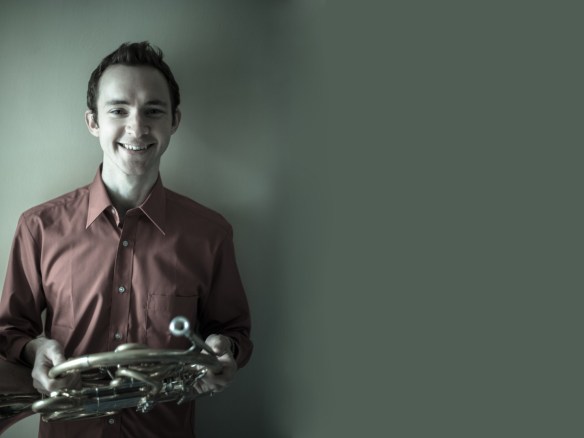
alec-frank-gemmillWigmore Hall, London, 1 February 2016

written by Ben Hogwood

Audio (open in a new window) – available until 3 March

http://www.bbc.co.uk/programmes/b06yrgk5

What’s the music?

James MacMillan – Motet V from ‘Since it was the day of Preparation’ (for solo horn) (2010-11) (8 minutes)

Beethoven – Horn Sonata in F major Op. 17 (1800) (16 minutes)

John Casken – Serpents of Wisdom (world première, 2015) (12 minutes)

Schumann – Adagio and Allegro in A flat major Op. 70 (1849) (9 minutes)

Spotify

Unfortunately neither the MacMillan nor the Casken pieces are available to stream at present. However you can hear the Beethoven and Schumann on the link here:

About the music

There is a pleasing amount of recent music written for the solo horn – and Alec-Frank Gemmill begins this concert with an extract from a much larger work by Sir James MacMillan. Since it was the day of Preparation… is a large, 70-minute piece using texts from St John’s Gospel – but within it are sections for solo instruments from the ensemble, using the sort of structure a composer like Benjamin Britten would have employed. A substantial one of these, for solo horn, is heard here.

John Casken wrote Serpents of Wisdom for this concert and these players, and was inspired by the imagery of a serpent primarily through the poem Celtic Cross by Norman MacCaig. As he wrote he was taken through the idea of a musical representation of the coils of brass that make up the horn. Through the piece he uses some unusual effects such as natural harmonics, which make the horn sound out of tune but are intended.

Beethoven wrote one of the very first sonatas for horn and piano, a three-movement construction that he started – and finished – the day before giving it in concert with the horn player known as Giovanni Punto. Meanwhile Schumann’s only work for horn and piano, the Adagio and Allegro, was written for a member of the Dresden Court Orchestra. It has been a little unfairly taken on by viola and cello players, and is more commonly heard in that version. Reverting to horn and piano enables us to hear why the theme for the Allegro works so well in its original form.

Performance verdict

A pleasant change for a Monday lunchtime from the Wigmore Hall – the first horn recital they have programmed at such a time for years. It was made all the better by the choice of a world premiere, and by the artistry of Alec Frank-Gemmill and Alasdair Beatson, an exciting duo fully justifying their billing as young musicians well worth experiencing live.

Frank-Gemmill is a really excellent player, and took on the Casken with impressive belief and skill. While clearly not an easy piece to play it made a powerful impression – equally so in the piano part, where Beatson had to work hard with some tricky passage work. Although inspired by the coils of brass, Casken’s piece often felt to me as though it was craggy in outline, and while its impression was largely gruff and unforgiving, there were some surprisingly tender asides.

The MacMillan was a striking piece, clearly in homage to Britten – and reminiscent of some of his writing for Dennis Brain – but also showing how it is possible to write quietly for the horn without losing any expression. Frank-Gemmill managed the low notes brilliantly here.

The Beethoven and Schumann were much more conventional but equally enjoyable. Beethoven writes for the horn without any inhibitions and there was plenty of gusto in the outer movements of this performance. The Schumann is a glorious piece, a true musical evocation of happiness, though this account did not completely lift itself off the printed page. No matter, for the new pieces had already left a lasting imprint – and an encore, Glazunov’s Rêverie, made for a lovely finish.

What should I listen out for?

MacMillan

1:41 – MacMillan’s piece has a soft and reverential opening which gives the piece a tonality and also a very low main note, which makes a lovely sound on the horn.

The melody has the appearance of plainchant, and gradually it grows in breadth and confidence. Then around 7:20 the music takes a confrontational approach, whooping excitedly and going all the way up to a remarkably high note at 8:04 – before its relatively calm finish.

Beethoven

11:58 – a brief yet quite understated fanfare from the horn begins the work – and it receives ample support from the more graceful piano theme behind it. A thoughtful second theme is heard at 12:55 before the first section of the first movement is repeated at 14’29. After a short development we hear the main tune once again at 18:15, and the second theme – now in the same key as the main one – at 18:59.

21:04 – a slower movement that begins with a soft and slightly sad air – but it doesn’t last long, as essentially it serves as a long introduction to the final movement, beginning at…

22:30 – quite an angular main tune for this movement, which proceeds in high spirits. The main theme comes back again, signs off brilliantly around 27:27

Casken

29:39 – a brisk start, energetic too. The first of the ‘natural’ notes is heard at 30:13 – you can hear it is out of tune but it is meant to be. The slower music at 30:44 is brooding and paints a relatively austere picture. As the music gets quieter the horn turns to the mute.

There is then an extended piece of writing with impressive energy and stature from the horn, which is required to perform a number of very difficult tasks, usually in cahoots with the piano, which itself has a jagged outline to its music. A slower section runs around 38:30, but then the piece gathers itself for a big finish at 40:15.

Schumann

42:42 – a slow and romantic Adagio, led by the horn, which is largely graceful but has some tricky high notes. This leads into the exuberant Allegro at 46:59. This has a tricky theme with a wide range.

Encore

53:19 – as a soft-hearted encore the pair play the Rêverie in D flat major by Glazunov, which is a warm piece, even when it reaches the depths at 54:55. (4 minutes)

Further listening

This very fine disc from Richard Watkins, on the NMC label, brings together writing for horn from a number of highly respected modern composers, among them Gerald Barry, Peter Maxwell Davies, Robin Holloway, Colin Matthews, David Matthews, Mark Anthony Turnage and Huw Watkins. You can listen here:
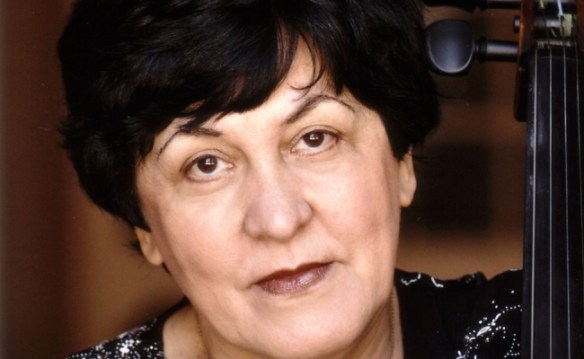
Friendly Fire – Natalia Gutman, London Philharmonic Orchestra / Vladimir Jurowski

natalia-gutmanFriendly Fire – Natalia Gutman (above), London Philharmonic Orchestra / Vladimir Jurowski

Royal Festival Hall, London; Wednesday 27 January 2016

Welcome to Arcana’s new ‘alternative’ reviews slot! It is an ‘ask the audience’ feature – where I (Ben Hogwood) take a friend / colleague who doesn’t normally attend a classical concert and get them to review it in the bar afterwards. First up is Tony Winter, a young-at-heart 50-something from Watford, who shares his thoughts on a program of Schnittke (Pianissimo), Shostakovich (Cello Concerto no.2) and Bruckner (Symphony no.3 – original version)

tw

Arcana: How did you prepare for this concert?

Tony: Well I had a shave (d’oh! – Ed) No, I’ve been playing some recordings of the Shostakovich and a little bit of the Bruckner. Not the Schnittke, which was a bit of a surprise! I haven’t done an enormous amount of preparation.

What was your musical upbringing?

I had a brief encounter with the violin which I never really got on with – I didn’t get on with the teacher – and then when I was about 13 the guitar, but that was rock music. I played the guitar for years. When I retire it’s going to come out again! I played in a band called The Committee, but to be fair by the time they’d risen to fame they’d chucked me out!

Name three musical acts you love and why:

I love Bach, just because of the melodies. I think you can look at other people and say the orchestration is great but for me the genius is the melody. James Rhodes says ‘the immortal Bach’, which sums it up.

I’ve been playing a lot of David Bowie recently with his demise, I was a big fan of Bowie up to about the Let’s Dance era, and now suddenly I’ve been playing some of the later albums as I’ve been guilty of overlooking some of them. I don’t like it when it gets too commercial! But I think later on he was saying that he didn’t give a shit, which is an approach I’ve always liked.

The Outside album was described as ‘difficult and industrial’ but I think it’s great. I wonder in 200 years if people will be playing Bowie? He died at the same age as Shostakovich but who knows? Only time will tell. How many people were on stage tonight, over 100? I’m sure everyone would be using that if there weren’t cost implications to it!

I don’t know whether to say the Rolling Stones or Mozart for the third!

Have you been to classical music concerts before, and if so what has been your experience?

I’ve been to a few over the years – I’ve even started going to a few operas! Living close to the Watford Colosseum I’ve been going to concerts there as I’m a bit of a lazy bugger. I tend to go to any classical concerts they put on there. I’ve seen Beethoven’s 9th at Westminster Abbey, but that was a bit echoey!

James Rhodes sticks in the mind for his more modern presentation which particularly appealed to my kids. They’re learning the piano so that helped but it helped that he stood up and made a few jokes. I’m not saying everyone has to turn into a variety act but he judged it right. I like sitting at the front in an intimate gig, but coming here tonight though I think I should drag my sorry arse into London more as I don’t think you could fit that orchestra on the stage in Watford!

What did you think of the Schnittke?

I think I’d have to give it a few more listens. It did somewhat sound like they were tuning up for a while, and I’m not sure I liked the screeching of the flute over the top. Parts of it were interesting though, and when the violins came in quietly and slowly it almost sounded like a Jimi Hendrix track where he’s playing the guitar backwards. There were elements of it that appealed to me, and I will definitely investigate more. It didn’t grab me by the throat.

What about the Shostakovich?

I enjoyed that for a variety of reasons. Because I had prepared by having a few versions on in the background it had sunk in a bit, and then when you’re actually watching it live you’ve got to concentrate on it, and I thought Natalia Gutman was obviously really fantastic. It was an interesting piece and I really enjoyed it.

What about the Bruckner?

I did enjoy it but it was a different version to the one I’d been playing. It felt like it was building up to the end for a while! When I was listening to it at home I thought there were echoes of Beethoven in it, but listening to it tonight he was heavily influenced by Wagner and I could hear that. It wasn’t as melodic as some of the Beethoven symphonies, and I wasn’t overwhelmed by it.

I don’t think Bruckner will be one of my favourites, but then again, maybe I need to go back and listen to it! It was fantastic seeing an orchestra of that size, with ten double basses. As a bit of a hi-fi geek, you think that’s what it should sound like!

What about the environment and setting of the concert, and how it was promoted?

Well they didn’t get me down here, you did! I do feel strongly about this though because at the Watford Colosseum you go down there, and they’re absolutely fantastic, and the place is quarter full. You think why is this, as it’s fantastic value for money and there are as many people on stage as in the audience!

The Royal Festival Hall is very nice though and before the concert the youth musicians of the London Philharmonic Orchestra, The Foyle Future Firsts, were great. They were playing Shostakovich’s incidental music to Hamlet, and Vladimir Jurowski got up and talked about the piece and gave us loads of facts about it for ten minutes before they played. I was hugely impressed by that, it was really nice to see and the musicians were great. It was well worth the effort getting down here early!

Arcana’s brief thoughts on the concert:

A really rewarding evening which represented great value with a concert that lasted two and a half hours. The Schnittke, as Tony says, sounded a bit like an excerpt from a horror movie.

The Shostakovich was deeply considered by Natalia Gutman, who did not play with great volume but who managed to project her thoughts to a spellbound audience. She is one of the great surviving musicians from Shostakovich’s era, and it was a humbling experience to see her play – she may have missed one particularly crucial entry in the finale but her thoughts elsewhere were extremely profound.

Finally the Bruckner, a real tour de force – and a superb account from the orchestra and the brass in particular. This is one of Bruckner’s wildest symphonies, full of ideas that are not always controlled, and Jurowski projected the tension between instinct and adhering to symphonic form. The triumphant end was well-earned.

In concert – Dutilleux centenary concert at the Wigmore Hall

frank-braleyDutilleux 100th Anniversary Concert

Wigmore Hall, London, 24 January 2016

Dutilleux: Trois strophes sue le nom de Sacher; Trois preludes

Ravel: Piano Trio in A minor

Debussy: Violin Sonata in G minor

Dutilleux: Ainsi la nuit

Lisa Batiashvili, Valeriy Sokolov (violins), Gérard Caussé (viola), Gautier Capuçon (cello), Frank Braley (piano, above)

Written by Richard Whitehouse

Having marked his 95th birthday with a concert centred on his music, it was good to see the Wigmore Hall commemorating Henri Dutilleux’s centenary – and, even though the composer has been gone almost three years, the influence of his modest output seems greater than ever.

Interesting that the three works chosen were all conceived during the 1970s – a decade which saw some of Dutilleux’s most exploratory writing. Hence Trois strophes sur le nom de Sacher (1976/82), which grew from a 70th birthday tribute to the Swiss conductor and patron into a ‘sonatina’ of evident resource; one whose alternately combative and taciturn humour was not passed over by Gautier Capuçon in this focussed yet never too earnest account. Even longer in gestation, Trois préludes (1973/88) makes for a fluid distillation of pianistic practice and a culmination of Dutilleux’s involvement with the medium – but here the connection between pieces is more gestural than motivic; the music’s gliding between formal and technical puns obscured by the sheer allure of its pianism, as Frank Braley’s questing performance attested.

Ending the first half then opening the second were pieces by Ravel and Debussy, composer whose influences on Dutilleux were enduring if hardly straightforward. The expansiveness of Ravel’s Piano Trio (1914) betrays an emotional commitment only just held in check during the restive opening movement and quixotic scherzo – its rhythmic subtleties ably negotiated by Lisa Batiashvili, Capuçon and Braley, who pursued a seamless course across the searching passacaglia then drew the finale’s formal poise and expressive rhetoric into seamless accord.

Despite its proximity in time, Debussy’s Violin Sonata (1917) is far removed in its emphasis on a sardonic humour which, dominating the brusquely truncated opening Allegro, yields a measure of finesse in the central intermezzo such as Batiashvili and Braley conveyed in full. Not so much the sum of its preceding movements as the reconciling of its antagonisms, the finale achieves that far-reaching amalgam of lucidity and abandon which its ailing composer no doubt saw as inherently French, and which these performers captured in no small measure.

dutilleux-2Henri Dutilleux, who died aged 97 in 2013
The programme concluded with Ainsi la nuit (1973-6) – Dutilleux’s sole contribution to the genre of the string quartet, though one whose well-nigh seamless succession of movements and parenthetical interludes acknowledges Boulez as well as Carter through that imaginative freedom which is this composer’s alone. Whether or not Batiashvili, together with Valeriy Sokolov, Gérard Caussé and Braley, perform often as an ensemble, there was no mistaking the conviction and insight that lay behind this passionate yet always considered reading. The only proviso might be the several over-extended pauses (this being a single movement of 12 sections rather than one in six pairs of movements), though this did very little to undermine momentum over the heady accumulation towards that wickedly disintegrative final gesture.

A fitting tribute, then, to its featured composer. No place for the Piano Sonata, Figures de résonances or Les citations (to name his other main chamber or instrumental works), but if these were to feature in another Dutilleux-centred recital later this year, so much the better.

An appreciation of the music of Henri Dutilleux will follow soon on Arcana.

Wigmore Mondays – Armida Quartet play Mozart and Beethoven

The Armida Quartet play string quartets by the teenage Mozart and Beethoven – his first quartet for Count Razumovsky of Prussia

armida-quartetPhoto: Felix Broede

Wigmore Hall, London, 25 January 2016

written by Ben Hogwood

Audio (open in a new window) – available until 24 February

http://www.bbc.co.uk/programmes/b06xwtbp

What’s the music?

Mozart – String Quartet in G major, K80 (1770) (10 minutes)

Beethoven – String Quartet in F major, Op.59/1 (Razumovsky) (1806) (39 minutes)

Spotify

If you cannot hear the broadcast then this attached playlist has all the repertoire in the concert. The Armida Quartet have recorded a disc of Mozart but not this particular piece – so the Hagen Quartet version is included here, along with the Tokyo String Quartet in the first Razumovsky:

https://open.spotify.com/user/arcana.fm/playlist/726X8dueQnIBJOflr9jeIt

About the music

What were you doing when you were 14? I daresay you hadn’t completed a String Quartet lasting 20 minutes by then! The teenage Wolfgang Amadeus Mozart had managed that – he had also completed ten symphonies and numerous other works – and was about to witness the premiere of his first opera, Mitridate, in Italy with his father Leopold.

This string quartet was written on the road, between Milan and Parma – an early ‘tour album’, you could say! – and initially sat in three movements to conform with Italian taste. Later the composer added a fourth to suit German audiences. All were completed under the watchful eye of his father.

Beethoven dedicated three of his ‘middle period’ string quartets to Count Razumovsky, the Russian ambassador in Vienna at the time and a musical patron. At his request Beethoven included a Russian theme in each work, and in the first quartet it can be heard at the beginning of the last movement.

With these three quartets Beethoven noticeably expanded the form, no longer the intimate salon experience of Mozart but now a medium for the communication of extremely personal thoughts and big structures. The three works are big, each around 35-40 minutes in length, and they push the boundaries of string quartet writing so that on occasion the four instruments sound at least double the size. This one, Op.59/1 in F major, is the longest of the three and is notable for its profound slow movement (one of only two pieces marked mesto (sad) by the composer) and for the fun and games in its second movement Scherzo.

Performance verdict

The Armida Quartet are BBC Radio 3 New Generation artists, and on the strength of their Beethoven performance in particular they clearly have a very bright future.

This was excellent quartet playing, incredibly well balanced and full of vitality. Their sense of enjoyment in the second movement of the Beethoven was infectious, and throughout their quiet playing in particular was something to treasure, enabling them to reach the very sombre depths of the slow movement but also the dynamic contrasts used by Beethoven elsewhere. The outer movements contrasted nicely with this, being vibrant and humourous on occasion, and always revelling in the composer’s tuneful invention.

The Mozart was very stylish, possibly a little too rich in the first movement as the quartet recaptured the Italian style. The main emotion here was one of surprise at the composer’s sheer prowess – this is a remarkable work for someone the age of 14 to have turned out – but on occasion.

The quartet decided not to employ the repeats marked in each movement, effectively halving the length of the piece with the Beethoven in mind. A shame, perhaps, but not a decision that stopped us from sitting in awe of the adolescent’s genius!

Interestingly the quartet changed their seating arrangements during the concert. For the Mozart the violinists faced each other, with viola and cello in between, while for the Beethoven the cello and second violin swapped for a more conventional arrangement.

What should I listen out for?

Mozart

1:32 – the first of Mozart’s quartets is quite top heavy in structure, and it is the first movement that has a lot of the emotional and musical content, lasting nearly twice as long as any of the others. It starts with such elegance you would never know it was the work of a fledgling composer. There is assured writing for the four instruments, often divided into pairs in the part writing.

5:17 – a lively second movement, the four instruments playing in unison initially then moving apart.

7:33 – Mozart writes a graceful minuet for the third movement, one with a light spring in its step.

9:27 – the finale brings with it more open textured, bright writing for the quartet

Beethoven

13:40 – the piece starts quietly, the cello theme immediately evident before being passed to the violin. At 15:03 we hear the other main theme of the quartet, different in character – the music feeling more ‘established’ by this point. At 16:06 we hear the cello’s theme again, but now Beethoven moves this through a development section, chopping and changing it – before bringing it back for a recap at 19:40. By now the music feels increasingly restless, and continues to pass through a number of different forms and keys, until the quartet state the theme in fall, and the music falls away a little to the end, seemingly content.

23:44 – the ‘Scherzo’, traditionally the movement where composers show their witty side. Beethoven certainly does that here, picking a tune that can be cheeky or quite aggressive by turns. It starts sheepishly, but Beethoven varies the volume a lot in this movement, passing from very quiet to loud, often in a way that might make you jump!

The music then moves into the minor key for a contrasting ‘trio’ section, beginning at 30:00, but by 31:14 is back in the major key and playing with different volume levels again! Snippets of the main tune and other phrases are passed around until the soft finish at 32:16…though even this has a sting in the tail!

32:48 – the slow movement begins – and with it one of Beethoven’s saddest themes, heard on the first violin. While fragile at the start the music gains intensity and sounds rather tortured at times. At 37:48 we hear the sad music again, though it is higher and weightless in its new guise. Then Beethoven takes us through a section developing the tune, with a pensive and very intimate dialogue between the four instruments. This profound passage of play comes out of the doldrums and into…

46:05 – the last movement, based on a Russian folk tune – and immediately positive with the cello’s rendition of it. Beethoven structures this as a Rondo – a form that means the tune comes back repeatedly, with differing sections in between. Then at 51:31 we hear the tune very slowly, setting up a quick drive to the finish from 52:03.

Encore

54:09 – as an encore the quartet play Contrapunctus IV from J.S. Bach’s The Art of Fugue. The violin begins, then the second violin joins, then the viola and then the cello – all in a perfectly calculated example of how a fugue works with four parts. (3 minutes)

Further listening


On record: John Cale – M:FANS / Music For A New Society (Domino)

MFANS

Richard Whitehouse considers in detail John Cale’s Music For A New Society, back from its original release in 1982 and now in digital guise.

That John Cale should have chosen to make his 16th studio album the rewriting of his eighth is hardly provocative in itself. Not least as Music For A New Society remains in any case the most provocative of all his releases, coming at a time when Cale – poised on his fifth decade – was not so much reassessing his creative priorities as searching, uncertainly if by no means tentatively, for the way forward. That the way forward only made explicit its fraught genesis explains why Cale should wish to readdress such anxieties and, in doing so, transcend them.

Originally released in September 1982, Music For A New Society came in the midst of what is perhaps Cale’s most challenging creative period. Seemingly caught on the back-foot with the advent of punk rock, this most recalcitrant of singer-songwriters duly stormed the citadel in the visceral guise of 1979’s Sabotage/Live (among a select handful of live albums to consist wholly of new songs), followed by its studio complement in 1981’s waspishly sardonic Honi Soit. Finding himself without a touring back the following year became the catalyst for Cale to pursue a more inward and uncompromising take on those issues personal and social in its successor – the result of live improvisations at New York’s Sky Line Studios – and how like Cale to focus his acute emotional angst through the discipline of a ‘time is money’ schedule.

Warmly while equivocally received on its release, Music For A New Society predictably died a death in commercial terms and soon went out of print. For a 1993 reissue, Cale subjected it to a degree of revision – notably with the inclusion of the track ‘In the Library of Force’ for a close of magisterial despair. Appreciative of if understandably guarded as to the qualities of an album long held in high esteem, he performed it live at the Aarhus Festival in 2013 then refashioned it from scratch into the very different if no less absorbing statement of M:FANS.

This release comprises a remastered Music For A New Society (largely adhering to the 1993 revision), such as renders its claustrophobic intensity with even more unsparing immediacy, along with M:FANS: their differences (not so) paradoxically highlighting their relatedness.

The precise nature of that relationship is clear at the outset – the barbed nostalgia of blurred keyboards and acoustic slide guitars of ‘Taking Your Life in Your Hands’ now an ominous processional of fazed ambience and interpolated voices, while the world weary vocal as set against mindless ostinato patterns of ‘Thoughtless Kind’ yields to an agile vocal line made more tactile by an unwavering rhythmic backdrop as makes possible the heady culmination. ‘Sanctus’ (heard now in a ‘Sanities mix’ as though to acknowledge its history of mistitles) duly swaps a fragmented vocal given context by fugitive percussion and glowering organ for a dehumanized rendition made even more menacing by its remorseless electronic backing.

By the same token, the eloquent vocal as enhanced by a fervent organ contribution of ‘If You Were Still Around’ is accorded greater sonic presence through melding of its keyboards and guitars with a motoric rhythmic undertow. Most lauded among the original tracks, ‘(I Keep A) Close Watch’ (the stripped down reworking of an opulent ballad from 1975 album Helen of Troy) has now acquired a deft lilt to its vocal thanks to the soulful backing voices – while, in ‘Broken Bird’, the formerly haunting combination of imploring vocal with subtly shifting keyboards has taken on heightened expression with piano and electronics sharply separated.

The intimate confession with acoustic guitars and intertwined strings of ‘Chinese Envoy’ gets a complete rhythmic overhaul with syncopated backing vocals over a funky electronic groove – while ‘Changes Made’, with its almost affirmative vocal and full-on rock backing, receives a more circumspect treatment via a whimsical central interlude and narrower sonic ambience. ‘(In the) Library of Force’, its initial incarnation no less fateful despite loss of that slammed piano lid, is more self-contained with its spoken voice foregrounded and an equivocal close.

M:FANS finds no place for ‘Damned Life’, its careworn vocal thrown into relief against the skewed instrumental paraphrase of Beethoven’s Ode to Joy, or the palpably uneasy amalgam of matter-of-fact recitation over an intrusive classical sample that is ‘Risé, Sam and Rimsky-Korsakov’. Music For A New Society is rounded off by out-takes of ‘Chinese Envoy’, heard in a ruminative acoustic version that is an almost perfectly realized demo, and ‘Thoughtless Kind’, which emerges as no less direct in its emphasizing one of Cale’s most revealing lyrics. M:FANS opens with ‘Prelude’, the fragmentary sample of a reticent phone-call between Cale and his mother as heard through a haze of processed ambience, and gains a second version of ‘If You Were Still Around’ whose discreet choral enhancement exudes even greater emotion. It closes with ‘Back to the End’ – a wistfully affecting number not so much abandoned as lost at the original sessions, and that makes for a restrained yet uplifting close wholly in keeping with the underlying affirmation of this ‘new’ album as well as (one presumes) of John Cale.

Make no mistake, such affirmation does not make M:FANS any ‘easier listening’ than was its parent album; rather the raw confessional of 33 years ago takes on a greater musical presence that conceivably serves to obscure or at least make the more oblique its singular perspective. As such, it fits securely into that sequence of albums which began with 2003’s HoboSapiens and then continued via 2005’s blackAcetate to 2012’s Shifty Adventures in Nookie Wood: a sequence in which personal observation has been rendered no less expressively acute for all that its creator has become not so much a primarily emotive force as a teasingly provocative presence. Where Cale goes from here remains to be seen: he evidently has an album of new songs ready for later this year; meanwhile, his realizing of The Velvet Underground & Nico to mark its 50th anniversary of release should be no less timely or relevant than is M:FANS.

Listen