
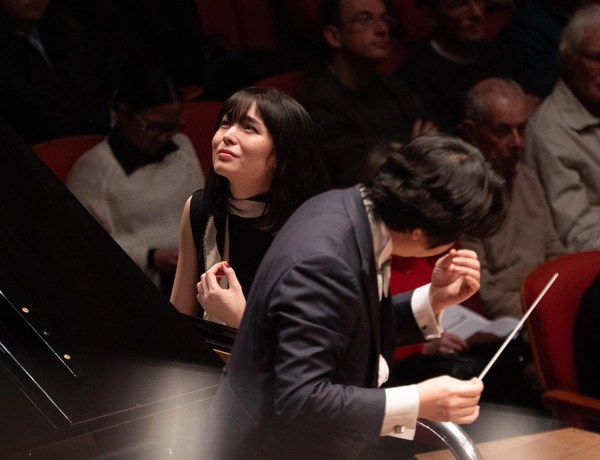
Alice Sara Ott (piano), City of Birmingham Symphony Orchestra / Kazuki Yamada
Bax Tintagel (1917-19)
Grieg Piano Concerto in A minor Op.16 (1868)
Clyne Restless Oceans (2018)
Debussy La mer L109 (1903-05)
Symphony Hall, Birmingham
Tuesday 22 September 2026
Reviewed by Richard Whitehouse Photo (c) Hannah Blake-Fathers
The sea, in various manifestations, was a dominant factor in this evening’s concert by the City of Birmingham Symphony Orchestra. One which began with Tintagel, long the most familiar (if not the only one now being revived) of Bax’s tone poems, where Kazuki Yamada showed a sure grasp of music more a reflection of its composer’s involvement with the pianist Harriet Cohen than of Arthurian times or places. Its ‘love music’ lacked nothing in rapture, yet it was the seascape from which it emerges then to which it returns that made the lasting impression.
Grieg’s Piano Concerto might not convey any overt maritime associations, but its expressive ambience is audibly that of the outdoors (unlike that of the Schumann concerto that provided its model in many particulars) and Alice Sara Ott – CBSO Collaborative Artist these next two seasons – responded with playing as impetuous and soulful as its opening movement requires. Fleeting hesitancies aside, there was no mistaking the rapport between her and Yamada; with its cadenza an emotional culmination in every respect. Soulful while never inert expressively, the central Adagio exuded inward warmth as found ideal contrast in the bracing energy of the finale – its poetic middle section artlessly rendered, and its apotheosis opulent with no undue bathos. Ott’s limpid rendering of John Field’s Ninth Nocturne made for an appealing encore.
The second half got off to a short if by no means sweet start with Restless Oceans, a compact yet eventful celebration of female identity from Anna Clyne – CBSO Composer in Residence for the current season – that lacked little in presence. Rhythmically incisive and harmonically expressive ideas, alternating purposefully on their way to the tersely unequivocal conclusion, were offset by vocal and gestural contributions from the musicians that added a layer of vivid theatricality. Further and more extended instances of Clyne’s music will follow in due course.
Bax can only have been too aware when writing Tintagel of Debussy’s La mer – this latter a game-changer in terms of orchestral composition, whose influence continues to radiate some 120 years on. Right from the opening of From dawn to midday on the sea, it was apparent Yamada had found the balance between the placing of detail within an overall structure that, if not symphonic per se, has a formal integration and expressive sweep as feels nothing if not symphonic – witness the majestic peroration with which this opening movement culminates.
Much the most elusive of these symphonic sketches, Play of the Waves yielded a lightness of touch and deftness of motion that only emphasized its emotional ambivalence. Unerringly phrased, its coda prepared ideally for Dialogue of the Wind and the Sea, a finale where the combative and alluring are brought together for what proved a thrilling culmination (though Yamada might have dispensed with those trumpet entries which Debussy subsequently and unwisely added). Certainly it brought this concert to its unequivocal and impressive close.
Yamada returns to Birmingham just before Christmas and Ott does likewise next May, while the CBSO is back in a week’s time with a programme featuring Elgar’s Enigma Variations as well as a second hearing for the co-commissioned Saxophone Concerto by Gwilym Simcock.
To read more about the CBSO’s 2026/27 season, visit the CBSO website. Click on the names to read more on pianist Alice Sara Ott and conductor Kazuki Yamada, and more on composer Anna Clyne
Published post no.3,027 – Thursday 24 September 2026

