Unknown's avatar

About Arcana

My name is Ben Hogwood, editor of the Arcana music site (arcana.fm)

On Record – Crispin Lewis & Raymond Lewis: Herbert Murrill: The Rediscovered Songs (First Hand Records)

Herbert Murrill
Four Elizabethan Songs (1927-30)
Three Carols (1929)
Self-Portrait (1929)
Trois Poèmes (1930)
Four Pastorals (1936)
The Months of the Year (c1936)
Two Herrick Songs (1938)
In Youth is Pleasure (1942)
Sonatina for Piano (1952) – Andantino

Crispin Lewis (baritone); Raymond Lewis (piano) with Rachel Broadbent (oboe, carols)

First Hand Records FHR161 [55’48’’] All world premiere recordings
English/French texts and English translations included
Producer Emily Baines Engineer John Croft

Recorded 19 & 20 April 2024 at Rosslyn Hill Chapel, Hampstead, London

Reviewed by Richard Whitehouse

What’s the story?

First Hand Records issues this first release devoted to the songs of Herbert Murrill (1909-52), now a largely forgotten though once influential figure on music circles in London and further afield; his pedagogical and administrative skills held in high esteem by a younger generation.

What’s the music like?

Murrill’s death at only 43 brought to its premature end a career which, in addition to a sizable output, involved working at the BBC – latterly as its Head of Music – and, in the earlier war years, intelligence work at Bletchley Park. An unassuming figure who operated within if at a conscious remove from the music establishment of his day, Murrill was widely respected for his professionalism – as is borne out by his own music with its lightness of touch and its deft handling of traits stemming from Stravinsky, Poulenc and neo-Classicism between the wars.

It made sense to open this recital with My Youth is Pleasure, its airy setting of Robert Wever highlighting that acute yet unforced nostalgia such as pervades so many of these songs. The lengthy The Months of the Year sustains itself ably, then a wittily engaging quartet of songs to Elizabethan texts almost inevitably recalls the influence of Peter Warlock. Four Pastorals find Murrill indulging his more lyrical tendencies to appealing effect, notably in a setting of the anonymous text Phillada Flouts Me that unerringly catches its deadpan anguish. Nor is he unwilling to tackle more contemporary writers, witness his Satie-esque response to verse by Jacques Prévert and Robert Desnos; though whether those changes to the former’s poems were considered improvements or just unintentional anomalies is now impossible to decide.

A trio of carols with oboe accompaniment (including a Medieval Scottish translation of verse by Martin Luther) would be a welcome addition to a medium which features little other than Vaughan Williams’s masterly Blake settings. After which, the wryly elegant Arioso from a Piano Sonatina makes one wish the surrounding movements could have been included (there was certainly room in terms of playing time). The brace of songs to texts by Robert Herrick summons a more sustained and eloquent response, as to suggest that Murrill’s music might have explored deeper emotions had he lived. This anthology concludes with Self-Portrait – four settings of his contemporary Geoffrey Dunn which anticipate Betjeman in their dry wit and self-deprecating humour – a very English take, indeed, on matters of existential import.

Does it all work?

Yes, albeit for the most part within its narrowly while precisely defined limits. As a composer, Murrill was clearly not out to change the world but rather to offer a discreet commentary from the margins, which he does with admirable skill and not a little affectingly. He has a devoted advocate in Crispin Lewis, for whom this project was doubtless a labour of love, and who is sensitively accompanied by Raymond Lewis or, in the Three Carols, Rachel Broadbent. He also contributes informative and well-researched notes about the life of this singular figure.

Is it recommended?

It is, and there is enough of interest musically to make one curious to hear such as Murrill’s jazz-opera Man in Cage, written to a libretto by Dunn and that enjoyed an eight-week run in London in 1930 before vanishing without trace. For now, this collection ably fulfils its remit.

Listen & Buy

Click on the artist names to read more on Crispin Lewis, Richard Lewis and Rachel Broadbent

Published post no.2,509 – Saturday 19 April 2025

Switched On – Future Loop Foundation: The Planet Dog Years (Cherry Red Records)

by Ben Hogwood

What’s the story?

Renowned producer Mark Barrott used the alias Future Loop Foundation in the mid-1990s, and under it he made two albums of ambient drum and bass, along with a number of EPs. Here they have been assembled with a clutch of stand-alone tracks and remixes, previously unreleased demos and a live track.

The two albums in question are Time And Bass, from 1996, and Conditions For Living, released two years later – made at a time when the reach of drum and bass was extending well beyond the club and into the home.

What’s the music like?

There are plenty of highs in Barrott’s music as Future Loop Foundation, right from the heady Discovery, with which Time And Bass begins. The clipped rhythm and spacey backdrop are perfect chill out material but there is a mass of positive energy here, enforced by the swirly textures of Kinetic Pioneers. The piano-led Journey’s End is a treat, but what stands out about the first album is Barrott’s consistency, setting a warm summery mood but utilising rhythms with a huge amount of movement and drive.

The beats get stronger and heavier on Conditions For Living, and the mood gets darker as the title track asks, “what kind of world are we living in?” Sadly it’s as relevant now as it was then. Barrott takes more risks here, to good effect on the woozy, mysterious Omerta, which blossoms into a bassy track with piano floating above. There is some inventive, long form drum and bass here, and the quickfire beats of Moog Road are a particular thrill. Karma packs a punch, suggesting a lesson learned.

The set of singles and bonus tracks is the ideal complement. Sonic Drift blends piano, warm chords and the syncopated rhythms that Barrott made a signature of his style, while the Lo-Fi Dub of Discovery shows how versatile the music could be when reworked. Darwin Sound skates along energetically, while an energetic live version of Shake The Ghost wraps things up.

Does it all work?

It does. Some of the tracks are lengthy – a habit of the time in the mid-1990s – but in this case that gives the listener a good deal of time to get fully immersed in the music. Barrott’s productions are excellent.

Is it recommended?

Absolutely. The music is very much of its time…but happily 1990s drum ‘n’ bass has aged extremely well, and the Future Loop Foundation with it. Great stuff that is well worth revisiting.

For fans of… Alex Reece, LTJ Bukem, Adam F., 4hero

Listen / Buy

For streaming and purchase details, visit the Cherry Red Records website

Published post no.2,506 – Thursday 17 April 2025

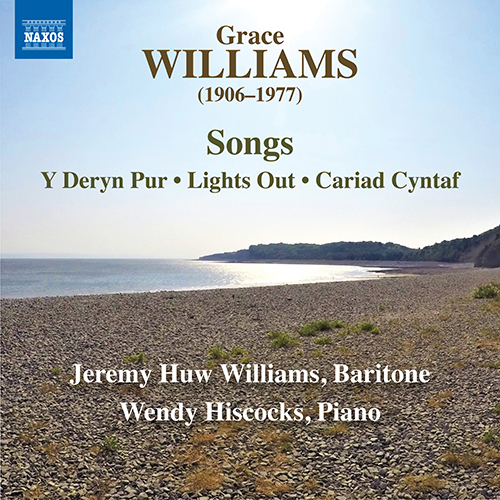
On Record – Jeremy Huw Williams & Wendy Hiscocks: Grace Williams: Songs (Naxos)

Grace Williams
Slow, slow, fresh fount (c1925); I had a little nut tree (c1930); Green Rain (1933); Stand forth, Seithenin (1935, rev; 1951); Ffarwel i langyfelach (?1920s); Llangynwyd (?1920s); The Song of Mary (1939, rev; 1945); Shepherds watched their flocks by night (1948); Fairground (1949); Flight (1949, rev; 1954); À Lauterbach (c1950); Le Chevalier du guet (1949); Four Folk Songs (1950-51); When thou dost dance (1951); Three Yugoslav Folk Songs (1952); Y Deryn Pur (1958); Y Fwyalchen (1958); Cariad Cyntaf (c1960); Ow, Ow, Tlysau (1964); Dwfn yw’r Môr (c1940); Lights Out (1965); Fear no more the heat o’ the sun (1967)

Jeremy Huw Williams (baritone), Wendy Hiscocks (piano)

Naxos 8.571384 [77’47”]
Producer Wendy Hiscocks Engineer Alastair Goolden

Recorded 28-30 September 2022 at Cooper Hall, Selwood Manner, Frome

Reviewed by Richard Whitehouse

What’s the story?

Naxos continues its long-running series of releases sponsored by the British Music Society with an album of songs by Grace Williams (1906-77), all of which are recorded here for the first time and, between them, extend chronologically over the greater part of her composing.

What’s the music like?

Even more than others of her generation, Williams has benefitted from the upsurge of interest in women composers this past decade with recordings of major works on Lyrita and Resonus. Songs may not have the primary place in her output, but they afford a viable overview of her stylistic evolution with individual instances among her most characteristic statements. Most are in English or Welsh though there also settings of French texts, while her own translations of several from the former Yugoslavia further underline the breadth of her literary concerns.

Early settings of Ben Johnson along with traditional English and Welsh poems find Williams, barely out of her teens, tackling verse with audible appreciation of this genre’s lineage within the Victorian and Edwardian eras. That of Mary Webb’s Green Rain is audibly more personal for its wistful ambivalence, while The Song of Mary brings due sensitivity to bear upon some familiar lines from St Luke. The most extended item, Fairground is a setting of Sam Harrison that captures the sights and sounds of said environment with an immediacy never descending into kitsch, while that of Flight matches the sentiments in Laurence Whistler’s poem and has a piano part testing in its intricacy. Her setting of the Jacobean-era When thou dost dance is, by comparison, slighter though no less attuned to the limpid elegance of its anonymous text.

Arrangements of traditional verse had early featured in this composer’s output, and this is not the customary text for her attractive treatment of a traditional Czech carol Shepherds watched their flocks by night. The period around 1950 saw a number of such arrangements and mainly of French texts, but with her take on the Northumbrian Bonny at Morn appreciably different from the more familiar one by Tippett. The end of that decade brought forth a trio of eloquent Welsh settings, while that of the Medieval text Oh, Oh, Treasures may be pastiche yet it has a fervency which feels not a little unsettling. The final two songs see a return to more familiar verse: that of Edward Thomas’s Lights Out evinces a subdued and even fatalistic acceptance, while that of Shakespeare’s Fear no more the heat o’ the sun captures its aura of resignation.

Does it all work?

Yes, allowing for inevitable unevenness in what is a conspectus over four decades. At least a half-dozen of these songs ranks with the best of those by British composers from this period and well warrant investigation by more inquiring singers. Jeremy Huw Williams clearly has no doubts as to their quality and, though his tone as recorded here is not always flattering, it captures his intensity of response. Nor could he have had a more committed or a perceptive accompanist than Wendy Hiscocks, who teases out myriad subtleties from the piano writing.

Is it recommended?

Indeed, and there ought to be enough remaining vocal items for a follow-up release at some stage. Graeme Cotterill pens informative notes, and while it is a pity that several texts could not be printed for copyright reasons, the clarity of Williams’s diction seems fair recompense.

Listen & Buy

Click on the artist names to read more on Jeremy Huw Williams, Wendy Hiscocks, composer Grace Williams and the British Music Society

Published post no.2,506 – Wednesday 16 April 2025

On Record – John Foxx: Wherever You Are (Metamatic)

by Ben Hogwood

What’s the story?

“Around dawn is the best time to play piano,” says John Foxx. “Self-critical mechanisms mostly dormant, so I’m free to invent and enjoy for a while. The piano faces a window overlooking a valley surrounded by hills, where the sun comes up. There’s often an early mist in the valley – and quite often, it rains. Some notes and sounds resonate with remembered experiences and you get glimpses of times and people. It’s valuable. Quiet. Free association, myriad moments orbiting – and off you go.”

This set of eleven solo piano recordings was made in the wake of Foxx’s successful appearance at Kings Place in October 2023, where he took part in a ‘Night Tracks’ evening for BBC Radio 3. The title is mindful of friends, the music written in gratitude to them.

“So – simply, thanks.”, writes Foxx. “Wherever you are.”

What’s the music like?

Deeply personal, and extremely relaxing. There is no mistaking the intimacy of this music, that these are the thoughts of one person, but with each recording you feel as though Foxx is training his focus on a different friendship.

When She Walked In With The Dawn captures the very moment the light begins, Foxx’s piano surrounded by reverberation but revealing its thoughts with a steady gaze. By contrast Evensong is bathed in early evening sunshine, its musical language closer to the Baroque and Pachelbel’s Canon. Meanwhile Someone Indistinct goes higher in pitch, revealing a close association with the music of Erik Satie.

Foxx’s writing often has watery connotations. The water glints in the upper reaches of A Swimmer In A Summer River, while Once I Had A Love is gently reflective. The two Night Vision pieces unfold pleasantly, the latter especially evoking nocturnal memories, while Morning In A Great City, by nature, has a wider perspective. The closing title track has the warmth of appreciation.

Does it all work?

It does. Foxx’s sound world is both a comfort and a source of positive energy, giving relaxation but also helping focus the mind. Listen closely and you get hints of deeper emotion, the personal profiles difficult to ignore.

Is it recommended?

It is. Foxx has of course charmed with ambient albums in the past, and Wherever You Are draws from the best of his solo work and collaborations with Harold Budd and Robin Guthrie. These are deeply personal utterances, deceptively simple but meaningful, and offer a consoling arm around the shoulders of any listener.

For fans of… Erik Satie, Federico Mompou, Anthony Phillips, Steve Hackett

Listen / Buy

Published post no.2,504 – Tuesday 15 April 2025