
Unknown's avatar

About Arcana

My name is Ben Hogwood, editor of the Arcana music site (arcana.fm)

Switched On – Lia Bosch: Polar Code (Glacial Movements)

by Ben Hogwood

What’s the story?

Story, visuals and music come together in the work of Italian Lia Bosch, the first woman to record on the Glacial Movements label in its history. Described as ‘a multi-dimensional work that encourages deep reflection on existential and social themes’, Polar Code unfolds with the following plot:

Polar Code unfolds through a story set in an abandoned alien base in Antarctica, a remote and mysterious location where ancient human experiments once took place.

The protagonist, a researcher sent by a secret government agency, is tasked with investigating unusual activity detected in the region. Upon arrival, he encounters a desolate, eerie landscape filled with darkness and secrets, where every corner hides traces of a vanished alien presence that still feels ominously close. As the researcher explores the facility, he comes across the symbol of infinity, a glowing, pulsating portal that seems to be the key to understanding the connection between all life forms in the universe. This symbol becomes the focal point of the narrative, conveying a profound message about interconnection: every human action, every choice, has repercussions that extend beyond time and space.

The researcher is thus plunged into a deep existential reflection on his own existence and humanity’s role in a vast, intricate cosmos. The symbol of infinity, laden with meaning, is not merely a scientific discovery but an ethical and philosophical call. It embodies a profound truth: no matter how separate or superior humans may believe themselves to be, they are an integral part of a universal, interconnected system. The information contained within the symbol offers humanity a chance for redemption and salvation, but it also demands an acknowledgment of human fragility and the oppressive structures that underpin society.

The protagonist faces a crucial decision: to accept the revelation of the symbol and risk disrupting the global order, or to turn away from the opportunity to change humanity’s fate. This choice presents a profound moral dilemma, in which the potential to reform society—currently rooted in exploitation and conflict—collides with the risk of unleashing further destruction. Bosch delves into the tension between the need for renewal and the dangers inherent in transformation. Polar Code stands out as a work that transcends simple storytelling, weaving together sound, images, and words to provoke reflection on power dynamics, human fragility, and cosmic.

What’s the music like?

Compelling – and not a little eerie.

Polar Code opens with thick ambience, the remoteness of the location described by music that is simultaneously comforting and a little oppressive, the audio equivalent of lying under a thick duvet.

Gradually the sonic perspective widens and Bosch reveals her descriptive powers. Secret Frequencies pulses with activity, while the frequencies reach higher in Resonance. Stepping Beyond caries with it the danger of exploring hidden places and dark corners, the thickness of the sound closing in. Unknown System and Alien Circuit provide a little relief from this but presents mysterious vistas, created through subtle harmonic implications.

As the explorations continue so Bosch’s noise spectrum broadens still further, with long notes of New Parameters ushering in the striking scenes of Unveiling, where single notes in shrill timbres paint vivid pictures. Infinity has a sprawling, semi-industrial outlook, still cold but with various machine workings spotlit. Gradually the sound retreats, with Insight offering a reflection then a sonorous blast of ambient noise.

Does it all work?

Yes, but is all the more effective if the listener has the story close by. Then the full range of Lia Bosch’s painting in sound can be fully appreciated.

Is it recommended?

It is indeed. Polar Code presents a cold outlook and is often bleak in its canvas, but there is real storytelling afoot here, and for Bosch to achieve that in a small number of meaningfully deployed notes is most impressive.

For fans of… Loscil, Autechre, Cabaret Voltaire, Tim Hecker, Biosphere

Listen & Buy

Polar Code is released on Friday 5 December – at which point you will be able to listen to it via Bandcamp here:

Published post no.2,381 – Monday 2 December 2024
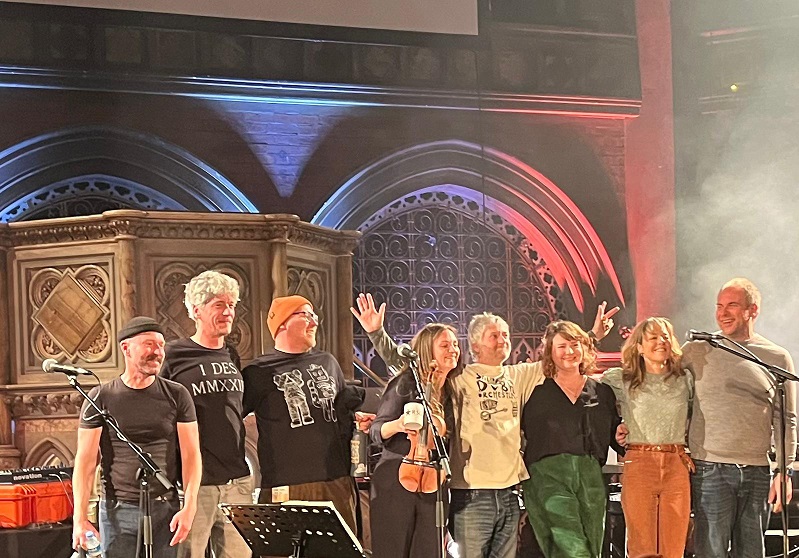
In concert – King Creosote @ Union Chapel, London

Union Chapel, London, 29 November 2024

by John Earls. Photo credit (c) John Earls

I fell in love with King Creosote (real name Kenny Anderson) in 2006 with the release of the special edition of KC Rules OK (which included superb sleeve notes by author Ian Rankin) and have been smitten ever since. He is a great singer-songwriter.

I first saw him live at London’s 100 Club in 2009 playing to about 100 people and then again at Union Chapel in 2011 where he performed the masterpiece Diamond Mine album with Jon Hopkins.

As an aside, I also met him on a bus in London in 2013. I was going to a concert at the Barbican and he hopped on with crutches and his ankle in a cast. He was utterly charming and it says something about him that he was on his way to play a gig (yes, on a bus and on crutches).

Needless to say I was looking forward to seeing him again at Union Chapel which is a stunningly beautiful venue. So let me get a couple of gripes out of the way.

Firstly, the sound system. Kenny Anderson is not just a superb singer – he is also a consummate wordsmith. It was therefore particularly disappointing that his words were often unintelligible (at least where I sat in the fifth pew). One can patch things up if familiar with the lyrics, but what a shame for those coming to KC for the first time. I’ve seen a number of live acts at Union Chapel (including, as mentioned, KC himself) without the same issue.

Secondly, the concert was performed in front of a screen which showed graphics accompanying the music. These were an interesting visual accompaniment and I get that they would be effective against the usual stage setup, but when gifted with such a magnificent backdrop as the wonderful stained glass East Window above Union Chapel’s pulpit and stage why obscure it? (again, this may have been more of an issue from my vantage point).

So to the concert which mostly consisted of a performance of the excellent 2023 I DES album in full. Inevitably, this will seem as much a review of that album (which I think will also be regarded as a masterpiece) as of the gig itself, for which KC was joined by an excellent seven piece band (including Emily Barker who performed a very good solo opening set) featuring acoustic guitar, accordion, fiddle, keyboards, synths, drum machines and percussion.

The performance effectively portrayed the album’s themes of love, loss and mortality, as well as its sense of optimism, hope and gratitude and opened with It’s Sin That’s Got Its Hold Upon Us with thumping beats and sweet strings.

We then had what Anderson has referred to as his “death trilogy” starting with the wonderful Blue Marbled Elm Trees. There can’t be a better song about one’s own funeral (I recommend listening to the fabulous episode of Nicola Meighan’s Kick Up The Arts: All Back To Mine with Anderson, where he says of this song “it had to be a jaunty death”). Burial Bleak and Dust complete the trilogy, which is then followed by the melancholic Walter de la Nightmare, the very bouncy Susie Mullen and Love Is a Curse.

The piano ballad Ides is one of the standout songs of the album (in my view it’s one of Anderson’s best ever), a perfect example of his unparalleled combination of voice and lyrics. Take the opening verse which amounts to a short story in itself:

When I said ‘excuse me, please’
You asked oh what did I want
I wanted someone to lie with on a Tuesday afternoon
Let’s say sometime around one o’clock
You must have looked shocked I fast changed tack
Right enough Thursdays are better for me
Once the clocks have gone back.

Mournful and beautiful, he sings, “But once I heard your voice / Like a punch to the chest / A kick in the gut / And a blow to the head all at once” and it takes my breath away.           

The I DES section of the show closes with Please Come Back I Will Listen, I Will Behave, I Will Toe the Line, shorter than the 13-minute album version but equally absorbing with fine backing vocals.

The rest of the concert consists of four numbers, a lovely So Forlorn, a lively No One Had It Better (from 2009’s Flick the Vs), Spystick (from 2007’s Bombshell) which (movingly for this reviewer) includes a taste of Not One Bit Ashamed (from KC Rules OK), and a groovy cover of Amanda Lear’s disco banger Follow Me. Kenny and the band then take a bow and are gone. As I left Union Chapel I said to myself “Thank God for Kenny Anderson”, a unique voice – lyrically, musically and literally.

John Earls is Director of Research at Unite the Union. He posts on Bluesky and tweets / updates his ‘X’ content at @john_earls

Published post no.2,370 – Friday 22 November 2024

In concert – Alexander Roslavets, Gidon Kremer, LPO / Andrey Boreyko @ Royal Festival Hall: A Dark Century

Alexander Roslavets (narrator / bass), Gidon Kremer (violin), London Philharmonic Choir (men’s voices), London Philharmonic Orchestra / Andrey Boreyko

Schoenberg A Survivor from Warsaw Op.46 (1947)
Weinberg Violin Concerto in G minor Op.67 (1959)
Shostakovich Symphony no.13 in B flat minor Op.113 ‘Babi Yar’ (1962)

Royal Festival Hall, London
Wednesday 27 November 2024

Reviewed by Richard Whitehouse Pictures (c) Richard de Stoutz (Andrey Boreyko), Angie Kremer (Gidon Kremer)

Anyone who heard one or other of these works for the first time at this concert by the London Philharmonic Orchestra could be forgiven for thinking that the twentieth century, if not a ‘dark century’ per se, was at the very least a troubled one for all that the quality of its music was undeniable.

With its elements of melodrama and cantata, Schoenberg’s A Survivor from Warsaw is one of his most original conceptions and necessarily so, given the unnerving immediacy of its text in which a speaker has to take on the roles of survivor and officer in just six minutes. Alexander Roslavets rose to this challenge, bringing out emotional contrasts as surely as he instilled his words with that ominous dread whose culmination in the prayer Shema Yisrael was intoned by the London Philharmonic Choir with the right balance between desperation and defiance.

One composer who witnessed something of such atrocities was Mieczysław Weinberg, and if his Violin Concerto demonstrably continues the ‘Romantic’ tradition, this is still an inherently personal statement. Gidon Kremer has championed the composer extensively in recent years and, while technical issues seemingly inhibited the respectively incisive and impetuous outer movements, the restless searching of its intermezzo-like Allegretto then confiding eloquence of its Adagio were abundantly in evidence. For all its outward virtuosity, the music’s essential inwardness is what prevails as the soloist remains musing when the orchestra fell silent at the close of the finale. Kremer was in his element here, as in a touching rendition of Silvestrov’s Serenade which made for an apposite encore and was dedicated to all the people of Ukraine.

Best known for giving the posthumous premiere of Gorecki’s Fourth Symphony with the LPO 10 years back, Andrey Boreyko is well established as an exponent of Shostakovich so that his take on the Thirteenth Symphony did not disappoint. At a distance of over six decades, it can be hard to recapture the provocation of that most eminent Soviet composer using verse by the most populist younger poet, as Yevgeny Yevtushenko then was, but this setting of Babi Yar retains all its expressive force through the immediacy and resourcefulness in which it relates official indifference to the Jewish massacre as that ravine outside Kyiv was transformed into landfill. Broodingly restrained, Roslavets emerged into his own with Humour – its scabrous send-up of bone-headed officialdom inspiring one of Shostakovich’s most scurrilous scherzos.

Fashioning the last three movements into a cohesive if cumulative unity, Boreyko underlined the potency of Shostakovich’s creative vision as he takes the Soviet establishment to task for various failings economic as In the Store, political as in Fears and cultural as in A Career. Implacable then volatile, these first two are rounded off by Yevtushenko’s considering of the relationship between society and the individual; framed by an undulating melody, for flutes then strings, which is one of its composer’s most evocative as well as affecting inspirations.

It duly brought this work, and this performance, to its subdued yet spellbinding close. As the relationship between East and West becomes ever more confrontational, Shostakovich’s 13th remains a testament to rationality and compassion whose denigration is to everybody’s cost.

For details on the 2024-25 season, head to the London Philharmonic Orchestra website. Click on the names to read more about soloists Alexander Roslavets and Gidon Kremer

Published post no.2,373 – Monday 25 November 2024

In concert – Quatuor Danel: Shostakovich & Weinberg #7 with François-Frédéric Guy @ Wigmore Hall

François-Frédéric Guy (piano), Quatuor Danel [Marc Danel & Gilles Millet (violins), Vlad Bogdanas (viola), Yovan Markovitch (cello)]

Shostakovich String Quartet no.10 in A flat major Op.118 (1964)
Weinberg String Quartet no.11 in F major Op.89 (1965-6)
Weinberg Piano Quintet in F minor Op.18 (1944)

Wigmore Hall, London
Monday 25 November 2024

by Richard Whitehouse Photo (c) Marco Borggreve

This latest instalment in Quatuor Danel’s parallel cycle of string quartets by Shostakovich and Weinberg comprised one of the former composer’s most understated pieces followed with two of the latter’s most characteristic yet, at least in terms of expression, utterly contrasted works.

Written during just 11 days, the Tenth Quartet is something of a standalone in Shostakovich’s cycle – coming as it does between the four innately personal quartets that preceded it and the four related to members of the Beethoven Quartet (who premiered all except the first and last of this cycle) that followed. Yet, as its dedication to Mieczysław Weinberg suggests, this is no less specific in intent – hence the musing ambivalence of its initial Andante and visceral force of its scherzo. The Danel savoured their respective essence, cellist Yovan Markovich coming into his own in the ensuing Adagio with its emotionally restrained variations. The link to the finale was seamlessly effected, then the movement built methodically towards a heightened restatement of the passacaglia theme before tentatively retracing its steps to a wistful close.

Written months later, Weinberg’s Eleventh Quartet is by no means lesser by design or intent. Its fugitive opening Allegro exudes a scurrying motion such as resurfaces at key moments in the overall design, akin to that of the Shostakovich in equivocation, and if the scherzo could hardly be more different in its fleeting delicacy (the original such movement it replaced was likely much more demonstrative), the solemn alternation of ensemble and solo writing in its Adagio conjures up a similarly processional aura. Contrast is again pronounced in the finale where, instead of channelling the musical loose-ends towards a formal and expressive unity, Weinberg leaves matters in abeyance; despite (or because of) the most tentative recollection of that scurrying motion which flits across the already fragmented texture at the very close.

If the Danel had long mastered Weinberg at his most refractory, it proved equally adept with the communicative power of his Piano Quintet. At almost 45 minutes this is also his largest chamber work, its five movements unfolding as a discursive if never random sequence such that the furtive questioning of its opening Moderato finds accord with the unsettled humour of its ensuing Allegretto – an intermezzo next to the scherzo-like energy of its central Presto, in which the interplay between François-Frédéric Guy and the Danel was at its most incisive.

Much the longest movement, the Largo accumulates intensity through juxtaposing passages in rhythmic unison with those during which piano and strings predominate. Its impassioned culmination is exceeded by that of a final Allegro whose impetuous main ideas bring about    a climactic return to the work’s opening theme. Even more remarkable is what follows: the intensity soon subsiding prior to this movement’s initial idea returning, quietly transformed, as though to suggest its composer having been reborn as a sentient being and creative artist.

Hearing this work, performances of which have fortunately become more frequent these past two decades, is an experience like few others in the chamber domain; suffice to add that Guy and the Danel were as one in their realizing the scale and impact of this modern masterpiece.

You can hear the music from the concert below, in recordings made by Quatuor Danel -including their most recent cycle of the Shostakovich quartets on Accentus:

For more information on the next concert in the series, visit the Wigmore Hall website. You can click on the names for more on composer Mieczysław Weinberg, Quatuor Danel and pianist François-Frédéric Guy

Published post no.2,378 – Saturday 30 November 2024

Switched On – Bibio: Phantom Brickworks II (Warp)

by Ben Hogwood

What’s the story?

This is the second instalment in Bibio’s Phantom Brickworks project, an ambient / drone concern begun in 2017. On it, Stephen Wilkinson (who is Bibio) has the aim of exploring “the human echoes still present in various sites around Britain. Wilkinson has visited these locations, observed their gradual decline, and responded with improvised and composed music.”

The sequel brings forward new, intriguing sites, described as ‘vast scars on the natural landscape, some surviving through memories, historic clips and photographs. A few remain submerged from ordinary sights, while some exist purely as legends and stories’.

What’s the music like?

Immediately restful, as Bibio leads us to an appealing calm place. The loop subtly powering Dinorwic moves at a very slow pace but maintains its poise, while the magical Dorothea’s Bed has wordless voices transmitting an icy beauty. A higher register piano twinkles in the fog of Phantom Brickworks IV, while Llyn Peris reflects the dappled light of a winter sky, the sun near the horizon.

Tegid’s Court rocks gently like a Berceuse, leading into the immensely calming, spoken word Brograve. Spider Bridge once again makes evocative use of the piano’s higher register, a distinctive feather in Bibio’s cap.

Does it all work?

It does. Bibio has mastered the art of making more from less, and these pieces are ideally weighted.

Is it recommended?

Phantom Brickworks II is strongly recommended, another feather in the cap of an artist whose versatility continues to be most impressive. Having charmed us with pastoral electronica, Bibio now has real durability as a long-form ambient artist.

For fans of… Harold Budd, Loscil, Luke Abbott, Jon Hopkins

Listen & Buy

Published post no.2,377 – Friday 29 November 2024