Unknown's avatar

About Arcana

My name is Ben Hogwood, editor of the Arcana music site (arcana.fm)

In concert – Steven Osborne, CBSO / Kerem Hasan: Coleman, Grieg & Beethoven

Steven Osborne (piano), City of Birmingham Symphony Orchestra / Kerem Hasan (above)

Coleman Umoja: Anthem for Unity (2001, orch. 2019)
Grieg Piano Concerto in A minor Op.16 (1868)
Beethoven Symphony no.4 in B flat major Op.60 (1806)

Symphony Hall, Birmingham
Thursday 7 November 2024, 2.15pm

Reviewed by Richard Whitehouse Picture (c) Tristan Fewings

Highly regarded for his work with Welsh National Opera and his five years at the helm of the Tyrolean Symphony, British-Cypriot conductor Kerem Hasan’s is a relaxed though attentive presence that resulted in no mean rapport with the City of Birmingham Symphony Orchestra.

Such was evident from the outset of Valerie Coleman’s Umoja. Written for wind quintet, this ‘Anthem for Unity’ (the latter word in Swahili being the title) went through incarnations for wind sextet and concert band before being expanded to a commission from the Philadelphia Orchestra. Essentially a sequence of free-flowing variations on a theme stated by solo violin after an atmospheric introduction, it emerges in sharply contrasted guises before arriving at   a culminative statement – its evocation of ‘unity’ the more powerful for such overt restraint.

If the remainder of this programme consisted of repertoire staples, there was nothing routine or predictable about the performances. Steven Osborne has doubtless given more consistently accurate accounts of Grieg’s Piano Concerto, but his determination here to throw caution to the wind almost always paid off. Not least in an opening movement at its most perceptive in an unusually cohesive development, then a cadenza which ably sustained emotional tension through to a thunderous close. Building to a fervent rendering of its main theme, the Adagio evinced no lack of pathos, and Hasan secured a seamless transition into the finale – its virile main theme tellingly contrasted with that rapturous flute melody (Marie-Christine Zupancic on fine form), which emerged duly transformed as a majestic apotheosis towards the close.

That Hasan was out to make the case for Beethoven’s Fourth Symphony was evident from an introduction whose speculative mystery was tangibly conveyed, thus making contrast with the first movement’s main Allegro the more potent. Nor was the repeat of the exposition a carbon copy of what preceded it, Hasan channelling its impetus into an eventful development whose hushed transition into the reprise brought a surge of adrenalin no less palpable than that of the brief if thrilling coda. The ensuing Adagio might be felt to lack the drama or heroism of those in the symphonies either side, though its wistful main theme accrued considerable profundity on its successive and varied reappearances – not least through the unforced eloquence of the CBSO woodwind in what becomes something of an all-round showcase for that department.

Hasan drove the scherzo sections of the third movement hard, yet there was never any lack of articulation, while the trio sections had all the ingratiating charm needed. Taking the finale at anything that approaches the composer’s metronome marking can easily become a hostage to fortune, but the CBSO held its collective nerve throughout what was an eventful as well as an exhilarating ride – one fully underpinned by Beethoven’s irreverent humour such as comes to the fore in the tonal and emotional punning of those captivating bars that round off this work.

A persuasive case, then, for Beethoven Four as for Hasan’s conducting. Meanwhile, Sunday afternoon brings an intriguing event in the guise of Bach’s Goldberg Variations arranged by Dmitry Sitkovetsky for string ensemble and directed by CBSO leader Eugene Tzikindelean.

For details on the 2024-25 season A Season of Joy, head to the City of Birmingham Symphony Orchestra website. Click on the names to read more about pianist Steven Osborne, conductor Kerem Hasan, and composer Valerie Coleman

Published post no.2,357 – Saturday 9 November 2024

Switched On – Craven Faults: Bounds (The Leaf Label)

by Ben Hogwood

What’s the story?

The mysterious Craven Faults knows exactly how to tell a story. The accompanying text for the four track album Bounds does just that, describing the third album as “another 37-minute journey through Northern England via a lifetime obsessing at the fringes of popular culture. New details and perspectives. Dusk gathering.

There’s some discussion over where this journey begins. Certainly, less than twenty miles north-west of the city, but possibly much closer. Ironic given we’re searching for a distance marker. A gritstone pillar is the prime candidate – destroyed by lightning almost 200 years ago, and then rebuilt a quarter of a mile away. A curiosity. Many a journey starts here these days, as we take flight and head further north and west. The tarn was drained in 1940 to protect critical infrastructure. We leave the sounds of heavy industry behind us to float weightlessly over the moors.

We pick up pace and hit those levels of repetition engineered to the highest standards in Düsseldorf and Köln, 1971. A gift to the world. At this point the altitude is no longer clear; there’s no sense of scale. We could be a matter of inches from the ground, but the patterns are the same. Eventually we arrive at a hillside with no defined boundaries. The limestone pavement is visible in parts, and snaps us into focus once again.

It’s a little way east for our next stop, very close to where the journey began on Standers. Documents from 1651 suggest an arbitrary drawing of boundaries, the distribution of power and wealth set down in pen and ink and then passed down through generations. We beat a path around the perimeter. The divides still exist although the crab apple tree is long gone. Melodies give way to bent notes and dissonance.

We take a circuitous trip to Hamburg and Rome for filming between February 11 and April 23, 1972. A slower pace. Less structure, but emotive, evolving. The master touch, indeed. One final job before retiring and living off the land for the next 373 years.”

What’s the music like?

Reading the text as an accompaniment to the music is very helpful, for it puts this slow-moving discourse in perspective. Yet in spite of its quite restrained nature, and its restricted tempo, Craven Faults secures music of stature, laden with atmospheric touches.

The four tracks unfold effortlessly, but not without tension, with each prompted by a sonorous, slow-moving bass. Groups Hollows moves at two speeds simultaneously, with the slow tread of the bass against a quicker rhythmic profile, and a twinkling loop adding colour up top.

Meanwhile the crossrhythms of Lampes Mosse create an intriguing picture before the epic, sprawling Waste & Demesne which casts a spell – again slow movement against quicker, before the elegant line at the top is left in isolation.

Does it all work?

It does. Craven Faults’ music has a timeless quality to it, and provided you experience the album with all frequencies available – especially bass! – you’ll get the most immersive experience from Bounds.

Is it recommended?

Yes, enthusiastically. Craven Faults are one of those outfits who have mastered the art of ‘less is more’, and this quartet of captivating tableaus tells as vivid a story as the text accompanying it. Essential listening for those who have already latched on to their talents.

For fans of… Luke Abbott, Boards Of Canada, Mogwai, Aphex Twin

Listen & Buy

Published post no.2,356 – Friday 8 November 2024

In concert – Steven Isserlis and Friends – Fauré at the Wigmore Hall (5)

Steven Isserlis (cello) – with Joshua Bell, Irène Duval (violins), Blythe Teh Engstroem (viola), Connie Shih, Jeremy Denk (pianos)

Fauré Dolly Suite Op.56 (1894-6)
Enescu Pièce sur le nom de Fauré (1922)
Ravel arr. Garban Berceuse sur le nom de Garbriel Fauré M74 (1922)
Koechlin Hommage à Gabriel Fauré Op.73bis (1922)
Fauré Cello Sonata no.2 in G minor Op.117 (1921)
Fauré String Quartet in E minor Op.121 (1923-4)

Wigmore Hall, London
Tuesday 5 November 2024

Reviewed by Richard Whitehouse Picture (c) Wigmore Hall Trust

So to the final concert of this series, curated by cellist Steven Isserlis and centred on Fauré’s larger chamber works in the centenary of his death. The last of five concerts was rounded out in its coverage by including his most popular work for piano duet, along with miniatures from several pupils of one who was held in equal esteem as a teacher.

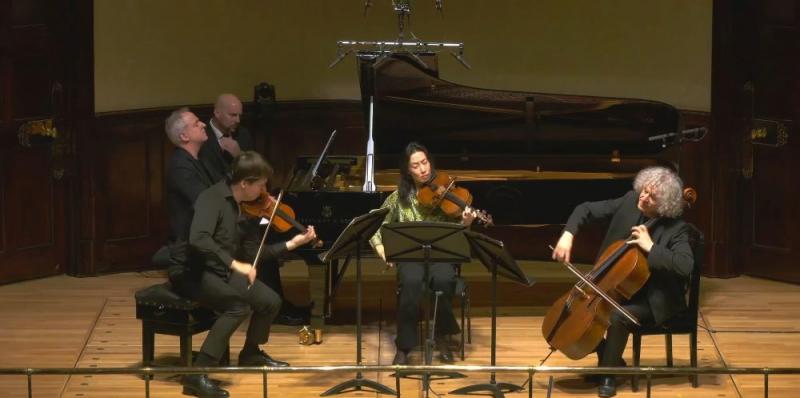
It is doubtless as easy to describe the Dolly Suite with patronizing charm as it is to play it so but, with Jeremy Denk and Connie Shih an alert if always sensitive partnership, there was no likelihood of this latter. A limpid take on the evergreen Berceuse was followed by no less a deft rendition of Mi-a-ou; the ineffable charm of Le jardin de Dolly made a telling foil to the skittish evocation (of a dog) that is Kitty-valse, then the searching poise of Tendresse created a delightful contrast with that affectionate send-up of Chabrier in Le pas espagnol.

Quite why the journal Le Revue chose Fauré’s 77th year to publish an edition devoted to his music is unclear, but it did enable seven former students to express their admiration through miniatures that encapsulate his own idiom as surely as theirs. Hence the intricate texture and enfolding harmony of Enescu’s Pièce, the pert elegance of Ravel’s Berceuse arranged (from its violin-and-piano original by Lucien Garbon), then the gently inflected wit of Koechlin’s Hommage to remind one of the latter composer’s service to Fauré as sometime orchestrator.

These three items were engagingly played (and introduced) by Denk, and it seemed a pity the other four (by Aubert, Ladmirault, Roger-Ducasse and Schmitt) could not have been included – perhaps at the start of the second half – given the appositeness of the programme. This first half ended with the Second Cello Sonata which, while it resembles its predecessor in form, is appreciably more forthcoming as to expression. It is evidently a work that Steven Isserlis first played as a teenager, and there could be no mistaking his identity with the close-knit dialogue of its opening Allegro, pathos bordering on the elegiac of its central Andante that started out as music commemorating the centenary of Napoleon’s death, and effervescence of a finale as endows what is otherwise typical late Fauré with a genial humour never less than captivating.

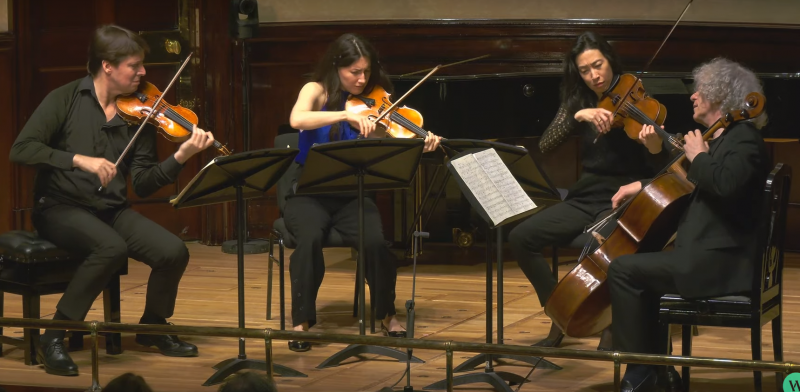
After the interval, this series ended in the only way possible with the String Quartet that was Fauré’s last work. In his initial remarks, Isserlis mentioned how long it had taken for him to ‘get’ this piece and, indeed, its three movements each unfolds in a seamless polyphonic flow which can feel disconcerting even in the context of the composer’s other late chamber works. Whether or not they play it frequently, Joshua Bell, Irène Duval, Blythe Teh Engstroem and Isserlis audibly had its measure – their steady though always flowing tempo for its Allegro moderato ideally complemented by the luminous radiance of its Andante; before its Allegro elides elements of scherzo and finale in music whose dextrous pizzicato writing and gently cumulative intensity conveys an affirmation that speaks of a challenge, and a life, fulfilled.

As a work and as a performance, it set the seal in the only way possible on a series of concerts through which the quality and substance of Fauré’s chamber music could not have been more eloquently confirmed, which is just as should be expected from a retrospective of this nature.

You can watch the concert below, thanks to the Wigmore Hall YouTube channel:

For more information on the Fauré series, visit the Wigmore Hall website – while you can also read Arcana’s interview with Steven Isserlis about the French composer

Published post no.2,355 – Thursday 5 November 2024

In concert – Steven Isserlis and Friends – Fauré at the Wigmore Hall (4)

Steven Isserlis (cello) – with Joshua Bell, Irène Duval (violins), Connie Shih, Jeremy Denk (pianos), Quatuor Agate [Adrien Jurkovic, Thomas Descamps (violins), Raphaël Pagnon (viola), Simon Iachemet (cello)]

Fauré Cello Sonata no.1 in D minor Op.109 (1917)
Enescu Violin Sonata no.2 in F minor Op.6 (1899)
Fauré Piano Trio in D minor Op.120 (1922-3)
Ravel String Quartet in F M35 (1902-03)

Wigmore Hall, London
Monday 4 November 2024

Reviewed by Richard Whitehouse Picture (c) Wigmore Hall Trust

Tonight’s instalment of the Wigmore Hall series focussing on Fauré’s larger chamber works was also the most cohesive in its alternating two of the composer’s late pieces with formative ones by Enescu and Ravel for what was a fascinating programme of echoes and anticipations.

While not necessarily the weakest of those works played in this series, Fauré’s First Cello Sonata is the least remarkable – the melodic content reduced to barest essentials such that its main motifs can verge on the anonymous. That said, its opening Allegro is a model of formal economy and expressive restraint, Steven Isserlis and Connie Shih being no less perceptive in the pensive musing of its central Andante or the urbanity of a final Allegro whose ‘commodo’ aspect was always evident. Less may not always be more, but it is rarely less than appealing.

Less often heard than its successor, Enescu’s Second Violin Sonata is no less significant. Its composer’s first masterpiece, much of the fascination lies in the degree to which its melodic ideas evolve across and between each of the three movements for a potent demonstration of motivic unity. This was something Irène Duval conveyed in ample measure, yet without ever neglecting that reticent or sometimes ominous quality characterizing much of its content – at least until the quixotic finale channels these diverse elements towards a resolution achieved almost despite itself. Throughout, Jeremy Denk’s pianism was a model of lucidity and poise in a performance which went all the way in confirming this work as one of the three greatest masterpieces by a teenager – the other two being written 74 years earlier, then 72 years later. (presumably Mendelssohn’s Octet and a piece to be confirmed! – ed)

Fascinating how much Enescu’s precocity resembles Fauré’s maturity in what was the latter composer’s penultimate work. Compact almost to a fault, the Piano Trio is dominated in all respects by a central Andantino whose melodic eloquence has intensified almost to the point of ecstasy by its close, not least as rendered by Joshua Bell, Isserlis and Denk in what was a near-ideal performance. Succinctness almost gets the better of the outer movements, though it would be churlish not to acknowledge the tensile energy of its opening movement and the exhilaration of a finale whose element of syncopation marks Fauré’s nearest approach to the jazz idiom. Interesting as it is to hear this piece with clarinet as was originally intended, its interplay of violin, cello and piano is no less inevitable than in the parallel work by Brahms.

The well-regarded Quatuor Agate duly took the stage for Ravel’s String Quartet, evidently a work for which Fauré expressed only muted enthusiasm. Superbly played though a little self-regarding interpretively, this account was at its best in its latter stages – the inward rapture of its slow movement in pointed contrast to the volatility and ultimate decisiveness of its finale. The opening movement at times verged on expressive inertia and the scherzo’s deft humour was rather self-conscious, but the overall conviction of this performance still came through. Seemingly the Agate will not be playing Fauré’s String Quartet which forms the culmination of tomorrow’s concert and of this series; one that also includes the Second Cello Sonata and music written in tribute to a composer whose greatness could hardly be doubted now as then.

You can watch the concert below, thanks to the Wigmore Hall YouTube channel:

For more information on the Fauré series, visit the Wigmore Hall website – while you can also read Arcana’s interview with Steven Isserlis about the French composer

Published post no.2,354 – Wednesday 5 November 2024

In concert – Steven Isserlis and Friends – Fauré at the Wigmore Hall (3)

Steven Isserlis (cello) – with Joshua Bell, Irène Duval (violins), Blythe Teh Engstroem (viola), Jeremy Denk, Connie Shih (pianos)

Fauré Violin Sonata no.1 in A major Op.13 (1875-6)
Saint-Saëns Piano Trio no.2 in E minor Op.92 (1892)
Ysaÿe Solo Violin Sonata in D minor Op.27/3 ‘Ballade’ (1923)
Fauré Piano Quintet no.2 in C minor Op.115 (1919-21)

Wigmore Hall, London
Sunday 3 November 2024

Reviewed by Richard Whitehouse Picture (c) Joanna Bergin

This third instalment of the Wigmore Hall’s journey through Fauré’s larger chamber works, as overseen in typically understated fashion by Steven Isserlis, took in works from (almost) either end of this composer’s output alongside pieces by two very different contemporaries.

It was Joshua Bell’s recovering illness that brought a switch in programme such that tonight began with the First Violin Sonata which established Fauré’s reputation and remains among his best-known works (also the only one of these pieces in a major key). The melodic verve of its initial Allegro responded well to Bell’s tonal warmth, despite marginal loss of focus as the development ran its cumulative course, then the Andante lacked little in lyrical intimacy nor the scherzo in nimble dexterity. That the final Allegro felt less than animated (not much evidence of ‘quasi presto’) was understandable in context and, even if it meant rounding off this performance with less than ideal decisiveness, there could be no doubting the sense of epiphany as its main theme returns transformed for an apotheosis of heightened eloquence.

At a time when Fauré was grappling with the implications of what became his Second Piano Quintet, Saint-Saëns was writing his no less substantial Second Piano Trio with relative ease. Its stylistic retrenchment is not hard to discern, witness the opening movement’s prolonged and ultimately doomed struggle to break free of a main theme riven with doubt and anxiety. Tensions relax appreciably in the sequence of middle movements – a lithe and ingratiating Allegretto, an Andante of ‘song without words’ lyricism, then a Grazioso with more than its touch of quixotic humour – during which, interplay between Bell, Isserlis and Jeremy Denk was at its most felicitous. Returning to weightier issues, the finale takes in some intensively contrapuntal passages prior to a conclusion whose headlong impetus came to the fore here.

After the interval came the third of Ysaÿe’s solo sonatas – the Ballade dedicated to Enescu but, as Bell pointed out, premiered by his teacher Josef Gingold who had been the last pupil of its composer; its ‘introduction and allegro’ format incisively delineated on this occasion.

Thence to Fauré for his Second Piano Quintet. Although written relatively quickly compared to its predecessor, it is no less fastidious in content or elusive in character – witness the initial movement whose harmonic subtlety is accentuated by the flexibility of its rhythmic contours, which latter aspect comes to the fore in a scherzo whose angularity betrays more than a touch of malevolence. Is there a more consummate instance of this composer’s art than its Andante? Once characterized as a synthesis between Beethoven and Wagner, it exudes a transcendent calm entirely its own in which the eloquence of Irène Duval and Blythe Teh Engstroem added appreciably to the underlying affect. If the finale is less remarkable, it injects an impetus that propelled the work to a headily affirmative close which was conspicuous by its presence here. An impressive performance of a masterpiece that, while it will never achieve in popularity what it has in respect, could never seem other than communicative when realized with this empathy – something that should be no less evident in the remaining concerts of this series.

You can watch the concert below, thanks to the Wigmore Hall YouTube channel:

For more information on the Fauré series, visit the Wigmore Hall website – while you can also read Arcana’s interview with Steven Isserlis about the French composer

Published post no.2,353 – Tuesday 5 November 2024