
Listening to Beethoven #79 – Rondo a capriccio in G major, ‘Rage over a lost penny’


2020 Germany €20 Silver Coin Issue Ludwig van Beethoven 250 Years

Rondo a capriccio in G major Op.129, ‘Rage over a lost penny’ for piano (1795, Beethoven aged 24)

Dedication not known
Duration 5’30”

Listen

Background and Critical Reception

The title of this piece is wholly misleading. The Rondo a capriccio element is certainly correct, but, as Barry Cooper writes in his notes for Deutsche Grammophon’s New Complete Beethoven Edition, ‘the popular title The Rage Over the Lost Penny is on the original manuscript, though not in Beethoven’s handwriting, and it is not clear whether he sanctioned it’.

The late opus number, 129, suggests it is contemporaneous with Beethoven’s late string quartets – but the piece was completed in 1795 and not published in his lifetime. Cooper writes of how it was ‘found amongst his papers after his death in a not-quite-finished state. Diabelli bought the manuscript, made the necessary additions and published it shortly afterwards’.

Alan Tyson, writing in The Beethoven Companion, notes how it was rare for Beethoven to leave works unpublished if he felt they would have musical or monetary value. ‘A small work like the Rondo A Capriccio’, he writes, ‘may have been kept for concert use and then overlooked when he had outgrown it and had lost interest in it’.

Thoughts

Irrespective of whether or not he coined the nickname (sorry – Ed!) Beethoven’s powers of description are right on point here. The use of a Rondo form (where the main ‘A’ theme keeps recurring as the main part of an A-B-A-C-A-B-A structure) is ideal, as through it the intense frustration of losing something, and not finding it despite repetitive searching, can be fully expressed.

It is a catchy theme, too, suitable for playing at high speed – and as the piece goes on so the speed becomes a whirlwind, the music amusing but also potentially annoying! Again Beethoven’s writing captures the moment perfectly in what is one of his most memorable short piano pieces.

Recordings used and Spotify links

Artur Schnabel (Naxos)

Anatol Ugorski (Deutsche Grammophon)

Evgeny Kissin (BMG)

Ronald Brautigam (BIS)

Artur Schnabel gives a sparkling performance, the quickness of the fingers an absolute delight as the lost penny eludes capture! The final page is brilliantly chaotic, and the recorded sound – remarkably for a 1937 recording made in Abbey Road Studio 3 – stands up really well. Anatol Ugorski is nearly a minute longer but is still excellent in his execution, with crisp digital sound – which Evgeny Kissin also benefits from in a technically superb account. Ronald Brautigam, on a fortepiano, gives a thrilling performance.

You can chart the Arcana Beethoven playlist as it grows, with one recommended version of each piece we listen to. Catch up here!

Also written in 1795 Clementi 2 Piano Sonatas and 2 Capriccios, Op. 34

Next up Sextet in E flat major Op.81b
Listening to Beethoven #78 – 6 Minuets for orchestra (arr. Beyer)

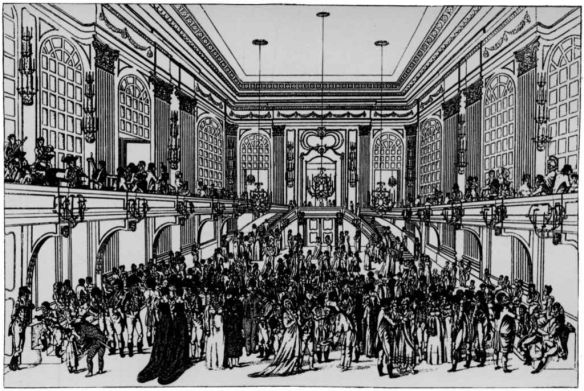
The Grosse Redoutensaal (Grand Ballroom) of the Hofburg Imperial Palace in Vienna Engraving by Joseph Schütz

6 Minuets, WoO 10 for orchestra (1795, Beethoven aged 24. Arranged by Franz Beyer)

no.1 in C major
no.2 in G major
no.3 in E flat major
no.4 in B flat major
no.5 in C major
no.6 in D major

Dedication not known
Duration 11′

Listen

Background and Critical Reception

Beethoven’s six minuets of 1795, our first encounter with him working as a composer of dances ‘to order’, were written for an unknown combination of instruments. The only surviving version in his hand is for solo piano, so respected scholar Franz Beyer made an arrangement for orchestra, an imagination of what Beethoven might have written for the bigger stage.

Thoughts

The orchestrations are attractive, Beyer working with a small orchestra to deliver arrangements that sound to these ears like a close approximation of what Beethoven himself would have written. The lively third minuet comes off particularly well in its full arrangement, as does the genial fourth. The sixth is full bodied, like the minuet of a late Haydn symphony.

Recordings used and Spotify links

Philharmonia Hungarica / Hans Ludwig Hirsch (Warner Classics)

The performances here are nicely weighted, if a little slow at times. The celebrated Minuet in G in particular is given at a pedestrian speed, but after acclimatising the ear takes that as a graceful dance.

You can chart the Arcana Beethoven playlist as it grows, with one recommended version of each piece we listen to. Catch up here!


Also written in 1795 Gyrowetz Three Flute Quartets Op.11

Next up Rondo in G major WoO129 ‘Rage over a lost penny’

Listening to Beethoven #77 – Canon in G major

Plaster casts of Ludwig van Beethoven’s seals, probably made in the Beethoven House in Bonn © Beethoven-Haus Bonn
Canon in G major Hess 247 for three voices (1795, Beethoven aged 24)

Dedication not known
Duration 1’10”

Listen

Background and Critical Reception

The canons are a fascinating but very little-known part of Beethoven’s output – and they reveal plenty about him as a composer. Many of them are short pieces but often with a particular friend or person in mind, and often shot through with humour and witty musical play.

The first example we hear is for three ‘voices’ – as in, three distinct instrumental voices.

Thoughts

This short piece has an attractive lilt in triple time, rather like a Minuet – and . Beethoven repeats his idea several times, and it is catchy enough to have worked its way into your head by the end of its 70-second stay.

Recording used and Spotify link

Benjamin Lichtenegger, Lara Kusztrich, Luka Kusztrich (violins) (Naxos)

An attractively performed version.

You can chart the Arcana Beethoven playlist as it grows, with one recommended version of each piece we listen to. Catch up here!

Also written in 1795 Salieri Il mondo alla rovescia

Next up 6 Minuets WoO 10 (orchestral version)

Listening to Beethoven #76 – 6 Minuets for piano


line art drawing of Minuet dance from the Archives of Pearson Scott Foresman, donated to the Wikimedia Foundation 

6 Minuets, WoO 10 for piano (1795, Beethoven aged 24)

no.1 in C major
no.2 in G major
no.3 in E flat major
no.4 in B flat major
no.5 in C major
no.6 in D major

Dedication not known
Duration 11′

Listen

Background and Critical Reception

As he grew accustomed to Vienna, Beethoven was increasingly aware of the potential for composers to make a name for themselves by writing music for dancing in the ballroom.

This was to bear fruition through sets of German Dances and Minuets for orchestra, but first we witness Beethoven trying out his skills on the piano. There is the possibility these six works were written for instruments but if they were that version is no longer available.

Instead we have a set of piano pieces that have caught on among amateurs and musicians in their infancy, the Minuet in G – no.2 in the set – becoming especially popular for Associated Board exams in the UK. Each of the Minuets has a contrasting ‘trio’ section in the middle, traditional among these dance forms – and Beethoven generally uses that to make more flowing melodies to complement the light-footed main material.

Thoughts

This is genial music for carefree music making. Beethoven writes the six pieces in a clearly defined sequence, the keys of each linking together nicely.

The first minuet is lively and slightly cheeky with its main theme. The second, the well-known Minuet in G, has more of a march-like quality, with a catchy tune, while its trio feels like a variation on the theme. We move to E flat major for a bold third tune, with a few chromatic leanings in the trio, then an amiable fourth minuet with a syncopated trio. The fifth minuet has a nagging and rather catchy motif, before Beethoven signs off back in C major with a bold and uplifting dance.

These pieces may be polite but fulfil their function comfortably, raising more than a few smiles in the process.

Recordings used and Spotify links

Mikhail Pletnev (Deutsche Grammophon)

Jenő Jandó (Naxos)

Pletnev applies a few idiosyncrasies to his reading but is otherwise very enjoyable. Jandó’s version links all six minuets together as one track, performing them as the one linked piece Beethoven possibly intended.

You can chart the Arcana Beethoven playlist as it grows, with one recommended version of each piece we listen to. Catch up here!

Also written in 1795 Gyrowetz Three Flute Quartets Op.11

Next up 3-Voice fugues Hess 237

Listening to Beethoven #75 – Variations on ‘Là ci darem la mano’ from Mozart’s ‘Don Giovanni’

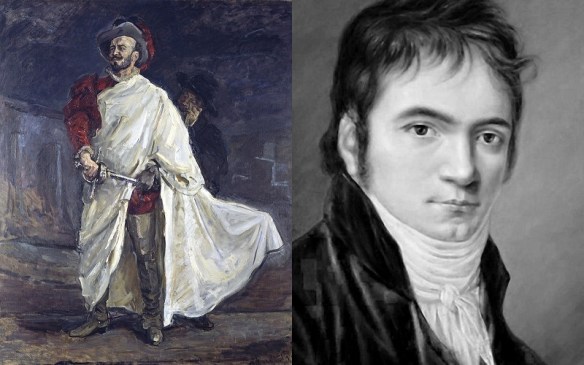
Portrait of Francisco D’Andrade in the title role of Don Giovanni by Max Slevogt (1912) / Young Beethoven

Variations on ‘Là ci darem la mano’ from Mozart’s ‘Don Giovanni’ WoO 28 for 2 oboes and cor anglais (c1795, Beethoven aged 24)

Dedication Not known
Duration 9′

Listen

Background and Critical Reception

This set of variations is closely related to the Trio in C major for the same instrumental combination, published later in Beethoven’s life as Op.87. The unusual trio of two oboes and cor anglais appears to have been inspired by Johann Wenth, a contemporary oboist and composer.

It is possible these variations were intended as a finale to the bigger work, sharing as they do the overall key of C major. There are eight variations and a coda.

Thoughts

Beethoven has an ability of making this trio sound like a much bigger ensemble right from the off. The theme gets a relatively polite outing, but soon Beethoven rolls his sleeves up to have some fun. Variation 2 gives the cor anglais a thorough workout with a very busy part in triplets, then a gentle Andante and spikier fourth variation work the players’ control.

The oboe has a flurry of notes marked ‘leggiero’ (‘lightly’) for the fifth variation, a real exercise in breath control, before the doleful tones of the cor anglais come to the fore in a straight faced minor-key variation.

To offset this, Beethoven writes a spiky and witty seventh variation, before the rich colours of the flowing eighth variation. A substantial coda follows, with a perky fugue that shows Beethoven putting into practice his recent teaching from Albrechtsberger. The three instruments then move in stepwise fashion before the piece fades to a graceful and more thoughtful close.

It is easy to see the link between this work and the Trio in C Op.87 for the same instrumental combination and mood, and these variations could effectively form an encore for that piece. They show Beethoven can write attractively and very skilfully for domestic music making, which like the best chamber music proves equally effective in concert as it does in private.

Recordings used and Spotify links

Heinz Holliger, Hans Elhorst (oboes), Maurice Bourgue (oboe) (Deutsche Grammophon)

Consortium Classicum (Christian Hartmann and Gernot Schmalfuß (oboes), Matthias Grünewald (cor anglais)

Les Vents FrançaisFrançois Leleux (oboe), Paul Meyer (clarinet), Gilbert Audin (bassoon) (Warner Classics) – tracks 8 to 16

The recording led by Heinz Holliger has aged a little but is still a lot of fun. Les Vents Français substitute the second oboe and cor anglais parts for a clarinet and bassoon, which gives a more rounded texture. The Consortium Classicum version, like their account of the Trio Op.87, is very well played too.

You can chart the Arcana Beethoven playlist as it grows, with one recommended version of each piece we listen to. Catch up here!

Also written in 1795 Haydn Berenice, che fai Hob.XXIVa:10

Next up 6 Minuets WoO 10