Charles Villiers Stanford by William Orpen Image Credit: Trinity College, University of Cambridge
As part of Arcana’s 10th birthday celebrations, we invited our readers to contribute with some of their ‘watershed’ musical moments from the last 10 years.
Celia Lister writes:
“My musical discovery from the last decade is Charles Villiers Stanford’s Magnificat and Nunc Dimittis in G.
As an oboist specialising in solo and baroque ensemble performance, I was until recently hugely ignorant of vast swathes of church music. That all changed when my children became old enough to be church choristers, a hobby which my husband (an ex-lay clerk) was keen for them to pursue. As a result, over the last few years, I have been exposed to a huge quantity of music which was new to me, ranging from the early Spanish polyphony of Tomás Luís de Victoria to the anthems of Howard Goodall. A firm favourite genre in our house is liturgical Victoriana – Stanford, Wesley, Parry, Wood and Elgar to name but a few. Choral evensong is a highlight of the calendar, and a one of the most wonderful new pieces was Stanford’s ‘Mag & Nunc’ in G.
My daughters are lucky to have inherited my husband’s dulcet tones rather than my mezzo squawking, and my eldest recently had the pleasure of singing the not inconsiderable soprano solo in this wonderful work, with her siblings and parents on sop 2, alto and tenor respectively. Hearing her voice soaring to the rafters was undeniably special, as a parent and as someone who loves music, and was the culmination of hours of church practises, services and RSCM study sessions. It makes the seemingly endless taxi service I perform to shuttle my daughters to and from innumerable rehearsals worth it.
So in a way, it’s not that Stanford in G is a single piece which I can’t do without; it’s that for me it represents the pinnacle of a genre of music which I’d hitherto largely ignored. Liturgical music – not only, but largely Victorian – now affords me great pleasure for both musical and personal reasons. Now all I need to do is wait a few more years until they are trained up for the Passions…
‘A moment of sudden and great revelation or realization’.
This is the second Oxford definition for the word ‘epiphany’…which is also a Christian feast day, ‘the manifestation of Christ to the Gentiles as represented by the Magi’.
It’s the ‘sudden realization’ that has descended on Arcana towers, however, as many of us go back to work today. Christmas is done, two weeks that have flown by – and just a heartbeat later we’re thrust wide-eyed into the New Year, back into the strong current of the river that is modern life.
Help is at hand, however. Music is such a reliable ally in times like this, whether it’s the music we know and love or the music we haven’t discovered yet. Both are reasons to look forward to 2025 with anticipation! Arcana will be hoping for several ‘epiphanies’, as we split our loyalties between the old and the new, covering music from the last 500 years or more as we go.
2025 will see the tenth birthday of this resource, believe it or not – on Saturday 1st February. By then we hope to be well in the groove of providing a daily digest of shared musical loves, interviews and concerts. Along the way there will be special focus on Shostakovich, who died 50 years ago this year, and is a favourite composer in these parts. We will also look to enjoy classical music from London, Birmingham and online, electronic music from all corners of the world, and plenty in between.
If you’d like to get in touch with us about any of it, suggest some things for us to listen to, or even write for us, get in touch! You can get me, Ben Hogwood, via e-mail (editor@arcana.fm), over BlueSky (Ben Hogwood or Arcana) or – if you must – on Twitter / X for a little while longer.
Before you go, do listen to this remarkable carol marking Epiphany from British composer Judith Bingham – both haunting and tremendously powerful. Happy New Year!
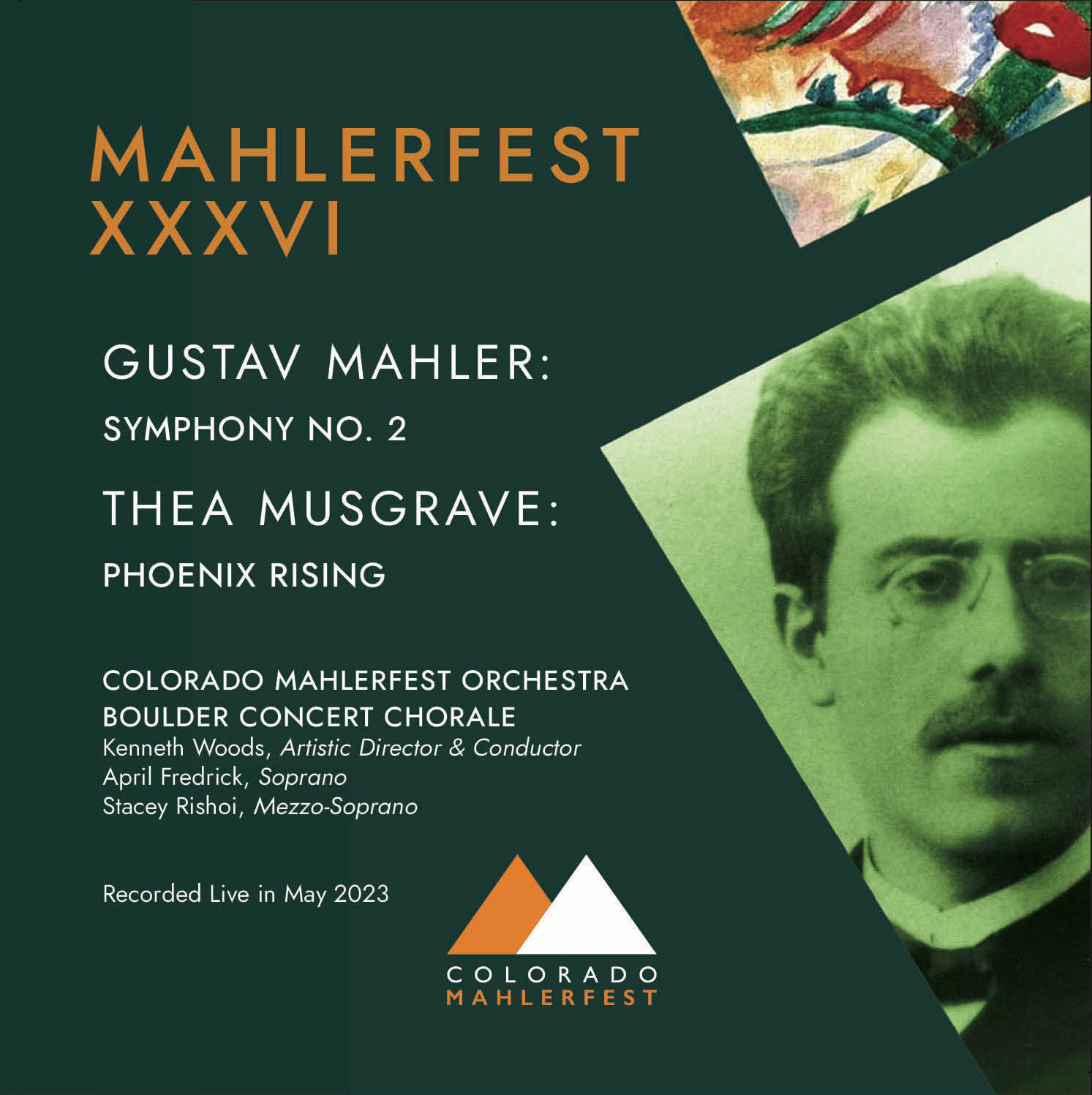
Musgrave Phoenix Rising (1997) Mahler Symphony no.2 in C minor ‘Resurrection’ (1888-94)
Colorado MahlerFest 195269301194 [two discs, 104’02”] Live performances on 21 May 2023, Macky Auditorium, Boulder, Colorado
Reviewed by Richard Whitehouse
What’s the story?
Last year’s edition of MahlerFest continued its latest, not-quite-chronological traversal of the symphonies with the Second – appropriately coupled on this release (as in the concert) with a work such as considers ‘resurrection’ from a very different while no less relevant perspective.
What’s the music like?
Six years in the writing, Mahler’s Second Symphony fairly laid the basis for his reputation as a composer at its Berlin premiere in 1895. It is a measure of this performance that it captures something of the shock or excitement no doubt in evidence back then, not least in an opening movement with Kenneth Woods notably more interventionist tempo-wise as compared to that of the Third Symphony a year before. What emerges is imposing but never diffuse, at its most gripping in that baleful lead-in to a development whose terseness duly accentuates its impact, with the pathos of the second subject on its reprise making the coda’s sardonic recessional the more acute. After which, the second movement feels the more enticing through its alternation of warm sentiment with capering animation while heading to a conclusion of beatific repose.
There is no lack of incident in a scherzo whose glancing irony is leavened yet not lessened by its trios, the first as soulful with its lilting trumpets as the second is ominous in its import; but not before Stacey Rishoi has characterized the Urlicht setting with rapt inwardness. What to say about the finale other than, while this may not be the most overwhelming take on its vast fresco, it is matched by relatively few as regards an organic unfolding that sees the movement whole. Its contrasting elements here fuse with unforced cohesion to a fervent rendering of the chorale episode then on to a surging Toten-marsch – the kinetic momentum carried through to a methodical reprise of earlier ideas, then a rendering of Klopstock’s text (much altered by the composer) as only grows in intensity before the majestic affirmation of its closing pages.
As the ‘first half’, Thea Musgrave’s Phoenix Rising provides an ideal complement. The much esteemed (latterly more in the US than the UK) nonagenarian has written often for orchestra, but seldom with such immediacy than in a piece whose formal and expressive trajectory feels nothing if not symphonic in its progress. Comparison with the 2016 studio recording by BBC National Orchestra of Wales and William Boughton (Lyrita SRCD372) confirms that, passing tentativeness in ensemble excepted, Woods’s reading demonstrably makes more of this aspect.
Does it all work?
Yes, pretty much always. As on previous releases in this ongoing Mahler cycle, the Colorado MahlerFest Orchestra punches appreciably above its weight in music which should never fall prey to wanton virtuosity. The unyielding acoustic of Macky Auditorium is less an issue than before, with the finale’s offstage brass adeptly managed. April Fredrick brings her customary eloquence to bear on this movement, and the Boulder Concert Chorale – as prepared by Vicki Burrichter – rises to the occasion with notable fervency as this work reaches an ecstatic close.
Is it recommended?
It is. There have been too many superfluous Mahler cycles, but this traversal is shaping up as one of the most worthwhile and more than the memento of a memorable occasion. Hopefully such standards will be maintained by the Sixth Symphony as part of next year’s 37th edition.
George Lloyd A Symphonic Mass (1990-92) Brighton Festival Chorus, Bournemouth Symphony Orchestra, Philharmonia Orchestra / George Lloyd A Litany (1994-5) Janice Watson (soprano), Jeremy White (baritone), Guildford Choral Society, Philharmonia Orchestra / George Lloyd
Lyrita SRCD.2419 [two discs, 60’44” and 49’30”] Latin and English texts included
Producers Ben Turner (A Symphonic Mass), Christopher James (A Litany) Engineers Harold Barnes, Alan Mosely (A Symphonic Mass), Tony Faulkner (A Litany)
Recorded 19 & 20 June 1993 at Guildhall, Southampton (A Symphonic Mass), 24 & 25 March 1996 at Town Hall, Watford
George Lloyd Requiem (1997-8) Psalm 130 (1995)
Stephen Wallace (countertenor), Jeffrey Makinson (organ), Exon Singers / Matthew Owens
Lyrita SRCD.420 [63’22”] Latin and English texts included
Producer Ben Turner Engineer Harold Barnes
Recorded 31 August – 2 September 2000 at Church of St Alban the Martyr, Holborn, London
Reviewed by Richard Whitehouse
What’s the story?
Lyrita continues its reissue schedule of George Lloyd-related recordings for the Albany label – the ‘Signature Edition’ – with those three late choral works which, between them, constitute a worthy culmination to a composing career with few parallels in the annals of British music.
What’s the music like?
While three operas and twelve symphonies are the backbone of Lloyd’s output, choral music came to the fore during his final decade. Few would have demurred had the composer called A Symphonic Mass his ‘Thirteenth Symphony’, given its formal cohesion and harnessing of its liturgical text to a structure in which thematic consistency and cumulative momentum are uppermost. Hence the opposing conflict and consolation in the Kyrie anticipates a struggle reflected, in the Gloria, by the music’s juxtaposing of fervent outbursts with a luminous and otherworldly calm. The Credo becomes an extended development of motifs and expression, informed by an acute relating of textual imagery to musical content – its strenuousness offset by a brief if potent orchestral interlude that is the Offertorium. The piece climaxes with the Sanctus and Benedictus, its rapt intensity heightened by the blazing affirmation at Osanna; after which, the Agnus Dei passes through doubt and apprehension before achieving a new-found though hard-won serenity at Dona nobis pacem. Certainly, a Mass of its time and ours.
Three years on, and A Litany is less inclusive but equally involving – even with Lloyd’s aim of composing a ‘repertoire’ piece likely undermined by the size of its orchestral forces or the demands of its vocal writing. Its words are the first 12 (out of 28) verses from John Donne’s eponymous poem, as set by Lloyd from a spiritual yet non-specifically religious standpoint. Despite being in four movements, this is not an overtly symphonic conception – though the formal follow-through is nothing if not cohesive in its relating of music to text. The opening Allegro Dramatico pursues its respectively passionate then sombre traversal of the first two verses, the ensuing Allegro being akin to an extended intermezzo in its setting the third and fourth verses with a deft yet often oblique eloquence. The brief Adagio focusses on the fifth verse in an intimate acapella setting, then the final Vivace sets the sixth to twelfth verses as a cumulative sequence in which passing anxiety is gradually overcome; the music accruing the energy needed to hit the ground running for what becomes a decidedly affirmative close.
Written in the months before his death, with a dedication to the memory of Diana, Princess of Wales, the Requiem is an understated if characteristic swansong with, at almost 55 minutes, a scale comparable to those earlier works. This follows the expected liturgical text with just a few pointed modifications (no Libera me at the end), its 16 designated sections falling into three main parts. Requiem and Kyrie sets the reflective if by no means unvaried tone of the whole and highlights the role of the countertenor – occupying the lower end of its compass so that it becomes the subdued complement to choral writing notable for its textural clarity and inwardness. The Dies irae sequence (itself in two halves) has a notably perky Tuba mirum and songful Rex tremendae, while the Lacrimosa seems consoling rather than elegiac. The third part takes in a whimsical Hostias, brief but vibrant Sanctus, elegant and supplicatory Agnus Dei, then a Lux aeterna as sees the whole work through to its close with the voices gradually receding in gently undulating chords for what is a serene yet poignant valediction.
Three years earlier, Lloyd had composed two pieces for unaccompanied choir – of which his setting of Psalm 130 (Out of the depths) is notable for its often circumspect while never aloof manner, the emergence of a soprano in the later stages pointing up its mood of tentative hope.
Does it all work?
Yes, and not least owing to the persuasiveness of recordings made soon after their respective premieres. Lloyd secures a dedicated response in the Mass from the Brighton Festival Chorus (under the redoubtable László Heltay) and Bournemouth SymphonyOrchestra while, in the Litany, the Guildford Choral Society (for whom it was written) and Philharmonia Orchestra are no less committed. In the latter piece Janice Watson gives a thrilling contribution, but Jeremy White is not wholly at ease for all his warm nobility. As for the Requiem, the Exon Singers sound tonally assured and Stephen Wallace copes ably with his distinctively conceived role, while Jeffrey Makinson applies a light touch to organ writing as evinces a continuo-like dexterity, though it might yet be worth transcribing this part for woodwind and brass so as to open-out its expressive ambit.
Is it recommended?
Indeed, not least as these reissues come with full texts and detailed notes from Paul Conway. Inherently unoriginal while unequivocally sincere, Lloyd’s late choral works are far removed from the facile disingenuity of much current choral music and are the more appealing for this.
Leon Bosch (double bass), Lviv National Philharmonic Orchestra of Ukraine / Theodore Kuchar
Thomas de Hartmann Symphonie-Poème no.1 Op.50 (1934) Fantaisie-Concerto Op.65 (1942)
Toccata Classics TOCC0676 [81’49’’] Producers and Engineers Andriy Mokrytskiy and Oleksii Grytsyshyn Recorded 15-23 September at National Philharmonic Hall, Lviv
Reviewed by Richard Whitehouse
What’s the story?
Toccata Classics continues its exploration of orchestral music by Thomas de Hartmann with first recordings for two of his most characteristic works, idiomatically realized by the most fervent of present-day advocates and further confirming the intrinsic value of this composer.
What’s the music like?
De Hartmann heralded a return to original composition, after more than a decade focussed on his collaboration with philosopher Georges Gurdjieff, with the first of four pieces designated Symphonie-Poème. Those having heard the unfinished last of these (recorded on TOCC0633) may be taken aback by what they encounter – this 65-minute work drawing on such expansive symphonic precursors as Rachmaninoff’s Second and Glière’s Third, but with a formal logic and harmonic practice all its own. Not least in the imposing first movement, whose brooding introduction presages its synthesis of fantasia and fugue with an underpinning of sonata form to result in a construct as diverse in musical content as it feels cumulative in its overall design.
That the composer continued from here says much for his ambition, but the work does justify itself as a totality – whether in a Scherzo that unfolds as continually evolving structure rather than the usual ternary form, an Andante whose recourse to martial rhythm and Ukrainian folk -music gives it a distinctive colouring and emotional affect, then finale (interestingly marked Allegretto feroce) such as projects this covertly autobiographical statement defiantly into the ‘present’ through a trenchant rhythmic profile that builds inexorably toward the visceral close. Received with guarded admiration and not a little consternation at performances in Paris and Brussels in the mid-1930s, this is a major inter-war work as well warrants its belated revival.
So, too, does the Fantaisie-Concerto which de Hartmann wrote with the double-bass playing of Serge Koussevitzky vivid in his mind’s ear decades afterwards (the latter had long since turned to conducting, and it is not stated who premiered this piece). Drawing on elements of dance, the outer Allegros indicate those quizzical and capricious qualities which come to the fore in the composer’s later music, but the central Adagio leaves the most lasting impression. This ‘Romance 1830’ draws on an earlier setting of Vasily Zhukovsky, along with images of Glinka and his bass-playing servant, in what is a ‘song without words’ of no mean eloquence or evocative poise: qualities duly enhanced by the subtle understatement of its orchestration.
Does it all work?
Yes, though the larger work will likely take a few listens for its overall coherence to become manifest. That it does so is owing primarily to the conviction of de Hartmann’s thinking, but also to that of Theodore Kuchar in having the measure of this opulent score and conveying it to the musicians of the Lviv National Philharmonic Orchestra, who almost always sound unfazed by its demands. The concerto benefits from the expertise of Leon Bosch, affirming this as among a handful of pieces that establish the double bass as a concertante instrument in its own right.
Is it recommended?
Indeed – not least as the orchestral sound has been so sympathetically captured, detailed and spacious in equal measure, with informative notes by Elan Sicroff and Evan A. MacCarthy on life and work respectively. Cordially recommended, with the third instalment keenly awaited.





 Arcana.fm