
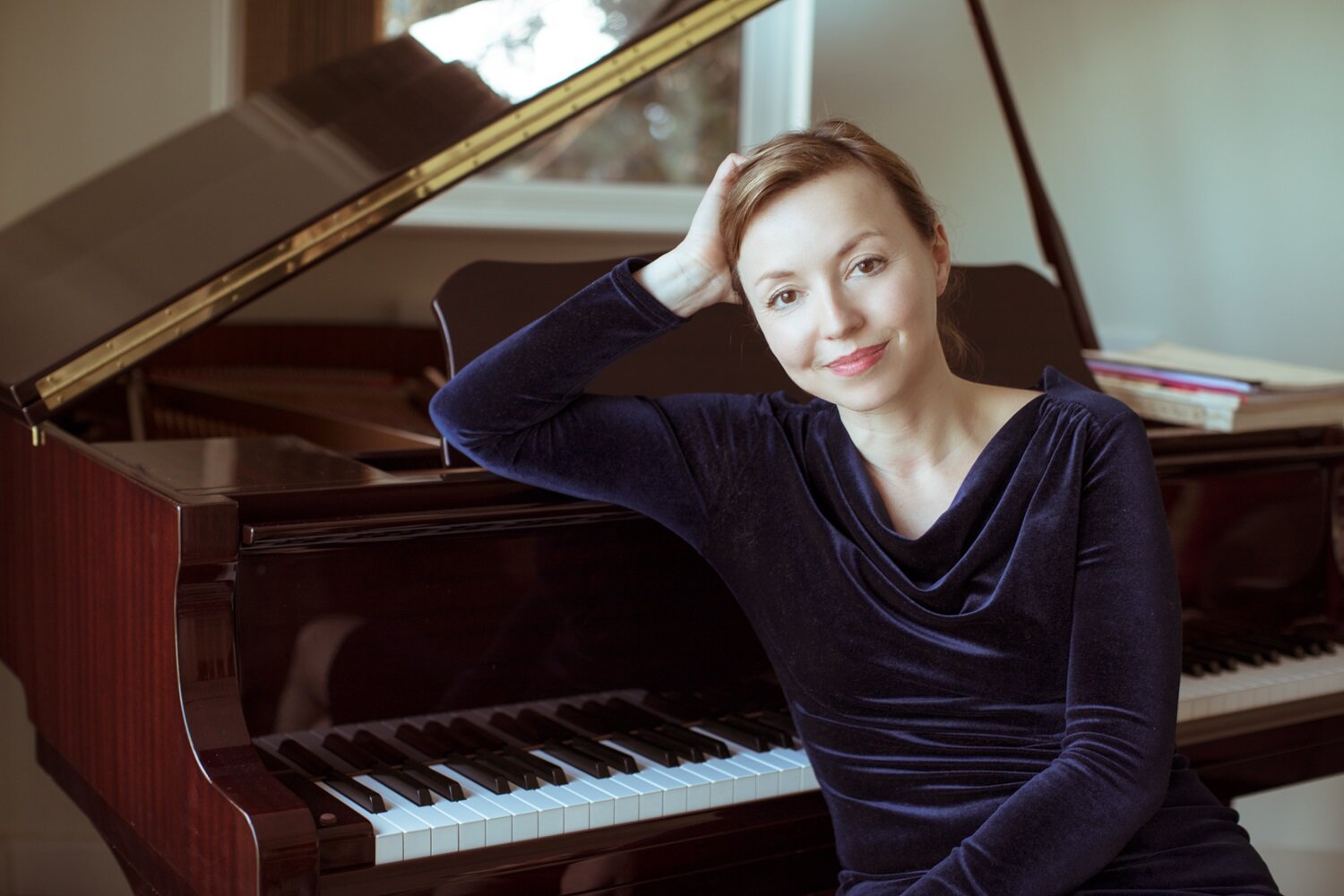
The composer talks about her new work for the London Philharmonic Orchestra, a revival of her opera Four Sisters and how the Russian-born, UK-based composer channels her feelings on the conflict in Ukraine.
Interviewed by Ben Hogwood
Arcana is in conversation with composer Elena Langer. Born in Russia but moving to study in this country two decades ago, she is full of anticipation at the weekend she has coming up. On Saturday 18 March the London Philharmonic Chorus and Orchestra, together with soloist Kristina Blaumane, will give the first performance of The Dong With The Luminous Nose, a major new piece for the forces.
Exercise is uppermost in Langer’s mind when we are connected to our call, however. “I’m rehearsing with the chorus tonight”, she says, “and after our call, I’m going to have a swim. I love cold water swimming, and I go to Hampstead Heath, where there is a well-known ladies’ pool.” Given the temperature on the day we talk is a little above freezing, this is a brave move. “Yes, it’s cold – but it will be a quick swim, and it gives you a kick for the rest of the day. It means I will be nice and well-behaved with the chorus!”
As you will have gathered, Elena has a healthy sense of humour, and a zest for life too. The primary reason for our conversation is to talk about a major new choral piece receiving its world premiere in the Royal Festival Hall soon. The Dong With The Luminous Nose is a setting of a nonsense poem by Edward Lear (illustrated below), though as we quickly establish it is a work of several layers. “It’s not nonsense as such, it is a love story”, she explains. “The Dong is broken hearted, and went mad – but it’s told in the right way.”
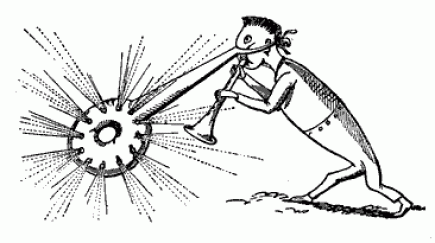
She recalls her first encounter with the poem, “maybe about 10 years ago. A journalist friend introduced me to it, and I really liked it – and then forgot about it. Then at the right time I remembered, because when I was asked to write this piece for chorus and orchestra I found it difficult to find the right text. Often composers set religious texts that don’t resonate, and I love setting poems, but poems for the chorus quite often feel wrong – the words never quite come across as they should. With The Dong it is a poem, but it’s a little opera for chorus. It tells a story, and you follow it, and it felt like the perfect vehicle for the task.”
The opening lines of The Dong set a telling scene: “When awful darkness and silence reign over the great Gromboolian plain”. Elena reveals how she set them to music. “I started with a big solo cello, a concentrated line. The cello represents the Dong or his longing, his soul. She is playing that solo, and that tells the story in music from beginning to end. Then the music continues in the very low registers of the orchestra, tremolo – and tam-tam, with low bassoon and trombones, low double basses too. I only used the basses in the beginning and introduce the timbres of the chorus gradually. The story is told by the basses, and then the tenors, who begin on the word ‘light’, and then all the female chorus only appears when it says “The Dong, The Dong”. We are introduced to every layer of the piece gradually, because there are lots of layers, all with the big chorus and the cello.”
With so many forces at her disposal, is it tempting to use them too much? “I have them and I like using everything a lot, but obviously it should make sense. The cello tells the story and follows the climaxes and moods of the text. It’s a strange genre – a cantata on one hand, but at the same time it’s a cello concerto because sometimes the cello is in competition with the chorus or the orchestra, and there are some instrumental bits which make it slightly symphonic.”
Rather than copy established formats, Elena has sought an original approach. “I tend to not think about what genre I’m writing in, like making new film”, she explains. “It’s not a romantic comedy, or a drama – it has everything – a bit like a good salad! This approach runs through my operatic work, when you have these resources and you use them as tools to make the drama and to have an effect on the audience. I want to tell the story as precisely as I can with my resources.”
The cello part is written for Langer’s good friend Kristina Blaumane, principal cello of the London Philharmonic Orchestra. “She’s an old friend of over 20 years, and she has this passionate, romantic side to her personality, with big emotions. I hope the cello part does that – it’s quite virtuosic, and it requires this soulful, deep, rich sound, which she has in her instrument. She looks wonderful on stage and tells the story in a dramatic way!”
Delving deeper into the story itself, the title – The Dong With The Luminous Nose – brings up a parallel with the young Shostakovich, and his first satirical opera The Nose. Would the story have appealed to him, possibly? “The plot is the opposite, as the nose disappears”, points out Langer, “so you have two noses! But you’re right, I love this in Russian literature where you get this fantastical thing which comes from Gogol, and runs through the work of Daniil Kharms, a Leningrad poet who behaved in a very eccentric way, and who I’m sure was influenced by the English tradition of Lewis Carroll and Edward Lear. It’s fantastical and surreal, but at the same time dramatic and real. All kinds of political, horrible things are happening around us, and I don’t feel like the kind of artist who comments directly on direct events.”
Elena qualifies her observation. “My survival technique is escapism, using music as something that when I write I am in control of my notes. I build this world, but I’m not in control of the rest of the world. The events – the real events – seem like a dream. In a way it’s my lament, to comprehend the world and what’s happening, done through this crazy little creature The Dong, who goes mad and loses what’s important to him.”
Inevitably, talk turns to the conflict in Ukraine. Elena may have lived in the UK for over 20 years, but the links are still strong. “I love being here, and I am in some way detached, but in some way not. I still have friends in both places, but I don’t want to run around with flags. I want to express how I feel in my own way.”
Langer’s music is indeed deeply expressive, as attendees to the Royal Philharmonic Society Awards, heard at the Queen Elizabeth Hall recently, will attest. Soprano Anna Dennis, oboist Nicholas Daniel and pianist John Reid gave a moving performance of her song Stay, Oh Sweet. It confirmed Langer’s intensely vocal approach to composition – even when writing for voices. “Yes, I think so”, she agrees, “and my cello writing for Kristina proves that. I see every instrument of the orchestra as a voice, rather than some composers who work the other way round.”
Coincidentally, on the night The Dong receives its premiere, Langer’s one-act opera Four Sisters will be performed in a new production by the Royal Conservatoire of Scotland in Glasgow. It is part of an appealing program, the 2012 opera paired with César Cui’s A Feast in Time of Plague.
“It should be fun!” she says with amusing understatement. “Four Sisters was commissioned 12 years ago by Dawn Upshaw, who had a class at Bard College in the Fisher Arts Centre, in upstate New York. They have a conservatoire there, and Dawn had a nice class there, mostly of girls. She asked me to write something that would involve more girls, as they needed parts for everyone. I thought of a funny mix of Three Sisters by Chekhov and something like Sex And The City! Each part is equal, there are no prima donnas!”
Langer studied briefly with Upshaw, but the pair’s connection goes back still further. “In 2009 I was invited to participate in the project writing for Carnegie Hall writing songs with Dawn Upshaw and Osvaldo Golijov, the Argentinian-American composer. I spent a week or more with Dawn and some singers, and she liked my work – hence the commission. She is a very good teacher, she teaches to sing and to understand what you are doing, what you are thinking about – not just the notes.”
Elena does not sing herself. “Oh no, I have a terrible voice!” she laughs. “I can play on the piano and play my pieces if I need to show them to directors or to performers, but never singing!”
On her arrival in the UK from Moscow, Langer spent one year studying with Julian Anderson, and then moved to the Royal Academy of Music for her PhD. “I saw Simon Bainbridge there, and he was very encouraging, a pleasant presence. That’s also where I met Anna Dennis, who has been my muse since then. When I write for sopranos, I have her timbre in my ears. She is very versatile, and a good musician too. She can play cello and piano.”
After the recent flurry of activity, “like a wave”, Langer is planning to take a short break. “I wanted to have a short break to stop the conveyor”, she says, as I have only just finished the arrangement that we made of Stay My Sweet for the awards. It was originally written for string trio, harpsichord and voice, and I arranged it for voice, oboe and piano. The original is recorded on Harmonia Mundi.”
Her musical thoughts are still active, mind. “It is my week off, but I’m already thinking about a Trumpet Concerto! I was working in November, and had a fantastic concert with the Boston Symphony Orchestra, who were doing a suite from my opera Figaro Gets A Divorce. They have a fantastic, very bright brass sound, polished and very smart. Their trumpeter asked me if it is possible to write a Trumpet Concerto for him and the chamber orchestra, so I agreed – and now I imagine a kind of quasi-Baroque piece, bright and energetic. I will probably write that next.”
Is the Baroque period an inspiration for her work? “It’s one of the colours which I have. My taste, as you can probably tell from my music, is very eclectic. I like all kinds of music, like Baroque and Rossini, Donizetti, Strauss, Wagner and Handel. I get excited by music! The Baroque period I like, and have written a lot for harpsichord and oboe, partly because Anna has sung a lot of Baroque music. I have been commissioned through her – and soon in Aldeburgh, at Snape, they will perform another of my compositions, Love and Endings. They are three songs based on Middle English poems, and they’re written for Anna, Mahan Esfahani and Nick Daniel. It’s going to be performed at Easter.”
She is intrigued by Esfahani’s approach. “It’s going to be the first time that I work with him. While I was writing the new songs, I went to Oxford to visit his harpsichord, and I played the instrument which was specially built for him. It is much more resonant than your normal Baroque instrument, and has more notes. It has a very thick and groovy bass!”
As well as the wide range of classical music above, Langer also encounters pop music through her son. “He’s 17, and sometimes when he’s in a good mood he shares some music that he listens to. I love a lot of it, rap and RnB. He played something that was a crossover between Muslim prayer, and rap, and something else, made in East London. I like this kind of thing, and also older jazz from the 1920s to 1950s. My favourites are Ella, Miles Davis, Coltrane and my favourite, Oscar Peterson.”
Returning to her own compositions, a glance at Langer’s list of works on her website reveals that The Dong has the biggest orchestral group she has used so far. “I’ve never used chorus and orchestra like this, it’s the first time, other than in my operas. I was a bit worried about it, as it’s completely different.”
She will hear the piece in full two days before the concert, “but tonight I’ll rehearse with the chorus. We are rehearsing in bits, to give the chorus more time to prepare – and then Kristina will join the chorus, and only then will we have everyone. I hope it works!”
She laughs, nervously – but also modestly. “This whole thing, you spend so much time orchestrating, doing the parts and this and that, and you just hope it sounds right!” With experience, she is less often surprised by the results. “The older I get, the more close it is to the initial idea. I think it’s a part of being a bit more skilful, although when I studied at the Tchaikovsky Conservatoire some of our teachers would say we must take risks and write something where we don’t know what the sound will be. I don’t want that, as I have a vision. I want it to be like a well-built house, it should not have anything unpredictable.”
The Dong With A Luminous Nose will receive its world premiere on Saturday 18 March at the Royal Festival Hall. For ticket information and purchase, visit the London Philharmonic Orchestra website. Meanwhile you can find information about the performance of Four Sisters at the Royal Conservatoire of Scotland website



 Arcana.fm