In concert – Laura van der Heijden, CBSO / Richard Egarr: Bach, Haydn & Schumann

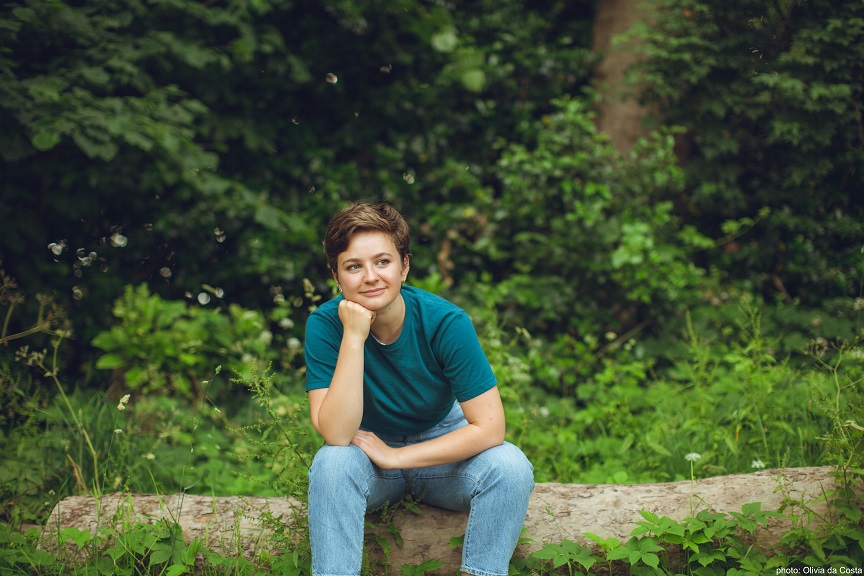
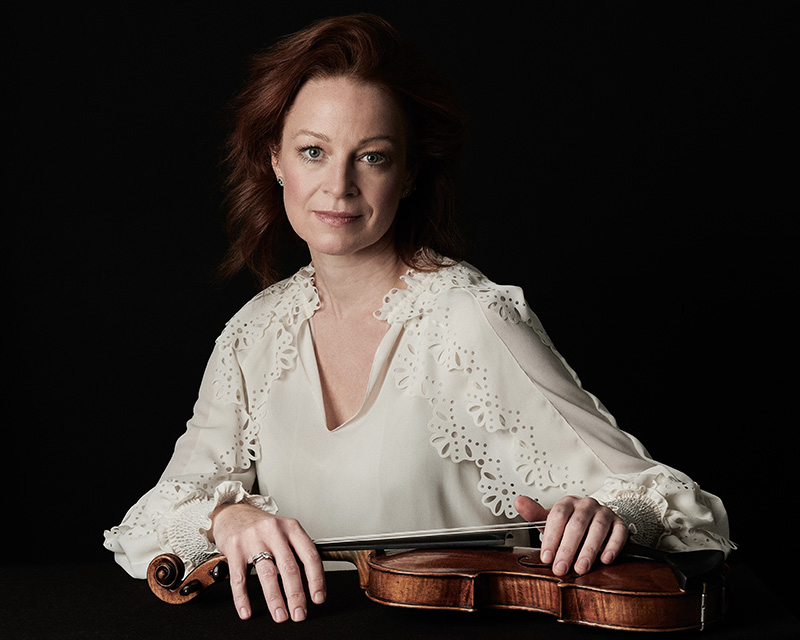
Laura van der Heijden (cello, above), City of Birmingham Symphony Orchestra / Richard Egarr (harpsichord)

J.S. Bach Orchestral Suite no.3 in D major BWV1068 (1730)
Haydn Cello Concerto in D major Hob.VIIb/2 (1784)
J.S. Bach Fuga a tre sogetti BWV1080 no.19 (1748-9)
Schumann Symphony no.2 in C major Op.61 (1845-6)

Symphony Hall, Birmingham
Tuesday 14 November 2023

Reviewed by Richard Whitehouse

The City of Birmingham Symphony Orchestra has put on smaller-scale concerts over several seasons, and tonight’s wide-ranging programme saw the players being conducted or directed – and frequently at the same time – by the personable and always enthusiastic Richard Egarr.

Egarr and Laura van der Heijden ensured Haydn’s Cello Concerto in D remained unaffected by that understatement, bordering on somnolence, which so often used to characterize it in performance. Although a staple of its repertoire from the outset, it was only discovery of its autograph in 1951 that confirmed it as by Haydn rather than Anton Kraft who had reworked the solo part extensively. Here the initial Allegro had a vibrancy that never wavered, and if Van der Heijden’s tone was not always flattering, the impetus instilled into its development and cadenza (by Colin Matthews?) ensured this movement’s vivid projection. The brief yet eloquent Adagio was enticingly rendered, while the final Rondo had an agility maintained from the first appearance of its indelible theme through to the buoyancy of its closing bars.

Egarr had opened proceedings with Bach’s Third Orchestral Suite, welcome not least because this composer’s orchestral works (other than his Violin Concertos) are seldom encountered at ‘mainstream’ concerts these days. Although its Aria (Air on the G string) – rendered so that its pathos never cloyed – will always be its chief attraction, the Ouverture had grandeur and energy redolent of Handel, then the alternate Gavotte movements evinced a genial humour to which the boisterous Gigue with its clarion-like trumpet writing made an admirable foil. After the interval, an unexpected but absorbing take on the final and unfinished fugue from Bach’s The Art of Fugue. Once more speculated on than actually heard, Contrapunctus XIV remains a fete of technical and imaginative dexterity arguably intensified by its breaking off just after the appearance of the B-A-C-H motif. Whether abandoned from failing eyesight or for reasons of intellectual game-playing, its fascination remains endless and, as heard in this lucid if dour transcription for strings, its fusing of the visceral with the arcane is not in doubt.

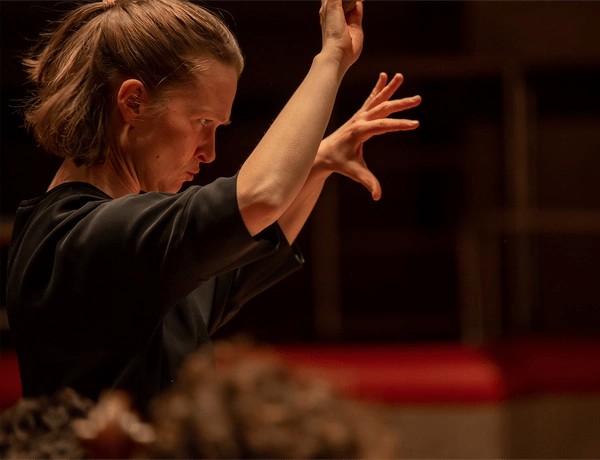
Richard Egarr Photo: Marco Borggreve

Not an inappropriate entrée, moreover, to Schumann’s Second Symphony: formally the most rigorous of this composer’s cycle, and one whose historical or aesthetic lineage is evident at every level. Egarr ensured the first movement’s lengthy introduction, pensive yet expectant, led seamlessly into a main Allegro whose momentum carried through to a propulsive close; then into a Scherzo whose pivoting between the agitated and whimsical was not resolved by its headlong coda – superbly articulated here. Nor was there any lack of emotional gravitas in the Adagio, surely among Schumann’s most potent creations, though Egarr’s not always tacit encouragement of applause between movements rather undermined the expectancy of a coda being fulfilled by the final Allegro as this sets out on its joyous while always eventful course.

Just on occasion the inevitability of that course seemed to lose focus, most likely as Egarr’s concept of ‘authenticity’ tended to impede more seamless formal cohesion – but, as the piece headed to its close, a sense of affirmation in the face of daunting odds could hardly be denied.

You can read all about the 2023/24 season and book tickets at the CBSO website. Click on the artist names for more information on cellist Laura van der Heijden and conductor / harpsichordist Richard Egarr

Published post no.1,998 – Friday 3 November 2023

In concert – Ilya Gringolts, BBC Symphony Orchestra / Roderick Cox: Debussy, Wennäkoski, Lyatoshinksky & Stravinsky

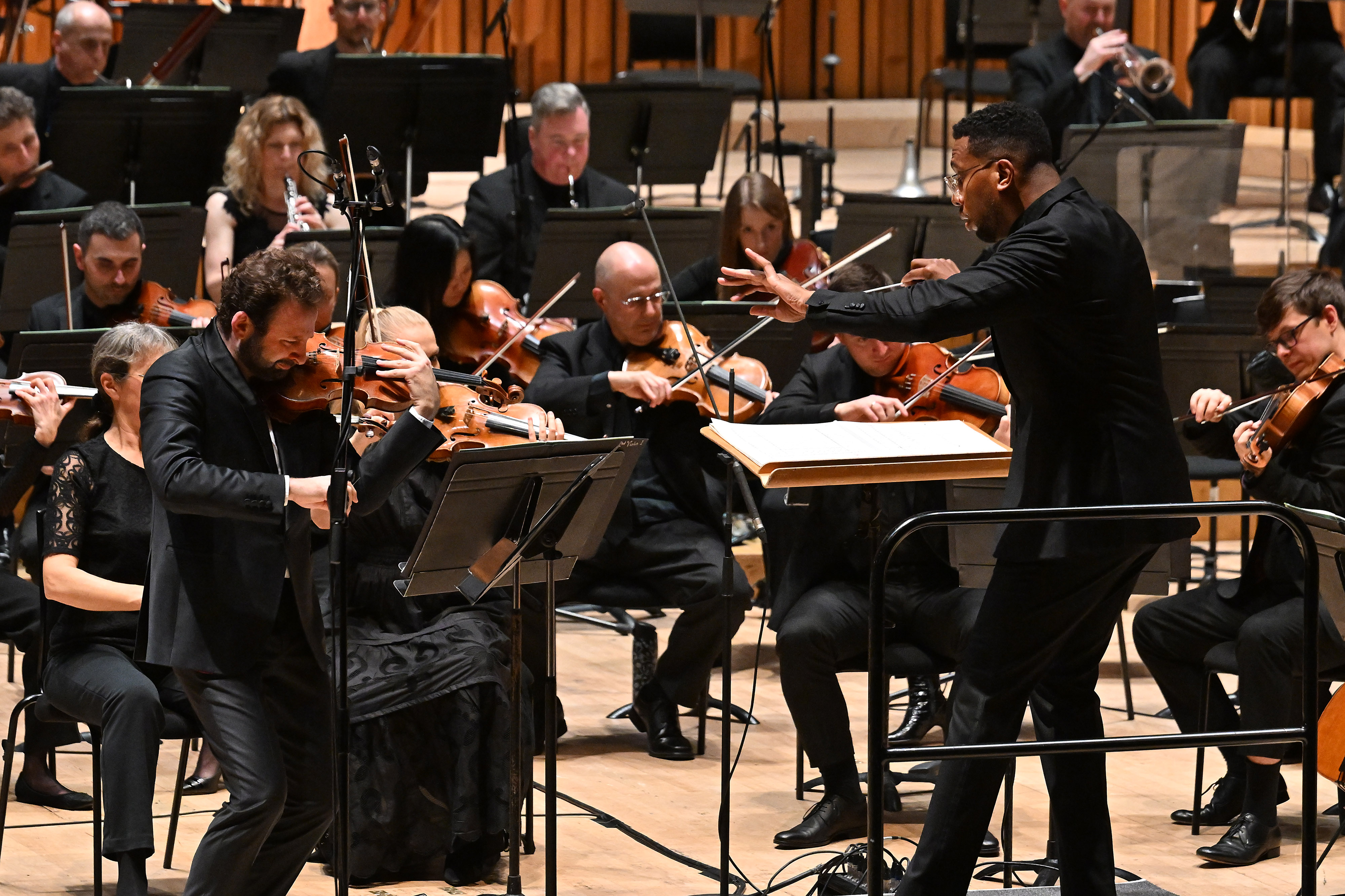
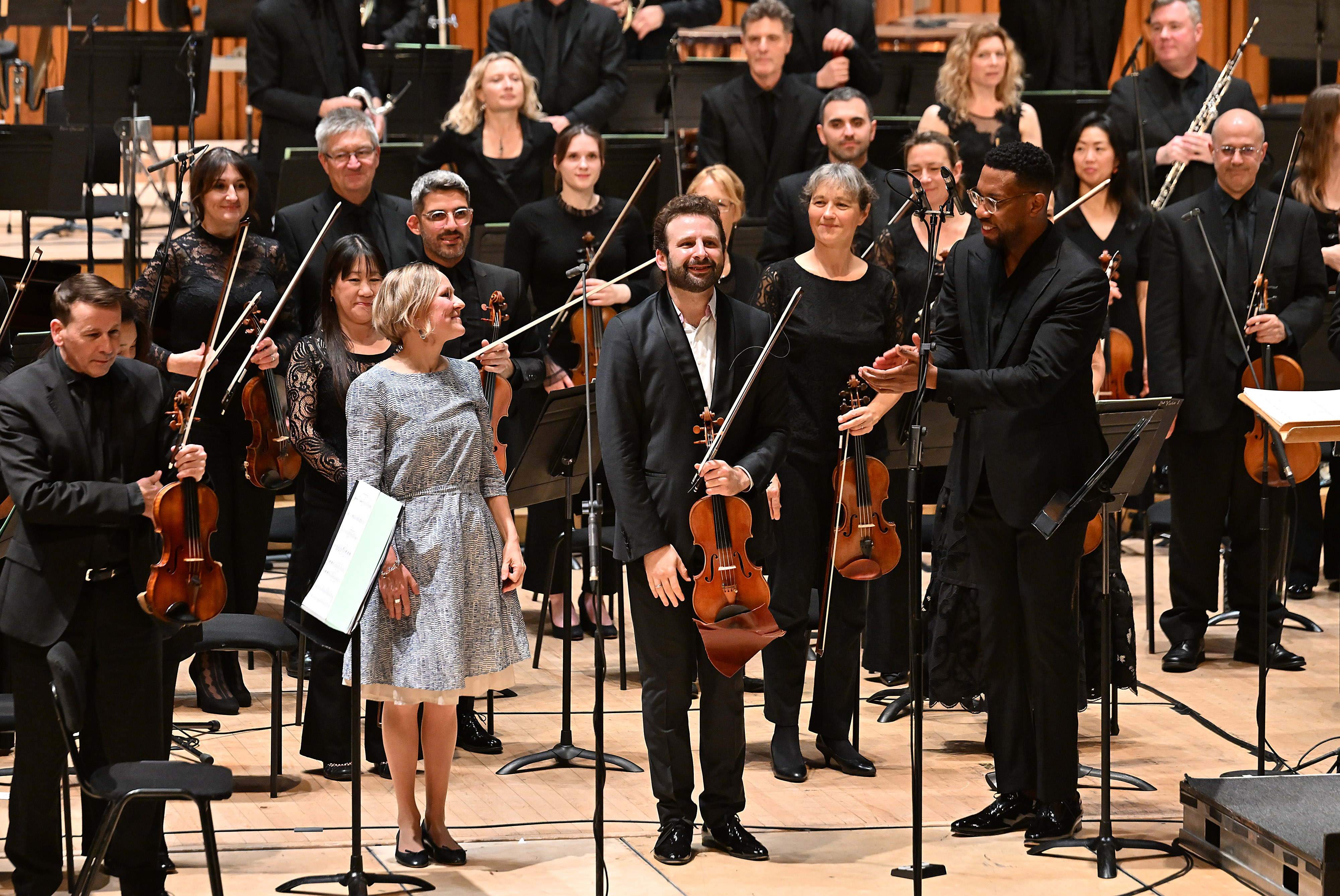
Ilya Gringolts (violin), BBC Symphony Orchestra / Roderick Cox

Debussy Prélude à l’après-midi d’un faune (1891-4)
Wennäkoski Prosoidia (BBC co-commission: world premiere)
Lyatoshinsky Grazhyna
Stravinsky The Firebird – suite (1919)

Barbican Hall, London
Friday 3 November 2023

Reviewed by Ben Hogwood. Pictures courtesy of BBC/Mark Allan

If the number of concertgoers whistling the Finale of Stravinsky’s Firebird down Silk Street to the tube was anything to go by, this typically creative BBC Symphony Orchestra program had made its mark.

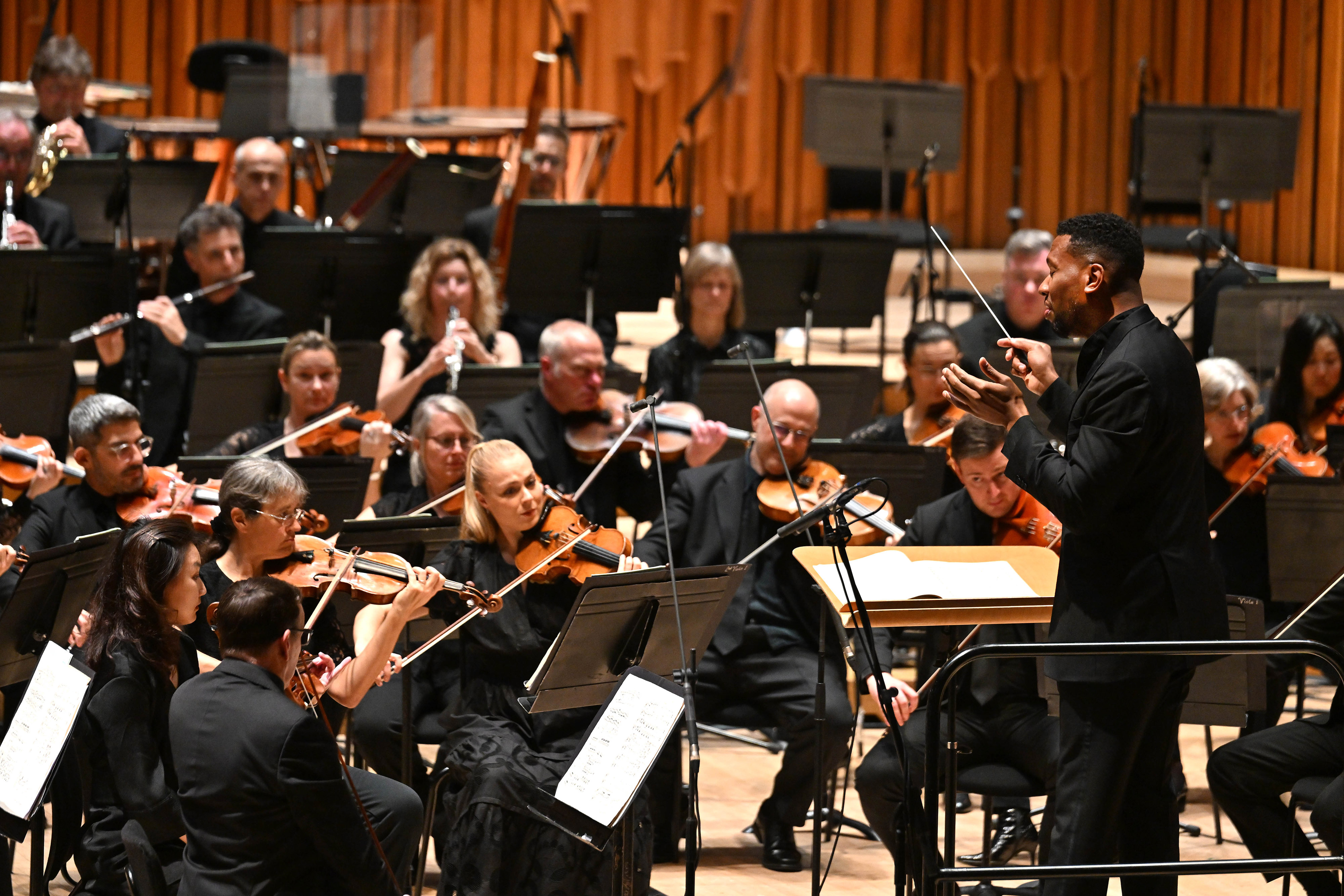
This was in spite of a late change of conductor, Roderick Cox replacing the indisposed Eva Ollikainen – yet the transition was seamless, Cox an alert and subtly commanding presence who clearly enjoyed making music with his new charges. All those qualities were evident in a hazy, sensuous account of Debussy’s Prélude à l’après-midi d’un faune, the temperature raised in spite of the autumnal weather outside. This is, as Paul Griffiths observed in the booklet notes, where Debussy’s ‘music begins here afresh. So does modern music generally.’ Daniel Pailthorpe’s flute solo set the tone, the BBC Symphony Orchestra revelling in alluring wind melodies and hazy, soft-focus strings. The sense of the new – even 120 years after completion – was tangible throughout.

Lotta Wennäkoski’s Prosoidia was also new – still drying on the page in fact, as this was the world premiere of a co-commission from the BBC SO, Lahti SO and Norrlands Opera for violin and orchestra. Though not billed in the title as a violin concerto it assumed that function, though Ilya Gringolts (above) moved between his own solo statements and conversations as part of the orchestra. Throughout he showed impeccable technique and great expression. The orchestra’s role was headed by percussion and harp, with some exquisite shading especially in the quiet music. How refreshing to hear a composer confidently writing music that the audience strained to hear, the resultant effect all the more powerful for this restraint. Here Wennäkoski was reflecting linguistic instructions inspired by ‘prosody’ – the word referring to the musical properties of speech: rhythm, pitch, stress and pauses. Her focus gave the work a moving humanity, a concerto where wordless instrumental voices spoke with great intensity.

The second movement, Word Stress, had a primal savagery, the orchestral voices clamouring to be heard and on occasion drowning the violin. Here the influence of Bartók was palpable, Wennäkoski drawing perhaps on her studies in Budapest. A moving third movement followed, inspired by Ingmar Bergman’s film Cries and Whispers – and in particular a scene where the voices are replaced by the Sarabande from Bach’s Cello Suite no.5. Written in memory of the recently departed Kaija Saariaho, Wennäkoski’s teacher, it was an intimate discourse, recalling the equivalent passage in Berg’s Violin Concerto where the composer also quotes from Bach. Here the approach was less explicit but formed an engaging tableau, where the dynamic dimmed and textures became spare at the thoughtful close. A concerto with an appealing economy and frank musical language, Prosoidia deserves a regular place in the repertoire.

After the interval we heard music from Boris Lyatoshinsky, described in Martin Anderson’s composer profile as ‘the first explicitly Ukrainian composer of the modern age’. Grazhyna, a symphonic poem about a fictitious 15th century female Lithuanian chieftain, cast its eyes back to Liszt and Saint-Saëns in its orchestral narrative, but the modern harmonic language of 1955 spoke more of Myaskovsky and Shostakovich’s music for the stage, not to mention the lasting influence of Lyatoshinsky’s teacher Glière. Roderick Cox presided over a convincing interpretation, impressively grasping the piece in spite of what was surely limited preparation. From the brooding violas portraying the River Neman, we heard a plangent cor anglais lament from Max Spiers, then a high voltage tutti as the battle scene raged. Though short on distinctive melodies, Grazhyna was dramatic to the last as the river music returned, capping an atmospheric and compelling account.

This was also the case for Stravinsky’s 1919 suite from The Firebird, fashioned by the composer into a crowd-pleasing five movements, and creeping in stealthily on the lowest strings. This was an assured interpretation, Cox cajoling the well-drilled BBC SO through a thrilling Infernal Dance, having enjoyed the vivid colours of The Princesses’ Round Dance. The bassoon of Andrea de Flammineis excelled in the Berceuse, where Stravinsky’s ‘sweet and sour’ melodies were in evidence, before the bold as brass Finale that sent the audience home whistling. This was an impressive concert all round, showing the strength in depth the BBC Symphony Orchestra possess these days. Their ensemble, a winning combination of experience and raw talent, is enjoying a purple patch.

You can listen to this concert on BBC Sounds – and read all about the 2023/24 season and book tickets at the BBC Symphony Orchestra website. Click on the artist names for more on violinist Ilya Gringolts and conductor Roderick Cox, and for more on composer Lotta Wennäkoski

Published post no.1,999 – Saturday 4 November 2023

In concert – Carolin Widmann, CBSO / Nicholas Carter: Haydn, Ligeti & Brahms

Carolin Widmann (violin, below), City of Birmingham Symphony Orchestra / Nicholas Carter

Haydn Symphony no.96 in D major Hob.1/96 ‘Miracle’ (1791)
Ligeti Violin Concerto (1989-93)
Brahms Symphony no.3 in F major Op.90 (1883)

Symphony Hall, Birmingham
Wednesday 1 November 2023

Reviewed by Richard Whitehouse

Tonight’s concert by the City of Birmingham Symphony Orchestra saw a collaboration with the well-regarded Nicholas Carter – former chief conductor of the Adelaide Symphony, now holding that position with Bühnen Bern alongside guest appearances in Europe and the US.

Few conductors would nowadays begin a programme with a Haydn symphony, and Carter’s take on no.96 did not lack for conviction. The Miracle of a falling if harmless chandelier may have taken place at the premiere of no.102 but does not lessen the quality of this work, its slyly portentous Adagio introducing an Allegro whose motivic unity is most evident in a tensile development and agile coda. With felicitous writing for oboe (rendered so by Helena Mackie) and violin (a welcome ‘guest lead’ from Zoë Beyers), the Andante is the highlight – Carter making the most of antiphonal violins where the gains in clarity or incisiveness were never in doubt. Steady but with a lilting grace then a piquant trio, the Minuetto was a perfect foil to the final Vivace – its energetic interplay duly capped by a coda of uninhibited verve.

Good that the CBSO marked György Ligeti’s centenary with his Violin Concerto, combining the composer’s love of polyrhythms and varied tunings with a heady recall of his Hungarian heritage. No stranger to this piece, Carolin Widmann emphasized the teasing reticence of its Praeludium and found aching nostalgia in the folk inflections of its Aria-Hoquetus-Choral. The coruscating build-up of its Intermezzo and finely wrought intensity of its Passacaglia were well judged, Carter bringing out the strangeness of orchestral writing with its extremes of register and an array of unorthodox instruments. The final Appassionato was trenchantly done, and while Widmann’s overly matter-of-fact cadenza robbed the closing ensemble bars of their barbed humour, it proved a small blemish on this otherwise captivating performance.

BrahmsThird Symphony has done well by the CBSO in recent seasons, and Carter’s reading was no exception. Any hint of stolidity at the outset of the initial Allegro had gone during the exposition’s repeat, then the development accrued a momentum such as carried through to the end of this movement. The coda’s transfigured poise (Brahms’ riposte to Tristan?) was no less evident in the Andante, its melodic simplicity belying an emotional ambiguity as was implied by its ruminative asides before suddenly being made explicit during the confiding final pages.

The Poco allegretto was (rightly) taken not as an extra slow movement, rather an intermezzo of a pathos which was accentuated by its deft forward motion. The final Allegro then brought a culmination in all respects – Carter alive to its stark contrasts between the speculative and the combative, with a thrilling transition into the reprise then a coda that recalled the work’s defining motto with mingled aspiration and benediction on its way to an ending of perfectly judged repose. Never the easiest symphony to bring off, this was a Brahms Three to savour.

Carter will hopefully be working with this orchestra again soon. Next Wednesday’s concert brings Cristian Macelaru in a programme with Sibelius and Mendelssohn, while Thursday’s Centre Stage recital has a welcome revival of the Clarinet Quintet by Elizabeth Maconchy.

You can read all about the 2023/24 season and book tickets at the CBSO website. Click on the artist names for more information on violinist Carolin Widmann and conductor Nicholas Carter, and for more about composer György Ligeti

Published post no.1,998 – Friday 3 November 2023

In concert – Jenebah Kanneh-Mason, CBSO / Andrew Gourlay: Coleridge-Taylor, Rachmaninoff & Wagner

Jenebah Kanneh-Mason (piano), City of Birmingham Symphony Orchestra / Andrew Gourlay

Coleridge-Taylor Ballade in A minor Op.33 (1898)
Rachmaninoff Piano Concerto No. 2 in C minor, Op. 18 (1900-01)
Wagner arr. Gourlay Parsifal Suite (1877-82, arr. 2017-18)

Symphony Hall, Birmingham
Thursday 12 October 2023 (2.15pm)

Reviewed by Richard Whitehouse

A regular collaborator with the City of Birmingham Symphony Orchestra over recent seasons, Andrew Gourlay returned to Symphony Hall this afternoon for a varied programme of music from the late nineteenth-century and one where his input extended to more than conducting.

The resurgence of interest in Samuel Coleridge-Taylor’s music continues apace, his Ballade a success at the Three Choirs Festival and no less an effective concert-opener today. Gourlay drew a keen rhythmic impetus from its outer sections, while making the most of the surging melody that comes between before it returns to dominate the closing pages. What (if anything more specific) this piece might be about remains uncertain, but its undeniable impulsiveness of expression carries all before it, not least in so vibrant and committed a performance as this.

Rachmaninoff’s Second Piano Concerto has never been more ubiquitous than it is today, and it takes a performance of some distinction to experience it afresh. That was not the case here, even though Jeneba Kanneh-Mason certainly contributed pianism of a high order – elegance of touch combined with crystal-clear articulation as made those more understated passages a pleasure to behold. What it lacked was greater projection elsewhere – piano all but inaudible at the climax of the first movement, despite Gourlay reining in orchestral dynamics – or that sense of the work as a long-term, cumulative entity. Intimate and confiding, the Adagio was the undoubted highlight and though the scherzando sections of the finale lacked a degree of incisiveness, the ‘big tune’ was eloquently rendered when it returned as a fervent peroration.

Overall, if this was a performance not quite the sum of its best parts, it confirmed this latest addition to the Kanneh-Mason dynasty is shaping up as a pianist with whom to reckon – as was demonstrated by her capricious take on Rachmaninoff’s Prelude in A flat major Op.23/8.

Symphonic syntheses from Wagner’s music-dramas (latter-day equivalent of those ‘bleeding chunks’ beloved of an earlier generation) have enjoyed something of a vogue in recent years, though Gourlay’s Parsifal Suite feels both more modest and more successful in its ambitions.

Writing in the programme, the conductor explained his concern had been to draw this opera’s numerous orchestral passages into a continuous as well as a cohesive sequence, with no need for ‘outside’ linking material. This he achieved by reordering those seven sections in question such that one segued naturally into the next. Thus the Prelude to Act One – opulent but never portentous – was followed by the Good Friday Music from Act Three, its beguiling pathos a perfect foil for the anguished Transformation Music from Act Three then the desolate Prelude to Act Three; now finding its continuation in the volatile Prelude to Act Two, before dramatic and musical equilibrium is restored with the Transformation Music from Act One – its stately progress here making possible the Finale to Act Three with its serenely enveloping catharsis.

Certainly, anyone deterred by the formidable length and gravitas of the complete opera will find Gourlay’s suite conveys its essence – not least as rendered with such poise and insight by the CBSO, in excellent shape prior to touring Germany and Switzerland later this month.

You can read all about the 2023/24 season and book tickets at the CBSO website. Click on the artist names for more information on pianist Jeneba Kanneh-Mason and conductor Andrew Gourlay, and for more on composer Samuel Coleridge-Taylor. Andrew Gourlay’s recording of the Parsifal Suite is available through Orchid Classics, and can be listened to below:

Published post no.1,979 – Sunday 17 October 2023

In concert – Fazil Say, CBSO / Kazuki Yamada: Prokofiev, Saint-Saëns & Rachmaninoff

Fazil Say (piano), City of Birmingham Symphony Orchestra / Kazuki Yamada

Prokofiev Symphony no.1 in D major Op.25 ‘Classical’ (1916-17)
Saint-Saëns Piano Concerto no.2 in G minor Op.22 (1868)
Rachmaninoff Symphonic Dances Op.45 (1940)

Symphony Hall, Birmingham
Wednesday 4 October 2023

Reviewed by Richard Whitehouse. Picture (c) Fethi Karaduman

French and Russian music has dominated the start of this season by the City of Birmingham Symphony Orchestra, this afternoon’s programme continuing the trend with early pieces by Prokofiev and Saint-Saëns heard alongside Rachmaninoff’s last and arguably greatest orchestral work.

Prokofiev consigned two earlier such pieces as juvenilia prior to his Classical Symphony, an infectious refit of Haydn in the early 20th century and calling-card for a career that beckoned in the West. If Kazuki Yamada slightly over-egged the humour in the opening Allegro, as too a rather self-conscious take on the Gavotte, the limpid phrasing of the intervening Larghetto was as disarming as was the interplay of wind and strings in the Finale – a reminder, here as throughout, that such musical directness should not be mistaken for mere technical facility.

This could be said of the Second Piano Concerto that Saint-Saëns unleashed on an evidently nonplussed Parisian audience half-a-century earlier. True, the conflation of Bach – given a makeover worthy of Alexander Siloti – with Liszt affords the opening movement an almost makeshift design, but Fazil Say took it firmly in hand from a surging ‘chorale-prelude’ to a tersely decisive coda. A pity his pianism was not applied a little more deftly in the ensuing intermezzo, its ingratiating poise smothered by an almost hectoring insistence, but the final Presto suited this most demonstrative of present-day virtuosi to a tee – its perpetuum mobile undertow maintained with unflagging resolve through to those almost brutal closing chords. Credit to Yamada for enhancing the total effect with his astute and precise accompaniment.

Say, as much composer as pianist, responded to the applause with his Black Earth – a study in sonority alluding to the golden-age of Turkish balladry as well as the Saz (a Turkish lute) in a mood of sombre fatalism which, unlike his orchestral epics, did not outstay its welcome.

The CBSO has given frequent performances over the decades of Rachmaninoff’s Symphonic Dances, but none so incendiary. Not that there was anything overly powerhouse in Yamada’s conception of an initial piece whose outer sections felt trenchant in their energy, with the alto saxophone melody at its centre eloquently given by Kyle Horch and the coda rendered with melting grace. Nor was any lack of suavity in the central piece, its underlying waltz motion poised on a knife-edge of sardonic humour rightly given its head in the hectic closing pages.

Yamada had the measure, too, of the last piece with its dramatic introduction and impulsive continuation, but it was in the lengthy central episode this reading really came into its own – the composer creating music of an intoxicating expression via subtleties of harmonic nuance or textural shading rather than any defining melodic line. From here, impetus was seamlessly restored to a climactic emergence of the Dies irae plainchant then surged on to the explosive closing gesture that might have resounded longer had the audience not unreasonably erupted.

Yamada responded with Lezginka from Khachaturian’s ballet Gayane. An exhilarating close to an afternoon as began for early arrivals with what sounded like a medley from a mid-1970s children’s TV show on the first-floor performance space: it could only be here in Birmingham.

You can read all about the 2023/24 season and book tickets at the CBSO website. Click on the artist names for more information on pianist Fazil Say and conductor Kazuki Yamada