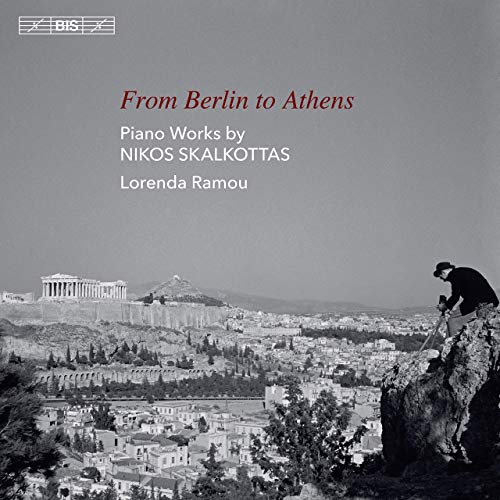
On record – Lorenda Ramou – From Berlin to Athens: Skalkottas Piano Works (BIS)

Skalkottas
Griechische Suite A/K79a (1924)
(Suite) A/K79b (1924)
Sonatina A/K75b (1927)
15 kleine Variationen A/K75c (1927)
Suites – no.2 A/K72 (1940); no.3 A/K73 (1941); no.4 A/K74 (1941)
The Gnomes A/K110 (1939)

Lorenda Ramou (piano)

BISBIS 2364SACD [87’43’’]

Producer & Engineer Christian Starke

Recorded October and November 2017 at Reitstadel, Neumarkt in der Oberpfalz

Written by Richard Whitehouse

What’s the story?

Between 1998 and 2008 BIS undertook a ground-breaking series devoted to Nikos Skalkottas (1904-1949), and this new release features almost all the music for solo piano that was still to be collated. The result is a fascinating journey through one facet of this fascinating composer.

What’s the music like?

As Lorenda Ramou indicates, this recital divides into three parts.

The first of these comprises music written in Berlin during Skalkottas’s study there, including the composer’s two earliest surviving works. Greek Suite is a quirkily appealing amalgam of neo-classical and traditional stylisms with distinct jazz overtones in its closing movement. The ‘Suite’ (its title can only be conjectured as the first two pages of music are missing) develops these influences on a larger scale, not least the scintillating Shimmy tempo finale. Come the Sonatina and Skalkottas’s language has evolved apace – hence the expressively detached Siciliano, then restive finale with its ominous coda; an upbeat to the masterly 15 Little Variations on a Beethoven-inspired theme that finds a natural climax in its laconic recollection following a subdued apotheosis.

The next three pieces were all written in Athens during Skalkottas’s ‘inner exile’ after being repatriated. Ramou’s implication that the Second, Third and Fourth Suites (the earlier First Suite was recorded by Nikolaos Samaltanos on BIS1133/4) form an extended sequence that fuses this composer’s preoccupation with ‘classical’ and popular’ formal archetypes in his mature post-tonal language. Highlights include the angular virtuosity of no.2’s Rapsodie, the inexorable motion of no.3’s Marcia funebre, and the oblique wistfulness of no.4’s Serenade. Performable (also listenable to) separately or as a 30-minute continuum, these confirm Skalkottas’s mastery of a medium about which he often felt equivocal yet to which he contributed some of the most thought-provoking music from the mid-twentieth century.

Also written in Athens, The Gnomes was intended to accompany a Christmas dance-show but rhythmic difficulty led Skalkottas to orchestrate a selection of miniatures by other composers under an identical title (recorded by the Caput Ensemble on BIS1364). Relocated in 2015, the present piece unfolds in two parts of six and three items – the former as tensile and impulsive as the latter – notably an Intermezzo (Chorale) – are hieratic and evocative. What the scenario depicted is unclear, though the presence of a Greek carol rather suggests something seasonal.

Does it all work?

To varying degrees according to when the music was written. The Variations and three Suites can rank with the finest Skalkottas compositions, while the early pieces and The Gnomes are fascinating subsidiary items. Nothing here should be without interest for discerning pianists.

Is it recommended?

Indeed. Ramou is a perceptive guide throughout, even if certain of the more extrovert pieces could evince greater panache. Among the previously recorded works, those from Samaltanos (BIS) of the Sonatina and Variations are coupled with the 16 Melodies, with those by Steffen Schleiermacher (MDG) and Lefki Katanou-Lindahl (Caprice) of Third and Fourth Suites part of miscellaneous recitals. At nearly 88 minutes, this is among the longest discs yet issued, but the range and depth of the SACD sound is wholly commensurate with BIS’s usual standards.

Stream

Buy

For more information on this release and to purchase in multiple formats visit the BIS website

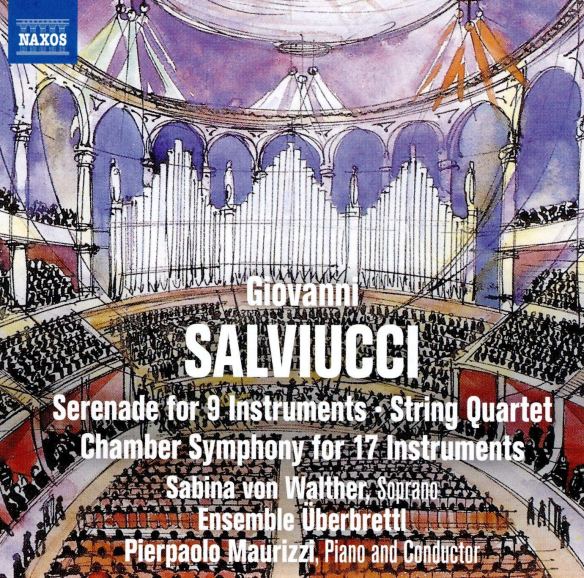
On record – Salviucci: Serenade, Chamber Symphony & String Quartet (Naxos)

Salviucci
Cinque Pezzi (1930)*
Pensiero nostalgico (1931)*
String Quartet in C major (1932)*
Salmo di David (1933)*/***
Sinfonia da camera (1933)**
Serenata (1937)**

***Sabina von Walther (soprano); Ensemble Überbrettl / Pierpaolo Maurizzi (piano)
***Latin text and English/Italian translation.

Naxos 8.574049 [83’05”]

Producer Giovanna Salviucci Marini
Engineer Tommaso Tacchi

Recorded *23-25 July 2017 at Sala dei Concerti di Palazzo Chigi Saracini, Sienna and **4-7 October 2018 at Teatro degli Atti, Rimini

Written by Richard Whitehouse

What’s the story?

Naxos continues its inestimable series devoted to Italian music of the twentieth century with this disc of mainly first recordings by Giovanni Salviucci (1907-1937) – a largely forgotten composer, whom his contemporary Goffredo Petrassi once referred to as ‘‘the best of us all’.

What’s the music like?

Although his composing career lasted barely a decade, Salviucci left several notable works across most major genres. Of those pieces included here, earliest is the Five Pieces for violin and piano – appealing if expressively unvaried music, from which only the lively Alla Festa hints at his later rhythmic ingenuity. Each of them, though, would make an attractive encore; as too would Nostalgic Thought for cello and piano, or Psalm of David for soprano and piano – verse from Psalm 61 with its roots in a modality also drawing on French and Italian sources.

Just before this latter piece, Salviucci achieved something of a breakthrough with his String Quartet. The fast-slow-fast trajectory may yield no obvious surprises, but beneath the intently contrapuntal surface of its outer movements is a quixotic handling of tonality that offsets any risk of predictability. The highlight (in every sense) is the slow movement, an Adagio whose suffused eloquence and finely wrought rhetoric transcend Salviucci’s earlier music. That the piece is unpublished is something this excellent recording should go some way to remedying.

The other two pieces have previously been recorded, which hardly makes them familiar. Its scoring for 17 instruments suggests that the Chamber Symphony may have been conceived with knowledge of Schoenberg’s eponymous work, even though Salviucci’s approach to the balance between wind and strings is less combative and more pragmatic. Outer movements combine rhythmic incisiveness with a harmonic lambency redolent of Vaughan Williams, while the heartfelt Adagio and piquant scherzo confirm an ongoing process of maturation.

A process culminating in the Serenade that was Salviucci’s last completed work. Scored for nine instruments, its textural clarity and harmonic astringency suggest increasing familiarity with the composer’s inter-war contemporaries (Italian and otherwise), and if the lively outer movements are almost too succinct for their motivic ingenuity fully to register, the Canzona elides between soloistic and ensemble writing with deft mastery. The Venice premiere, four days after Salviucci’s death, must surely have rendered the loss of such potential more acute.

Does it all work?

For the most part. Salviucci’s earlier music may be notable more for fluency of technique, but the composer’s idiom evolved apace over his few remaining years, so that one is left only too aware of what he might have gone on to achieve in the very different cultural climate of post-war Italy.

The performances by the excellent Ensemble Überbrettl leave little to chance, with Pierpaolo Maurizzi as astute in direction as he is a pianist. Sound is just a little confined in the chamber works, while Giordano Montecchi’s notes provide a valuable biographical overview.

Is it recommended?

Indeed. Salviucci was already a composer to reckon with, and this generous selection makes an ideal introduction to his music. Hopefully Naxos will now turn to the handful of orchestral works that he completed: in the meantime, the present release should be acquired forthwith.

Stream

Buy

For more information on this release and to purchase in multiple formats visit the Naxos website

On record – Jürgen Bruns conducts Hanns Eisler’s Leipzig Symphony (Capriccio)

Eisler
Leipziger Sinfonie (1959-62: compl. 1998 Medek)*
Trauerstücke aus Filmpartituren (1961/2: arr. 2015 Bruns/Fasshauer)*
Nuit et brouillard (1955: original film score)**

*MDR Sinfonieorchester Leipzig, **Kammersymphonie Berlin / Jürgen Bruns

Capriccio C5368 [63’22”]

Producers *Stefan Antonin, **Gideon Boss
Engineers *Martin Staffe and Robert Baldowski, **Stefan Haberfeld and Regine Kraus

Recorded **9 November 2015 at Konzerthaus, Berlin; *15-16 August 2018 at MDR Studios, Leipzig

Written by Richard Whitehouse

What’s the story?

An important disc of orchestral works from Hanns Eisler (1898-1962), each a first recording and confirming the continued distinctiveness of his music over his final years in (then) East Berlin, when more ambitious plans were constantly thwarted by the East German authorities.

What’s the music like?

Eisler essayed symphonic pieces across his output, notably the Deutsche Sinfonie that is his largest concert work.

The Leipzig Symphony was commissioned by that city’s Gewandhaus orchestra but, at the time of Eisler’s death, consisted of a folio of sketches and memos given definition by Tilo Medek (1940-2006) to commemorate the composer’s centenary. Drawing mainly on film scores (as Eisler had done in his six orchestral suites), these four movements make for a quirky yet compelling entity: unfolding from the pungent contrasts of the initial Prelude and Idyll, via a restive slow movement then a sardonic scherzo both entitled Con moto, to a closing March without Words whose bracing impetus is typical of Eisler at all stages of his career. Some aspects – notably a percussive onslaught at the end of the second movement – are likely interventions by Medek (briefly a pupil of Eisler), though overall the expressive content and formal follow-through have an authentic quality such as makes this piece a necessary addition to the Eisler catalogue and one that warrants repeated exposure.

The other two works are both film scores. In the instance of Funeral Pieces of Motion Picture Scores, its nine miniatures were extracted by Jürgen Bruns and Tobias Fasshauer from music for two films about the Holocaust. The moods may be consistently subdued, but the motivic repetition Eisler threaded ingeniously through these scores has enabled a cohesive sequence whose end returns deftly or without contrivance to its beginning. Given that both films were forgotten soon after being made, this arrangement constitutes a worthwhile act of restitution.

Night and Fog presents a rather different proposition. This half-hour piece is in fact the entire score to a documentary about Auschwitz shot (partly on location) by Alain Renais and whose acclaim facilitated his subsequent film career. This is now available on DVD and mandatory viewing, yet Eisler’s contribution is entirely viable on its own terms. Its 13 numbers (lasting between 30 seconds and five minutes) again opt for understatement.

Peter Deeg’s insightful booklet note indicates how the studio musicians seemed nonplussed by Eisler’s insistence on emotional restraint, but the resulting music is its own justification; whether in more ominous episodes (not least one entitled Herr Himmler), or the final movement that encapsulates its subject in a threnody of Mahlerian anguish. Never was Eisler’s ‘commitment’ more explicit.

Does it all work?

Absolutely. It helps that the playing of both MDR Symphony and Berlin Chamber Symphony orchestras feels unerringly attuned to the angularity yet also plangency of Eisler’s expressive ambit, ably guided by the versatile Jürgen Bruns so all three pieces leave a lasting impression.

Is it recommended?

Indeed. To get the measure of Eisler, the collection of (mainly) Berlin Classics recordings – now available on Brilliant Classics – is an essential purchase, but the present disc is a vital supplement and a further significant release from the always enterprising Capriccio label.

Stream

Buy

For more information on this release and to purchase in multiple formats visit the Capriccio website

In concert – Christian Tetzlaff, Philharmonia Orchestra / Esa-Pekka Salonen: Weimar Berlin – Angels and Demons

Christian Tetzlaff, Philharmonia Orchestra / Esa-Pekka Salonen (above)

Royal Festival Hall, Southbank Centre, London
Thursday 26 September 2019

Hindemith Rag Time (well-tempered) (1921)
J.S. Bach arr. Schoenberg Two Chorale Preludes: Schmücke dich, o liebe Seele BWV654; Komm, Gott Schöpfer, heiliger Geist BWV667 (1925)
Berg Violin Concerto (1935)
Hindemith Mathis der Maler Symphony (1934)

reviewed by Ben Hogwood

This year the Philharmonia Orchestra have been exploring the music of Weimar Berlin as it was in the 1920s and 1930s, with fascinating results. Their most recent concert, subtitled Dreams and Demons, may have been relatively short, but it gave plenty of food for thought and the musical rewards were considerable.

A rather older composer who worked in Weimar made himself known throughout the concert, for the music of Johann Sebastian Bach was quoted, refracted and alluded to in each of the four pieces on the programme. Firstly we heard the opening notes of the Prelude in C minor from The Well-Tempered Clavier, part of an affectionate and brilliantly ‘worded’ joke by Hindemith, whose Ragtime started the concert with a swagger. Esa-Pekka Salonen clearly enjoyed its gruff humour, but found the touches of elegance beneath the surface too.

The Ragtime’s surge to the close in E flat minor blossomed with a cleverly executed join into the first of two Bach chorale prelude arrangements by Schoenberg. Here we wondered at his audacious orchestration, taking on what he saw as ‘the first twelve tone music’ and sharing it around the orchestra with typically inventive pointing towards the melodies. Timothy Walden’s cello probed elegantly at the inner melodic lines of Schmücke dich, o liebe Seele, while the exuberant close of Komm, Gott Schöpfer, heiliger Geistdrew heralded the Hindemith work we were about to hear.

Berg’s Violin Concerto quotes from a Bach chorale, Es ist genug (It is enough) at the height of its remembrance of Manon Gropius, daughter of Alma Mahler. Subtitled To the Memory of An Angel, the work traverses a wide range of emotions in its thought processes, from brief oases of calm to fraught periods of activity. The clarinets of the Philharmonia, in all ranges, were superb, whether in the lighter Ländler theme of the first movement or the solemn chorale itself, their imitation of a pipe organ ghostly and – when the solo violinist’s harmonics were in play – ethereal. This was because soloist Christian Tetzlaff (above) also brought a wide range of sounds to the piece, from the fragility of the opening strings of the start to the surging faster music where he took the music by the scruff of the neck. His was a technically brilliant yet musically sensitive performance, closely joined to Salonen’s deft work with the orchestra.

All the while this wonderful piece was heading for the final bars and the ultimate rest, the sort of chord you would want to go on forever as Berg’s orchestral colours mingle with the highest note the violin reaches in the whole piece. Together Teztlaff and Salonen ensured the pacing was ideal, helped considerably by the light and shade of the Philharmonia’s contribution.

After the interval came a regrettably rare chance to hear some Hindemith in the concert hall in the shape of the Mathis der Maler Symphony, a three-movement work drawn from the opera of the same name. This oft-maligned composer exerts a good deal of influence on the tonal music of the second half of the 20th century, more than he is credited for, and his own works are instantly recognisable. Nor, as Salonen and the Philharmonia illustrated, is there a lack of colour or personality in his orchestral writing.

This was a superb performance of a piece Salonen clearly holds close to his heart, having conducted it at the Proms and recorded it for Sony in 2004. The expectant hush from the strings at the start was magical, the effect like walking into a sacred building, and this was reinforced by a solemn intonation of a chorale from the trombones, those Bach influences coming quickly to the surface. Salonen’s slower tempo here worked well.

The silvery strings enjoyed the moments of confluence in Hindemith’s writing, with the added note chords allowed to breathe, but Salonen was not above letting the grittier parts of the music off the leash, pushing forward through the faster phrases. The Philharmonia woodwind and brass were superb, the bell-like clarity of their playing bolstered by deeper shades. With all these qualities noted, Engelkonzert (Angelic Concert) unfolded beautifully, with a grand sense of ceremony at the end, while in response Grablegung (Entombment) was initially thoughtful, its ruminative woodwind then replaced by a brass-dominated climax which Salonen controlled immaculately.

Most dramatic of all was Versuchung des heiligen Antonius (The Temptation of Saint Anthony), with a ravishing tone from the Philharmonia strings at the outset. As it progressed the movement had a terrific cut and thrust, its tension released with impressive stature in the closing pages. Mathis der Maler is a wonderful score, one of Hindemith’s finest achievements – and by no means the only peak of his orchestral output. Here it put the seal on a fascinating and immensely rewarding concert, with superb musicianship throughout.

Further listening

You can hear the music played in this concert on the Spotify playlist below, including Salonen’s account of the Mathis der Maler symphony:

This playlist offers a broader view of Hindemith’s orchestral output, with the ballet suite Nobilissima Visione, the Concert Music for Strings and Brass and the vastly underrated piece for piano and orchestra The Four Temperaments:

Enescu Festival 2019 – Peter Donohoe, Muntenia Philharmonic Orchestra Daniel Jinga: Bentoiu, Lipatti & Enescu Symphony no.5

Andrei Lazăr (tenor), Peter Donohoe (piano), Acoustic Chorus (women’s voices), Muntenia Philharmonic Orchestra / Daniel Jinga (above)

Trade Unions’ Cultural Centre, Târgoviște, Romania
Friday 13 September

Bentoiu Suite ‘Ardelenească’, Op.6 (1955)
Lipatti Concertino ‘en style classique’ Op.3 (1936)
Enescu (compl. Bentoiu) Symphony no.5 in D major (1941)

Review by Richard Whitehouse
Photo credit (Peter Donohoe) Sussie Ahlburg

A welcome facet of the Enescu Festival, the Concerts in Other Cities schedule could easily be overlooked owing to distances involved in this sizable country. That said, a day in Târgoviște is eminently feasible. Just 50 miles and a 90-minute train journey from Bucharest, it features several historic buildings (notably the Chindia Tower) that can be visited prior to an evening concert – on this occasion, by the Muntenia Philharmonic Orchestra with principal conductor Daniel Jinga. A quick online perusal suggests the majority of their concerts are of a popular or ‘crossover’ nature, making their playing in this programme of unfamiliar and technically demanding compositions the more impressive – not least in as unsparing an acoustic as the main hall of Trade Unions’ Cultural Centre (a scaled-down version of London’s Barbican).

It may be a relatively early work, but the Transylvanian Suite finds Pascal Bentoiu utilizing folk elements within the context of an already distinctive idiom. Each of its four movements draws on music from a region of Transylvania, and Jinga secured a lively but always flexible response from his musicians for a piece in the lineage of Bartók’s Dance Suite or Enescu’s Romanian Rhapsodies. Surely the most significant post-war Romanian symphonist, Bentoiu had from the start an innate command of the orchestra as was scintillatingly in evidence here.

Peter Donohoe (above) then took the stage for Dinu Lipatti’s Concertino in the Classical Style. Most of Lipatti’s larger-scale pieces are from the period before his playing career took precedence, with this Concertino typical in its synthesis of folk melodies with a neo-classical idiom closer to Hindemith or Ravel than Stravinsky. Modest in their dimensions these may be, Donohoe rendered its four movements with deft insouciance and poise, as heard to advantage against the modest instrumentation which abounds in contrapuntal ingenuity and harmonic finesse.

Impressed with the response of the players as of a near-capacity audience, Donohoe returned for substantial encores of Mozart’s Sonata in A minor then Ravel’s Alborada del grazioso – both of which feature in Lipatti’s select discography and given here with engaging vitality.

The second half brought a rare hearing for Enescu’s Fifth Symphony. Substantially drafted over summer 1941 but left in abeyance with its first movement largely orchestrated, it was Bentoiu who undertook a full realization during 1995-6 of what he considered the composer’s requiem for himself.

The first movement centres upon that endlessly evolving melody which was made possible by Enescu’s conception of heterophonic texture – the music afforded its momentum via acutely differentiated timbral layers that coalesce into an unlikely but audible sonata design. Its successor recalls the folk-inflected poignancy of the Suite Villageoise, now with a fatalistic undertow that comes to the fore in the ensuing Vivace which brings the only rapid music of the whole work. Essentially an adjunct to the finale, this culminates with the finale’s gaunt opening theme – the latter movement then unfolding as a funeral march whose valediction is transcended in the setting of Mihai Eminescu’s poem Mai am un singur dor -emerging not as a contrives apotheosis but an organic culmination of all that has gone before.

A combination of the dry ambience with acoustic enhancement meant that Andrei Lazăr was balanced too forwardly against the orchestra, yet he sang with great eloquence (not least his unaffected parlando in the closing lines) – the women’s voices of the Acoustic Chorus adding an ethereal halo to those closing stages. Jinga instilled real forward motion into the opening movement, then brought out the wistfulness and anguish of its two successors. Whether here or in the radiant aura of the finale, his instinctive feel for this piece could hardly be gainsaid.

Make no mistake, this was an enterprising programme in which the Muntenia players was on occasion hard-pressed but rose to its challenges with commitment and enthusiasm. Hopefully orchestra and conductor will secure themselves a concert in Bucharest at the 2021 edition of the Enescu Festival, yet anyone visiting the capital two years hence should certainly consider spending a day in Târgoviște – a compact and appealing city, while hardly an inappropriate place for a first live encounter with the last as well as most elusive of Enescu’s symphonies.

Further listening

You can listen to Pascal Bentoiu’s completion of Enescu’s Symphony no.5 in a CPO recording released in 2014. Marius Vlad is the tenor soloist, with the NDR Chor and Deutsche Radio Philharmonie Saarbrücken-Kaiserslautern conducted by Marius Vlad: