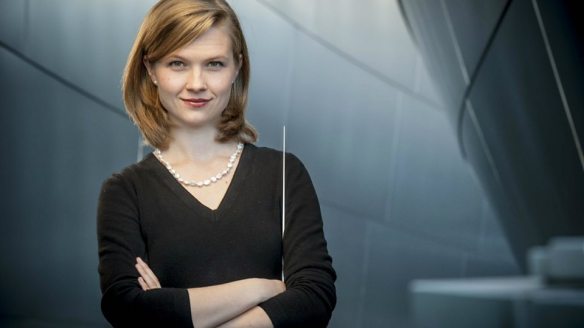
Enescu Festival 2019 – Michael Barenboim, Francesco Tristano, Sibiu Philharmonic Orchestra / Cristian Lupeş: Dediu, Basica, Widmann & Tristano

Michael Barenboim (violin), Francesco Tristano (piano), Sibiu Philharmonic Orchestra / Cristian Lupeş (above)

Radio Hall, Bucharest
Sunday 15th September 2019 (1pm)

Dediu Elegia minacciosa, Op.161 (2017)
Tristano Island Nation (2016)
Widmann Violin Concerto no.1 (2007)
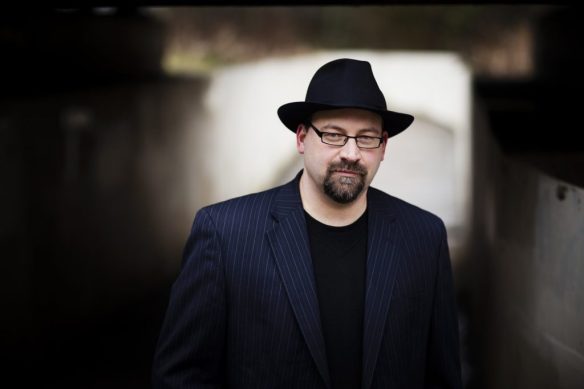
Basica Concerto for Conductor and Orchestra (2019) [World premiere]

Review by Richard Whitehouse

Cristian Lupeş has enjoyed a long association with the Enescu Festival as both conductor and administrator, and now combines these roles in his activity with the Sibiu Philharmonic. This afternoon saw him directing the orchestra for a wide-ranging programme, given as part of the festival’s ‘Music of the 21st Century’ series, which demonstrated Lupeş’ ability to secure a committed response in music that makes few concessions either technically or interpretatively. The outcome was a programme which fascinated, provoked and frustrated to an equal extent.

Provocation was the watchword in Elegia minacciosa by Dan Dediu (b1967), the most prominent Romanian composer of his generation. Emerging almost imperceptibly, this short if eventful piece assumes an increasingly ominous demeanour – not least through allusions to Satie from solo piano (hence the subtitle con Gnossienne-Mandala), then the explosive interjections of bass drum heard from behind the auditorium. A piece whose poly-stylistic connotations could easily result in fragmentation and diffuseness here sustained powerful cumulative momentum through to its atmospheric yet unresolved conclusion. Lupeş evidently had the measure of this ‘threatening elegy’ as he secured playing of verve and commitment from his forces, leaving this listener keen to experience the piece again – albeit in an appreciably different context.

Not that hearing Island Nation was time wasted, though this concerto by Francesco Tristano (b1981) impressed more in the freely extemporised nature of its solo part and the composer’s magnetic realization of this than for intrinsic musical content. Most involving was its central movement The Islanders, with what sounded like an amplified metronome pulse providing the basis for an accumulation of orchestral activity – capped by piano playing channelled into a cadenza both pensive and, in its Parsifal allusion, equivocal. Otherwise, the energetic outer movements offered energy aplenty in their manufactured post-minimalist idiom, the orchestra matching the soloist (a distinctive exponent of Bach as of numerous 20th century composers) in immediacy of response. Great for first impressions, though not much of actual substance.

By comparison, what is now the First Violin Concerto by Jörg Widmann (b1973) is audibly within a lineage of mid-20th century European modernism – specifically that of Berg, whose own concerto proves a touchstone in many respects. Indeed, it seemed at times as though this latter work’s opening Andante had been extended into a whole work – such was the inward and self-communing nature of Widmann’s own piece, with its virtually continuous solo part heard against orchestral writing of exquisite textural nuance yet little rhythmic or expressive variety. The former had a formidable exponent in Michael Barenboim, playing with audible finesse and a frequently mesmeric concentration such as provided the ‘thread’ around which the orchestra wove a hardly less committed response – with Lupeş assured in his direction.

What to make of Concerto for Conductor and Orchestra by Constantin Basica (b1985)? This evidently arose from its composer’s investigating the interface of neurology and technology at Stanford University (and which interested readers can peruse at length on the composer’s website). The work, though, gave all the appearance of a spoof with its presentation of a lengthy film where composer and scientist discussed their researches, during which the orchestra was presided over by Lupeş – clad in an eco-friendly ‘Tarn-helm’ as his physical gestures were apparently transmuted into the real-time musical responses from his players. Trouble was, the sonic element was no more than a generalized backdrop that culminated rather too predictably with a brief burst of audience participation.

Whatever else, this was an entertaining way to round-off a demanding programme to which the audience responded with enthusiasm. Quite what it said about Basica’s music is another matter, but the composer played a central role in both performance and film while enacting the ‘mad scientist’ accordingly. Lupeş directed proceedings with aplomb: he clearly has an effective rapport with the Sibiu orchestra, and one looks forward to their appearance at this festival in 2021 – hopefully in an equally diverse though musically more consistent concert.

Further listening

You can hear more of the music of Jörg Widmann, including the Violin Concerto no.1, in first class performances on the disc below:

Meanwhile Francesco Tristano‘s most recent album Tokyo Stories can be heard here:

Live review – Lucy Crowe, Karen Cargill, CBSO / Mirga Gražinytė-Tyla: Mahler Symphony no.2

Lucy Crowe (soprano), Karen Cargill (mezzo-soprano), CBSO Chorus,
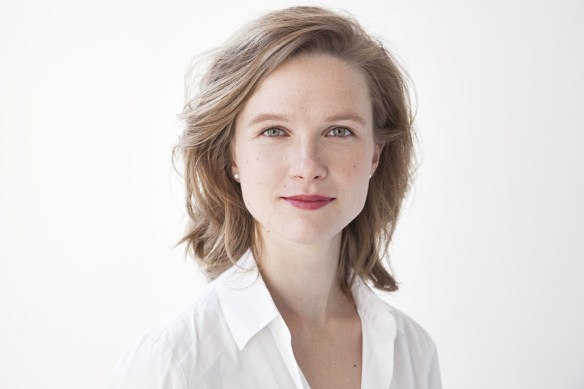
City of Birmingham Symphony OrchestraMirga Gražinytė-Tyla (above)

Symphony Hall, Birmingham
Thursday 13 June 2019

Mahler
Symphony No. 2 in C minor, ‘Resurrection’ (1888-95)

Written by Richard Whitehouse

Almost 46 years since this orchestra first played it, then 39 years since Sir Simon Rattle made it his mission-statement, Mahler’s Resurrection is one of those pieces which constitutes a ‘rite of passage’ for conductors at the helm of the City of Birmingham Symphony. Tonight it was the turn of Mirga Gražinytė-Tyla – who, coming towards the end of her third season as music director of this orchestra, presided over a reading which assuredly had the measure of a work that, over recent decades, has too often felt in danger of becoming a classy lifestyle accessory.

If there was anything at all lacking (aside from a handful of imprecisions as would only have surprised those drawn to this music for its showpiece potential), it was of the piece evolving as a cumulative and inevitable unity. As often, the first movement brought most reservations – Gražinytė-Tyla’s handling of its long-term momentum being slightly less convincing than her characterization of its individual components; though at its best, as in her easing into the ruminative second subject or her sustaining of tension going from the eruptive climax of the development into the reprise, this was highly impressive. Mahler seldom approached sonata design other than obliquely, and the deadpan fatalism conjured from its final pages suggests this conductor already has the measure of its expressive range if not yet its formal cohesion.

Coming after a judicious pause, there was little to fault in the Andante – its lilting main theme as felicitous as the counter melody with which it finds common cause, and with the animated secondary theme sounding suitably crepuscular. More unexpected was the scherzo, exuding a suave and even phlegmatic air as Gražinytė-Tyla hears it – though few could have objected to the aching nostalgia of its trio, even if tempo elisions during its final stages were just a touch awkward. Karen Cargill (left) then brought out the tenderness and intimacy of the Urlicht setting.

It was in the epic expanse of the finale, however, that this performance readily came into its own. Launched with explosive intent, its starkly contrasted constituents were drawn together so that the sense of a steadily evolving whole was never in doubt. Such as the baleful chorale passage and the ‘last judgement’ frenzy which duly parodies it were judiciously realized, as was the contribution of offstage brass and percussion in opening-out its emotional remit on the way to the (partial) setting of Friedrich Klopstock’s Resurrection Ode which forms the culmination.

Tellingly, Gražinytė-Tyla had the chorus remain seated for most of its length – building gradually but intently towards its blazing affirmation of the beyond. Lucy Crowe (left) was a little overwrought in her initial entries, while joining ecstatically with Cargill in their subsequent duet, yet it was the CBSO Chorus (who must have sung this music more often than almost any other such group) that ensured a truly blazing culmination; after which, the brief orchestral postlude unfolded swiftly and headily toward those majestic closing chords.

Eschewing bathos, and shorn of any tendency to grandstanding, this was a powerful end to what is an impressive interpretation in the making, besides confirming the rapport between orchestra and conductor that is audibly on the incline as the CBSO approaches its centenary.

Further listening

You can listen to the City of Birmingham Symphony Orchestra‘s recording of the Resurrection Symphony with Sir Simon Rattle on Spotify below:

Live review – English Symphony Orchestra / Kenneth Woods: Matthew Taylor Symphony no.5, Mendelssohn & Beethoven

Pavel Šporcl (violin), English Symphony Orchestra / Kenneth Woods (above)

Cadogan Hall, London
Sunday 9 June 2019 (3pm)

Taylor Symphony no.5 Op.59 (2018)
Mendelssohn Violin Concerto in E minor Op.64 (1844)
Beethoven Symphony no.5 in C minor Op.67 (1808)

Written by Richard Whitehouse, who also introduced the concert with Matthew from the Cadogan Hall platform

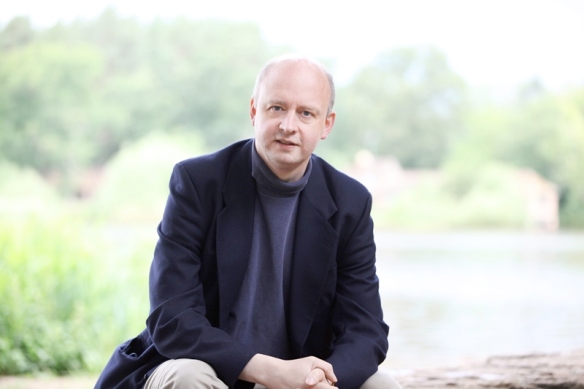
This debut at Cadogan Hall by the English Symphony Orchestra was also the third in its 21st Century Symphony Project, having previously included the Third by Philip Sawyers and the Ninth from David Matthews. This afternoon brought the Fifth Symphony of Matthew Taylor (below).

Symphonism goes back to the start of Taylor’s composing career, his Sinfonia Brevis having been completed at just 21. The present work is only his second such piece in four movements, but here the formal and expressive emphasis feels very different. Indeed, the opening Allegro is unprecedented in his output for its tensile volatility (not unlike that of Beethoven’s Serioso Quartet), its driving impetus and explosive culmination creating a momentum pointedly left unfulfilled by the ensuing intermezzi: the first (a tribute to composer and teacher Cy Lloyd) as terse and equivocal as the second (a tribute to Angela Simpson, wife of composer Robert Simpson) is poised and wistful. It remains for the final Adagio (a tribute to Taylor’s mother Brigid) to secure that eloquent apotheosis towards which the whole work had been headed.

The ESO responded with playing of sustained emotional power such as carried through this movement’s plangent twin climaxes and on to its resigned coda. Not that there was any lack of commitment earlier – Kenneth Woods having set a suitably headlong tempo for the first movement as left his players unfazed, then characterizing the central intermezzi with regard for their subtly different auras. A fine rendering of a piece which amply reinforces Taylor’s standing as a symphonist of stature. Hopefully further hearings will not be long in coming.

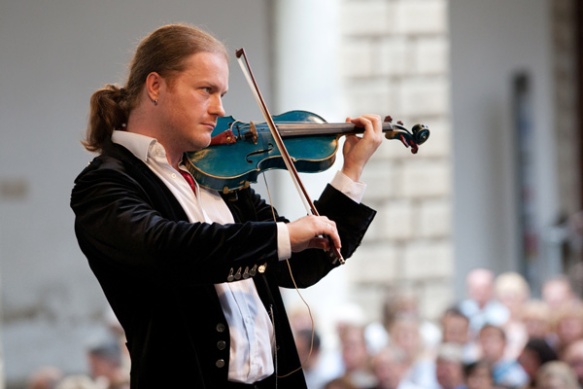
The rest of this concert consisted of standard repertoire, but there was nothing routine about the performances. Pavel Šporcl (above) was soloist in Mendelssohn’s Violin Concerto, notable for the trenchancy and forward impetus of its opening movement – not least the structurally crucial cadenza placed between development and reprise, then the alternately easeful and searching Andante. The finale had no lack of wit or insouciance – Šporcl duly returning for a dynamic account of the Fifth Caprice by Paganini, its coruscating passagework delivered with aplomb.

After the interval, Beethoven’s Fifth Symphony received a reading as attentive to the smaller detail as to its overall trajectory. The initial Allegro was incisive though never inflexible, not least in delineating the myriad variants on its indelible four-note ‘motto’, and if the Andante evinced a marginal lack of grandeur at its relatively swift tempo, those teasing asides which open-out its expressive course were deftly underlined.

Using the Clive Brown edition of this piece, Woods (rightly) opted to include the second-time repeat of scherzo and trio – giving it an enhanced presence as ideally complemented the finale’s ensuing majesty. There was little to fault in the latter’s uninhibited course: whether, or not, this edition places greater emphasis on the piccolo part, the clarity with which it emerged itself proved something of a revelation.

A memorable conclusion to a concert which also underlined the importance of this project in bringing together past and present of the symphony as a genre of ongoing and vital relevance. Next year sees a third instalment in the guise of the First Symphony by James Francis Brown.

Further listening

Toccata Classics have previously issued an album of Matthew Taylor orchestral music, recorded with the BBC Symphony Orchestra and Garry Walker. The composer’s Second Symphony and Viola Concerto can be heard here:

Pavel Šporcl can be heard in violin concertos by Richard Strauss and Korngold on the album below:

For more information on Matthew Taylor, visit the composer’s website Meanwhile Kenneth Woods has a detailed website of writing and engagements here, and you can read more about the English Symphony Orchestra here

Live review – CBSO / Mirga Gražinytė-Tyla: Honegger, Ravel & Brahms Second Symphony

City of Birmingham Symphony OrchestraMirga Gražinytė-Tyla (above)

Symphony Hall, Birmingham
Friday 31 May 2019

Honegger Pastorale d’été (1920)
Ravel Introduction and Allegro (1905); Le tombeau de Couperin (1919)
Brahms Symphony no.2 in D major Op.73 (1877)

Written by Richard Whitehouse

Back from their extensive European tour, the City of Birmingham Symphony Orchestra and their music director Mirga Gražinytė-Tyla returned to home-base with this arresting programme of early 20th-century French music and a classic of the Austro-German symphonic repertoire.

Most understated among curtain-raisers, Honegger’s Pastorale d’été is always a pleasure to encounter and this account had its measure – whether in the evanescent outer sections with their intangible aura, or livelier central episode with its fleeting allusions to Swiss folksong. Gražinytė-Tyla has spoken of her desire to investigate composers ‘off the beaten track’ and Honegger would seem a plausible candidate; such works as the capricious Cello Concerto or anguished Fifth Symphony fairly crying out for reassessment and considered advocacy.

Ravel’s Introduction and Allegro enabled the conductor to take a break while a seven-strong ensemble from the CBSO gave this perfect marriage of formal lucidity and expressive poise; at its most perceptive in the wistful opening music that returns even more hauntingly towards mid-point, with a harp cadenza that Katherine Thomas rendered precisely while delicately. It duly prepared for Le tombeau de Couperin, Ravel’s highly oblique response to the enveloping tragedy of the First World War in an account that defined more fully than usual the character of its middle movements. The astringent irony of the Forlane became more so at Gražinytė-Tyla’s swift tempo, with the Menuet allowed space for its pathos and tenderness to register. If the Prélude and Rigaudon left less of an impression, there was little to fault with either.

After the interval, a performance of Brahms’s Second Symphony that went much of the way towards conveying those passing yet always tangible ambiguities which offset any general equanimity of mood. The opening movement felt not quite the sum of its parts – Gražinytė-Tyla tending to rush headlong into climaxes, and with a curiously indecisive transition into the development as suggested she might still be pondering over that repeat of the exposition. Yet such as the stark transition into the reprise (those granitic harmonies of trombones and tuba really hitting home) then the suffused eloquence of the coda were perfectly achieved, as was the slow movement which here emerged as a more complex amalgam of agitation and resignation than is often the case, not least in those fatalistic intimations towards the close.

Next came a winsome take on the Intermezzo, its pert alternations of elegance and animation deftly while never too knowingly rendered; after which, the finale had energy to spare, if not at the expense of that ambivalence as is made explicit with the mysterious transition into the reprise (a passage of which Mahler could hardly have been unaware). From here Gražinytė-Tyla steered a secure course through to the closing peroration, its exhilaration never risking bombast when emphatic brass chords drove home the prevailing tonality in bracing fashion.

An absorbing performance, then, bolstered by some consistently fine playing from the CBSO. Gražinytė-Tyla returns one final time this season when, in the middle of June, she tackles a piece that has become synonymous with this orchestra – Mahler’s Resurrection Symphony.

Further listening

You can hear a playlist of the pieces heard in this concert on Spotify below – none of which appear to be available in recordings made by the CBSO as yet:

Live review – English Music Festival opening night: BBC Concert Orchestra & Martin Yates play Robin Milford, Stanford, Vaughan Williams & Arnold

Sergey Livitin (violin), BBC Concert Orchestra / Martin Yates

Dorchester Abbey, Dorchester-on-Thames
Friday 24 May 2019

Berners Portsmouth Point (1918) [World premiere]
Arnold Serenade Op.26 (1950)
Stanford Violin Concerto in D major (1875) [First public performance]
Vaughan Williams orch. Yates The Blue Bird (1913) [First public performance]
Delius A Song before Sunrise (1918)
Milford Symphony no.2 Op.34 (1933) [World premiere]

Written by Richard Whitehouse
Picture of BBC Concert Orchestra (c) Sim Canetty-Clarke

The 13th English Music Festival got off to an impressive start this evening, with Martin Yates presiding over the BBC Concert Orchestra for a substantial and wide-ranging programme that brought together the hitherto unknown and the relatively familiar in appropriate EMF fashion.

Who else would provide a platform for a first public performance of the Violin Concerto in D major that Stanford wrote at Leipzig in his mid-20s but which, despite the seeming approval of Joachim, remained unheard before being recorded two years ago. Admittedly the first movement rather outstays its welcome, the themes lacking memorability and a solo part not ideally contrasted with the orchestra, but the slow Intermezzo has an appealing poise; its cadenza artfully made an extended transition into the final Rondo (a procedure likely taken over from Wieniawski’s Second Concerto – the model in several respects), its winsome second theme brought back as a lingering coda prior to the closing flourish. Sergey Levitin proved an able and sympathetic soloist in a piece which, whatever its stylistic limitations, was certainly worth rehabilitating.

As too was the incidental music Vaughan Williams devised for Maurice Maeterlinck’s play The Blue Bird, idiomatically orchestrated from the piano score by Yates. This is essentially a ballet (or rather mime) sequence for the end of the first act, its series of thematically related dances striking a fantastical note such as the composer tellingly (if unexpectedly?) conveys. It may well have proved too ambitious in its original context though makes for a lively and imaginative suite, into whose whimsical spirit the BBCCO entered with evident enjoyment.

Malcolm Arnold’s Serenade exemplifies this composer’s early maturity with its pert melodic writing, harmonic ambiguity and rhythmic impetus. A Song before Sunrise is less often heard than other Delius miniatures, but its ruminative mood – barely ruffled by passing shadows, is no less characteristic. It could not have been more different from Lord Berners’s Portsmouth Point, redolent of early Prokofiev in its mechanistic aggression that, if it lacks the ebullience of Walton’s later overture, still packs an uninhibited punch when presented as a curtain-raiser.

The concert ended with its most intriguing item. Long considered a miniaturist (at least in his expressive scope), Robin Milford was not lacking in ambition – as reinforced by his Second Symphony (so designated following the rediscovery of its predecessor from six years earlier), admired by Vaughan Williams but only now receiving its first complete performance. Its four movements ostensibly reflect classical archetypes, but the first of these modulates ever more stealthily as it unfolds, while the scherzo’s latter trio unexpectedly opens-out the expressive range. The highlight is undoubtedly a slow movement of sustained and cumulative emotional depth, closer to Nielsen than Sibelius in tonal follow-through; after which, the (intentionally?) concise finale barely manages to provide a decisive resolution without seeming perfunctory.

Not in doubt was the commitment of the BBCCO and Yates in realizing this dark horse among British inter-war symphonies. A fitting end to an absorbing event: good to hear that orchestra and conductor will be returning for the 14th EMF – scheduled for May 20th–22nd next year.

Further listening

This concert will be broadcast on BBC Radio 3 on a date as yet unknown. Much of the music is not currently available in recorded versions on Spotify. However EM Records, the label who run the festival, made this enterprising release of Stanford‘s Violin Concerto no.2, coupled with Robin Milford‘s Violin Concerto no.2, both with soloist Rupert Marshall-Luck:

For more Robin Milford this album on Toccata Classics provides great insight into his writing for chamber music forces:

Meanwhile the following playlist includes the Malcolm Arnold and Delius works, the more familiar version of Portsmouth Point by Sir William Walton, and Arnold’s Symphony no.1: