
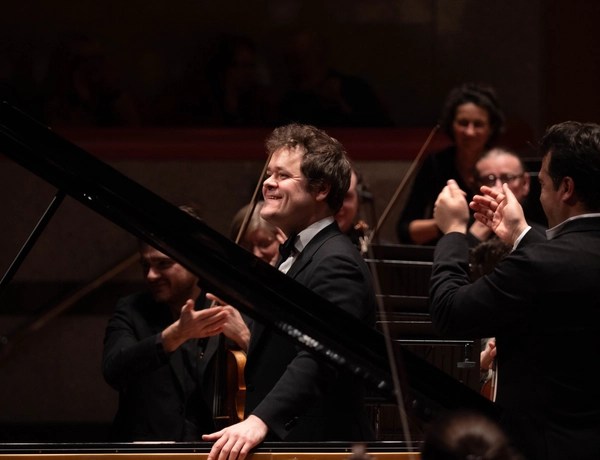
In concert – Benjamin Grosvenor, CBSO / Jac van Steen: Stravinsky, Hindemith, Ravel & Honegger

Benjamin Grosvenor (piano), City of Birmingham Symphony Orchestra / Jac van Steen

Hindemith Concert Music for Strings and Brass Op.50 (1930)
Ravel Piano Concerto in G major (1929-31)
Honegger Pacific 231 (1923)
Stravinsky Petruska (1911, rev. 1947)

Symphony Hall, Birmingham
Wednesday 5 May 2026

Reviewed by Richard Whitehouse Picture (c) Jonathan Ferro

Tonight’s concert by the City of Birmingham Symphony Orchestra saw the welcome return of Jac van Steen in a programme centred on several of the composers who contributed works to the Boston’s Symphony’s 50th season and what was an auspicious time for Western music.

Concert Music for strings and brass found Hindemith at an early peak of success abroad, as is evident from the ease with which he variously juxtaposes and combines these distinct groups. Formally the work is no less innovative – its initial part eliding first and slow movements as it pivots between densely orchestral or translucently chamber textures on the way towards a cumulatively sustained threnody; whereas its successor elides scherzo and finale as it veers between incisively fugal or plaintively homophonic textures prior to its resolute apotheosis. Music which has a notable advocate in Steen, ensuring this music never sounded congested or rhythmically inflexible while securing an impressive response from the CBSO musicians.

Although the Hindemith has latterly regained prominence, Ravel’s Piano Concerto has only gained further hearings across time. No mean exponent, Benjamin Grosvenor was not at his best in this account – the initial Allegramente finding rapport between soloist and orchestra less than unanimous, with its elements of jazz sounding a touch forced. The central Adagio opened with its solo passage lacking subtlety, though the build-up towards its close brought a frisson of anticipation, while the final Presto had a fluency and energy even more evident in that from Prokofiev’s Seventh Piano Sonata – Grosvenor on something like his best form.

A pity that no-one ever revives the [First] Symphony which Honegger wrote for that Boston anniversary, but his Pacific 231 has retained something of its early notoriety and Steen made the most of its implacable build-up from stasis, via a remorselessly accruing velocity then on to its merciless apotheosis. Certain members of the audience might first have encountered it in Louis Frémaux’s recording with this orchestra from 1973; the present performance being no less attentive to the music’s essentially human rendering of a technological phenomenon.

The scene was duly set for Stravinsky’s Petrushka, heard in its 1947 orchestration but with no lack of finesse on Steen’s part such as opened-out the music’s textures yet without diluting its emotional immediacy. There was no lack of evocation in the opening tableau’s depiction of St. Petersburg’s Shrove-Tide Fair, nor with that tantalizing passage when the anti-hero comes to life before a spirited Russian Dance. The central tableaux, focussing on Petrushka then the Moor in their respective cells, found an unerring balance between the music’s whimsical and its all-too-human emotions; heading into the Shrove-Tide Fair at Evening with its set-pieces vividly characterized. Just why Steen dispensed with the final minutes, depicting Petrushka’s death then his ‘resurrection’, is anyone’s guess: the CBSO trumpets were doubtless up for it.

An impressive concert, even so, not least as means for launching the CBSO’s 2026/27 season – details of which can be found elsewhere on Arcana.fm as well as on the orchestra’s website. Given the fitful funding at local and national levels, such ambition can only be commended.

To read more about the CBSO’s 2025/26 season, visit the CBSO website. Click on the names for more on soloist Benjamin Grosvenor and conductor Jac van Steen

Published post no.2,883 – Sunday 9 May 2026

Live review – CBSO / Mirga Gražinytė-Tyla: Honegger, Ravel & Brahms Second Symphony

City of Birmingham Symphony OrchestraMirga Gražinytė-Tyla (above)

Symphony Hall, Birmingham
Friday 31 May 2019

Honegger Pastorale d’été (1920)
Ravel Introduction and Allegro (1905); Le tombeau de Couperin (1919)
Brahms Symphony no.2 in D major Op.73 (1877)

Written by Richard Whitehouse

Back from their extensive European tour, the City of Birmingham Symphony Orchestra and their music director Mirga Gražinytė-Tyla returned to home-base with this arresting programme of early 20th-century French music and a classic of the Austro-German symphonic repertoire.

Most understated among curtain-raisers, Honegger’s Pastorale d’été is always a pleasure to encounter and this account had its measure – whether in the evanescent outer sections with their intangible aura, or livelier central episode with its fleeting allusions to Swiss folksong. Gražinytė-Tyla has spoken of her desire to investigate composers ‘off the beaten track’ and Honegger would seem a plausible candidate; such works as the capricious Cello Concerto or anguished Fifth Symphony fairly crying out for reassessment and considered advocacy.

Ravel’s Introduction and Allegro enabled the conductor to take a break while a seven-strong ensemble from the CBSO gave this perfect marriage of formal lucidity and expressive poise; at its most perceptive in the wistful opening music that returns even more hauntingly towards mid-point, with a harp cadenza that Katherine Thomas rendered precisely while delicately. It duly prepared for Le tombeau de Couperin, Ravel’s highly oblique response to the enveloping tragedy of the First World War in an account that defined more fully than usual the character of its middle movements. The astringent irony of the Forlane became more so at Gražinytė-Tyla’s swift tempo, with the Menuet allowed space for its pathos and tenderness to register. If the Prélude and Rigaudon left less of an impression, there was little to fault with either.

After the interval, a performance of Brahms’s Second Symphony that went much of the way towards conveying those passing yet always tangible ambiguities which offset any general equanimity of mood. The opening movement felt not quite the sum of its parts – Gražinytė-Tyla tending to rush headlong into climaxes, and with a curiously indecisive transition into the development as suggested she might still be pondering over that repeat of the exposition. Yet such as the stark transition into the reprise (those granitic harmonies of trombones and tuba really hitting home) then the suffused eloquence of the coda were perfectly achieved, as was the slow movement which here emerged as a more complex amalgam of agitation and resignation than is often the case, not least in those fatalistic intimations towards the close.

Next came a winsome take on the Intermezzo, its pert alternations of elegance and animation deftly while never too knowingly rendered; after which, the finale had energy to spare, if not at the expense of that ambivalence as is made explicit with the mysterious transition into the reprise (a passage of which Mahler could hardly have been unaware). From here Gražinytė-Tyla steered a secure course through to the closing peroration, its exhilaration never risking bombast when emphatic brass chords drove home the prevailing tonality in bracing fashion.

An absorbing performance, then, bolstered by some consistently fine playing from the CBSO. Gražinytė-Tyla returns one final time this season when, in the middle of June, she tackles a piece that has become synonymous with this orchestra – Mahler’s Resurrection Symphony.

Further listening

You can hear a playlist of the pieces heard in this concert on Spotify below – none of which appear to be available in recordings made by the CBSO as yet:

Wigmore Mondays – Roderick Williams & Roger Vignoles in French art-song

Roderick Williams & Roger Vignoles – French Art Song

Fauré Mirages, Op 113 (1919)

Caplet Cinq ballades françaises de Paul Fort (1919-20)

Honegger Petits cours de morale (1941)

Poulenc Deux poèmes de Guillaume Apollinaire (1938); Parisiana (1954)

Listen to the BBC broadcast here

Written by Ben Hogwood

How heartening to have such an inventive hour-long recital of French art-song for a Monday lunchtime. In choosing a programme mostly comprising rarely performed works Roderick Williams and Roger Vignoles demonstrated both the depth of the genre and the rich variety of source texts on which the composers drew.

For this concert we had the intriguing combination of late Fauré, bright Caplet, silly Honegger and typically heart-on-sleeve Poulenc, and both baritone and pianist applied themselves to each with great enthusiasm and character. No stone was left unturned as they strove to bring the texts to life, helped as they were by some wildly differing moods of interpretation.

Late Fauré has a uniquely timeless approach, and the essentially slow Mirages are no exception. The composer’s last song cycle, it is a quartet of settings from the collection of the same name by Renée de Brimont. Williams and Vignoles inhabited a still world, especially in the remarkable passage in Reflets dans l’eau (Reflections in the water) (beginning 4:44 on the radio broadcast), the song almost stopping completely, seemingly in the middle of the lake, for sustained contemplation (from 8:08)

Still more affecting was Danseuse (Dancer), a haunting closing song that vividly portrays the languid movements of the dancer. With his single melodic line in the right hand Vignoles had the lilt just right, as did Williams in his controlled singing.

The Caplet cycle of Paul Fort setting was an altogether different story. André Caplet was a close friend of Debussy, and did a lot of work for him on editions and such. Debussy comes through to some of the harmonies and sleights of hand, but Caplet’s own style makes itself known and is fascinating. Here Vignoles was exceptional in his setting of the five scenes, with some incredibly tricky piano parts made to sound comparatively easy. The start of Cloche d’aube (Tolling dawn) (from 18:09) was a sparkling, brightly lit piano part, complemented by Williams’ sonorous tones.

Notre chaumière en Yveline (Our cottage in Yveline), the third song (from 23:38), was even more striking, falling over itself in rapture, while the glissando of the piano and soaring vocal of Songe d’une nuit d’été (A Midsummer Night’s Dream) (from 26:07) continued the rapt mood of the recently married composer and his domestic bliss. Only the final song, L’adieu en barque (Farewell from a boat) struck a note of caution with the refracted bell ringing conveyed so vividly by Vignoles.

The Honegger songs (from 34:46) were little picture postcards, lasting just over four minutes in total. Described as ‘a short course in morality’, they were written with some striking if rather odd observations by Jean Giraudoux, four of which centred on locations in the UK. Each one, given a woman’s name, had a certain charm – the wandering Jeanne, a rather brusque Adèle (35:25), the heady scents of Cècile (36:11), a strident Irène (37:03) and finally Rosemonde (37:48). Williams and Vignoles clearly enjoyed them, and were on sparkling form throughout.

Finally music by Poulenc, one of the great French songwriters, was given exemplary performances. We heard 2 poems by Guillaume Apollinaire, the colourful Dans le jardin d’Anna (In Anna’s Garden) (40:16), the increasingly bothered Allons plus vite (Move Along) (43:35) and the two Max Jacob poems making up Parisiana (Jouer du bugle (Playing the cornet)) from 46:44 and the short but riotous Vous n’écrivez plus? (You do not write any longer?) (48:15). Both performers were again wreathed in smiles as they enjoyed Poulenc’s direct emotional approach, and then, as a bonus, we had a reflective encore in the form of La Grenouillère (The Froggery).

Even Vignoles was silently singing along at this point, the two finding a strong bond in this little known but richly rewarding box of treats.

Further listening

One of my favourite discs of French song is from the baritone François le Roux, joined by a crack team of French soloists under Charles Dutoit. It includes Poulenc’s Le bal masqué and Le Bestiare cycles, along with the Rapsodie nègre: