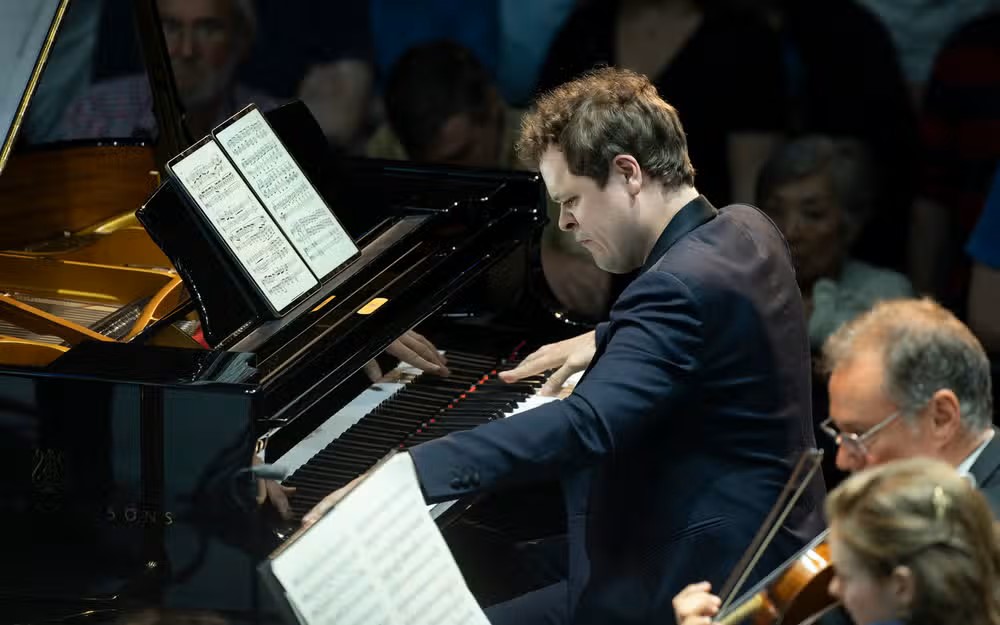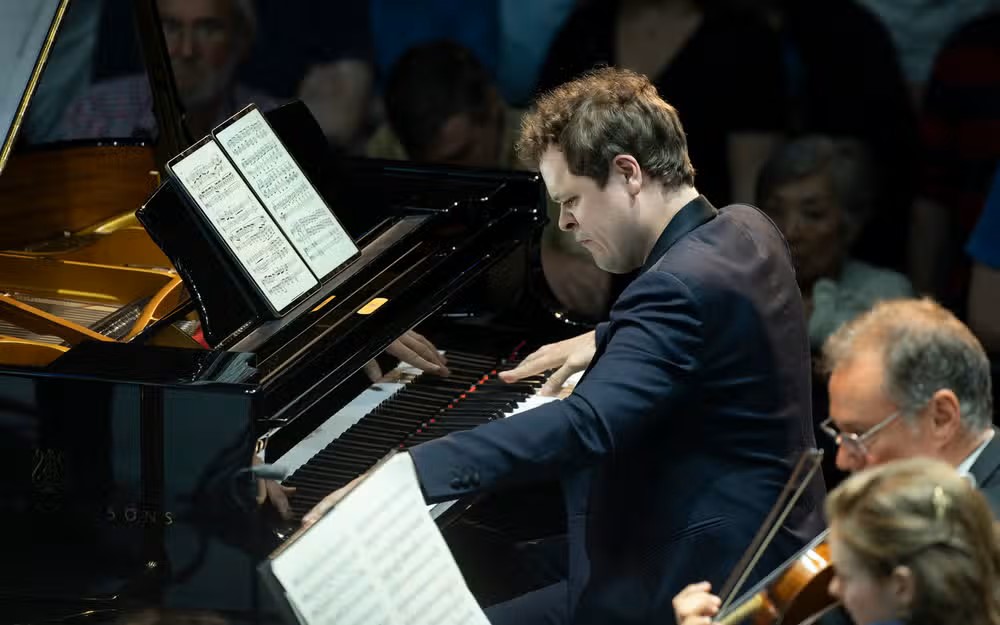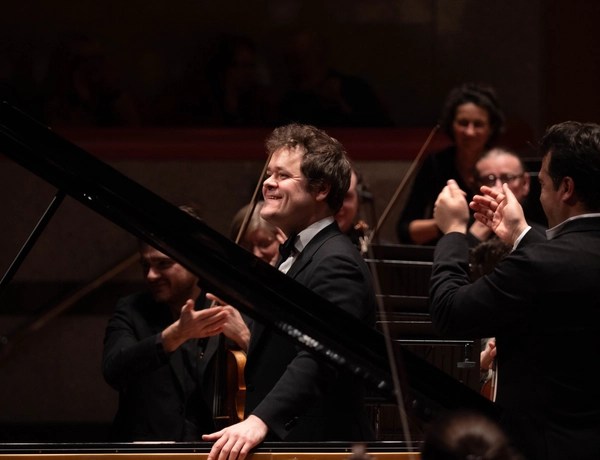
In concert – Benjamin Grosvenor, CBSO / Jac van Steen: Stravinsky, Hindemith, Ravel & Honegger

Benjamin Grosvenor (piano), City of Birmingham Symphony Orchestra / Jac van Steen

Hindemith Concert Music for Strings and Brass Op.50 (1930)
Ravel Piano Concerto in G major (1929-31)
Honegger Pacific 231 (1923)
Stravinsky Petruska (1911, rev. 1947)

Symphony Hall, Birmingham
Wednesday 5 May 2026

Reviewed by Richard Whitehouse Picture (c) Jonathan Ferro

Tonight’s concert by the City of Birmingham Symphony Orchestra saw the welcome return of Jac van Steen in a programme centred on several of the composers who contributed works to the Boston’s Symphony’s 50th season and what was an auspicious time for Western music.

Concert Music for strings and brass found Hindemith at an early peak of success abroad, as is evident from the ease with which he variously juxtaposes and combines these distinct groups. Formally the work is no less innovative – its initial part eliding first and slow movements as it pivots between densely orchestral or translucently chamber textures on the way towards a cumulatively sustained threnody; whereas its successor elides scherzo and finale as it veers between incisively fugal or plaintively homophonic textures prior to its resolute apotheosis. Music which has a notable advocate in Steen, ensuring this music never sounded congested or rhythmically inflexible while securing an impressive response from the CBSO musicians.

Although the Hindemith has latterly regained prominence, Ravel’s Piano Concerto has only gained further hearings across time. No mean exponent, Benjamin Grosvenor was not at his best in this account – the initial Allegramente finding rapport between soloist and orchestra less than unanimous, with its elements of jazz sounding a touch forced. The central Adagio opened with its solo passage lacking subtlety, though the build-up towards its close brought a frisson of anticipation, while the final Presto had a fluency and energy even more evident in that from Prokofiev’s Seventh Piano Sonata – Grosvenor on something like his best form.

A pity that no-one ever revives the [First] Symphony which Honegger wrote for that Boston anniversary, but his Pacific 231 has retained something of its early notoriety and Steen made the most of its implacable build-up from stasis, via a remorselessly accruing velocity then on to its merciless apotheosis. Certain members of the audience might first have encountered it in Louis Frémaux’s recording with this orchestra from 1973; the present performance being no less attentive to the music’s essentially human rendering of a technological phenomenon.

The scene was duly set for Stravinsky’s Petrushka, heard in its 1947 orchestration but with no lack of finesse on Steen’s part such as opened-out the music’s textures yet without diluting its emotional immediacy. There was no lack of evocation in the opening tableau’s depiction of St. Petersburg’s Shrove-Tide Fair, nor with that tantalizing passage when the anti-hero comes to life before a spirited Russian Dance. The central tableaux, focussing on Petrushka then the Moor in their respective cells, found an unerring balance between the music’s whimsical and its all-too-human emotions; heading into the Shrove-Tide Fair at Evening with its set-pieces vividly characterized. Just why Steen dispensed with the final minutes, depicting Petrushka’s death then his ‘resurrection’, is anyone’s guess: the CBSO trumpets were doubtless up for it.

An impressive concert, even so, not least as means for launching the CBSO’s 2026/27 season – details of which can be found elsewhere on Arcana.fm as well as on the orchestra’s website. Given the fitful funding at local and national levels, such ambition can only be commended.

To read more about the CBSO’s 2025/26 season, visit the CBSO website. Click on the names for more on soloist Benjamin Grosvenor and conductor Jac van Steen

Published post no.2,883 – Sunday 9 May 2026

In concert – Benjamin Grosvenor, CBSO / Robert Treviño: Mozart ‘Prague’ Symphony, Mendelssohn Piano Concerto no.1 & Brahms Symphony no.1

Benjamin Grosvenor (piano, below), City of Birmingham Symphony Orchestra / Robert Treviño (above)

Mozart Symphony no.38 in D major K504 ‘Prague’ (1786)
Mendelssohn Piano Concerto no.1 in G minor Op.25 (1830-31)
Brahms Symphony no.1 in C minor Op.68 (1868-76)

Symphony Hall, Birmingham
Thursday 23 January 2025 (2.15pm)

Reviewed by Richard Whitehouse Picture of Benjamin Grosvenor (c) Jenny Bestwick

Having worked with the City of Birmingham Symphony Orchestra on numerous occasions, Robert Treviño was well placed to take on a programme which was pretty demanding for all that its constituents were hardly unfamiliar – its two symphonies repertoire works to the core.

His cycle of Beethoven symphonies (Ondine) among the best of recent years, it was perhaps surprising to find Treviño boxing himself in interpretively with Mozart’s Prague symphony. If the first movement’s Adagio introduction was imposingly wrought, the main Allegro was taken at too consistently headlong a tempo for its intricacy of textures and its range of expression fully to register, though the CBSO admirably stayed the course. Nor was the central Andante wholly successful, the pervasiveness of its five-note motif not matched by the diversity of emotional responses to which this is put, with the development sounding harried rather than impetuous. Best was a final Presto that was a sizable-enough counterpart (first- and second-half repeats taken) to what went before, and its élan maintained through to the effervescent closing bars.

Fresh from having taken on Busoni’s epic Piano Concerto (most notably at last year’s Proms), Benjamin Grosvenor (above) met the very different challenge of Mendelssohn’s First Piano Concerto with comparable conviction. Written quickly but with nothing left to chance, this takes up the precedent of Weber’s Konzertstück (which, completed barely a decade earlier, had featured at Mendelssohn’s public debut) by eliding its individual movements into a succinct and cohesive whole. Vividly as Grosvenor projected its opening Molto allegro – no lack of ‘con fuoco’ – he came into his own with an Andante whose dialogue of piano and lower strings was meltingly rendered, then a final Presto both dextrous and exhilarating. The CBSO made a fine recording with Stephen Hough a quarter-century ago (Hyperion) and this was at the very least its equal.

Even so, it was Brahms’s First Symphony as proved the highlight of this afternoon’s concert. Whereas his Mozart had felt unduly beholden to ‘authentic’ concepts, Treviño was entirely his own man here – not least the opening movement whose implacable introduction linked effortlessly into an Allegro trenchantly characterized and with a cumulative impetus such as carried over into the fatalistic coda. Its eloquence never laboured, the Andante featured some felicitous woodwind and a poised contribution from guest leader Nathaniel Anderson-Frank.

Having had the measure of what feels more intermezzo than scherzo, pensive and playful by turns, Treviño steered a secure and always purposeful course through the lengthy finale. Its introductory Adagio preparing stealthily for a fervent if not over-bearing take on its majestic ‘alpine’ melody, the main Allegro was unerringly paced so that its formal elaboration never risked being discursive. Nor was the CBSO found wanting in a peroration that endowed the main motivic ideas with a resolution the more powerful for having been so acutely gauged.

There can be few seasons when Brahms’s First Symphony does not feature in this orchestra’s schedule, but Treviño’s was surely among the most impressive in recent memory; confirming demonstrable rapport between him and the CBSO one hopes will be renewed before too long.

For details on the 2024-25 season A Season of Joy, head to the City of Birmingham Symphony Orchestra website. Click on the names to read more about pianist Benjamin Grosvenor and conductor Robert Treviño

Published post no.2,423 – Sunday 26 January 2025

Arcana at the Proms – Prom 23: Benjamin Grosvenor, Rodolfus Choir, London Philharmonic Chorus & Orchestra / Edward Gardner – Busoni & Rachmaninoff

Rachmaninoff Symphonic Dances Op.45 (1940)
Busoni Piano Concerto in C major Op. XXXIX (1902-4)

Benjamin Grosvenor (piano), The Rodolfus Choir (men’s voices), London Philharmonic Choir (men’s voices), London Philharmonic Orchestra / Edward Gardner

Royal Albert Hall, London
Monday 5 August 2024

reviewed by Richard Whitehouse Photos (c) Andy Paradise

This centenary of Busoni’s death has not thus far seen a great deal of activity in the UK, so it was gratifying to find the Proms scheduling his most (in)famous work – the Piano Concerto tonight receiving its second performance at these concerts, 36 years to the day after its previous outing.

Back then, the first half featured Beethoven’s Fourth Symphony and a more apposite coupling than Rachmaninoff’s Symphonic Dances. Now firmly ensconced in the orchestral repertoire, it remains a stern test the London Philharmonic Orchestra did not quite meet on this occasion – despite such felicities as Martin Robertson’s eloquent alto sax in the first movement and Edward Gardner’s conjuring of a tangible malevolence in its successor. Impulsive but erratic in its outer sections, the finale’s evocative central span had a superficial quality typical of this performance overall.

This was not the case in the Busoni. Benjamin Grosvenor (above) might not the first name who comes to mind for this concerto but, having already given performances in Reykjavik and Berlin, he was audibly attuned to an idiom not as elusive as often supposed in its canny amalgam of the Germanic and Italianate, while his playing was fully equal to its technical demands. That he is not a pianist looking to confront the orchestra head on ensured a more than usually close-knit coordination with players and conductor, which was almost always to the benefit of this piece.

Not least in Prologo e Introito, its orchestral introduction enticingly shaded by Gardner with Grosvenor integrating his unequivocal entry into what are essentially variations on the theme at the outset. Few pianists have weighted Busoni’s complex chords or his intricate harmonies with such translucency, not least the end of this movement where piano and orchestra melded to spellbinding effect. Straight into Pezzo giocoso, its capricious outer sections framing one of stealthy ambivalence as perceptively rendered as was that spectral angularity near its close.

Grosvenor managed the rare trick of making Pezzo serioso simultaneously cumulative and cohesive. He duly channelled the slow-burning momentum of its introduction into the rolled chords of its barcarolle-like first part – Gardner sustaining impetus across its successor to an imperious climax, during which the soloist never risked being obliterated. The lead-in to its third part had a poise equal to that at the end, where subtle rhythmic contrasts between piano and timpani against undulating strings had an enfolding calm to diffuse any lingering tension.

A general pause for retuning, then All’italiana burst forth – the underlying tarantella rhythm a springboard for its motley succession of vernacular elements initially humorous and latterly uproarious, held in check by the scintillating give-and-take of soloist and orchestra. Grosvenor almost topped these shenanigans with his electrifying cadenza – after which, Gardner prepared admirably for Cantico in which male voices (above) hymned Allah’s praises with mounting fervour; Grosvenor a largely passive observer until he belatedly returned for the headlong signing-off.

Quite a performance, then, that will hopefully be released commercially. Did Busoni offer an encore at that Berlin premiere? It could not have been more suitable than J.S. Bach’s Prelude in E minor BWV855, transposed and arranged by Alexander Siloti – three minutes of balm bringing us gently down to earth.

For more on this year’s festival, visit the BBC Proms website – and to read more on the artists involved, click on the names: Benjamin Grosvenor, Edward Gardner, The Rodolfus Choir, London Philharmonic Choir and the London Philharmonic Orchestra

Published post no.2,264 – Thursday 5 August 2024

Arcana at the Proms – Prom 23: Thoughts on Busoni’s Piano Concerto

Benjamin Grosvenor (piano), The Rodolfus Choir, London Philharmonic Choir, London Philharmonic Orchestra / Edward Gardner

Royal Albert Hall, London
Monday 5 August 2024

by Ben Hogwood Photo (c) Andy Paradise

A full review of Prom 23 will follow from Richard Whitehouse, but I wanted to register some thoughts on my first live encounter with one of the most extraordinary piano concertos you could ever hope to hear.

In the last few months pianist Benjamin Grosvenor has taken Ferruccio Busoni’s Piano Concerto on something of a concert tour, and has written of his love and admiration for the piece in a Guardian article, which proves a helpful guide for anyone not fully attuned to the piece.

The centenary of Busoni’s death falls this year, hence the first appearance of this piece at the Proms in 36 years, since a memorable occasion when Peter Donohoe squared up to the solo part in the company of the BBC Symphony Orchestra and Mark Elder. Oh, and the BBC Singers – for this work, unbelievably, has a male chorus in the finale, singing “Lift up your hearts to the Power Eternal”, a hymn to Allah from Adam Oehlenschläger’s Aladdin. Busoni’s quote in the score at this point is that “The Pillars of Rock begin to make soft and gentle music.”

Yet even before we got to that fifth movement the extraordinary power and individuality of Busoni’s music was shining through. The London Philharmonic Orchestra under Edward Gardner had a big part to play here, setting the scene in the Prologo e introito as though we were standing in a cathedral, awestruck at the architecture but still taking in a new sight with each about turn.

Grosvenor’s interpretation of his part was balletic, and the music really danced – swooping down from the heights or bubbling up from the depths, the pianist finding remarkable clarity in even the most complex passagework. Busoni, a formidable concert pianist himself, really tests his soloist, but retains a well-judged balance between piano and orchestra. Grosvenor and Gardner somehow found this equilibrium in the notoriously tricky acoustics of the Royal Albert Hall, where from the arena you could hear the clear communication of Busoni’s ideas. The orchestra were superb here – percussion ideally balanced, strings and wind interacting with the piano cleanly and the brass sensitively placing their chorale interventions. The clarinet and viola solos in the second movement had all the room they needed, while the orchestral colour that appears so unexpectedly and vividly in this work was richly shaded.

And what of the piece itself? In many ways it was like listening to a progressive rock album from the 1970s, which in itself is extraordinary when you think the Piano Concerto was completed in 1904. The sheer scope of Busoni’s imagination knew no bounds, then – taking on board more obvious influences from Bach, Beethoven, Chopin and Liszt, while using harmonic techniques to remind us that we were now in the age of Sibelius, Elgar and even Schoenberg.

The fourth movement was perhaps the most remarkable in this performance. With the gargantuan third completed, a kind of meditation in four parts, Busoni summons even greater invention for a Tarantella of remarkable energy, the solo part whirling round in a circle and brilliantly played here by Grosvenor. Just as it seemed all possibilities had been exhausted, the appearance of the male chorus was a masterstroke, their sonorous tones floating above much of the audience in the Royal Albert Hall. They leant a whole new dimension to the work, meaning that even those who might have been struggling 55 minutes into a piece found the new impetus and energy in Busoni’s exultation.

If you have not yet encountered this extraordinary piece I encourage you to without delay – but don’t stop there, for Busoni’s solo piano output, while very different, has many riches to impart in a fraction of the time. First, though, you have to try the Piano Concerto. It will knock your socks off!

You can listen to this concert on BBC Sounds – with the Busoni Piano Concerto beginning at 1:03:55. For more on this year’s festival, visit the BBC Proms website

Published post no.2,263 – Wednesday 7 August 2024

In concert – Benjamin Grosvenor, CBSO / Riccardo Minasi: Schubert, Chopin & Mozart

Benjamin Grosvenor (piano), City of Birmingham Symphony Orchestra / Riccardo Minasi

Schubert Overture in C major ‘In the Italian style’ D591 (1817)
Chopin Piano Concerto no.2 in F minor Op.21 (1830)
Mozart Symphony no.41 in C major K551 ‘Jupiter’ (1788)

Symphony Hall, Birmingham
Thursday 1 June 2023 (2.15pm)

Reviewed by Richard Whitehouse

It is not often these days to have a whole concert of music from the late Classical and early Romantic eras, but that was just what the City of Birmingham Symphony Orchestra provided this afternoon under the disciplined as well as immensely assured direction of Riccardo Minasi.

There was no mistaking the inherent classicism of Chopin’s Second (sic) Piano Concerto – not least the simmering impetus in its opening Maestoso where, after a forthright tutti, Benjamin Grosvenor rendered those main melodies with requisite poise, and the emotional eddying of its development in direct contrast to the terseness of its coda. Most memorable was a Larghetto of melting eloquence but also, in its central episode, a volatility only gradually dispelled. Here, and in the final Allegro, the almost concertante role allotted to bassoon was characterfully taken by Nikolaj Henriques – as were those brass fanfares and col legno writing for strings (was this really Chopin’s idea?) which see the latter movement on its way to a spirited close. A limpid take on Chopin’s Nocturne in C sharp minor from the same year made for an appropriate encore.

Mozart symphonies rarely conclude a programme nowadays, yet the last four are ideal for this purpose and none more than the Forty-First – by some distance the weightiest and the most physical such work prior to Beethoven’s Eroica. This was the highlight of Minasi’s recording of the final triptych (Harmonia Mundi), with the opening Allegro likewise a statement of intent in its rhythmic tensility and general bravura, though its more ambivalent asides were never downplayed. Less distinctive melodically than its two predecessors, the Andante is memorable for its expressive understatement and a subtlety – with wind and strings enfolded into a textural continuity – that accentuates its pathos. Nor was there any lack of suavity in the Menuetto, its outer sections finding ideal contrast with a trio whose pert expectancy was delectably pointed.

The final Allegro crowns this work in every respect and, here again, Minasi did not disappoint. Not that there any sense of merely ‘going through the motions’ with his inclusion of first- and second-half repeats, each of which brought added intensity to what had gone before as well as enabling the wealth of contrapuntal detail to come through as it too rarely does. For its part the CBSO more than rose to the challenge, not least in a coda whose methodical combining of this movement’s themes makes possible an apotheosis such as felt truly visceral in its affirmation.

Schubert evidently had other preoccupations when essaying his two overtures ‘in the Italian style’, both of which have fallen out of the repertoire this past half-century but which make for attractive and appealing curtain-raisers. Especially that in C major with its teasingly portentous introduction, jocular and lilting main themes, then coda which sees it through to an effervescent close. The CBSO players (woodwind in particular) audibly enjoyed making its acquaintance, and it would be a real pity were such pieces relegated to the lower reaches of today’s playlists.

Hopefully a performance such as that by Minasi will make this just a little less likely. One looks forward to his future collaboration with this orchestra, which returns next Wednesday with its chief conductor Kazuki Yamada in a programme featuring Holst, Beethoven and Rachmaninoff.

You can read all about the 2022/23 season and book tickets at the CBSO website. Click on the artist names for more information on Riccardo Minasi and Benjamin Grosvenor