Live review – CBSO Weinberg Weekend: Symphony no.21 & Shostakovich: Symphony no.15

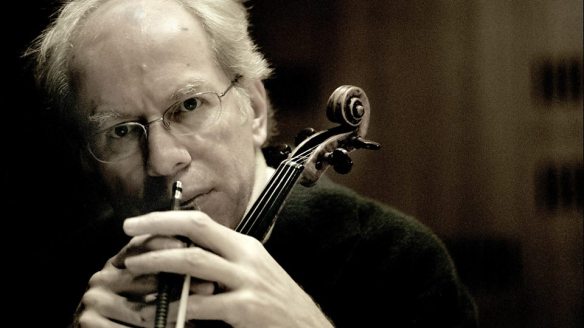
Freddie Jemison (treble), Maria Makeeva (soprano), Gidon Kremer (violin, above), Kremerata BalticaCity of Birmingham Symphony OrchestraMirga Grazinyte-Tyla

Symphony Hall, Birmingham
Saturday 24 November 2018, 11am

Weinberg Symphony no.21 op.152
Shostakovich Symphony no.15 in A major op.141

Written by Richard Whitehouse

The Weinberg Weekend being held in Birmingham reached its culmination tonight with this uncompromising yet rewarding symphonic double-bill. Those unfamiliar with the composer’s music may have been disconcerted by what they heard. Whereas the early Violin Concertino (heard at the previous concert) feels not so far removed from comparable works by Malcolm Arnold, the Symphony no.21 breathes an air of stark fatalism. Written at a time which witnessed the collapse of the Soviet Union and dedicated to the memory of those who died in the Warsaw Ghetto (the ‘Kaddish’ subtitle is found in his catalogue but not the actual score), it ranks among Weinberg’s deepest statements. At almost an hour it is also among his longest symphonies, so making its predominant sparseness and concentration the more remarkable.

The single movement falls into several continuous sections – an initial Largo’ introducing the plangent hymn that pervades the work then the chorale whose presence Weinberg traced back to his First Symphony, their alternation making way for the opening theme of Chopin’s First Ballade intoned somnolently on piano. An Allegro draws a theme from Weinberg’s Fourth Quartet into its reckless orbit, while a further Largo similarly utilizes one from his Double-Bass Sonata – the latter’s sepulchral tones sounding more bizarre given the ensuing klezmer-like passage with clarinet, which persists through a tensile Presto then plaintive Andantino that brings the principal climax. A final Lento unfolds with increasing introspection – violin, piano and harmonium adding their spectral sonorities until the music fades out of earshot.

The work went unheard in Weinberg’s lifetime, with its undoubted technical and emotional challenges having made revivals rare. Yet its formal cohesion and expressive consistency are undoubted – in the conveying of which, Mirga Grazinyte-Tyla took especial credit for rendering the epic structure as an inevitable yet cumulative entity whose febrile outbursts were held in check by that encroaching vastness which extends right across the whole. She was abetted by an assured response from the City of Birmingham Symphony, bolstered by members of Kremerata Baltica (Gidon Kremer taking the violin solos), and if dividing the vocalise between eloquent Maria Makeeva and plaintive Freddie Jemison slightly disrupted continuity in the closing stages, it hardly distracted from the stature of this reading overall.

Shostakovich‘s Symphony no.15 made a pertinent coupling, with Grazinyte-Tyla having its measure right from her purposeful take on the opening Allegretto. The Adagio’s ominous tread was finely sustained, its numerous solo passages having ample room to unfold prior to an anguished climax then desolate coda, while the brief scherzo fairly crackled with barbed irony. Nor was there any lack of focus in the finale, emerging from its miasma of allusions through to a spectral passacaglia whose seismic culmination never pre-empted the subdued recollection of earlier ideas or, above all, the transfigured conclusion with its evocation of ‘voices overheard’ over simmering percussion. It set the seal on an impressive performance and a memorable concert: one which certainly warrants the proposed commercial release.

Sunday morning saw a lecture in the Recital Hall at the recently-opened Royal Birmingham Conservatoire. As presented by Prof David Fanning (Manchester University) and Dr Michelle Assay (Huddersfield University), Exploring Weinberg offered a selective though consistently informative overview of the composer’s life and career: from his formative years in Warsaw, via his arrival in Moscow following periods in Minsk then Tashkent against the background of war; the dark years of the anti-formalism campaign then his incarceration during the final months of Stalin’s increasingly paranoid rule, then to the decades of growing acclaim from colleagues and public alike during the 1960s and ’70s, before a period of increasing neglect as a new generation of Soviet composers came to the fore and the Soviet Union neared its end.

The lecture was illustrated with numerous visual and musical examples, but it was archival recording of Weinberg playing and singing extracts from his opera The Passenger to the Moscow Union of Composers – in a futile attempt to secure its performance – that riveted attention. Hearing a composer’s actual voice is seldom less than revealing and so it proved here, setting the seal on an event which was certainly worth attending despite the absence of a selection of chamber works from Conservatoire students that was to have followed.

Summing up, the Weinberg Weekend fairly succeeded in terms of introducing Birmingham audiences to music by a composer whose importance continues to increase and as a prelude to what looks set to be a deluge of UK performances over the course of his centenary year.

Further information on the Weinberg Weekend can be found here

Live review – CBSO Weinberg Weekend: Gidon Kremer & Kremerata Baltica

Gidon Kremer (violin), Georgijs Osokins (piano), Kremerata Baltica (above)

Town Hall, Birmingham
Saturday 24 November 2018, 11am

Bach-Busoni (arr. Kremer) Chaconne in D minor BWV1004/5 (c1720)
Weinberg Concertino for Violin and Strings in A minor op.42 (1948)
‘Schubert meets Silvestrov’:
Schubert Five Minuets and Six Trios D89 (1813) and Der Musensohn D764 (1822) interspersed with
Silvestrov Five Pieces for violin and piano (2004)

Written by Richard Whitehouse

Having launched the Weinberg Weekend with his impressive transcription of the 24 Preludes for cello, Gidon Kremer this morning bought Kremerata Baltica to Birmingham’s Town Hall for a programme that placed Weinberg within a typically stimulating and unexpected context.

Few who have heard Weinberg’s opera The Passenger could have been left unmoved by that climactic moment when the opening of Bach‘s Chaconne is intoned by unison violins as the symbol of an enduring German culture. Disappointing, then, that Kremer’s own arrangement of Busoni’s mighty piano transcription (as referenced at the opening) should have proved so underwhelming; or was it more the demands of synchronization when not conducted that led Kremerata Baltica to neuter textural and emotional contrasts in this immaculate yet unresponsive rendering.

Kremer then joined his ensemble for Weinberg’s Violin Concertino, a product of late-1940s Soviet culture when accessibility was not just desired but proscribed. While there is little in its melodic content of real memorability, the deftness and subtlety with which the composer unfolds his ideas across an ingratiating Allegretto, ruminative Adagio (whose cadenza-like introduction brings the most arresting music) then an incisive final Allegro is nothing if not resourceful. Even then, this attractive piece waited almost half a century for its first hearing.

Kremer and his ensemble made the most of these attractions, as they did in the final piece – a curious though effective dovetailing of miniatures from Schubert and Silvestrov. The former was heard in transcriptions (by Kremer?) of an early sequence of minuets and trios for string quartet, his teenage gaucheness outweighed by melodic poise and rhythmic brio. In between these, Valentin Silvestrov’s Five Pieces proved suitably elusive – Kremer and pianist Georgijs Osokins teasing myriad subtleties from a subdued elegy, wistful serenade, poetic intermezzo, limpid barcarolle and haunting nocturne. The sequence was rounded off with an arrangement (by Christoph Ehrenfellner) of Schubert’s song Der Musensohn, one of a handful of Goethe settings that mark the onset of his full maturity; here working its bewitching charms in full.

A bewitching way, indeed, to conclude a typically provocative programme by this always enterprising ensemble. Kremer’s and Kremerata Baltica will also be taking part in tonight’s concert which features a very different piece by Weinberg, his valedictory 21st Symphony.

Further information on the Weinberg Weekend can be found here

Live review – CBSO Weinberg Weekend: Gidon Kremer – Preludes to a Lost Time (Imaginary Dialogues)

Gidon Kremer (above, violin), Antanas Sutkus (photographs)

CBSO Centre, Birmingham
Friday 23 November 2018

Weinberg (arr. Kremer) 24 Preludes op.100 (1968)

Written by Richard Whitehouse

His centenary may be over a year away, but the City of Birmingham Symphony has set the ball rolling with a weekend centred upon the music of Mieczyslaw Weinberg (1919-96), the Polish-born Soviet composer who has latterly (in terms of recording) come in from the cold.

The weekend opened with a performance of the 24 Preludes written for, but never played by, Mstislav Rostropovich and unheard publicly until 1995. These have now been transcribed for violin by Gidon Kremer, whose recent commitment to Weinberg’s cause has been typically unstinting, and it was he – in his capacity as the orchestra’s artist-in-residence for this season – who gave this evening’s performance in the clear though never clinical acoustic of CBSO Centre. His playing was accompanied throughout with overhead projections from Antanas Sutkus, the Lithuanian photographer whose images afford an overview of life in the latter decades of the Soviet bloc such as seems the more affecting for its starkness and restraint.

Just like Weinberg’s music, in fact – the Preludes finding their composer in combative mood as he neared his fiftieth year. Unlike Chopin and Shostakovich, he tackled the sequence not as a circle of fifths but as an arc of 12 ascending then 12 descending semitones – implying a two-part structure complemented by the three ‘waves’ as discerned by Yosif Feigelson (who gave the premiere). Equally plausible is a four-movement format with pivotal roles assumed by the stealthy sixth, confiding 12th, stately 18th then wistful 24th preludes. Throughout the sequence, pieces rich in allusion offset others which focus upon primary musical essentials.

A fascinating and expressively wide-ranging opus, then, to which Kremer did full justice in his skilful and idiomatic transcription; his taut and incisive tone only adding to the plangency of this music. A pity, perhaps, that Sutkus’s photographs could not have ‘bled’ from one to the other in a visual continuity rather then changing (as was often the case) mid-prelude, but this hardly hindered appreciation of the music overall. Kremer received an enthusiastic response from a near-capacity audience, so launching this Weinberg Weekend in impressive fashion.

Further information on the Weinberg Weekend can be found here

Live review – Benjamin Grosvenor, CBSO / Vassily Sinaisky – Mozart, Sibelius & Wagner

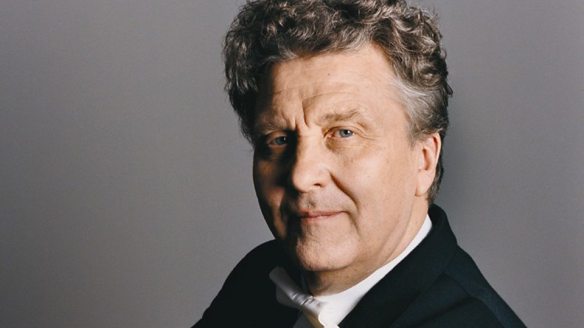
Benjamin Grosvenor (above, piano), City of Birmingham Symphony OrchestraVassily Sinaisky (below)

Symphony Hall, Birmingham
Thursday 25 October 2018 (matinee concert)

Wagner Der fliegende Holländer – Overture (1841)
Mozart Piano Concerto no.21 in C major K467 (1785)
Sibelius Symphony no.1 in E minor Op.39 (1899)

Written by Richard Whitehouse

It has often been remarked that concerts adhering to the once ‘standard’ format of overture, concerto and symphony are hardly frequent nowadays, so making this afternoon’s concert from the City of Birmingham Symphony Orchestra and Vassily Sinaisky the more welcome.

Wagner has always made for an effective curtain-raiser, not least his overture to The Flying Dutchman. Earliest of his acknowledged operas, its eventful 10 minutes fairly encapsulate the salient incidents and principal themes – not least in this performance, Sinaisky confirming his operatic credentials (in which capacity he has been regrettably little heard in the UK) with an assured reading; most perceptive in its approach to Senta’s eloquent ballad near the beginning and in its Tristanesque return during the closing bars such as Wagner transformed in revision.

A scaled-down CBSO was equally responsive in Mozart‘s K467, happily no longer indelibly associated with one of the dreariest 1960s films. Often at his most perceptive in 19th-century music, Benjamin Grosvenor is no slouch in Mozart and his performance – as was that at this year’s Proms with the BBCSO and Sakari Oramo – was full of felicitous phrasing, even if the formal focus of the imposing first movement was likely of Sinaisky’s choosing. The Andante was affecting without affectation, Grosvenor embedding the solo part closely into that of the orchestra, then the final rondo conjured up effervescence at a not unduly headlong tempo. All credit to Grosvenor in choosing cadenzas by Robert Casadesus (whose Mozart recordings are required listening) and for a limpid reading of Rachmaninov‘s Lilacs as his encore.

Although his ambivalent relationship with the Austro-German symphonic tradition has often been noted, Sibelius’s Russian heritage is often downplayed – yet his first two symphonies would be inconceivable without Tchaikovsky’s input. The First of these has been compared with the Pathétique in its epic and ultimately tragic nature, but the influence of the Russian’s Fifth Symphony feels even more overt in its sombre clarinet-led introduction and an Allegro with its ingenious take on the sonata format. Sinaisky duly has the measure of its brooding power and surging energy, then opted for a flowing account of the Andante that brought out its pathos and quixotic changes of mood without it seeming turgid or episodic. The Scherzo, too, had the requisite dynamism and, in its trio, an appealing whimsy that was deftly drawn.

The highlight, though, was the finale – most often the movement which fails to ignite by dint of its discursive structure. Yet ‘Quasi una Fantasia’ need not imply rhapsodic and Sinaisky treated it accordingly, characterizing its dramatic then fervent themes with due appreciation of their formal integration towards an impassioned climax whose fateful outcome was never in doubt. It helped that orchestral playing was of unwavering commitment, with the CBSO giving of its collective best in a piece which it has played frequently over the past 86 years.

It set the seal on a concert which was a reminder one that even a mainstream programme can surprise and engage when the constituents are thoughtfully planned and performances never less than responsive. The enthusiastic reception of a sizable house was its own confirmation.

For more information on future CBSO concerts head to their website

Live review – London Contemporary Orchestra @ The Barbican: Other Worlds

London Contemporary Orchestra & ChoirRobert Ames
Universal Assembly Unit (art direction)
Artrendex (artificial intelligence)

Barbican Hall, London
Wednesday 31 October 2018

Scelsi Uaxuctum (1969) (UK premiere)
John Luther Adams Become Ocean (2013)

Written by Ben Hogwood

If the apocalypse comes while we are alive, what music do you want played?

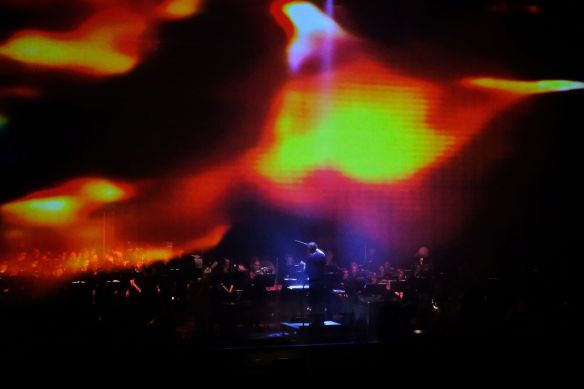
It is a thought-provoking question, one that some composers have tackled head-on by writing music of their own. The end of days provided the link for this programme of polar opposites from the London Contemporary Orchestra, given at the Barbican to the accompaniment of images dictated by algorithmic responses, thanks to the AI technology of Artrendex and the Universal Assembly Unit.

The first part was the end of days in the darkest possible sense. Giacinto Scelsi’s five-part Uaxuctum takes as its inspiration the Legend of the Maya City, and its self-destruction for religious reasons. Due to the demands made on the performers – and, the programme argued, an overly conservative approach to using Scelsi’s music – this was the UK premiere of a piece written nearly fifty years ago.

The textures were remarkable, achieved through a variety of vocal techniques such as trills, tremolos, hissing, deep breathing and nasal sounds. The use of quarter tones lent an extra level of difficulty and a sense of dread to the music, the vocals stubbornly sat in between the instrumental notes at times. The London Contemporary Choir met these demands heroically, stood on the left under a screen whose barbed imagery and sudden explosions of orange and red light were wholly appropriate.

The sizable orchestra was bolstered by a massive battery of percussion, including an enormous barrel rubbed with a ‘thundersheet’ – which made a suitably massive noise. This provided some chilling, incendiary shocks, while the percussion themselves supported the music from what felt like underneath the floorboards.

Perhaps because of the massive screen the edge was taken off the sound a little, which compromised the raw impact of the piece, but Scelsi’s often monotone musical language left an incredibly strong impact under the passionate direction of Robert Ames. Its resultant chill stayed throughout the interval.

John Luther Adams, environmentalist as well as composer, has garnered many plaudits for Become Ocean, a 2013 composition that sees the Earth returning to its early state of complete water coverage. Should it happen again, this form of apocalypse would be man-made; the ultimate destination should global warming continue in the way it does.

Adams chose not respond to this with the sharp edges and doom-mongered percussion of an industrial age. Rather he utilises the orchestra as a single instrument of subtly altering shades, beginning low in the murky depths of the piano but gradually superimposing layers to make a wonderfully sonorous block chord the listener can literally dive into.

Interpreting this as a colour, it could only be the deepest blue of the unfathomable ocean, and the imagery responded as such, submerging the orchestra in slow moving waves under deep, grey cloud. We were, it seemed, cast out in the middle of the ocean, as far from land as could be, but this was to be a meditative exile, accepting of its fate if not wholly aspiring to it.

The music carried for 45 minutes and there were several climax points, where the images grew deeper, before Ames pulled us back to the bare bones again. Adams ended where he had begun, back in the lower reaches of the piano.

Silence was the only appropriate response to this wall of water through sound, a wonderful contemplation and immersion that proved unexpectedly moving, the realisation hitting home of just how much damage we have inflicted on our own planet.

If they ever met, Scelsi and Adams would surely have found a common ground, despite the fascination of their wildly different responses to the final, greatest destruction. They left us with much to ponder and admire, especially from the London Contemporary Orchestra, whose standard of performance was unstinting, and whose virtuosity behind the scenes ensured these two apocalyptic visions met their final destination.

Further listening

The works in this concert can be heard on the Spotify playlist below: