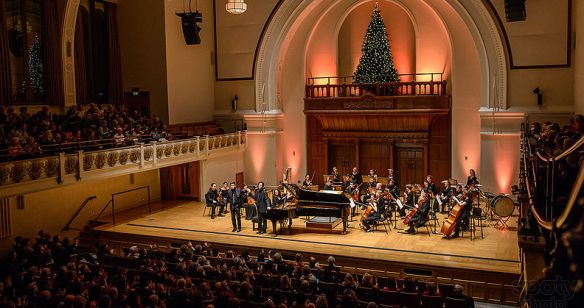
The 2016 BBC Proms are go! Here’s what happened in Prom 1…

proms-2016

The national flag of Argentina waves in response to Sol Gabetta‘s account of the Elgar Cello Concerto

(c) Ben Hogwood

The BBC Proms are go!

The 2016 season is underway, and in a packed Royal Albert Hall this evening we were treated to the first of 75 Proms. As is traditional Sakari Oramo and the BBC Symphony Orchestra gave us a flavour of the season, but also a substantial second half in the form of Prokofiev‘s cantata and film score, Alexander Nevsky.

To begin, a sad reflection of the world’s troubles could be keenly felt in La Marseillaise, the Proms showing solidarity with France after the horrors in Nice. After such an event music can feel inconsequential but it can also bring people together and provide some sort of comfort – and in the big, swooning tunes of Tchaikovsky‘s Romeo and Juliet Oramo provided just that. The woodwind chorale on the approach to the end was particularly moving.

Sol Gabetta then stamped her own personality on Elgar‘s Cello Concerto, taking a few liberties with the tempo – but none of these were for personal gain, rather reflecting her own interpretation of the music. The pauses at the end of some of Elgar’s phrases were unexpected but profound, while the silvery accompaniment of the BBC SO spoke of Autumn rather than our supposed high summer. Gabetta’s encore, Dolcissimo by the Latvian composer Peteris Vasks, found her singing as well as playing cello, reducing the Royal Albert Hall to reverent silence.

Things got even colder for Prokofiev‘s film score Alexander Nevsky, though there were thrilling moments when the massed choir of the BBC National Chorus of Wales – just over 200 in all – let rip. The basses reached their lowest notes with commendable accuracy, while the Battle On The Ice, where Nevsky faces his German and Estonian foes, was thrilling and immediate.

Yet the show was stolen by Olga Borodina, the Russian mezzo-soprano ghosting onto the stage for a keenly felt account of The Field of the Dead near the end. Her emotion was first hand, and Oramo’s sensitive hand on the tiller encouraged a similarly heartfelt response from the orchestra.

It was a concert that bodes well for the season – and this year Arcana is planning two different approaches to its coverage of the BBC Proms. There will be a few straight ‘reviewed’ concerts, but the focus of our coverage will be on taking people to the Proms who have not been before. To that end our reviews of Proms will not be by experts, rather by first-time punters chosen from a pool of friends and contacts. Further to that, all reviews will be from the Arena, which is the ultimate Proms experience – and which to my knowledge is the best place for sound quality, let alone atmosphere.

No other source reviews from here as far as I am aware…so stick with Arcana in the weeks ahead, particularly through August. I can assure you we will be bringing classical music to new audiences on a weekly basis!

Ben Hogwood

The Oberon Symphony Orchestra play Shostakovich, Copland & Prokofiev

oberon-draperOberon Symphony Orchestra and Samuel Draper
Richard Whitehouse on the Oberon Symphony Orchestra‘s latest concert of 20th century music from the superpowers, given at their home of St James’s, Sussex Gardens, London on Saturday 11 June

Shostakovich Festive Overture (1954)

Copland Clarinet Concerto (1948)

Prokofiev Symphony no.7 (1952)

Cosima Yu (clarinet), Oberon Symphony Orchestra / Samuel Draper

This evening’s concert from the Oberon Symphony Orchestra comprised three pieces which complemented each other ideally, especially when their immediacy and accessibility as music tends to offset their frequent technical difficulties – albeit for musicians rather than listeners.

Not least Shostakovich’s Festive Overture, written in three days to commemorate the 37th anniversary of the Bolshevik revolution, whose tunefulness does not make for ease of ensemble; not that this was an issue when the players were as alert rhythmically in the first theme as surely as they conveyed the suavity of its successor, and the grandeur of its framing fanfares emerging without undue heaviness. That Shostakovich struggled to refocus his music in the post-Stalin era hardly lessens the appeal of this piece when so capably rendered.

The sharp stylistic contrasts in Copland’s output may have been determined more by aesthetic than political considerations, yet here again those pieces written for a wider audience are by no means straightforward to perform. One might have expected a testing solo part in the Clarinet Concerto composed for Benny Goodman, but the high and exposed writing in the first movement hardly makes life easy, and it was a credit to the Oberon musicians that they met the challenge while capturing the Mahlerian plangency of this music. The second movement, with its continual syncopation and recourse to jazz idioms, presents difficulties that were less fully surmounted; which in no way deterred Cosima Yu – her elegant phrasing and rhythmic verve much in evidence through to that final and decidedly Gershwinesque upward glissando.

While it has never been neglected, Prokofiev’s Seventh Symphony is still too often interpreted at face value. A letter to the ailing composer from Shostakovich soon after the premiere betrays a recognition of deeper and more ambivalent emotion behind the outward naivety (something the latter clearly had in mind when writing his final symphony two decades on), and it was this ambivalence that Samuel Draper brought out most convincingly – not least in an initial Moderato of a formal simplicity concealed by the harmonic subtlety with which Prokofiev navigates its searching and often uneasy course. This was no less true of the ensuing Moderato, a waltz-sequence of ingratiating melodies undercut by a rhythmic assertiveness made manifest during a coda whose forced jollity came ominously to the fore.

The highlight was the Andante – easy to glide over when its themes are so simply and unobtrusively drawn, but here given with  a plaintiveness and regret as disarming as is the piquancy of its scoring (not least the melting harp passage toward its close). While the final Allegro was less convincing, this further instance of ‘easy’ expression allied to its fair share of technical difficulties is far from plain-sailing, and if ensemble was not always precise in the cavorting main sections (or the admittedly uninspiring central episode), the return of the first movement’s ‘big tune’ was finely judged and the coda suffused with acute poignancy.

Draper rightly opted for the quiet ending that Prokofiev had initially intended: no matter if   its final pizzicato was not together – the music’s essential fatalism could hardly be ignored.

The next Oberon concert takes place on 17th September 2015, where the orchestra will play the Saint-Saëns ‘Organ’ symphony and Liszt’s symphonic poem Les Préludes. Here they are in the Tchaikovsky’s Fifth:

Further information can be found at the orchestra’s website

In concert – Bristol University SO / John Pickard – The Vision of Cleopatra

bristol-uso-pickardImage credit: Bhagesh Sachania

Eve Daniell (soprano), Rachael Cox (mezzo-soprano), Angharad Lyddon (contralto), Jeffrey Lloyd-Roberts (tenor), Alexander Learmonth (baritone), Bristol University Choral Society and Symphony Orchestra / John Pickard

Victoria Rooms, Bristol; Saturday 12th March, 2016

Beethoven Mass in C, Op.86 (1807)

Brian The Vision of Cleopatra (1907)

Written by Richard Whitehouse

The regular concerts given by the Bristol University Symphony Orchestra can be relied upon for innovative programming, as was proved this evening with the first performance in 107 years of the most ambitious earlier work by Havergal Brian – his cantata The Vision of Cleopatra.

The work was finished in 1907 and premiered at the Southport Festival two years on, where it enjoyed a succès d’estime but no further performances. Loss of the orchestral score and parts during the 1941 Blitz made any revival impossible until 2014, when John Pickard undertook the new orchestration that received its first hearing tonight. Brian’s orchestral pieces from the 1900s offered a viable point of departure, though Cleopatra is hardly more indebted to these than to Pickard’s own large-scale works. The outcome is highly audacious within the context of British music from this period, notably for its taking on board those possibilities opened-up by Richard Strauss in his controversial opera Salomé – unheard in the UK until 1910, but which Brian had most likely studied from the score and absorbed its innovations accordingly.

Whatever else (and for all that Gerald Cumberland’s rather tepid libretto tries hard to suggest otherwise), Cleopatra is no anodyne Edwardian morality. After the orchestral Slave Dance that functions as a lively overture, the cantata unfolds as a sequence of nominally symphonic movements: a speculative dialogue between two of the queen’s retainers, then an increasingly fervent duet between Cleopatra and Antony followed, in its turn, by an expansive aria for the former; divided by a speculative choral interlude and concluded by a Funeral March of stark immediacy. So systematic yet by no means inflexible a formal trajectory serves to predicate expressive continuity over scenic evocation, a sure pointer to Brian’s future as a leading mid-century symphonist who operated at an intriguing remove from the Modernism of this period.

The Vision of Cleopatra may have fazed its first-night performers, but there was little tentative or underwhelming about tonight’s rendition. Eve Daniell was sympathetic as Iris and Rachael Cox even more so as Charmion, complementing each other effectively as the retainers, while Jeffrey Lloyd-Roberts made an ardent showing as Antony whose tendency to histrionics was understandable. Angharad Lyddon, though, stole the show (as she needed to) as Cleopatra – bringing real eloquence to her climactic aria while evincing palpable depth of tone that made light of Brian’s exacting demands. Bristol University Choral Society sang with evident lustre, and Pickard secured a committed response from his forces – alive to those audacities that the composer doubtless put into his orchestral writing and which were grippingly to the fore here.

The first half had seen a welcome revival of Beethoven’s Mass in C, a work destined to live in the shadow of its ‘solemn’ successor but whose almost cyclical constuction is allied to a generosity of spirit in itself affecting. Some fine choral and solo singing – notably from the baritone Alexander Learmonth – was allied to a perceptive interpretation which (rightly) put emotional emphasis on the Benedictus, most enquiring of this work’s sections whose repose communicated itself to tonight’s listeners as surely as it eluded those hearing it 109 years ago.


Calin Huma – ‘Carpatica’ Symphony World Premiere

philharmonic-orchestra-london

Richard Whitehouse on the London premiere of a new work from Romanian composer Calin Huma from the Philharmonic Chamber Orchestra of London under Christopher Petrie, with Leslie Howard joining them for Rachmaninov’s Second Piano Concerto

Cadogan Hall, London on Thursday 17 December

Rachmaninov: Piano Concerto no.2 (1901)

Enescu: Romanian Rhapsody no.2 (1901)

Calin Huma: Symphony, ‘Carpatica’ (London premiere) (2015)

Leslie Howard (piano), Philharmonic Chamber Orchestra of London / Christopher Petrie

The Philharmonic Chamber Orchestra of London has demonstrably established itself on the London calendar over its two years of existence, with tonight’s programme surely the most enterprising yet. Leslie Howard was on hand for Rachmaninov’s Second Piano Concerto – and a reading which, while offering little in the way of a fresh perspective, was for the most part finely articulated and well-coordinated. The opening Moderato was a touch stolid in its earlier stages, though the second theme was raptly conveyed on its return, then the central Adagio had pathos and, in its scherzo section, deftness to spare. The twin themes of the final Allegro were pointedly contrasted, the PCO nimbly negotiating the fugato at its centre, and the return of the ‘big tune’ capping the whole in a generous yet not over-bearing peroration.

Music by Romanian composers followed in the second half, which began with the welcome revival of Enescu’s Second Romanian Rhapsody. While its predecessor has latterly regained much of its former popularity, this piece is heard but seldom – its melodic eloquence at one with its largely ruminative persona. Christopher Petrie assuredly had its measure – whether in the soulful expression of its initial pages (Enescu’s deployment of traditional melodies at its most alluring), cumulative build-up to its fervent central climax, then the gradual ebbing away of emotion towards its close; a sense of place fleetingly if tangibly evoked. Hopefully this orchestra will go on to perform other works by Enescu – not least the First Orchestral Suite, whose mesmerising unison ‘Prelude’ would doubtless be relished by the PCO strings.

For now, listeners were treated to the London premiere (and only the second performance)   of the ‘Carpatica’ Symphony by Calin Huma (b 1965), the Romanian entrepreneur who has been based in Hampshire these past two decades. Huma has professed himself an avowed neo-Romantic in terms of aesthetic, and the present piece looks back beyond Enescu to the Romantic nationalism of Eduard Caudella (1841-1924) while evincing the melodic directness of more recent figures as Nicolae Kirculescu (1903-85), whose Moment Muzical (or at least its main theme) was well known to Romanian listeners in the 1960s and ‘70s. Huma’s work shared something of its unabashed nostalgia, yet whether the three movements of this half-hour piece amounted to anything which approaches a cohesive conception is open to doubt.

That it failed to do so was hardly the fault of the PCO, whose strings played with lustre, or of Petrie – who directed with sure conviction of where this rhapsodic music ought to be headed. Not that this prevented the lengthy first movement from losing focus before its final climax, while its successor – more a slow intermezzo than a slow movement – would have benefitted from a more flowing tempo. The finale brought a welcome degree of energy, its main theme capping the whole with a decisiveness in which the ends came closest to justifying the means.

A section from Petrie’s own Fantasia on Christmas Carols made for a winsome and appealing encore. More Romanian music from this source would be most welcome: the 90th birthday of Pascal Bentoiu, doyen of post-war composers, in April 2017 provides just such an opportunity.

You can listen to more music from the Philharmonic Chamber Orchestra of London on their website

Vilde Frang, Royal Scottish National Orchestra and Peter Oundjian – Viennese classics in Dundee

rsno
Ben Hogwood visits Dundee’s magnificent Caird Hall for an trio of Viennese works given by violinist Vilde Frang, the Royal Scottish National Orchestra and principal conductor Peter Oundjian
Caird Hall, Dundee, Thursday 12 November

Webern Langsamer Satz (1905), arr for string orchestra by Gerard Schwarz

Brahms Violin Concerto (1878)

Mozart Symphony no.41 in C, ‘Jupiter’ (1788)

What a magnificent setting for a concert. Dundee’s Caird Hall will be well known as an attraction by the locals but it bears repeating that the venue is an excellent acoustic for classical music, as the Royal Scottish National Orchestra conductor Peter Oundjian observed in his brief talk to the audience before the concert.

The high ceiling was perfect for the burnished ardour of Webern’s Langsamer Satz, written while the composer was still in a tonal way of thinking and in thrall to his hero Mahler. Although normally heard through the intimate medium of the string quartet, this arrangement, made by the conductor Gerard Schwarz for string orchestra, worked extremely well, and the RSNO strings made a beautiful and clean sound that left us in no doubt as to the composer’s feelings towards his cousin – who was later to become his wife.

The Norwegian violinist Vilde Frang then joined the enhanced orchestra for another Viennese piece, Brahms’s Violin Concerto­ – and in the process she built on a relationship already established with the erte concerto last year. Frang is not a player prone to exaggerated gestures or one-upmanship on the orchestra and this was the ideal approach for the Brahms, where the two forces work together and where the orchestra often have the better tunes. Oboist Adrian Wilson, acknowledged by Frang at the end, was superb in his slow movement solo, and while this was perhaps a more ‘classical’ reading looking back towards Schubert, Frang took the difficult and extended solo passages, particularly the cadenzas, by the scruff of the neck and refused to let them go.

Completing the Viennese trio was Mozart’s Jupiter symphony, his last – with Oundjian sensibly reducing the forces in the name of clarity. This was an extremely fine performance where the rapport between the RSNO and their conductor was abundantly clear, and where he ensured that Mozart’s deceptively simple themes were beautifully communicated and developed. A graceful minuet was notable for the floated violin delivery, though in the trio the minor key harmonies sowed the seeds of disquiet.

These were emphatically blown away by the finale, one of Mozart’s greatest achievements as a composer in his successful dovetailing of all five themes in a brilliantly worked fugue. Oundjian took this at a daringly fast tempo but we never lost sight of the tunes, the orchestra working incredibly hard to keep their lines clear and crisp. The enjoyment of all – players and audience – was clear, for this was music to banish even the squalliest of November nights.