BBC Proms 2023 – Mariza sings Fado

Prom 9 – Mariza with Luis Guerreiro (Portuguese guitar), Phelipe Ferreira (acoustic guitar), Adriano Alves ‘Dinga’ (bass guitar), João Freitas (percussion), João Frade (accordion), Strings of the London Contemporary Orchestra

Royal Albert Hall, London
Friday 21 July 2023

by Richard Whitehouse photos by Chris Christodoulou / BBC

The incidence of ‘world music’ at the Proms might be appreciably less than in its heyday of two decades ago, but a number of major figures still tread the boards at the Albert Hall and hearing Mariza this evening prompted a thought as to why she had not been invited before.

Maybe because Fado, of which she became the leading exponent on the death of its previous standard-bearer Amália almost a quarter-century ago, is still heard as provincial in its idiom and appeal. Emerging from urbanized Brazilian in the mid-19th century, it latterly took hold in Portugal as a means of opposing the authoritarian regimes in power until 1975 and retains its cultural potency today. With her Mozambiquan heritage and willingness to embrace other genres, Mariza has widened the stylistic remit of Fado but without diluting its essential ‘soul’.

An elegant and commanding but never overbearing presence on stage, she was joined tonight by a quintet of musicians whose intricate if discreet accompaniment was the perfect backdrop for this representative cross-section from her eight albums released over the past two decades. The smouldering pathos of What a strange way of living set the prevailing mood, followed by the pensiveness of There are Words that Kiss Us and the intimacy of Tear with its first hint of that vocalise Mariza unfurls to heighten the emotional ambit. The engaging Paper Carnations has a resonance for all who recall events of nearly 50 years ago, while Rain is the archetypal Fado number the world over. The underlying restlessness of Vain Wishes was complemented perfectly with the plaintiveness of Where Are You Going? from Mariza’s forthcoming album.

Thus far the set featured the strings of London Contemporary Orchestra, whose atmospheric arrangements evoked those by Wally Stott (later Angela Morley) for Scott Walker’s late ’60s albums. Their departure none the less abetted the immediacy of the music-making, witnessed by the impulsiveness of A Kiss of Longing and confiding warmth of I Wish, before the radiant poise of Spring brought the expected ovation. Hardly less enthusiastic was that accorded The Best of Me, its soaring aspiration furthered by the propulsive tread of Green Lemons then the rousing sentiments of Listen, Mr Wine when the singer’s rapport with her audience was made manifest. There was no lack of verve in the infectious White Rose, or in the headily rhythmic Black Boat with its breathtaking pause where one could have heard the proverbial pin drop.

A later than usual start and absence of an interval meant that this concert proceeded straight through 85 minutes, though neither musicians nor audience betrayed any sign of fatigue over its course. While the majority of a near-capacity house doubtless consisted of afficionados or enthusiasts, those unfamiliar with Mariza will surely have been encouraged to delve further into her music. As a starting-point, the studio album Fado Tradicional (2010) or live album Concerto em Lisboa (2006) are ideal for immersing oneself into what this music has to offer.

Tonight, however, the strings of the LCO emerged back on the stage to accompany Mariza and her ensemble in the incantatory O People from My Country – if not (yet) the Portuguese national anthem, then certainly a number such as encapsulates Fado at its soul-stirring best.

For more on the 2023 BBC Proms, visit the festival’s website at the BBC. Click on the names for more information on Mariza and the London Contemporary Orchestra

BBC Proms 2023 – María Dueñas, BBC Symphony Orchestra / Josep Pons – Falla, Lalo, Debussy & Ravel

Prom 8 – María Dueñas (violin), BBC Symphony Orchestra / Josep Pons

De Falla La vida breve (1904-05) – Interlude and Dance
Lalo Symphonie espagnole, Op. 21 (1874)
Debussy Ibéria (1905-08)
Ravel Boléro (1928)

Royal Albert Hall, London
Thursday 20 July 2023

by Richard Whitehouse photos by Chris Christodoulou / BBC

The Proms went to town on Spanish music just over two decades ago, and if tonight’s concert featured only one piece by a Spanish composer, an aura of ‘Spanish-ness’ fairly pervaded this programme which likewise found the BBC Symphony Orchestra in excellent form throughout.

The piece in question was Interlude and Dance from de Falla’s opera La vida breve, once a regular fixture at these concerts and one which makes for an ideal encore or (as here) curtain-raiser according to context. Josep Pons duly brought out the drama of its initial pages, before heading into a rendition of the main section such as (rightly) predicated suavity over rhetoric, while not lacking for impetus as this music reached its effervescent close. Lasting little more than an hour, the opera ought to enjoy more frequent revival as part of a judicious double-bill.

Édouard Lalo is himself a composer worth revival, his Symphonie espagnole having regained something of its familiarity from half a century ago. Her tonal warmth and incisiveness made María Dueñas an ideal exponent, while her rapport with the orchestra accordingly underlined its concertante-like ingenuity. There was no lack of energy or pathos in the opening Allegro, the capering elegance of the Scherzando duly complementing the forcefulness of the ensuing Intermezzo before the Andante brought a finespun eloquence, itself offset by the final Rondo with its indelible main theme and never wanton virtuosity. Evidently a first-rate accompanist, Pons drew as subtle a response from the BBCSO here as in a rapt arrangement for violin and strings of Fauré’s song Après un Rêve which Dueñas offered as the entirely apposite encore.

Debussy allegedly spent just one day over the Spanish border, but his feel for that country’s musical essence in Ibéria could not be gainsaid. The unwieldly trilogy that is the orchestral Images often makes performance of this in itself a stand-alone triptych preferable, and Pons had its measure from the outset of Along the Streets and Pathways, with its characteristic alternation of decisiveness and hesitancy. Nor was there any lack of ecstatic languor in The Perfumes of the Night whose soulfulness only gradually became apparent – Pons making a rhythmically seamless transition into The Morning of a Festive Day with its vivid evoking of castanets and guitars, along with a folk-inflected élan as carried through to the headlong closing bars. Highlighting of detail never risked cohesiveness in this scintillating account.

Ravel’s Rhapsodie espagnole would have been an ideal work to conclude this concert, though few in the audience would surely have begrudged hearing Boléro in its place and Pons did not disappoint. At just over 15 minutes it was appreciably faster than the inexorable unfolding its composer most likely envisaged, but the combination of textural definition and astute placing of detail ensured this traversal enticed over the short term as keenly as it compelled across the whole. In what is a ‘concerto for orchestra’ without equal, it would seem invidious to single out individual contributions, but Alex Neal was unerring in his articulation of the side-drum ostinato, while Antoine Bedewi’s timpani steered those climactic stages through to a forceful but not overbearing denouement. If not the ultimate Boléro, this was certainly one to savour.

For more on the 2023 BBC Proms, visit the festival’s website at the BBC. Click on the names for more information on the BBC Symphony Orchestra, Josep Pons and María Dueñas

BBC Proms 2023 – Elena Urioste, BBC NoW / Tadaaki Otaka – Rachmaninoff / Respighi, Coleridge-Taylor & Beethoven

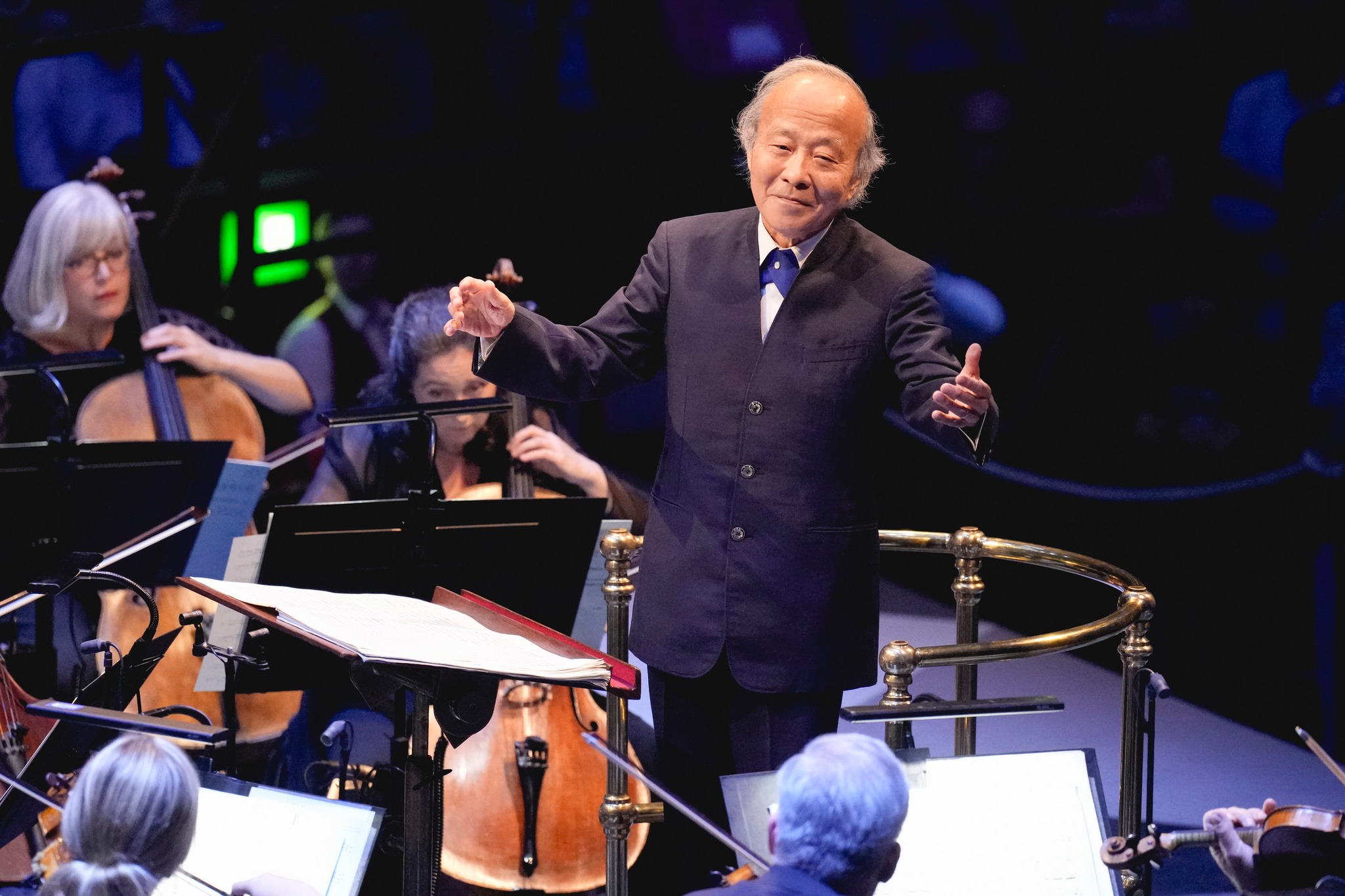
Prom 7 – Elena Urioste (violin), BBC National Orchestra of Wales / Tadaaki Otaka

Rachmaninoff (orch. Respighi) Five Études-tableaux (1911-17, orch 1930) [Proms premiere]
Coleridge-Taylor Violin Concerto in G minor Op.80 (1911-12)
Beethoven Symphony no.5 in C minor Op.67 (1807-08)

Royal Albert Hall, London
Wednesday 19th July 2023 [7pm]

by Richard Whitehouse photos by Andy Paradise / BBC

Tadaaki Otaka’s years at the helm of the BBC National Orchestra of Wales (1987-95) were a highpoint of the latter’s history, and it was good to see and hear the rapport between them now that he is Conductor Laureate being maintained throughout this evening’s programme.

Surprising that Respighi’s orchestration of five from Rachmaninoff’s sets of Études-tableaux had not been given at the Proms, but the respective 150th and 80th anniversaries of his birth and death provided an ideal opportunity. Otaka brought out the listless calm of The Sea and the Seagulls with its death-haunted aura, then conveyed the scintillating energy of The Fair. With its evocations of Orthodox chant and heady pealing of bells towards the close, Funeral March is the most imposing and Otaka gave it its due – not least by pointing up the deadpan humour of Little Red Riding Hood and the Wolf which provides greatest possible contrast. The sheer effervescence of March made a fitting conclusion to a sequence that, while other orderings are possible (not least 2-1-4-3-5), is a viable and a cohesive entity in its own right.

The resurgence of interest in Samuel Coleridge-Taylor continued apace with a revival of his Violin Concerto, 111 years after its UK public premiere at these concerts. Its composer’s last major work, this is a work audibly in the Romantic tradition and while the initial Allegro gets off to a less than promising start with its blousy and over-emphatic first theme, the resource with which the soloist elaborates both this and the insouciant idea that follows is as engaging as the cadenza underpinned by drum-roll is arresting. The central Andante is the undoubted highlight, its warmly confiding main melody capable of unexpected plangency as it unfolds, then the final Allegro draws on the Afro-American inflections of Coleridge-Taylor’s heritage in a spirited discourse whose climax sees an opulent restatement of the work’s opening theme.

A testing assignment such as Elena Urioste (after last year’s Proms debut with Ethel Smyth’s Double Concerto) gave with no little panache, her vivid while modest tone heard to advantage in Tom Poster’s eloquent take on Harold Arlen’s Over the Rainbow that was given as encore.

A staple of the Proms since its very first season 128 years ago, Beethoven’s Fifth Symphony comes so weighted with expectation as to make any performance in itself a provocative act. Eschewing astringency and portentousness, Otaka (rightly) rendered the initial movement as an elemental though unpredictable play on its indelible opening motif; the ensuing Andante pursuing an equally eventful course as its main theme evolves via a process of developing variation, the heroic and inquisitive held in unforced accord through to the decisive ending.

A pity that Otaka opted not to take the repeat in the Scherzo (rather than that of the finale) – its interplay between the ominous and the impetuous abetted by a transition of speculative intent. Here too there was never any risk of pomposity or overkill, Otaka steering this most visceral of symphonic finales through a development of bracing immediacy then on to a coda whose insistent C major reiterations were the outcome – no more and no less – of this movement’s innate potential. The undiminished relevance of this music was never for a moment in doubt.

For more on the 2023 BBC Proms, visit the festival’s website at the BBC. Click on the names for more information on the BBC National Orchestra of Wales, Tadaaki Otaka and Elena Urioste

BBC Proms 2023 – we’re underway…

Yesterday saw the start of the biggest festival in British classical music, the BBC Proms – broadcast live from the Royal Albert Hall.

Dalia Stasevska, guest conductor of the BBC Symphony Orchestra, led passionate Nordic music from Sibelius (the choral version of Finlandia with the BBC Singers and BBC Symphony Chorus, and a new arrangement of Snöfrid, narrated by actress Lesley Manville) and Grieg, whose evergreen Piano Concerto was given a new lick of paint by a wonderful interpretation from Paul Lewis.

Also featured was a Sibelian new work, Let There Be Light, from Ukrainian composer Bohdana Frolyak – a composer definitely worth seeking out in this evidence – and the concert closed with Britten‘s Young Person’s Guide To The Orchestra, with its triumphant fugal finale.

You can watch the Prom here on the BBC iPlayer:

https://www.bbc.co.uk/iplayer/episode/m001nr5b/bbc-proms-2023-first-night-of-the-proms

Arcana will be covering a good number of concerts as the season progresses, so check back through July and August to read more!

Online Concerts – The Cardinall’s Musick / Andrew Carwood: Byrd 400th anniversary

William Byrd
Masses for 4, 3 and 5 voices

The Cardinall’s Musick / Andrew Carwood

Wigmore Hall, London
Tuesday 4 July 2023

Reviewed by Ben Hogwood Photos (c) Benjamin Ealovega

This week we have been marking the 400th anniversary of the death of William Byrd, one of the founding fathers of English classical music as we know it today.

One of the key events on Tuesday, the day itself, was a trio of concerts at the Wigmore Hall from the Cardinall’s Musick choir and their conductor Andrew Carwood. Together they have recorded all of Byrd’s choral music for the Gaudeamus and Hyperion labels, but on this occasion the focus was the composer’s three Mass settings.

Context for these unique works is vital, and it was given by an extremely helpful and thorough note from Katherine Butler, bolstered by musical insight, and also from Carwood himself in well-chosen asides to the audience. Both illustrated vividly how perilous Byrd’s own position as a composer was, for as a Catholic he was compelled to write settings of the mass, despite knowing public airings of the music would be against the demands of his monarch, Elizabeth I, for whom he was royal composer. If discovered, these performances could bring about imprisonment and even death. Because of this, the works lay undiscovered in their largely anonymous packaging, used for very private occasions presided over by a priest who would even have his own bolthole, should the ceremony be discovered.

Byrd
Mass for 4 voices (c1592-3), with the Propers for the Feast of Easter Day

The Cardinall’s Musick [Patrick Craig, Matthew Venner (altos), William Balkwill, Mark Dobell (tenors), Richard Bannan, Robert Rice (baritones), Edward Grint, Nathan Harrison (basses)] / Andrew Carwood

The three Cardinall’s Musick concerts began with a lunchtime account of the Mass for Four Voices, dating from around 1592-3, and given context by in performance by Byrd’s settings of the Propers for Easter, completed in 1607. These began with a celebratory Introit, with its busy acclamation of the resurrection, with the mood changing for a solemn, weighty Kyrie from the Mass. This was given plenty of room by Carwood, with superb control from the singers in their sustaining of the notes. A fulsome Gloria followed, notable for its clarity of line and rhythm. Carwood was judicious in harnessing the ten voices available to him, reducing the forces to five for the Gradual & Alleluia. Here, the portrayal of ‘Mors et vita duello conflixere mirando’ (death and life have fought a huge battle)’ was vividly conveyed, before ‘et gloriam vidi resurgentis’ (‘and I saw the glory of the rising’) reached impressive heights.

The substantial Credo was paced just right, with a holding back from the ‘descendit’, with controlled lower notes to complement. A busy Offertory and graceful Sanctus were beautifully sung, the music gradually unfolding. The Communion (Pascha nostrum) was slow, appropriately reverent and pure, before the moving Agnus Dei had as its end a final chant and response telling us the Mass had finished.

Byrd
Mass for 3 voices (c1593-4), with the Propers for the Feast of Corpus Christi

The Cardinall’s Musick [Julie Cooper, Laura Oldfield (sopranos), Patrick Craig, Matthew Venner (altos), William Balkwill, Mark Dobell (tenors), Nathan Harrison (bass)] / Andrew Carwood

As Andrew Carwood explained, we heard some of the richest music in the first concert, then some of the most intimate in the second. This was music of the recusant house rather than the big church or cathedral, and Carwood invited us to imagine we were in a building no bigger than a sitting room. With Catholics shrouded in secrecy, he gave an idea of just how risky this music making was.

We heard the Mass For Three Voices, with a noticeable reduction in texture from the lunchtime concert, as well as less movement within the parts. That said, there was an air of restrained celebration all the same. A quick Kyrie & more florid Gloria was sung with two to a part, and while the single parts could be left exposed they were very secure in these hands, notably the tricky entries from on high. The Propers on this occasion were for the feast of Corpus Christi and were published in 1605. They featured a ‘risky’ Gradual, before a six-piece Credo found a lovely peak on the words ‘Et ascendit in caelum (and ascended into heaven)’ and a beautiful confluence at the end. There was a suitably thoughtful start to the Sanctus, which became more florid in its ‘Hosanna’ exultations. The Communion was outwardly expressive, retreating to a sombre Agnus Dei and a solemn final chant.

Byrd
Mass for 5 voices (c1594-5), with the Propers for the Feast of All Saints

The Cardinall’s Musick [Julie Cooper, Laura Oldfield (sopranos), Patrick Craig, Matthew Venner (altos), Ben Alden, William Balkwill, Mark Dobell (tenors), Edward Grint, Robert Rice (bass)] / Andrew Carwood

Finally the evening concert gave the Mass for Five voices with the Propers for the Feast of All Saints of 1605 – an effervescent celebration but becoming more meditative as the music proceeded. Carwood, revelling in the occasion, conducted with great sensitivity once again, presiding over a busy Introit with the rejoicing angels. The layered Kyrie of the Mass itself was ideally weighted, making the most of the chromatic possibilities, before a relatively restrained Gloria. The five voices, with increasingly complex writing, were nonetheless easy to follow, their rhythmic lightness suggesting a dance at the end of the Gradual – Carwood referring to the repartee between the voices.

He then referenced the intensity of Byrd’s writing, the declamation in the Credo and its extraordinary harmony, fusing of madrigal techniques into the mass. It was helpful to have these insights on top of the booklet notes, for Carwood setting Byrd apart as a composer even from the likes of Palestrina. The full ten-voice Credo explored deeply felt power and resonance, an incredibly expressive movement, while the purity of the sopranos shone through in the Offertory. A slow Sanctus gradually gathered pace with more complex writing, before the Communion – making explicit reference to the persecution Byrd felt, gave an appropriate stress to the words ‘propter iustitiam (for righteousness’ sake)’ and showed some well-handled dissonances. Finally an Agnus Dei of solemn, minor key angst found peace at last, capped by the closing sentence.

The choir and their conductor received a deservedly rapturous reception, for their beautiful and controlled singing had given Byrd the best possible remembrance, marking the death of this musical martyr in appropriate style. The Cardinall’s Musick and the Wigmore Hall should be applauded for such a well-conceived and executed trio of concerts, which are highly recommended for online viewing!

You can listen to the Cardinall’s Musick recordings of the Byrd Masses, dating from 2000, on the Spotify link below: