On Record: Sueye Park, Seoul Philharmonic Orchestra / Osmo Vänskä – Isang Yun: Violin Concerto III, Chamber Symphony I & Silla

Isang Yun
Silla (1992)
Violin Concerto III (1992)
Chamber Symphony I (1987)

Sueye Park (violin), Seoul Philharmonic Orchestra / Osmo Vänskä

BIS 2642SACD [67’13″]

Producer Robert Stiff Engineer Jin Choi

Recorded 30 August-3 September 2021, Lotte Concert Hall, Seoul, South Korea

Reviewed by Richard Whitehouse

What’s the story?

BIS makes a notable contribution to the growing Isang Yun discography with a judiciously chosen collection of orchestral pieces from his last years, performed with commitment and insight by the Seoul Philharmonic Orchestra under its recently departed music director Osmo Vänskä.

What’s the music like?

Most famous for his fractious relationship with the then military dictatorship of South Korea, Yun (1917-95) resided mainly in West Berlin from 1964 and built a sizable catalogue which effected a far-reaching synthesis of European modernist techniques with traditional Korean elements. At the forefront of the Western avant-garde during the 1960s, he latterly embraced more traditional genres – composing numerous symphonies, concertos and ensemble works such as extend and enrich this synthesis with engaging while frequently provocative results.

The First Chamber Symphony premiered in Güttersloh by the Deutsche Kammerphilharmonie Bremen and scored for early-Classical forces with pairs of oboes and horns alongside strings. Its three continuous sections outline an expected fast-slow-fast format – offset by the interplay of string groupings in the first section, then the emphasis on solo or chamber formations and contrasts of motion in those that follow. The final section moves towards a sustained passage of exquisite poise, before a sudden upsurge concludes the whole piece with terse decisiveness.

Premiered in Amsterdam by Vera Beths, the Third Violin Concerto follows a similar formal trajectory whose continuity is largely determined by greater or lesser contrasts in motion and emotion between its constituent episodes. Those of the opening section build to an intensive central climax, subsiding into a restive calm which takes on greater serenity in its successor; before the final section unfolds impulsively and with martial undertones towards the closing series of exchanges between violin and orchestra: the soloist has the conciliatory last word.

Subtitled ‘Legend for Orchestra’, Silla was Yun’s final such piece and premiered in Hanover by the Niedersächsisches Staatsorchester. Its title evokes connotations of home and origin – not least Korean court music from the earlier Medieval era, here alluded to within a context of nocturnal celebration. There are again three sections, though here the follow-through feels all but seamless while the orchestration enables a wide range of timbral and textural nuances – not least in a peroration as suggests an affirmation (understandably) rare in this composer.

Does it all work?

It does. Many of Yun’s latter works evince sufficient connections with the Western classical music of earlier eras to be accessible for mainstream audiences, with the pieces here being no exception. Sueye Park is assured and insightful in the concerto, while Vänskä secures playing that emphasizes the allure and iridescence of Yun’s orchestral writing. Over a quarter-century after the composer’s death and his music remains on the periphery of the modern repertoire, but releases such as this will secure it greater advocacy from younger musicians and listeners.

Is it recommended?

Very much so. The recording is as commendable in its clarity and definition as expected from BIS, as are Walter-Wolfgang Sparrer’s notes. One can only hope a follow-up release, perhaps featuring Konturen, the Oboe Concerto and the Second Chamber Symphony, is forthcoming.

Listen & Buy

For buying options, and to listen to clips from the album, visit the BIS website. For more information on Isang Yun, visit the Isang Yun International Society, and for more on the artists click on the names Sueye Park, Osmo Vänskä and the Seoul Philharmonic Orchestra.
In concert – Noriko Ogawa, English Symphony Orchestra / Kenneth Woods – Brahms, Grieg & Sibelius

Noriko Ogawa (piano), English String Orchestra / Kenneth Woods

Brahms Tragic Overture, Op. 81 (1880)
Grieg Piano Concerto in A minor, Op. 16 (1868)
Sibelius Symphony No. 5 in E flat, Op. 82 (1915-19)

Town Hall, Cheltenham
Sunday 16 April 2023

Reviewed by Richard Whitehouse

The English Symphony Orchestra’s latest concert had no English (or British) connection and no premieres or unfamiliar music. In short, a mainstream sequence of overture, concerto and symphony which worked as a programme simply because these pieces went so well together.

Although it has never lacked for performances, Brahms’s Tragic Overture remains among his more unusual conceptions: a concert overture whose deftly modified sonata design admits an element of evocation as if some intangible drama were being played out. It was to the credit of this performance when such subjection offset an otherwise unwavering formal trajectory, Kenneth Woods integrating the speculative central episode with a conviction that made the heightened reprise of the main theme the more telling for its implacably wrought fatalism.

Brahms’s writing of an overture with components as if ‘in the wrong order’ made an unlikely link to the Piano Concerto by Grieg, which still offers a wealth of surprises in a sympathetic reading. This it received from Noriko Ogawa – bringing out the unforced eloquence of what, the opening Allegro in particular, is much more than a loose sequence of enticing melodies in search of coherence. As her imaginative take on its cadenza underlined, Grieg left nothing to chance as the movement turns decisively full circle. With its easeful horn melody (courtesy of James Topp) and alluring solo response, the Adagio exuded an understated allure, and if the finale lacked for any rhythmic verve, the central section with its rapt flute melody (courtesy of Laura Jellicoe) sounded as affecting as its heightened peroration at the close was majestic.

The ESO and Woods are currently working towards a Sibelius cycle and their account of the Fifth Symphony had all the hallmarks of complete identity with, here again, a determination not to take to take anything in so familiar a work for granted. This was especially notable in the opening movement – its segueing between what began as two separate entities rendered with due seamlessness. Not least that central climax, out of which the scherzo emerged then proceeded to accrue motion imperceptibly through to a coda whose velocity was irresistibly evident. Much more than a whimsical interlude, the Andante had keen appreciation of those ambiguous shadows which inform its progress at crucial junctures, yet without undermining that guileless essence to the fore in the closing pages with their felicitous woodwind playing.

Making an attacca (and rightly so) directly into the finale, Woods brought out the productive contrast between its ideas – thus, the initial theme with its onrushing strings, then the ‘swan melody’ with its harmonic allure and intricate textural layering abetted here by the up-front acoustic of Cheltenham Town Hall. Just how so tensile and compact a movement generates an apotheosis of such grandeur cannot easily be explained, yet such an outcome was tangible as those concluding chords emerged with an inevitability as undeniable as it was heartening.

They certainly set the seal on an impressive performance which was warmly received by the sizable house. The ESO can be heard in Worcester early next month with assistant conductor Michael Karcher-Young, then with Woods in June for the latest edition of The Elgar Festival.

For more information on the artists in this concert, click on the links to read about Noriko Ogawa Kenneth Woods and the English Symphony Orchestra.

In concert – Behzod Abduraimov, CBSO / François Leleux – Rachmaninoff: Piano Concerto no.2; Brahms: Serenade no.1 & Academic Festival Overture

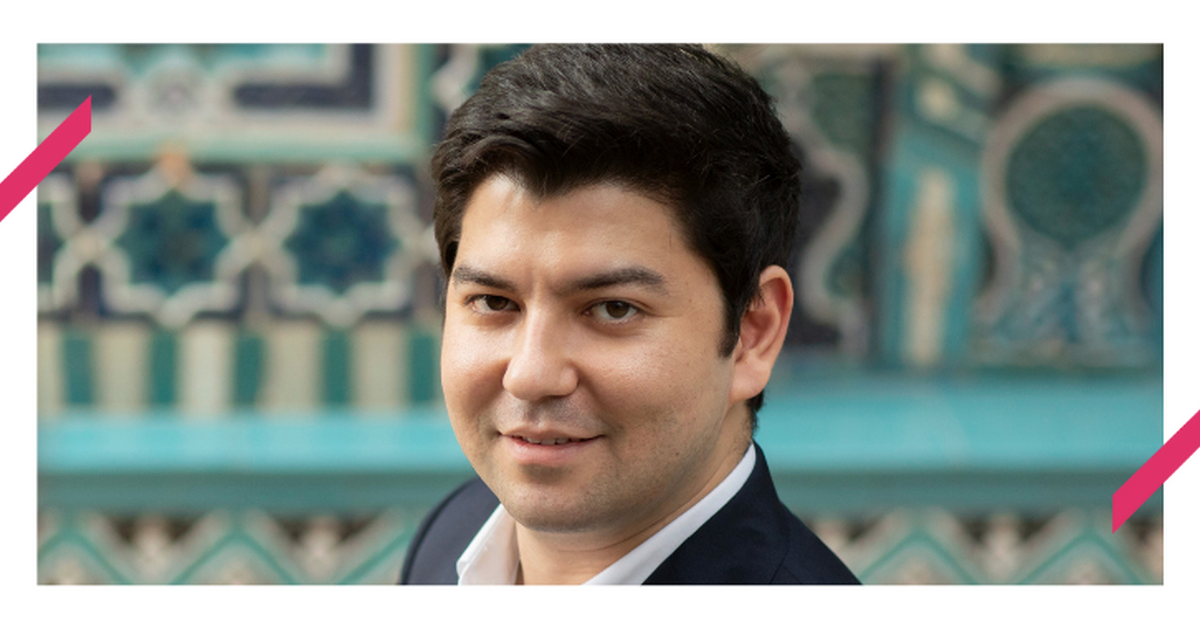
Behzod Abduraimov (piano, above), City of Birmingham Symphony Orchestra / François Leleux (below)

Brahms Academic Festival Overture Op. 80 (1880)
Rachmaninoff Piano Concerto no.2 in C minor Op.18 (1900-1901)
Brahms Serenade no.1 in D major Op.11 (1858-9)

Symphony Hall, Birmingham
Thursday 13 April 2023

Reviewed by Richard Whitehouse

Its first concert since returning from a European tour saw the City of Birmingham Symphony Orchestra in a programme which tellingly placed Rachmaninoff’s most famous composition within the context of less often heard or uncharacteristically (?) humorous pieces by Brahms.

Cinematic and other extra-musical associations often obscure the purely musical qualities of Rachmaninoff’s Second Piano Concerto, so credit to the Uzbek pianist Behzod Abduraimov for duly underlining these in a reading full of incident and unfailingly cohesive. Among the former might be mentioned the limpid elegance of the first movement’s second theme and its improvisatory continuation before the coda, bewitching transition from the Adagio’s central scherzo back to the main melody, and those evocative interludes after the finale’s ‘big tune’ – this latter returning to cap the whole work in unforced ardour. Integration between piano and orchestra was unfailing, as too the emotional immediacy of the CBSO’s response, and who could question Abduraimov’s decision not to provide an encore after so fine a performance.

Rachmaninoff and Brahms seldom complement each other in concert, though the Academic Festival Overture provided an ideal curtain-raiser. Typically more than a potpourri of student songs (drinking or otherwise), the cunningly fashioned sonata design was deftly unfolded by François Leleux so that its portentous and uproarious elements were held in perfect accord. The percussion audibly relished its rare outing in a Brahms score, not least at the close when the hymn-like ‘Gaudeamus igitur’ emerges to see this piece through to its exhilarating close.

Following the interval, a relatively infrequent hearing for Brahms’s First Serenade. Originally planned for chamber ensemble and later rescored for late-Classical forces (with four horns), its equivocally symphonic ambitions and proportions were inevitably overshadowed by what Brahms went on to achieve, but its musical attractions are many and Leleux had its measure. Not least during an initial Allegro, its dextrous horn theme setting the tone for a movement whose impetus was engagingly maintained through to the touching insouciance of its coda.

Omitting repeats in this movement’s exposition and the first half of the Scherzo – which latter anticipates Brahms’s intermezzos in its speculative aura and understated progress – ensured a viable balance with the Adagio. A pre-echo of slow movements to come, the observance of its ‘non troppo’ marking prevented any loss of expressive focus across the methodically evolving whole. If the remaining movements are closer conceptually to serenade rather than symphony, Leleux gave them their due – whether the twin Menuettos with their enticing contrast between woodwind and strings, a second and more rhythmic Scherzo with rustic horn writing here and in the trio, then the final Rondo in which Brahms looks back to those comparable movements from early Beethoven and Schubert with a lack of inhibition he was only rarely to recapture.

Such was the effect of an account that received an enthusiastic response from the near-capacity house. The CBSO strings take the stage next Saturday for a coupling of Schubert arranged by Mahler and Vivaldi interspersed with Piazolla, directed by their leader Eugene Tzikindelean.

You can read all about the 2022/23 season and book tickets at the CBSO website. Click on the artist names for more on Behzod Abduraimov and François Leleux

In Concert – BBC Singers @ St Giles’ Cripplegate & St Paul’s Knightsbridge

by John Earls

It has been quite a time for the BBC Singers recently. As this world-renowned choir approaches its 100th anniversary, the past few weeks have seen the BBC announce their closure, and magnificent campaign against it in response (including more than 700 composers writing to the BBC director general in condemnation) Here on Arcana you can get a glimpse of their recorded worth, with an appreciation and a BBC Singers playlist.

Thankfully a temporary reprieve has since been issued, with the BBC issuing a statement on an “alternative funding solution”.

All of this was book-ended by two concerts of sacred music broadcast on BBC Radio 3 for Holy Week, both demonstrating what a unique and valuable choir they are.

On 17th March they gave their first concert following the BBC’s shameful axing announcement at St Giles’ Cripplegate in London. It was inevitably a special and emotional occasion. The programme of choral and cello music went under the bitterly ironic title of All Will Be Well (after Roxanna Panufnik’s piece of the same name which concluded the programme). “I’m still the producer of the BBC Singers” said Jonathan Manners in his introduction to much applause.

The concert was a fitting example of the range and depth of the choir’s repertoire in terms of time (it opened with Hildegard von Bingen’s O cruor sanguinis from the 12th Century) and style. It displayed impressively their ability to convey a sense of comfort and balm such as in Lesia Dychko’s short piece Blessed be the name (Emma Tring a beautiful solo soprano) as well something more unsettling like Fac me tecum pie flere by Sven-David Sandström.

But this was a programme of choral and cello music and cellist Benjamin Hughes was individually expressive as well as combining powerfully with the choir, both in evidence in Knut Nystedt’s Stabat Mater.

A magnificent encore of Maurice Duruflé’s motet Ubi Caritas was followed by a rapturous and moving ovation (below)

The concert was broadcast on BBC Radio 3 on Palm Sunday and is available online for a limited period.

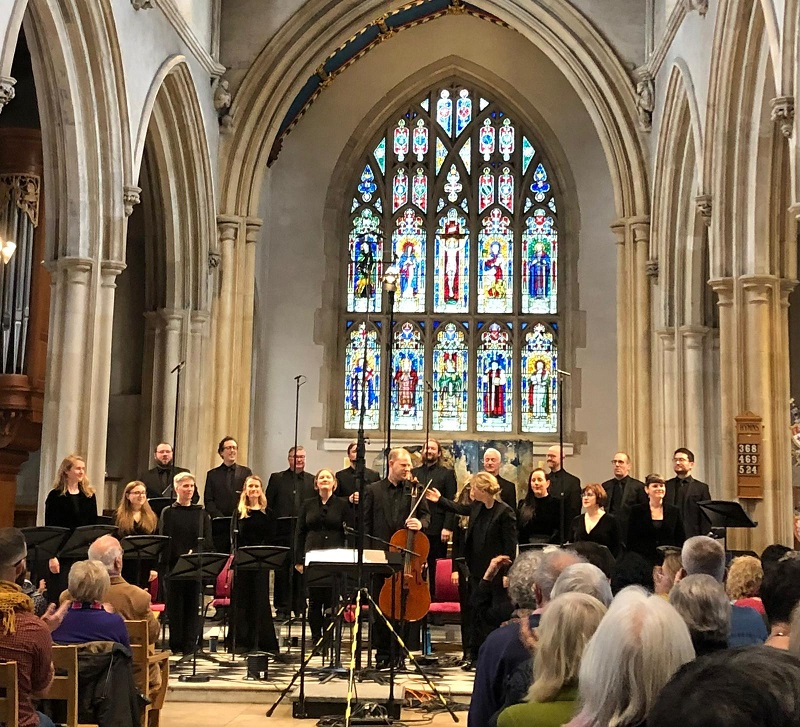
Less than three weeks later, and following the BBC statement announcing a suspension of the closure, the group performed a Music for Maundy Thursday concert of sacred pieces on the theme of ‘contemplation, sorrow and reflection’ for live broadcast on BBC Radio 3 at St Paul’s Church, Knightsbridge, London (above).

Yet again the programme highlighted the sweep of their repertoire opening with a meditative motet from the 1590s, Vittoria Aleotti’s Miserere mei, Deus (from the first published book of sacred music by a woman) and also featuring sacred pieces from the 21st Century (Karin Rehnqvist’s I raise my hands and Judith Bingham’s Watch with Me), as well as William Byrd’s 14th Century The Lamentations of Jeremiah.

But there were two pieces where the group really shone to spectacular effect. Domenico Scarlatti’s Stabat Mater à 10, with Richard Pearce on chamber organ, was stunning and utterly compelling in its detailed delivery. Francis Poulenc’s Quatre motets pour un temps de penitence made a glorious finale.

One must also acknowledge the key role of Chief Conductor, Sofi Jeannin, always assured yet empathetic. To watch her conduct is a mesmerising experience in itself.

The extent to which the BBC Singers and Jeannin develop and promote a diverse repertoire (they have a 50:50 gender policy for composers whose music they perform), engage in learning and community work, regularly perform commissions and broadcast on Radio 3 (making their phenomenal output available to such a wide audience) is all part of what makes them so unique.

I have seen them many times over many years and they never fail to move me. These two concerts only served to prove just why they are irreplaceable.

John Earls is Director of Research at Unite the Union and tweets at @john_earls

Click on this text to find out more about the Musicians’ Union campaign to protect the BBC Singers after September and action to stop job cuts at BBC Orchestras

Online concert – English String Orchestra / Kenneth Woods: Elgar Festival 2022 – In The South

Elgar In The South (Alassio) Op.50 (1903-4)

English Symphony Orchestra / Kenneth Woods

Filmed at Worcester Cathedral, Saturday 4 June 2022

by Richard Whitehouse

The English Symphony Orchestra’s concerts at last year’s Royal Jubilee Elgar Festival have already yielded several online performances of note, with In the South perhaps the finest yet in terms of vindicating a work that can all too easily fall victim to its seeming ‘indulgencies’.

The main issue is in setting a tempo flexible enough to accommodate this concert overture’s extended sonata design without it becoming episodic. At around 24 minutes, this unhurried take was mindful of Worcester Cathedral’s expansive acoustic and utilized it to the music’s advantage. The surging initial theme, its speculative transition and suave second theme duly emerged with a formal continuity – the underlying tension carried through to a development whose impulsiveness was maintained despite (even because of?) the intervening first episode.

Evoking the grandeur of ‘empires past’, this episode necessitates astute handling so that its implacability avoids bathos. Kenneth Woods judged it accordingly, and if his tempo for the second ‘canto populare’ episode felt just a little reticent, its expressive raptness (along with Carl Hill’s playing of its indelible viola melody) more than compensated. Nor was there any loss of continuity across the reprise of the opening themes, with Woods’ gradual building of momentum at the start of the coda ensuring an irresistible but never overbearing apotheosis.

Certainly, the response suggested anyone who may previously have harboured doubts about this piece was won over on this occasion. Further evidence of this orchestra and conductor’s empathy with this music as augers well for the First Symphony at this year’s Elgar Festival.

This concert could be accessed free until 4 April 2023 at the English Symphony Orchestra website, but remains available through ESO Digital by way of a subscription. Meanwhile click on the names for more on the English Symphony Orchestra and Kenneth Woods