BBC Proms – Víkingur Ólafsson, Philharmonia / Paavo Järvi: Bach, Mozart, Prokofiev & Shostakovich

olafsson-jarvi

Víkingur Ólafsson (piano), Philharmonia Orchestra / Paavo Järvi

Prokofiev Symphony no.1 in D major Op.25 ‘Classical’ (1916-17)
J.S. Bach Keyboard Concerto in F minor BWV1056 (c1738-9)
Mozart Piano Concerto no.24 in C minor K491 (1786)
Shostakovich Symphony no. 9 in E flat major Op.70 (1945)

Royal Albert Hall, London
Saturday 14 August 2021

Written by Richard Whitehouse

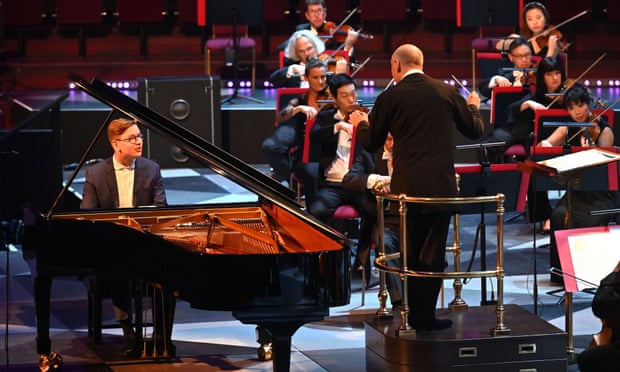
Tonight’s Prom brought change of conductor, the always reliable Paavo Järvi stepping in for Santtu-Matias Rouvali in what would have been the latter’s Proms debut, but not of soloist – Icelandic pianist Víkingur Ólafsson duly making his first appearance at these concerts with concertos which, for the most part, played to his strengths.

The number of times that Bach’s keyboard concertos have been heard here on piano in recent decades can be counted on the fingers on one hand (Tatiana Nikolayeva’s D minor resonates in the memory), but that in F minor was a good choice in terms of its succinctness – the outer movements pitting soloist and (sizable body of) strings against each other with a trenchancy as was vividly conveyed here, with the central Andante an oasis of serenity that was not without its plangent asides.

Placing this piece before the interval, however, made for a distinctly short first half – given the relative length of Mozart’s C minor Concerto after the interval. There were many good things in this latter, Ólafsson keeping the first movement on a tight yet never inflexible rein so that its inclination to pathos – if not always its portentous undertones – came through in ample measure; not least in a coda that had been cannily prepared by the soloist’s cadenza. The central Larghetto was none the less the highlight – Ólafsson varying his tone such that piano melded into the woodwind for an early and defining instance of timbral colouration, with its limpid elegance never undersold. Maybe the finale was a little staid in the overall unfolding of its variations, but the coda’s strangely ambiguous poise was tangibly realized.

An auspicious debut, then, for Ólafsson, who underlined his prowess with affecting readings of the slow movement of Bach’s Fourth Organ Sonata (BWV526) in August Stradal’s chaste transcription and Liszt’s not unduly mawkish version of Mozart’s Ave Verum Corpus (K617). These further extended the disparity between each half – the first of which had commenced with Prokofiev’s ‘Classical’ Symphony, not in the least small of scale or mimsyish as Järvi heard it; witness his acerbic and impetuous take on the initial Allegro, trumpets and timpani to the fore, then a Larghetto whose swift underlying tempo left little room for any harmonic piquancy to emerge. The Gavotte was slightly marred by several mannered agogics which tended to impede its rhythmic profile, but the Finale lacked little in sparkle or insouciance.

Among the most travelled and recorded conductors of today, Järvi can seem detached or even aloof in manner – but there was no such reticence evident in Shostakovich’s Ninth Symphony as ended this programme. After a tensile and assertive Allegro, which audibly benefitted from the sizable forces onstage, the Moderato recalled Efrem Kurtz’s classic recording as to overall restraint and a dark-hued introspection rising to anguish in its twin climaxes. Playing without pause, the other movements were of a piece with the foregoing – a driving and almost manic Presto subsiding into a Largo, whose ruminative bassoon soliloquys were eloquently taken by Emily Hultmark, then an Allegretto whose capriciousness was acutely gauged through to its bitingly sardonic climax and breathless final payoff. Undoubtedly a performance to savour.

You can find more information on the BBC Proms at the festival’s homepage

BBC Proms – Dame Sarah Connolly, BBC SO / Brabbins: Berlioz, Payne & Beethoven

sarah-connolly

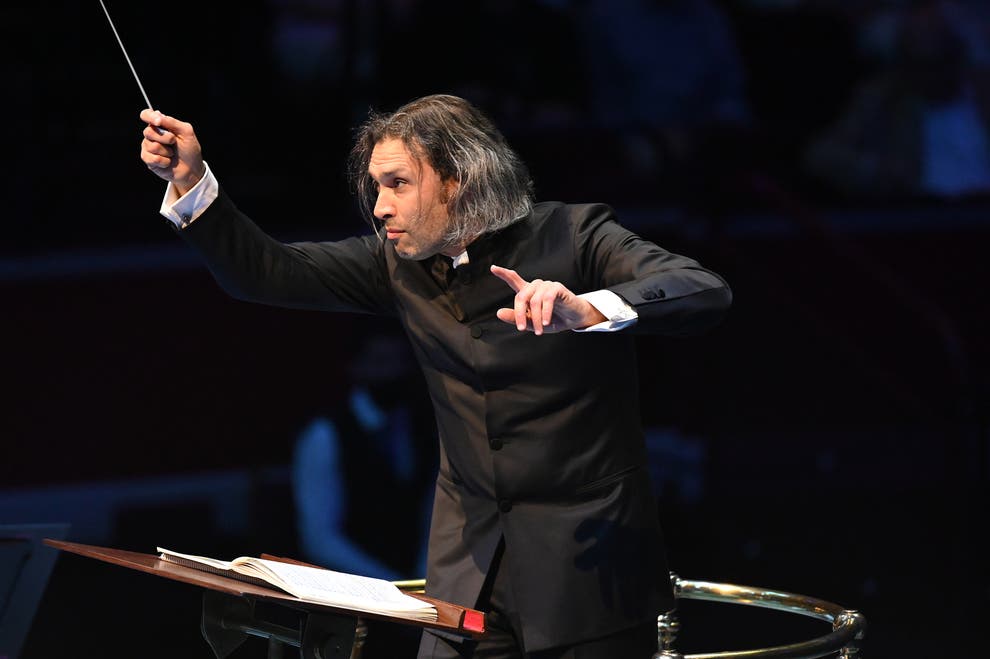
Dame Sarah Connolly (mezzo-soprano, above), BBC Symphony Orchestra / Martyn Brabbins (below)

Payne Spring’s Shining Wake (1980-81) (Proms premiere)
Berlioz Les nuits d’été Op.7 (1840-41, orch. 1856)
Beethoven
Symphony no.6 in F major Op.68 ‘Pastoral’ (1808)

Royal Albert Hall, London
Friday 13 August 2021

Written by Richard Whitehouse

A family bereavement meant that Sir Andrew Davis was unable to conduct this Prom, the baton having been taken up by Martyn Brabbins – whose currently in-demand status is a reflection not least of his broad range of musical sympathies and an inherent ability to ‘get things done’.

Not too many conductors would have taken on at relatively short notice a long-unheard piece by the late lamented Anthony Payne then render it with the familiarity of a repertoire staple. Seemingly unheard for 15 years, Spring’s Shining Wake was a breakthrough piece in several respects: the composer fashioning a ‘contemporary’ yet never esoteric idiom, unencumbered by stylistic precedent, as reflected his love of an earlier generation of English music. Delius’s In a Summer Garden is a focal-point in several respects, but what comes over most strongly in its modest scoring (seven wind, one percussionist and strings) is a sense of organic growth from the overtly static formal framework; textures diversifying and intensifying, yet without changing as to their essential features, in music exemplifying the ‘same yet different’ maxim.

From there to the limpid Romanticism of Berlioz’s song-cycle Les nuits d’été is nearer than might be imagined, this latter being notable for its range of expressive nuance despite (even because of) its pervasive restraint. Certainly, there was no uniformity of response from Dame Sarah Connolly – whose whimsical response to Villanelle contrasting with the wide-eyed fantasy of Le spectre de la rose, and becalmed rapture of Sur les lagunes thrown into relief by the fervent heartache of Absence then the spectral imaginings of Au cimetière; itself finding purposeful response in the animated L’île inconnue with its vouchsafing new imaginative realms. Coordination between soloist and orchestra is paramount throughout, and there was no lack of that in a reading as conveyed this music’s potent sensibilities with acute insight.

Nor was there anything routine about Beethoven’s Pastoral after the interval. Readers may remember a cycle of all nine symphonies which Brabbins (above) gave with the Salomon Orchestra just over a decade ago, and his purposeful if never inflexible take on the opening movement left room for its reflective asides and heady flights of fancy. This was no less evident in the Scene by the brook, with its emphasis on seamlessness of transition and unity of content – not least in the way those bird-calls of the coda were integrated into their textural context.

Unfolding with consistency of pulse, the remaining three movements yielded few surprises but no failings. A touch of blandness in the scherzo was duly countered with the immediacy   of the Thunderstorm and its nexus of accrued emotion whose dispersal makes possible the Shepherd’s Song – less cumulative in its eloquence than others have made it, perhaps, but whose inevitability of progress was sustained through to a close of serene poise; underlining the degree to which any trace of ego has been sublimated in the enveloping cosmic dance.

Some elegant and characterful playing from the woodwind of the BBC Symphony Orchestra was a highlight of this performance, a reminder that even a work with a Proms tally running to several dozen never need sound routine when approached with such unaffected reverence.

For further information on the music of Anthony Payne, visit the composer’s website. You can find more information on the BBC Proms at the festival’s homepage

BBC Proms – Steven Isserlis, LPO / Jurowski: Stravinsky, Bach, Walton & Hindemith

jurowski-proms

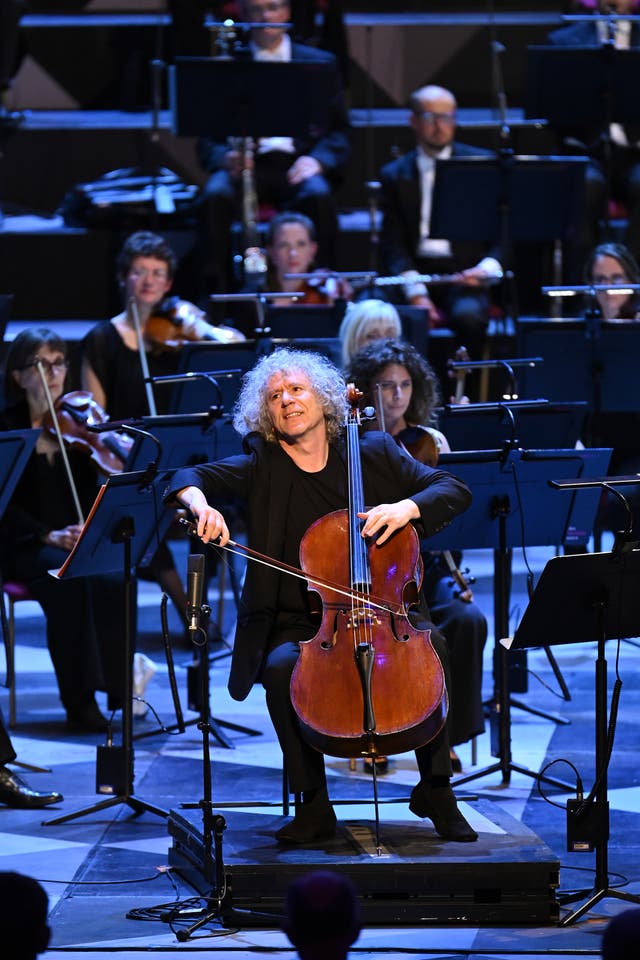
Steven Isserlis (cello, below), London Philharmonic Orchestra / Vladimir Jurowski (above)

Stravinsky Jeu de cartes (1935-6)
Walton
Cello Concerto (1955-6)
Bach (arr. Goldmann)
14 ‘Goldberg’ Canons BWV1087 (1742-4 arr. 1977)
Hindemith
Symphony ‘Mathis der Maler’ (1933-4)

Royal Albert Hall, London
Thursday 12 August 2021

Written by Richard Whitehouse; pictures (c) Chris Christodoulou

Vladimir Jurowski this evening concluded his highly impressive 14-year tenure as Principal Conductor of the London Philharmonic Orchestra with a thoughtfully conceived and well-proportioned programme; one which typically played to this orchestra’s strengths as much as to his own.

Although it can seem something of an ‘also-ran’ in the context of his compositions from the period, Stravinsky’s Jeu de cartes lacks for little in terms of that rhythmic effervescence as was engagingly evident in this performance – Jurowski pointing up the humour and even occasional glimmers of pathos that inform what can easily seem music written on autopilot. The LPO responded with a trenchancy and alacrity as held good throughout this ‘ballet in three deals’, the tonal punning of whose culmination at least ensures a humorous outcome.

Walton’s Cello Concerto used to be regarded with even less favour than Stravinsky’s ballet, but this piece (written by its composer at much the same age) is now seen as more than the enervated recycling of past success. Steven Isserlis (above) has long advocated its cause, and there was little doubting his commitment in a reading of perceptiveness and finesse. At times his spare and even fragile tone tended to recede into even so restrained and transparent as this, Jurowski mindful to rein in those brief climactic moments of the outer movements, but the artful interplay of the central scherzo did not lack for incisiveness or irony. Nor, after the second of the solo variations in the finale, was there any absence of rapture as soloist and orchestra are reconciled in drawing the music through to its close of fatalistic acceptance.

After the interval, a novelty in an arrangement by composer-conductor Friedrich Goldmann (1941-2009) of the 14 canons latterly identified from Bach’s printed copy of his Goldberg Variations. Arranged for a Stravinskian post-classical orchestra, these intricate and arcane studies in canonic dexterity emerge from gentle aridity to luminous elaboration with spare, methodical elegance such as intrigues and disengages in equal measure. Hardly something one expected to hear at such an occasion or this venue, though worth hearing all the same.

In its reiterating the values of Enlightenment humanism, moreover, this prepared admirably for Hindemith’s Symphony ‘Mathis der Maler’; premiered on the cusp of Germany’s descent into barbarous self-destruction, and a plea from the committed – however reluctantly – artist for a rational response as might be worth emulating today. The alternately radiant and tensile unfolding of Concert of Angels was perfectly judged, as too the plaintive resignation of the brief if affecting Entombment. The Temptation of St Anthony then made for an elaborate finale, but Jurowski paced it superbly – the plangent central interlude thrown into relief by the impassioned episodes on either side, then its anguished introduction by an apotheosis whose ultimate wresting of triumph from adversity remains thrilling as a statement of artistic intent.

A performance to savour, then, not least as John Gilhooly presented Jurowski with the Gold Medal of the Royal Philharmonic Society in recognition of services to music – an accolade with an illustrious history, which can rarely have been more deserved than on this occasion.

You can find more information on the BBC Proms at the festival’s homepage
Live review – April Fredrick, David Stout, English Symphony Orchestra / Kenneth Woods: Bartók – Bluebeard’s Castle

mahler-9-woods

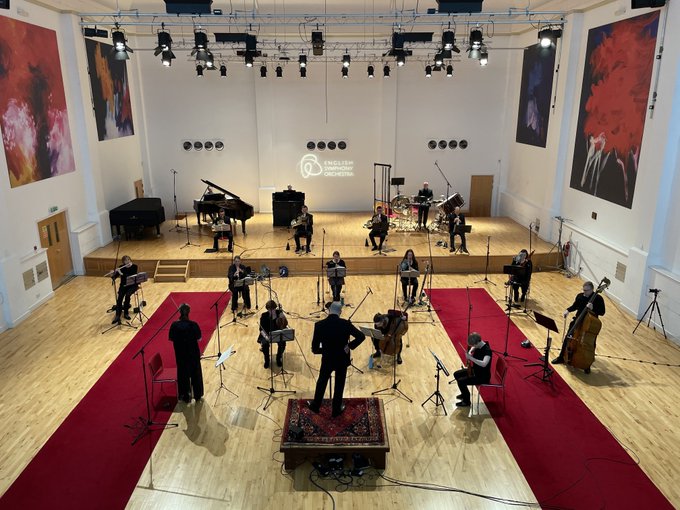
April Fredrick (soprano, Judith), David Stout [baritone (Bluebeard) / speaker (Prologue)], English Symphony Orchestra / Kenneth Woods

Bartók arr. van Tuinen / Karcher-Young Bluebeard’s Castle (1911/12)

Wyastone Concert Hall, Monmouth
Recorded June 16-17 2021 for online broadcast, premieres 13 August 2021

Written by Richard Whitehouse

The English Symphony Orchestra’s season of online concerts drew to its close tonight with a performance of Duke Bluebeard’s Castle, the only opera by Bartók and seminal work on the cusp between the late-Romanticism and nascent Modernism from the early twentieth century.

While its libretto by Béla Balázs is susceptible to interpretation, that concerning the ultimate impossibility of meaningful human communication is surely the decisive factor for Bartók’s setting of what became his longest work and his most explicitly personal statement. Yet this emotional scope never results in a lack of formal cohesion or expressive focus, ensuring that the duo-drama unfolds both inevitably and inexorably towards a fateful denouement that – by no means coincidentally – brings the piece full circle in terms of its underlying introspection.

A piece, then, of epic sweep but whose climactic moments only rarely dominate music that is (surprisingly?) well suited to reduction of a kind undertaken here by Christopher van Tuinen and revised by Michael Karcher-Young. The 25-strong ESO copes ably with those undulating contrasts in mood and texture that underpin the traversal of the protagonists through the castle and its environs, through to a culmination whose outcome feels no less tragic for having been ordained almost from the outset – a fable of disillusion whose impact comes across unscathed.

Of course, such considerations are relative to the success of the two singers in conveying the range of their respective roles. Whether or not she had previously sung that of Judith, April Fredrick has its full measure as she moves from confidence, via wariness and imploration, to reluctant acceptance of the part she must play in the completion of a journey that other wives have undergone before her. Rendered with vibrancy but no lack of finesse, this is a perceptive assumption, and one which Fredrick will hopefully be able to repeat on stage before too long.

Not that David Stout is necessarily upstaged in his portrayal of Bluebeard – emerging here as no misogynist, still less a murderer, than a conflicted figure whose avowals of love can never outweigh those inherent failings of self that have led to his repeating the same pattern of loss as before. Having previously taken on the spoken Prologue with thoughtful anticipation, Stout projects the role with no mean impetus as well as a keen eloquence that comes to the fore in those fateful later episodes when the sixth and seventh doors have almost to be prized open.

Otherwise, the ESO plays to its customary high standards throughout a score which, if never as radical as works of this period by Schoenberg or Stravinsky, remains a testing assignment with the integration of overtly expressionist tendencies into music of a Straussian opulence. This reduction loses little in either respect, due notably to a piano part as achieves more than textural filling-in then a harmonium part adding substance and atmosphere in equal measure. Kenneth Woods paces these 65 minutes with an acute sense of where the drama is headed.

Indeed, the only real proviso is the end-credits being accompanying by music from earlier in the opera. Surely it would be possible to have silence for the one minute it takes for these to ‘roll’? Otherwise, this is an excellent conclusion to a worthwhile season of online concerts.

You can watch the concert on the English Symphony Orchestra website here

For further information on future English Symphony Orchestra concerts, click here. ‘Fiddles, Forests and Fowl Fables’ is now available from the English Symphony Orchestra Website.

In concert – CBSO / Mirga Gražinytė-Tyla: Ruth Gipps, Adès & Brahms

City of Birmingham Symphony Orchestra / Mirga Gražinytė-Tyla

Gipps Symphony no.2 Op.30 (1945)
Adès
: The Exterminating Angel Symphony (2020) [CBSO Centenary Commission: World premiere]

Brahms Symphony no.3 in F major Op.90 (1883)

Symphony Hall, Birmingham
Wednesday 4 August 2021

Written by Richard Whitehouse

This unexpected yet worthwhile addition to the City of Birmingham Symphony Orchestra’s season saw the revival of two works recently heard along with a belated premiere – twice postponed – for one of the most notable among the orchestra’s impressive roster of Centenary Commissions.

Its UK premiere guardedly received four years ago, Thomas Adès’s third opera felt limited as to provocative intent by the difficulty of transferring its theme of Spanish religious fascism to a different era. What was undeniable is the suitability of its numerous orchestral passages to being rendered in a more abstract context, hence The Exterminating Angel Symphony heard tonight. Its four sections arguably amount to a symphonic suite rather than symphony per se, yet their formal follow-through undoubtedly makes for a cohesive and finely balanced entity.

Mirga Gražinytė-Tyla evidently thought so – obtaining an incisive response in the ‘Entrances’ music whose expressive ambivalence intensifies second time around, then a virtuosic one in ‘March’; its malevolence building over a remorseless side-drum tattoo in a vivid foretaste of what lies ahead. Although it draws on one of the opera’s love-duets, ‘Berceuse’ seems a little unyielding in its emotional content despite the allure of scoring as was always apparent here.  It remains for ‘Waltzes’ (following without pause) to provide a suitable finale and, while this extended and ingeniously organized sequence of fragments from across the opera undeniably evokes a notable precedent in terms of its inexorable motion toward ultimate catastrophe, the animation and sheer panache of the CBSO’s playing brought about a suitably emphatic close.

Before this MGT again made a persuasive case for the Second Symphony by the orchestra’s one-time oboist Ruth Gipps, the contrasted sections of its single movement – a martial scherzo and eloquent Adagio framed by an ambivalent Moderato and cumulatively energetic Allegro – audibly unfolding as variations on an evocative theme heard at the start. An autobiographical aspect, concerning personal aspirations near the end of war, explains this piece’s confessional nature. Whether or not it will undergo several further decades of neglect remains to be seen.

After the interval came Brahms’s Third Symphony, which orchestra and conductor had given before the lockdown last December. Tonight, however, the first movement (exposition repeat taken) was purposefully controlled with real cumulative thrust, a less than decisive transition into the reprise affording the only lapse in momentum prior to a coda of unfettered eloquence. The Andante was once again unerringly shaped in terms of its ruminative contrasts, and if the third movement had now become a little torpid, this hardly affected its unforced pathos. MGT rightly made the finale the culmination in every sense, her tautening of tension at the apex of its development yielding as tangible an expressive frisson as did the coda – where the work’s main motif descends as if from afar to secure the most transfigured of emotional touchdowns.

A memorable addition to an inevitably truncated yet memorable (and for all the right reasons) season, which the CBSO repeated at the Proms the following night. Beyond that, the autumn portion of its 2021/22 season has just been announced.

You can find information on the CBSO’s new season here.