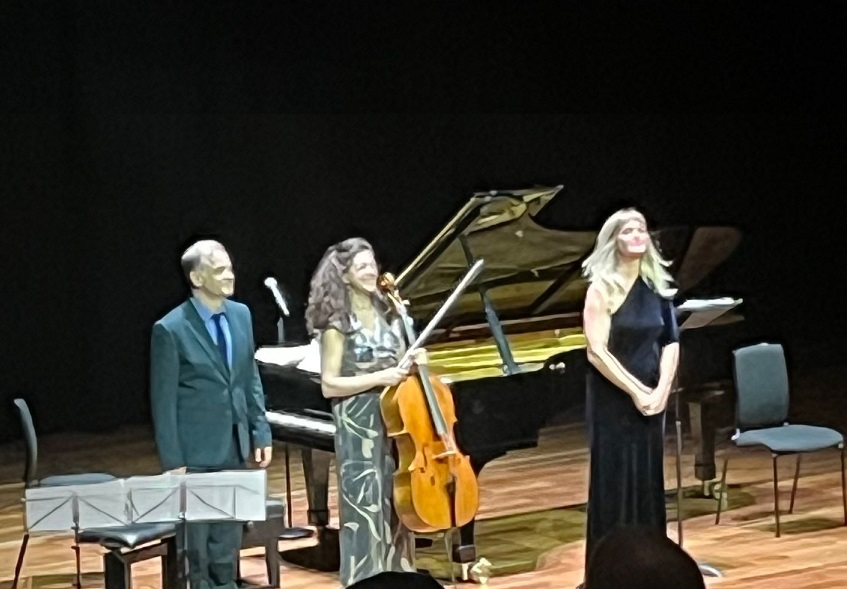
In concert – Ensemble intercontemporain – Boulez 100 @ The Barbican

Ensemble intercontemporain / Nicolò Umberto Foron, NikNak (turntables), tyroneisaacstuart (choreographer & dancer), Julien Creuzet (visuals), Nathan England-Jones (electronics technical support)

Hannah Kendall shouting forever into the receiver
Cassie Kinoshi [untitled]
Pierre Boulez Sur Incises

Barbican Hall, London, 27 May 2025

by John Earls. Photo credits (c) John Earls

Billed as part of the Boulez 100 series* to celebrate what would have been Pierre Boulez’s 100th birthday year, it was exciting to see a concert by Ensemble intercontemporain, the group the great iconoclast founded in France in 1976 (I can’t help but also tell you that this was with the support of the then French Secretary of State for Culture).

Recognising Boulez’s championing of new voices, the programme combined a classic Boulez piece with new works by two younger generation British composers. First up was Hannah Kendall’s shouting forever into the receiver. The title comes from Ocean Vuong’s novel On Earth We’re Briefly Gorgeous and refers to the description of a tiny plastic toy soldier yelling into its handheld radio transceiver. In this piece, spoken extracts, initially from the Book of Revelation and then verses from Ezekiel, are passed back and forth between two performers using walkie-talkie radios and sat on opposite sides of the stage. This is combined with arresting musical accompaniment including pre-programmed music boxes playing familiar works such as Beethoven’s Ode to Joy, dampened piano and a contemplative harmonica chorale. It was a fascinating opening 15 minutes.

Second on the programme was the world premiere of composer, arranger and saxophonist Cassie Kinoshi’s [UNTITLED]. Inspired by Boscoe Holder, the Trinidadian artist, dancer, choreographer and musician it “pays tribute not only to historic Caribbean artforms…but also to the continued evolution of these forms in modern diasporic contexts”. This is reflected in this multi-disciplinary piece combining music, choreography, improvisation, technology and visual art “embracing the kind of fluid creativity that Boscoe Holder explored throughout his lifetime”.

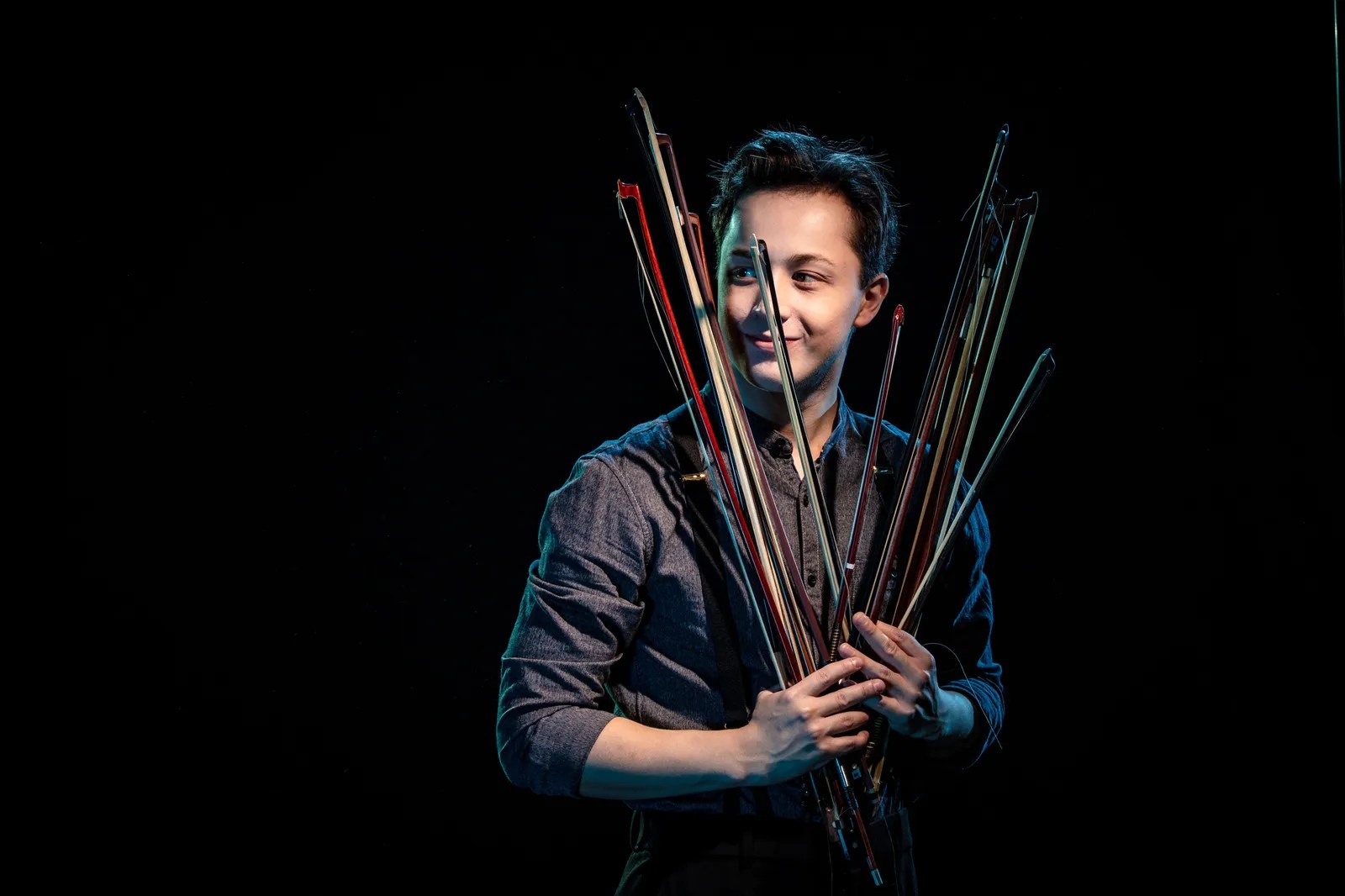
At the very start choreographer and dancer tyroneisaacstuart circles the stage before literally passing on the baton to conductor Nicolò Umberto Foron (currently Assistant Conductor of the London Symphony Orchestra). Throughout the evening Foron’s angular gestures complemented the music perfectly. Something of a dance in itself.

tyroneisaacstuart’s own dancing involved spins, weaving through sections of the orchestra, running on the spot and at one point appearing to hit a forcefield during a dramatic build-up of repetitive beats. Rhythm featured strongly throughout the piece including beats from NikNak on turntables (Nathan England-Jones provided electronics technical support) and we were frequently never far from an albeit eclectic dancefloor.

The dancer was all dressed in white contrasting with the fiery red visuals (by Julien Creuzet) on a large screen featuring the slower movements of blurred figures. Kinoshi’s intention is that the “on-stage presence invites the audience to not only hear but to see rhythm”. I don’t know whether when the orchestra, dancer and visuals are on stage together it makes it difficult to focus properly, but at times it felt a bit too busy. That said it is a stimulating and brave piece.

[left to right: Cassie Kinoshi, Nathan England-Jones, NikNak, Nicolò Umberto Foron, tyroneisaacstuart]

After the interval, nine members of the Ensemble performed Pierre Boulez’s Sur Incises (1996-1998) for three pianos, three harps and three percussion parts (including vibraphone, marimba, glockenspiel, steel drums, and tubular bells).

The stage setting alone with the instrumentalists set some distance apart (a bit like Covid times) with the harps centre stage was striking. It’s quite a sonic experience too. Heavy percussion and lustrous harmonies combine in an ebb and flow of crashes and trills that both comfort and have a sense of foreboding. Boulez’s music has a reputation for being difficult, but when played like this it is utterly captivating.

John Earls is Director of Research at Unite the Union. He posts on Bluesky and tweets / updates his ‘X’ content at @john_earls

*It was a bit strange, not to say disappointing, that the concert programme labelled this as part of the Boulez 100 series but contained nothing on Boulez himself or the piece of his being performed. The notes on the other two pieces, written by the composers themselves, were, not least for this reviewer, very useful.

For more on the ensemble, visit the Ensemble Intercontemporain website

Published post no.2,547 – Wednesday 28 May 2025

In concert – Quatuor Danel: Shostakovich & Weinberg #10 @ Wigmore Hall

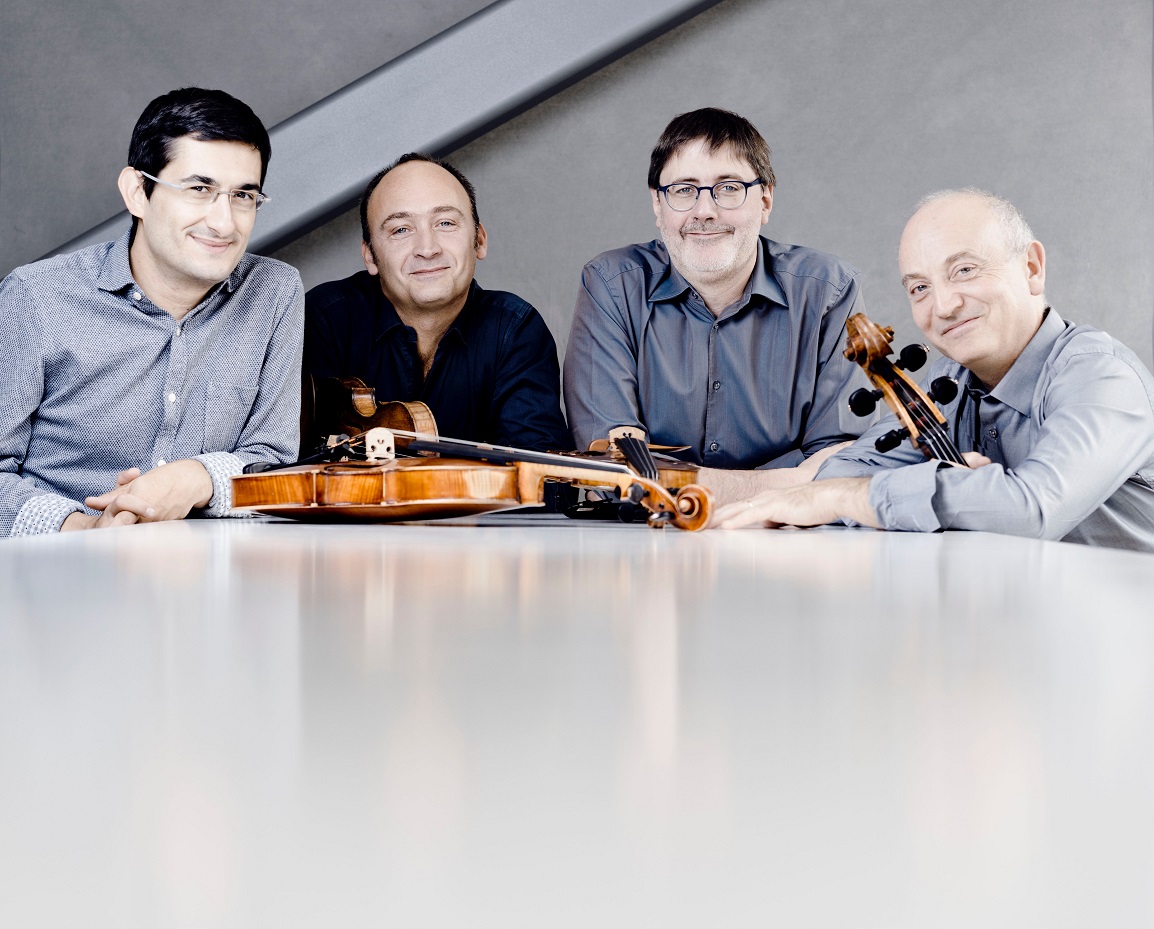
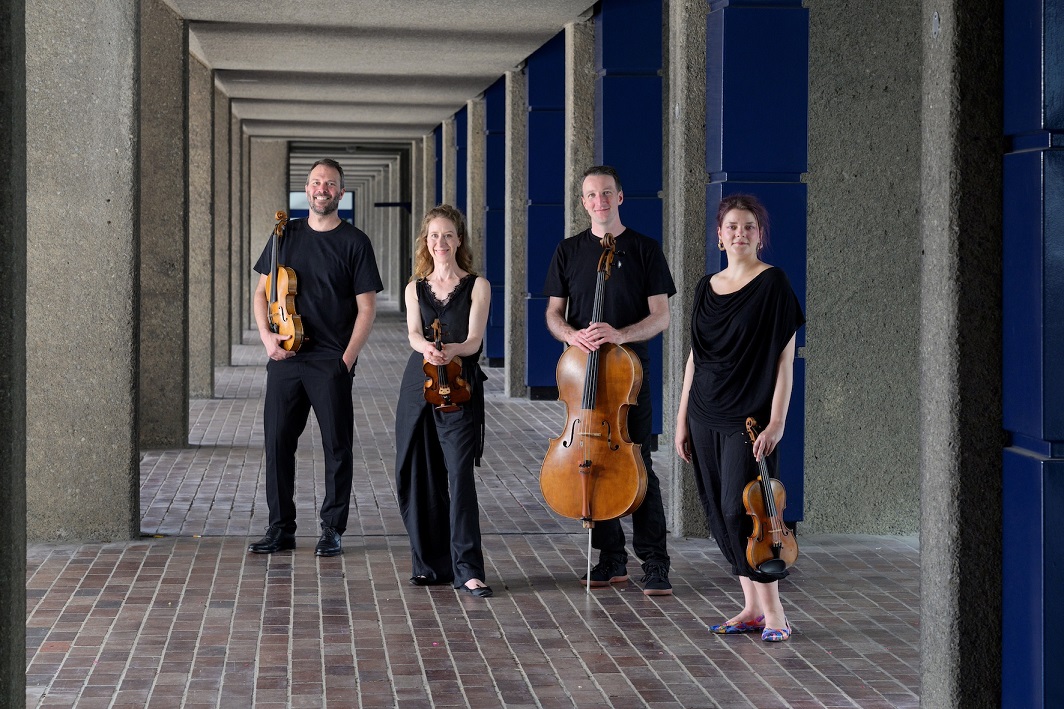
Quatuor Danel [Marc Danel & Gilles Millet (violins), Vlad Bogdanas (viola), Yovan Markovitch (cello)]

Weinberg String Quartet no.14 in B flat minor Op.122 (1978)
Weinberg String Quartet no.15 in G flat major Op.124 (1979-80)
Shostakovich String Quartet no.14 in F sharp major Op.142 (1972-3)

Wigmore Hall, London
Tuesday 6 May 2025

by Richard Whitehouse Photo (c) Marco Borggreve

Quatuor Danel’s interrelated cycle of string quartets by Shostakovich and Weinberg reached its penultimate stage this evening, and a programme with two of the latter composer’s most oblique such pieces heard alongside what is the most accessible of the former’s late quartets.

Second in a quartet of quartets written in the years after Shostakovich’s death, Weinberg’s Fourteenth Quartet continues straight from the sombre equivocation of its predecessor. Its five continuous movements never progress systematically as lurch forwards from an edgily austere first movement, by way of a moodily impassive successor, then on to a scherzo and intermezzo that are not so much elusive as gnomic in character; prior to a finale where any attempt at overall synthesis gradually subsides to leave only the wanly resigned conclusion. An ending, moreover, whose fatalism feels the more dismaying as it withdraws into virtual silence, as if Weinberg’s self-communing may well be a defence or even escape. As with its successor, his replacing tempo headings with metronome markings only abets obfuscation.

The Fifteenth Quartet might appear relatively less stark in outcome yet is certainly the most radical of all these works in formal design. Its nine mainly brief movements are interpretable in various ways – but a speculative sonata design is implied by the aggressive ‘development’ of the central three movements as framed by respectively angular and thrusting ‘transitions’; surrounded in turn by a two-stage ‘exposition’ of almost secretive inwardness which is itself balanced by a ‘reprise’ whose incrementally more direct expression facilitates that eventual, albeit tenuous sense of closure. Other approaches are entirely plausible, though there was an undeniable culmination imparted to those middle movements as the Danel steered its secure course through this fascinating if always disconcerting instance of Weinberg’s later maturity.

After such obliquities, the seeming directness of Shostakovich’s Fourteenth Quartet was the more affecting, though nothing should be taken at face value at this stage of its composer’s creativity. Allusions to earlier works (his own and others) abound and while the presence of serial elements is reduced next to its predecessors, sparsity of texture ensures a distanced or remote feeling even when this music is at its most active. As is true for most of the opening Allegretto, its lilting poise increasingly fitful as it nears a regretful if still inquisitive close.

By contrast, the central Adagio finds this composer at his most inward and confessional; its content allotted for much of its course to first violin and cello, so affording an austerity into which the eloquence of the ‘Angel Serenade’ by Gaetano Braga is a reminder Shostakovich was at time considering an operatic treatment of Chekhov’s story The Black Monk. The final Allegretto initially brings a more impetuous discourse, but this elides seamlessly into a coda whose pale radiance essentializes the work’s home key in a leave-taking of acute poignancy.

As always, the Danel gave its collective both here and in those miniatures which served as a welcome encore: two pieces from Prokofiev’s Visions fugitives, arranged for string quartet by Sergey Samsonov with a sensitivity for those piano originals as was nothing if not idiomatic.

You can hear the music from the concert below, in recordings made by Quatuor Danel -including their most recent cycle of the Shostakovich quartets on Accentus:

For more information on the final concert in the series, visit the Wigmore Hall website. You can click on the names for more on composer Mieczysław Weinberg and Quatuor Danel themselves.

Published post no.2,528 – Friday 9 May 2025

In concert – Viktoria Mullova & Alasdair Beatson @ Wigmore Hall: Beethoven & Schubert

Viktoria Mullova (violin), Alasdair Beatson (fortepiano)

Beethoven Sonata for piano and violin no.6 in A major Op.30/1 (1802)
Beethoven Sonata for piano and violin no.8 in G major Op.30/3 (1802)
Schubert Rondo brillant in B minor D895 (1826)

Wigmore Hall, London
Monday 7 April 2025 (1pm)

by Ben Hogwood

Violinist Viktoria Mullova and pianist Alasdair Beatson have been exploring Beethoven’s works for piano and violin for a while now, and this concert demonstrated the rapport they have built with the music – and the Wigmore Hall audience.

On a bright March day in London the Spring Sonata might have been the most appropriate choice – more of which later – but instead we enjoyed an unsung gem among Beethoven’s works for this combination. This was the Sonata for piano and violin no.6 in A major Op.30/1, the least heard of the trio published as Op.30 and a work brimming with good spirits in this performance.

As our BBC Radio 3 host Andrew McGregor informed us, Alasdair Beatson was playing a fortepiano copy of a Conrad Graf instrument, and it brought a wide range of tonal colour to the hall, with mottled treble and a wonderfully grainy lower register. Beatson and Mullova played as one, finishing each other’s sentences, or joining in unisons which could not be split. Op.30/1 warmed to this treatment, its bursts of energy complemented by tender, charming asides. Mullova’s intonation took a little while to settle, but once secured her phrasing was a delight. The soft centred, sweetly toned second movement was followed by an Allegretto con variazioni finale with terrific energy, driving up to and through a sparkling finish.

The Sonata for piano and violin no.8 in G major Op.30/3 followed – a charming work, especially in a performance such as this. Mullova and Beatson were on the edge, justifying a daringly fast tempo choice for the first movement with tight ensemble and drive, Mullova exaggerating the louder notes to put the listener in mind of the sort of sound Beethoven himself would surely have loved. The bubbly first movement was charming, its confidential asides well worth savouring, the togetherness between the two musicians truly admirable. The Tempo di minuetto explored darker moods, notably its brief passage in the minor key which cast a shadow over the return of the previously sunny first theme. The irrepressible finale enjoyed its humourous ‘wrong’ notes, recalling Haydn’s ‘Bird’ string quartet in their impudence.

It is hard to imagine a better performance of Schubert’s Rondo brillant, with which the concert ended. Here the two performers were like dancers in hold as they explored the composer’s unusual rhythmic terrain, bringing a sense of occasion to the introduction and an attractive sway to the dance rhythms as Schubert’s abundant melodies unfolded. A strong central section set up a series of virtuoso heroics towards the end, falling comfortably under Mullova’s fingers, while Beatson prompted with equal dexterity. The performance was a thrill from start to finish. As an ideal encore we did finally hear from Beethoven’s Spring Sonata – the beautiful second movement Adagio, given a charming lilt from Mullova’s phrasing and Beatson’s flowing accompaniment.

Listen

You can listen to this concert as the first hour of BBC Radio 3’s Classical Live, which can be found on BBC Sounds

Published post no.2,499 – Wednesday 9 April 2025

In concert – Mao Fujita, Philharmonia Orchestra / Osmo Vänskä: Missy Mazoli, Mozart & Mendelssohn

Mao Fujita (piano), Philharmonia Orchestra / Osmo Vänskä

Missy Mazzoli These Worlds In Us (2006)
Mozart Piano Concerto no.25 in C major K503 (1786)
Mendelssohn Symphony no.5 in D minor Op.107, ‘Reformation’ (1830)

Royal Festival Hall, London
Thursday 20 March 2025

Reviewed by Ben Hogwood Picture (c) Marc Gascoigne

Japanese pianist Mao Fujita has shown his impressive Mozart credentials in highly praised recordings of the composer’s complete piano sonatas. More recently his focus has shifted to the piano concertos.

Here he was partnered by the Philharmonia Orchestra and the visiting Osmo Vänskä in the substantial Piano Concerto no.25 in C major K503, a ceremonial work with fulsome orchestral accompaniment. Yet less is often more in Mozart performance, and that was certainly the case with Fujita as his fingers spun a magical web of notes. The piano’s magical first entry, after the pomp and circumstance of the introduction, was notable for its lightness of touch, Fujita listening closely to the Philharmonia wind players.

With so much to enjoy in this performance, Fujita exuded technical brilliance but also commendable restraint, always with affectionate shaping of the melodic line. That is, until the unattributed first movement cadenza. Here the rulebook was torn asunder, and a flow of unpredictable counterpoint broke loose, revealing links back to Bach but notably forward towards Beethoven.

Back under control, Fujita made the piano sing in the operatic slow movement, aided again by the quality of the wind section under Vänskä, who secured typically detailed, transparent clarity. The first violins began the finale with their touch as light as a feather, after which Fujita put the pedal to the metal once again, taking great pleasure in Mozart’s sparky dialogue with the orchestra. His encore, the first movement of Mozart’s Piano Sonata in C major K545, featured a delightful ‘wrong’ chord near the end, affectionately given and rounding off a truly memorable performance.

Prior to this we heard Missy Mazzoli’s These Worlds In Us, dedicated to her father, who was a soldier in the Vietnam War. Her imaginative orchestration extended to the use of wheezy melodicas in the outer section, adding a dreaminess and heightening the link with the music of Bali. The sighing violin theme was profound, but most telling of all was the soft rat-a-tat of the snare drum, a quiet but ominous reminder of war amidst the otherwise bright scoring. Mazzoli’s music has deeply human qualities that came alive in this performance.

For the second half, Vänskä led a dramatic account of Mendelssohn’s Symphony no.5, the Reformation. Second in order of composition, it was the last of his symphonies to be properly published, on account of its troublesome reception in 1832. In more recent years however the work has enjoyed greater exposure, rewarding its portrayal of triumph in turbulent times.

The magical hush from the strings of the Dresden Amen, quoted by the composer in the first movement, drew the audience in before Vänskä powered through a turbulent Allegro. The second movement danced like a late Haydn minuet, brisk and with a charming trio, while the Andante looked inwards, initially beyond comfort but ultimately softening to the touch. Mendelssohn’s quotation of the Lutheran chorale Ein feste Burg came to the rescue, sweetly intoned by flautist Samuel Coles, before the orchestra enjoyed Mendelssohn’s exuberant finale, and its parallels to Handel’s Messiah. As is his wont, Vänskä revealed previously hidden orchestral detail, giving a fully convincing account of a symphony whose cumulative power is all the more remarkable given Mendelssohn was 21 at the time of composition. Youth and experience were ideal foils here.

For details on the their 2024-25 season, head to the Philharmonia Orchestra website

Published post no.2,481 – Saturday 22 March 2025

In concert – Philharmonia Chamber Players – Beethoven: Septet

Philharmonia Chamber Players [Maura Marinucci (clarinet), Zsolt-Tihamér Visontay (violin), Scott Dickinson (viola), Alexander Rolton (cello), Owen Nicolaou (double bass), Sarah Pennington (horn), Marceau Lefèvre (bassoon)

Beethoven Septet in E flat major Op.20 (1802)

Royal Festival Hall, London
Thursday 20 March 2025 6pm

Reviewed by Ben Hogwood Picture (c) Marc Gascoigne

Beethoven’s six-movement Septet is, to all intents and purposes, a Serenade for seven instruments. As such it was perfectly timed in this early evening slot, the ideal piece with which to entertain a relaxed and healthily-sized crowd.

Clarinettist Maura Marinucci introduced the work, and her love of the piece was clearly shared by her Philharmonia Orchestra friends as they went about a performance that was by turns vigorous and lyrical.

Beethoven’s scoring was highly original in 1802, and it is easy to see why the piece proved so popular, with its abundance of good tunes and colourful textures. These were evident right from the opening, the bassoon and double bass giving a lovely heft to the lower end of the sound. They supported the winsome tunes, divided largely between Marinucci’s clarinet and the violin of Zsolt-Tihamér Visontay. Marinucci especially enjoyed the soft-hearted second movement, while Visontay had an increasingly virtuosic role to play, sometimes pushing ahead of the tempo in his eagerness but relishing Beethoven’s technical challenges.

The Minuet, with its impudent theme thumbing a nose at the audience, was nicely done, while the theme and variations forming the fourth movement were especially enjoyable, notably the first variation, assigned to the upper string trio, and the mischievous final variation and coda.

Above all this performance was a great deal of fun, the players enjoying sharing the tuneful material with their audience, an approach capped by a quickfire finale and dazzling cadenza from Visontay. Just as affecting, mind, was the hushed chorale from the winds preceding this moment.

Ultimately the music matched the weather, bringing the vitality of early spring to the Royal Festival Hall stage.

For details on the their 2024-25 season, head to the Philharmonia Orchestra website

Published post no.2,480 – Friday 21 March 2025