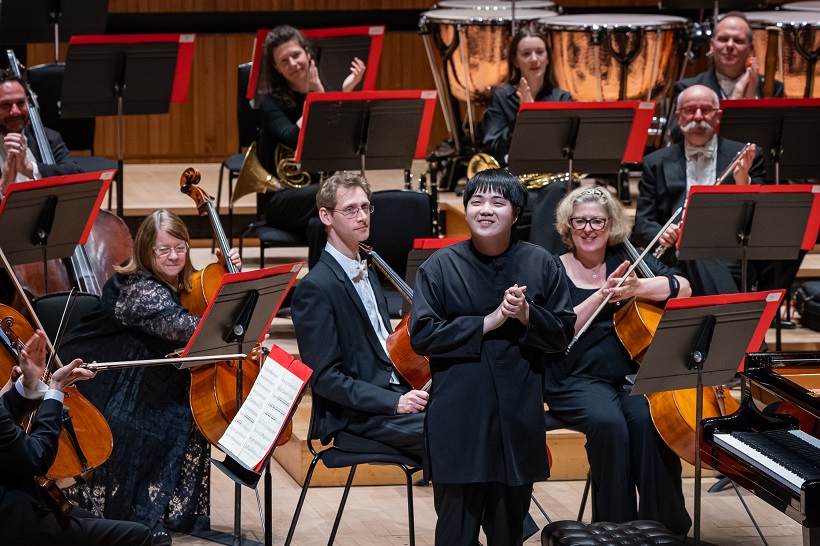
In concert – Philharmonia Chamber Players – Beethoven: Septet

Philharmonia Chamber Players [Maura Marinucci (clarinet), Zsolt-Tihamér Visontay (violin), Scott Dickinson (viola), Alexander Rolton (cello), Owen Nicolaou (double bass), Sarah Pennington (horn), Marceau Lefèvre (bassoon)

Beethoven Septet in E flat major Op.20 (1802)

Royal Festival Hall, London
Thursday 20 March 2025 6pm

Reviewed by Ben Hogwood Picture (c) Marc Gascoigne

Beethoven’s six-movement Septet is, to all intents and purposes, a Serenade for seven instruments. As such it was perfectly timed in this early evening slot, the ideal piece with which to entertain a relaxed and healthily-sized crowd.

Clarinettist Maura Marinucci introduced the work, and her love of the piece was clearly shared by her Philharmonia Orchestra friends as they went about a performance that was by turns vigorous and lyrical.

Beethoven’s scoring was highly original in 1802, and it is easy to see why the piece proved so popular, with its abundance of good tunes and colourful textures. These were evident right from the opening, the bassoon and double bass giving a lovely heft to the lower end of the sound. They supported the winsome tunes, divided largely between Marinucci’s clarinet and the violin of Zsolt-Tihamér Visontay. Marinucci especially enjoyed the soft-hearted second movement, while Visontay had an increasingly virtuosic role to play, sometimes pushing ahead of the tempo in his eagerness but relishing Beethoven’s technical challenges.

The Minuet, with its impudent theme thumbing a nose at the audience, was nicely done, while the theme and variations forming the fourth movement were especially enjoyable, notably the first variation, assigned to the upper string trio, and the mischievous final variation and coda.

Above all this performance was a great deal of fun, the players enjoying sharing the tuneful material with their audience, an approach capped by a quickfire finale and dazzling cadenza from Visontay. Just as affecting, mind, was the hushed chorale from the winds preceding this moment.

Ultimately the music matched the weather, bringing the vitality of early spring to the Royal Festival Hall stage.

For details on the their 2024-25 season, head to the Philharmonia Orchestra website

Published post no.2,480 – Friday 21 March 2025

In concert – Quatuor Danel: Shostakovich & Weinberg #9 with François-Frédéric Guy @ Wigmore Hall

François-Frédéric Guy (piano), Quatuor Danel [Marc Danel & Gilles Millet (violins), Vlad Bogdanas (viola), Yovan Markovitch (cello)]

Weinberg String Quartet no.13 Op.118 (1977)
Shostakovich String Quartet no.13 in B flat minor Op.138 (1970)
Shostakovich Piano Quintet in G minor Op.57 (1940)

Wigmore Hall, London
Thursday 6 March 2025

by Richard Whitehouse Photos (c) Marco Borggreve (Quatuor Danel), Lyodoh Kaneko (François-Frédéric Guy)

Quatuor Danel’s cycle at Wigmore Hall focussing on the string quartets of Shostakovich and Weinberg continued this evening with the Thirteenth Quartets by both composers, alongside the Piano Quintet that has long been among the former’s most representative chamber works.

After his exploratory (while not a little disconcerting) Twelfth Quartet, Weinberg avoided the medium for several years before penning four such pieces in relatively swift succession. Cast in a single movement of barely 15 minutes the Thirteenth Quartet, the shortest of his cycle, is influenced as much by Shostakovich’s late quartets as Weinberg’s own precedents. Facets of sonata form underpin its reticent progress from uncertain inwardness to unwilling animation – a vein of equivocation pervading the whole so that its eventual culmination does little more than lead back towards the initial stasis. Its progress enroute is similarly reticent, though this was hardly the fault of the Danel who unfolded the overall design with unforced conviction. Nor did they underplay the plangency of the ending, with its anguished crying into the void.

Seven years earlier, Shostakovich had essayed an altogether more radical take on the single-movement format with his own Thirteenth Quartet. It is dedicated to Vadim Borisovsky, then violist of the Beethoven Quartet, and the viola is audibly ‘first among equals’ over almost its entirety. Nominally the darkest and most forbidding of this cycle, the hymnic lamentation of its outer Adagio sections is thrown into relief by the Doppio movimento central span whose jazz-inflected impetus is but its most fascinating aspect; added to which, those frequent taps onto the body of each instrument (which evoke a death-rattle or a rhythm-stick according to preference) readily accentuate a sense of time running out. Vlad Bogdanas made the most of his time in the spotlight, not least at the close as viola joins with violins to unnerving effect.

After the interval it was a relief to encounter the younger, resilient Shostakovich of his Piano Quintet. Its piano part conceived as a vehicle for himself, this marked the onset of a creative association with the Beethoven Quartet as lasted almost until the end of his life. It also finds the composer immersed in Bachian precedent – witness the powerfully rhetorical dialogue of piano and strings in its Prelude, then the severe yet never inflexible unfolding of form and texture in a Fugue whose abstraction is informed by a pathos the more acute in its restraint.

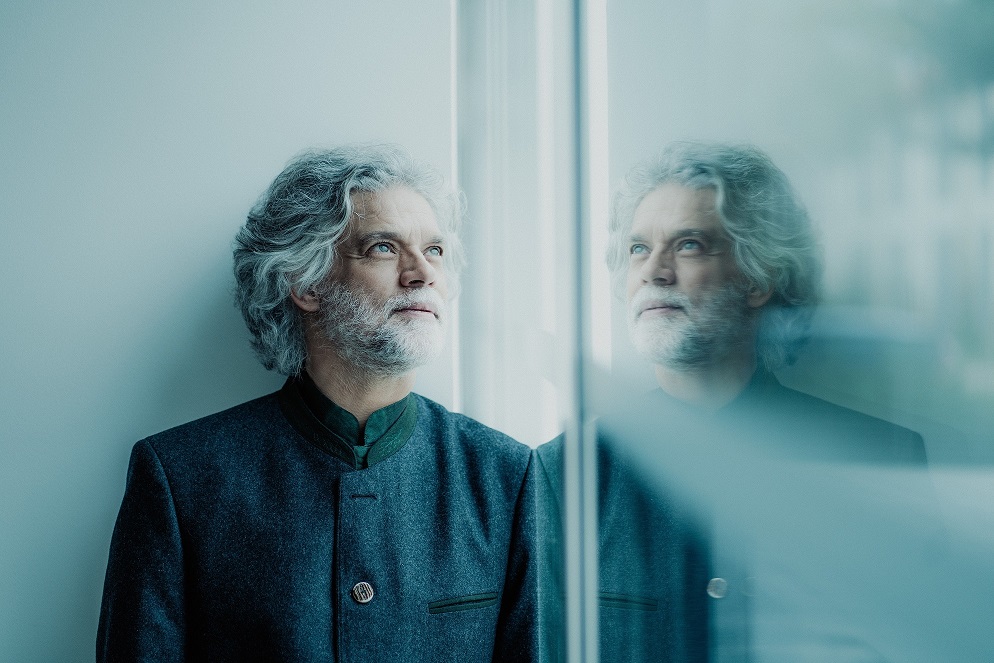
Playful and capricious by turns, the Scherzo makes for a striking centrepiece in spite (even because?) of its technical challenge. Suffice to add that François-Frédéric-Guy (above) and the Danel met this head on – after which, the Intermezzo mined a vein of soulfulness as was never less then affecting, while the Finale sounded more than unusually conclusive in the way it drew together aspects from the earlier movements towards a whimsical and even nonchalant close. At this stage, Shostakovich could still afford a measure of levity in his emotional response.

Thanks to Marc Danel’s acrobatics with a flying bow, the third movement stayed on course but it was no hardship to have this movement given even more scintillatingly as an encore. May 6th brings the penultimate recital in what has been an absorbing and revelatory series.

You can hear the music from the concert below, in recordings made by Quatuor Danel -including their most recent cycle of the Shostakovich quartets on Accentus:

For more information on the next concert in the series, visit the Wigmore Hall website. You can click on the names for more on composer Mieczysław Weinberg, Quatuor Danel and pianist François-Frédéric Guy

Published post no.2,467 – Saturday 8 March 2025

In concert – Mark van de Wiel, Philharmonia Chamber Players – Gipps & Weber

Philharmonia Chamber Players [Mark van de Wiel (clarinet, above), Eugene Lee, Fiona Cornall (violins), Scott Dickinson (viola), Karen Stephenson (cello)]

Gipps Rhapsody in E flat major (1942)
Weber Clarinet Quintet in B flat major Op.34 (1811-15)

Royal Festival Hall, London
Thursday 20 February 2025

Reviewed by Ben Hogwood Picture of Mark van de Wiel (c) Luca Migliore

This free concert in the Royal Festival Hall was a breath of fresh air. Bolstered by visitors, the auditorium was a heartening two-thirds full, the audience made up of families, tourists and workers seeking musical enlightenment. Yours truly fell into the latter category!

The Philharmonia Orchestra have played to this type of crowd for decades now, either by way of introduction to their evening concerts (like this one) or providing a standalone concert focusing on a particular composer (Music of Today) or instrument.

In this instance they covered all bases, with music for clarinet and string quartet introduced from the stage by principal clarinet Mark van de Wiel. The ensemble began with a relative rarity, Ruth GippsRhapsody in E flat major only coming in from the cold in recent years. Dedicated to her fellow RCM student and future husband, Robert Baker, it is an attractive piece with affection evident from its soft, pastorally inflected first statement. However Gipps’ folk-inspired variant on the opening theme steals the show, firstly heard on cello then subsequently joined by its companions, the clarinet finally singing eloquently over pizzicato strings.

In his talk Van de Wiel’s love of the piece was evident, before he introduced another sleeping giant, Weber’s Clarinet Quintet. Often sitting in the shade of its illustrious companions by Mozart and Brahms, this winsome piece – written for clarinettist Heinrich Baermann – demonstrates just how far the instrument had progressed in the two decades since Mozart’s Clarinet Concerto.

Van de Wiel demonstrated how his clarinet, with 17 keys, was at an advantage to that of Baermann’s ten, in theory reducing the difficulty. His modesty, however, was made clear in the virtuoso demands Weber still makes on the instrument, a fully-fledged soloist, with all manner of tricks up its sleeve.

To Weber’s credit this is not at the expense of musical quality or emotional impact, for although we enjoyed some flights of fancy in the first movement Allegro there was plenty of feeling in the dialogue between clarinet and string quartet. A tender, operatic second movement followed, then an airy and enjoyably mischievous Menuetto rather fast for dancing perhaps but charming all the same. Then came the brilliantly executed finale, living up to its Allegro giojoso marking as Van de Wiel mastered Weber’s increasingly athletic demands with flair and musicality.

Happily both pieces have been recorded as part of a new album forthcoming from the quintet on Signum Classics, where they will team this repertoire with Anna Clyne’s Strange Loops. If the performances match these live accounts, they will constitute a fine document from one of Britain’s very best clarinettists. As though to confirm this, the assembled throng left wreathed in smiles.

For details on the their 2024-25 season, head to the Philharmonia Orchestra website

Published post no.2,452 – Friday 21 February 2025

Arcana @ 10… Musical moments: Sebastian Rochford & Kit Downes – A Short Diary

Sebastian Rochford & Kit Downes @ Kings Place. Photo (c) John Earls

As part of Arcana’s 10th birthday celebrations, we invited our readers to contribute with some of their ‘watershed’ musical moments from the last 10 years.

Regular contributor John Earls writes:

A Short Diary consists of seven short piano pieces composed by Sebastian Rochford in memory of his father, the poet and academic Gerard Rochford, who died in 2019. An eighth piece was composed by his father. It is a profound and moving expression of loss. Rochford’s drumming combines beautifully with Kit Downes‘ piano playing.

When I heard it my own father had a few months before been diagnosed with Alzheimer’s disease (I am still a co-carer for him). This has been both an uplifting and consoling collection for me.

In January 2024 I saw Rochford and Downes perform the album at Kings Place, London and wrote about it for Arcana here

John Earls is Director of Research at Unite the Union. He posts on Bluesky and tweets / updates his ‘X’ content at @john_earls

You can listen to the album on Tidal below:

Published post no.2,434 – Wednesday 6 February 2025

In concert – The London Jazz Orchestra: Celebrating Kenny Wheeler @ The Vortex

The London Jazz Orchestra (full line-up below) / Scott Stroman

The Vortex, London, 2 February 2025

by John Earls. Photo credits (c) John Earls, picture of Kenny Wheeler (c) Scott Stroman

Kenny Wheeler (1930-2014) was a UK-based, Canadian born composer and trumpet and flugelhorn player who left a unique and significant mark on jazz and particularly UK and European jazz. He composed and played in a number of formats and was a master of writing for the big band and jazz orchestra.

Wheeler was a founder member of the London Jazz Orchestra (now in its 34th year), one of the best and most exciting big bands around. So it was more than fitting that the LJO paid tribute to what would have been his 95th birthday with this performance of his Long Suite 2005, written for his 75th birthday tour.

Wheeler’s tunes and arrangements are wonderfully and distinctively melodic and this concert was fine testimony to that quality. Yet they often also have a melancholy element to them which can be strangely uplifting. He is supposed to have said Sad music makes me feel happy” and this is an attribute he delivers frequently and brilliantly.

I also recall jazz bassist Dave Holland at a Kenny Wheeler tribute concert in 2015 citing another classic Wheeler quote: “I don’t say much. And when I do I don’t say much”. I guess he said it all in the music.

To my knowledge this suite has still to be recorded and released, which is a real shame. It is a continuous piece of some 40 minutes that meanders beautifully without losing thread and combines some glorious ensemble unity with solo virtuosity.

Kenny Wheeler (c) Scott Stroman

For this performance Miguel Gorodi sat in the ‘Kenny Wheeler chair’, playing the flugelhorn admirably. Brigitte Beraha, sitting next to him, provided gorgeous vocal accompaniment. Stand out solos included trombone, saxophones and double bass. There was crisp and articulate drumming throughout from the LJO debutante drummer.

Special mention should go to trumpeter Henry Lowther, an LJO stalwart and longstanding collaborator of Wheeler’s (I have previously noted how both Lowther and Wheeler played trumpet on Nick Drake’s Hazey Jane II), who is not just a solid LJO force but something of a Wheeler encyclopaedia.

A shout out too to saxophonist Pete Hurt who does so much in transcribing the work of Wheeler (and others) and keeping it alive, a fact acknowledged by LJO Musical Director, Scott Stroman, whose own enthusiasm whilst conducting this performance saw him nearly jump through the ceiling.

The first set of this concert demonstrated that the LJO still has significant composing talent in its ranks with exciting new music by pianist Alcyona Mick and bassist Calum Gourlay. It was great to see and hear a concert that contained such a thread of continuity in what the LJO does.

The music of Kenny Wheeler deserves to always be heard. I’m sure that as long as the London Jazz Orchestra is around it will be.

The London Jazz Orchestra line-up for this concert, directed by Scott Stroman, was:

Miguel Gorodi (solo part in Long Suite 2005), Luke Lane, Ed Hogben, Henry Lowther, Andre Cannier (trumpets); Martin Gladdish, Richard Pywell, Richard Foote (trombones), Yusuf Narcin (bass trombone); Matt Sulzmann (alto and soprano sax), Alyson Cawley (alto sax and clarinet), Tori Freestone (tenor sax and flute), Pete Hurt (tenor sax), Mick Foster (baritone sax and bass clarinet)

with Brigitte Beraha (vocals), Joe Garland-Johnston (guitar), Alcyona Mick (piano), Calum Gourlay (bass), Luke Tomlinson (drums)

John Earls is Director of Research at Unite the Union. He posts on Bluesky and tweets / updates his ‘X’ content at @john_earls

The London Jazz Orchestra play at The Vortex on most first Sundays of the month.

Song for Someone: The Musical Life of Kenny Wheeler by Brian Shaw and Nick Smart is published by Equinox on 14 February 2025.

Some Days Are Better: The Lost Scores by Kenny Wheeler Legacy, featuring the Royal Academy of Music Jazz Orchestra and Frost Jazz Orchestra, was released by Greenleaf Music on 31 January 2025.

Published post no.2,431 – Tuesday 4 February 2025