
Wigmore Mondays – Apollon Musagète Quartet play Haydn & Arensky

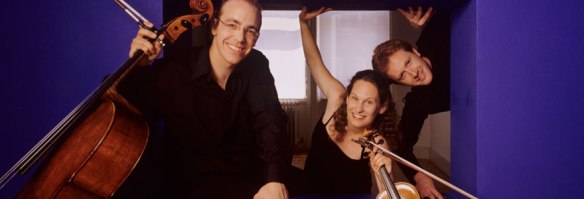
Apollon Musagète Quartet [Paweł Zalejski & Bartosz Zachłod (violins), Piotr Szumieł (viola), Piotr Skweres (cello)

Haydn String Quartet in D major Op.64/5 Lark (1790)

Arensky String Quartet in A minor Op.35 (1894)

Wigmore Hall, London; Monday 3 April, 2017

Listen to the BBC broadcast here

Written by Ben Hogwood

If you want a piece of chamber music for a bright spring day, look no further than Haydn’s utterly charming Lark quartet. The fifth in a set of six written for Johann Tost, a violin player from Haydn’s court orchestra, the ‘Lark’ is bright and very breezy. The first violin takes on the role of the bird, soaring above the other three instruments in the first movement () and then enjoying the role of a vocal soloist in the second movement (10:55), essentially an aria.

In this performance the Apollon Musagète Quartet allowed Haydn’s melodies all the room they needed, except for the end of the first movement which became a bit too fast. In the third movement Minuet – a predecessor of Beethoven’s scherzo (16:14) they dug in a little more. For the last movement, a brilliantly played torrent of notes issued forth from Paweł Zalejski’s violin, rushing the whole way through as the other instruments battled manfully to keep up.

The sudden change of mood for Arensky’s String Quartet no.2 was palpable. Arensky was a pupil of Rimsky-Korsakov and a close friend of Tchaikovsky, and although his music has never enjoyed the popularity of these two Russian heavyweights, at its best it has great appeal. Rimsky wrote him off as a composer, but this String Quartet is one of his finest works. A darker piece, it was originally written for violin, viola and two cellos, but in this performance the Apollon Musagete used the conventional quartet make-up.

The first movement was dark, its solemn intonations speaking of Russian liturgy rather than intimate chamber music, serving as a memorial for Tchaikovsky. The quartet captured its brooding thoughts (23:13) but allowed more light to seep into the outlook as the piece progressed.

The second movement (34:03), a set of variations on Tchaikovsky’s Legend, is often played separately in an arrangement for string orchestra, and the Apollon Musagète showed how these big, bold variations could easily be projected for the bigger form. They demonstrated great aptitude for the quick fire variations (36:23) and (close to 39:24) but showed the slow theme and its other slower, minor key counterparts plenty of time, especially in the final variation from 46:25. The music may have been downbeat on these occasions but still had the power to console.

The finale is a strange comparison of dark liturgical intonation (48:01) and a sudden burst of folk song (49:30), which eventually wins the day. When it did here at the Wigmore, the effect was thoroughly convincing and consolation had ultimately been found in this fine performance.

Further listening

In summing up Arensky’s best achievements as a composer the Wigmore Hall note omitted to mention his wonderful Piano Trio no.1, part of a Spotify playlist including piano music and the Quartet played here.
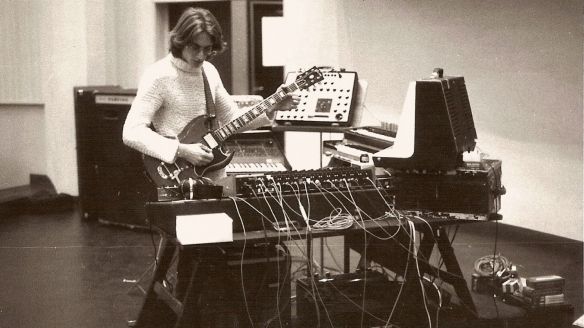
Live: Convergence 2017 – Manuel Göttsching at the Barbican

Manuel Göttsching (above – guitars, electronics), Shags Chamberlain (keyboards, percussion), Oren Ambarchi (bass guitar, percussion, drums)

Barbican Hall, Thursday 23rd March, 2017

Göttsching E2-E4 (1984)

Ash Ra Tempel excerpts from Schwingungen and Seven Up (1972)

Written by Ben Hogwood

Now in its fourth year, Convergence is one of those inspirational festivals that bring together different art forms without laying down rules of boundary or art form. Because of that, artists who might not get ready exposure are brought to the fore – and hence gigs like this one can take place.

Manuel Göttsching originally released his E2-E4 album in 1984, but it surfaced in remastered form last year to great acclaim, making listeners of a certain age (your correspondent included!) misty-eyed and reverent about its influence on a generation of techno producers.

The music is relatively close to the Steve Reich school of thought in concept, that is it begins with a deceptively simple phrase that stays constant for an hour, but around it various musical events develop. By the end the root of the music remains but where there was once an airy synthesizer riff there is now a full bodied bass, primitive electronic drums and some dreamy guitar, all of which Göttsching took his time to introduce. Little wonder that this music became an inspiration for Balearic producers such as Sueno Latino.

At this concert in the Barbican Hall, Göttsching performed in an incredibly modest manner, sitting in front of a laptop as though he were answering e-mails for at least half an hour, before standing with his guitar to deliver the crowning layer. The reality of course was very different, the stage dimly but effectively lit so that the audience could sit more or less in the dark, enjoying the music as it unfolded. Tapping the feet and fingers was an instinctive reaction, for this music has a great deal of energy, like a written out DJ set. It became a meditation for the mind but also a joyous ritual, the bright chords retaining their appeal even after an hour.

After the interval Göttsching emerged with drummer Oren Ambarchi and keyboard player Shags Chamberlain for company. Ariel Pink had been promised but was indisposed – but this was not a problem, as the trio set out to play excerpts from albums Göttsching had been involved with in the early 1970s as Ash Ra Tempel. These may well have worked better in the first half, but were nonetheless really well observed and open ended – so much so the improvisations were still going on when I sadly had to depart at 11:10.

The driving rhythms spoke of the Krautrock movement that was to take hold later in the 1970s, while some of the spacious textures and feedback also anticipated shoegaze and My Bloody Valentine. And yet there was the spirit of exploration that also incorporated contemporary classical compositions, with elements of the quieter side of Xenakis and Boulez, while also incorporating rich, added note harmonies of the likes of Thelonious Monk. There was a firm pitch centre, a point of reference at all times save for the last number, which found all three players on the same vibraphone initially. The music was difficult to pin down stylistically – so best just to sit back and enjoy!

It was an inspiring evening, providing some welcome respite and inspiration in the light of the awful events elsewhere in London earlier in the day. Those hung over the gig to some extent, but there was a sense that everybody was grateful to have their minds diverted and altered.

Musically there may not have been a great amount of melody, but inspiration came through texture, harmony and primitive drive – especially when Ambarchi drove the rhythm track forward in the second half. Göttsching himself was in fine form, and it was great to have an opportunity to appreciate and praise his influence on musical movements that have followed. Forty years on, his is a voice that still stands out.

For more information on Convergence, head to the festival festival website

Spotify

The Convergence 2017 playlist is below:

Wigmore Mondays – Annelien Van Wauwe & Nino Gvetadze play Debussy, Poulenc & Brahms

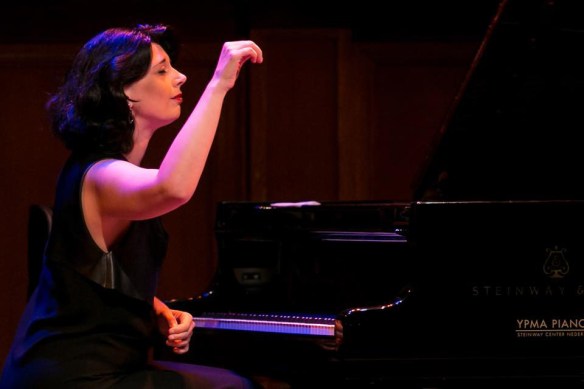
Annelien Van Wauwe (clarinet, above) and Nino Gvetadze (piano, below)
Debussy Première rapsodie (1909-10)

Poulenc Clarinet Sonata (1962)

Schumann Arabeske in C major, Op 18 (1838-9)

Brahms Clarinet Sonata in E flat, Op 120 No 2 (1894)

Wigmore Hall, London; Monday 20 March, 2017

Listen to the BBC broadcast here

Written by Ben Hogwood

The soft, languid tones of Annelien Van Wauwe’s clarinet were perfectly judged at the hushed start of Debussy’s Première rapsodie, the first piece in a nicely chosen set of music for clarinet and piano.

This piece is an elusive ten-minute train of thought, with two distinct ideas – the slow, sleepy opening paragraph (from 1:40 on the broadcast link) and another, spiky idea (around 3:42), begging for a jazz accompaniment. Gradually the two get closer together and the cumulative energy builds. Nino Gvetadze’s colourful piano accompaniment showed just how suitable the piece is for orchestra – which Debussy realised with a subsequent arrangement.

Poulenc’s Clarinet Sonata is one of his last published works, written in homage to fellow composer Arthur Honegger. Central to its success is the yearning theme of the central Romanza (16:36), where Van Wauwe’s tone and phrasing was beautifully observed. The first movement (beginning at 11:24) could have been a bit more mischievous, perhaps, but the brisk and largely upbeat finale (21:22) certainly hit the spot.

Following this was a chance for Gvetadze to take centre stage in Schumann’s lilting Arabeske (25:40), where wife Clara explicitly asked him to avoid making musical references to her. I’m not convinced he kept that bargain, because the music is very affectionate, and Gvetadze portrayed that too.
We then heard Brahms’ last published chamber work, the last part of an Indian summer instigated by the clarinettist Richard Mühlfeld, whose quality of tone directly inspired four pieces from the composer. This included a pair of sonatas published in 1894 as Brahms’s Op.120. These are lovely autumnal works, and both performers shaded the E flat work, the more positive of the two, with appropriate care. More authority could perhaps have been given to the second movement (marked Allegro appassionato, from 43:26 on the broadcast) but the outer movements had plenty to admire. The first movement (from 35:09) was largely contented, while the last, a theme and variations (48:50), was more changeable in mood and brilliantly played here, Brahms’ inspiration as keen as ever.

A final thought – what will Brexit mean for the non-English contingent the BBC choose for their excellent New Generations scheme? One of many questions classical music and the arts will face in the coming months and years.

Further listening

Brahms’s last works for clarinet are collected in the playlist below. They are autumnal in nature but have some wonderful lyrical writing for the instrument.

Wigmore Mondays – Kungsbacka Trio play Schumann and Ravel

Kungsbacka Piano Trio [Malin Broman (violin), Jesper Svedberg (cello), Simon Crawford-Phillips (piano)

Schumann Piano Trio no.2 in F major Op.80 (1847)

Ravel Piano Trio in A minor (1914)

Wigmore Hall, London; Monday 13 March, 2017

Listen to the BBC broadcast here

Written by Ben Hogwood

Schumann seems to have approached his career in clumps of music. 1841 was the fabled ‘year of song’, the catalyst for years of exceptional achievements in the form. The next year he ventured into the world of the string quartet, publishing three works. It wasn’t until 1847 that he decided to publish a piano trio, and here he was apparently spurred on by the quality of his wife Clara’s trio the year before. 1847 yielded two works for the combination.

The Second Piano Trio, Op.80 in his catalogue, begins with an outpouring of fervent but very positive feelings (1:35 on the broadcast), though its casting in F major makes it a little less tempestuous than the First Piano Trio in D minor, Op.63. Yes, it was a prolific year for the composer!

By now Schumann’s style was more contrapuntal – that is to say he was applying more of the practices perfected by Bach, linking his melodies through eventful interplay. The Kungsbacka Trio were alive to this way of writing, and all the parts were clearly audible, though when they merged into one there was some beautiful unison playing.

The second movement, a slow romance (from 9:57), was notable for the sweet tone of Malin Broman’s violin, though there was sterling work from cellist Jesper Svedberg at the outset. Meanwhile the third movement, a ‘canon’ (from 18:11), is almost like one bird following another in a slightly irregular waltz, the ‘canon’ being an almost exact imitation of one instrument (piano) by the others (cello and then violin). This movement softened further into the major key at the end. The finale (from 23:10) continued in the same high spirits.

The only Piano Trio of Ravel made a nice contrast. He did not publish much chamber music, but what his output lacks in quantity is compensated by works that remain right at the top of the repertoire. The shadow of World War I hangs over this work, published in 1914, especially as Ravel finished it before signing up as a truck driver. Despite moments of great sorrow and introspection in the slow movement, it ends on an ultimately positive note.

There are beautiful colours to be savoured, both through Ravel’s writing and this performance. The trio begins in dappled sunshine (31:10), and was especially notable in this performance for a first movement containing a lovely transition from the puffed up statements of the faster music to the slower, daintier second theme (leading up to 36:51).

The second movement (40:27) was also colourful, surging forwards in unison but also really attractively phrased for the second theme given by pianist Simon Crawford-Phillips at 42:23 and then a unison from the strings shortly after. Then the mood turned inwards at 45:09 for the solemn third movement passacaglia, a form where the same bassline is repeated again and again but the tune varies. The final movement (52:30) shimmered in the sunlight, making a timely appearance on the Wigmore Hall stage to accompany the beautifully rendered harmonics of violin and cello.

As an encore the trio gave Beethoven, a movement from his Piano Trio in E flat major, Op.70/2 – again beautifully played and consistent with 20 years of great artistry from this source.

Further listening

A very nice complement to both the Ravel and the Schumann can be found in the Kungsbacka’s recordings of Faure for Naxos. This album includes his late Piano Trio and the stormy – and thrilling! – Piano Quartet no.2

Wigmore Mondays – David Greilsammer plays Scarlatti and Cage

david-greilsammerDavid Greilsammer (piano)

Domenico Scarlatti Sonatas: in D minor (Kk213), in D minor (Kk141) (12:11), in E (Kk531) (17:57), in B minor (Kk27) (23:58), in B minor (Kk87) (28:33), in A minor (Kk175) (35:25), in E (Kk380) (42:01), in D (Kk492)

interspersed with

Cage Sonatas for prepared piano: nos. 14 (8:47), 13 (15:20), 11 (21:31), 1 (26:23), 12 (32:38), 16 (38:55) & 5 (46:42)

Wigmore Hall, London; Monday 27 February, 2017

Listen to the BBC broadcast here

Written by Ben Hogwood

John Cage is a composer whose music transcends eras. That bold statement was made into reality by David Greilsammer’s imaginatively conceived recital of piano music at the Wigmore Hall, where innovations of the 18th century from Domenico Scarlatti rubbed shoulders with Cage’s music for ‘prepared’ piano.

The prepared piano is a heavily tampered instrument, beginning as a normal grand piano but ending up festooned with dampers, screws, nuts, bolts and even a rubber eraser. Hearing it in person is a real shock, because the resultant sounds are so far removed from a conventional piano tone that the listener has to instinctively check that it is a keyboard being used. The immediate reaction of raised eyebrows gives way to amazement that the instrument with which we are so familiar can make so many different timbres, clicks and beats.

Cage is often derided for these amendments, but hearing this concert from Greilsammer showed just how original his thinking was. The pure imagination of Scarlatti was also revealed, for his 550 sonatas were initially cast aside, with few published in his lifetime. Subsequently they have been shown to contain music of great freedom, expression and colour, so much so that the first sonata of the recital, no.213 in Ralph Kirkpatrick’s catalogue, (1:44 on the live broadcast link) – could almost have been by Cage. It helped that Greilsammer exaggerated its sparse contours and slow tempo, but it was a striking way to begin.

Cage’s evocations of the gamelan in his Sonatas made an immediate impact, helped by the fact Greilsammer was literally spinning between the normal piano for the Scarlatti and the prepared piano with little to no time difference. We passed through periods of energy but also reflection, always enjoying the shock of the new and some familiar contours of the old. With each switch it felt like we were being taken into another world.

The energetic Scarlatti pieces were stressed as such by Greilsammer – a punchy Kk141 especially – while on the Cage side the moods could be equally energetic. The contrasts were beautifully chosen, and so were the tonal centres – the rippling Scarlatti Sonata in E major, Kk531 (17:57), went straight into the treble-rich Sonata no.11 (21:31), and a more thoughtful Sonata in B minor Kk27 (23:58) segued into the more percussive Sonata no.12 (26:20) with barely a join in the notes. The same effect could be experienced at 32:38, where a pensive Scarlatti and a free, improvised Cage Sonata no. 12 were effectively joined together, the latter becoming gradually more aggressive as it moved forward.

The final three sonatas in the group were perhaps the most effective, a military-style march of Scarlatti in E major (42:01) cutting to the most evocative gamelan picture from Cage (46:42) and then to the final D major work of the Italian (48:18).

As a brilliantly conceived encore, Greilsammer offered a vision of his own nightmare, playing the right piece on the ‘wrong’ piano. This was the last Scarlatti sonata (53:50) – only on the prepared piano rather than the untampered one. It served to show just how surprisingly close the sound worlds of these two composers can be, and how music can effortlessly transcend gaps of three centuries.

Thought provoking and eyebrow-raising, this was a wholly stimulating concert and should be heard again!

Further listening

David Greilsammer’s album of Scarlatti and Cage is available to stream on Spotify: