In concert – Sacconi Quartet & Festival Voices: Earth Unwrapped – Terry Riley’s Sun Rings

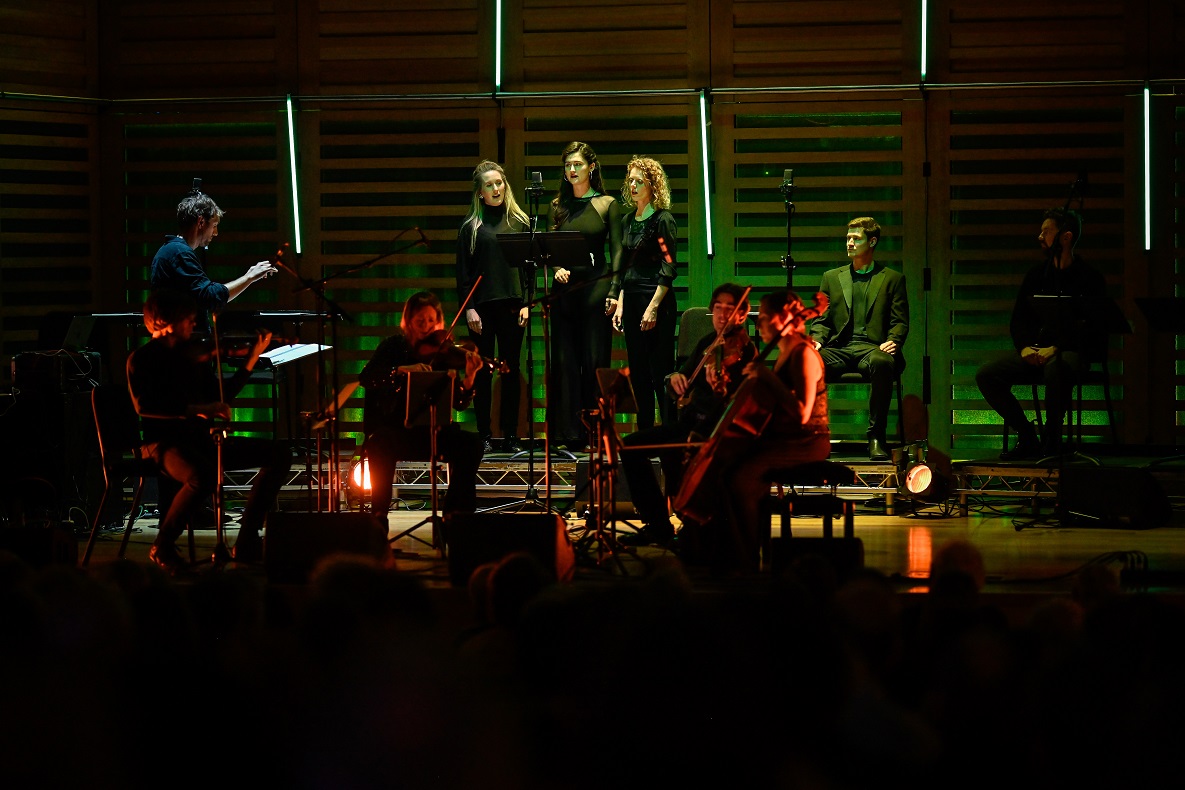
Sacconi Quartet [Ben Hancox, Hannah Dawson (violins), Robin Ashwell (viola), Cara Berridge (cello]; Festival Voices [Lucy Cronin, Ana Beard Fernández, Lucy Goddard, Sam Jenkins, Michael Craddock, Oskar McCarthy] / Greg Batsleer; Brett Cox (electronics)

Riley Sun Rings (2002)

Hall One, Kings Place, London
Thursday 16 January 2025

by Ben Hogwood Pictures courtesy of Monika S Jakubowska / Kings Place

A sobering thought: in the course of this concert, the NASA spacecraft Voyager 1 travelled another 60,000 miles away from the Solar System.

Quite how far it will travel in the course of the Kings Place festival Earth Unwrapped remains to be seen, but by that time audiences will have enjoyed a wide array of musical and visual treats, all designed to heighten awareness of the plight in which we find ourselves here on planet Earth.

Such thoughts were close to the surface throughout Sun Rings, an ambitious start to the festival. The substantial work was completed by Terry Riley in 2002, the result of an approach made by NASA to the Kronos Quartet. They wanted to create a work based on recordings of ‘space sounds’ (plasma waves) from Voyager 1 made by Professor Donald Gurnett. Riley had these transferred to audible audio frequencies in order to mark 25 years since the spacecraft was launched, at the same time contemplating the place of humanity in the universe. Since Sun Rings was completed, Voyager I has passed from the Solar System to interstellar space.

The Kronos Quartet released their recording of Sun Rings in 2019 (reviewed by Arcana here), and until now were the only ensemble to have played the piece in public. This UK premiere from the Sacconi Quartet and Festival Voices changed that, an illustration of the ever-growing reach of ‘minimalist’ music. The twelve assembled on stage performed heroically, the unbroken span of ten movements lasting 90 minutes yet delivered with flair, poise and no little emotion.

The music was prefaced by words from Riley himself, a stamp of authenticity and gratitude from the 90-year-old composer. It was the first of many audio clips carefully managed by Brett Cox, whose contributions were crucial to the success of the performance. Chief among these were the audio translations of the Voyager craft itself, converted by Riley from spectrographs. They provided an industrial edge to the sound – reminiscent of Voyager contemporaries Cabaret Voltaire – and were alternately eerie and consoling in their different sound worlds. As the audience sat in the dark the notion of being on our own journey was inescapable, a reminder that our own planet moves even quicker than Voyager 1 itself.

The quartet made a strong start, bolstered by colourful percussion. The Overture, Hero Danger and Beebopterismo sections had rhythmic vitality, complemented by the electronics and samples. Towards the halfway mark however the momentum and intensity flagged, the notion of deep space now all around us but feeling more oppressive. Time stood relatively still in the eerie Earth / Jupiter Kiss section, though Riley’s musical intensity flagged before being re-energised by the Festival Voices. The excellent singers brought expression and impetus to Earth Whistlers and Prayer Central, but on occasion it was difficult to hear some of the words, the singers’ pitch aligned with the frequency of the audio recordings.

The most powerful music, ironically, was the slowest and the most restrained. The coda, One Earth, One People, One Love, became a deeply felt meditation, the singers whispering under their breath as they moved slowly to the exit in an inspired piece of choreography. The pensive strings remained, adding their commentary to recorded spoken word, whose statements could not have been more apt.

As I write this, the news of alarming carbon dioxide levels in the Earth’s atmosphere serves as a reminder of our changing world, hurtling towards the environmental precipice. This stark reality check confirms Earth Unwrapped to be arguably the most important arts festival in London this year – and this was an auspicious start.

For more information on the Earth Unwrapped festival, head to the Kings Place website. Click on the artist names for Sacconi Quartet and Festival Voices, and composer Terry Riley. You can visit NASA to find out where Voyager 1 and Voyager 2 are now

Published post no.2,415 – Saturday 17 January 2025

In concert – Quatuor Danel: Shostakovich & Weinberg #8 @ Wigmore Hall

Quatuor Danel [Marc Danel & Gilles Millet (violins), Vlad Bogdanas (viola), Yovan Markovitch (cello)]

Shostakovich String Quartet no.11 in F minor Op.122 (1966)
Shostakovich String Quartet no.12 in D flat major Op.133 (1968)
Weinberg String Quartet No. 12 Op.103 (1969-70)

Wigmore Hall, London
Wednesday 15 January 2025

by Richard Whitehouse Photo (c) Marco Borggreve

This latest instalment in Quatuor Danel’s traversal of the string quartets by Shostakovich and Weinberg comprised the Twelfth Quartets from both composers – masterpieces both, and was prefaced by the teasing brevity and obliqueness of the former’s preceding such composition.

His 60th year marked the onset of Shostakovich’s ‘late period’ – its overt introspection being appropriate for a piece dedicated to the memory of Vasily Shirinsky, former second violinist of the Beethoven Quartet who premiered all but the first and last of the composer’s cycle. In fact, the Eleventh Quartet is appreciably more varied than this memorial aspect may suggest – the Introduction initiating a subdued discourse given an ironic twist in the Scherzo then erupting combatively in the Recitative, prior to the anxiety of the Etude and ruthlessness of the Humoresque. This performance came into its own with the Elegy, a remembrance of enfolding pathos – after which, the Finale assumed that retrospective function found in many of Shostakovich’s later works with due emphasis on its stealthy and quixotic humour.

Just two years on brought Shostakovich’s Twelfth Quartet – if not his greatest then surely in the top two, while arguably uncharacteristic in its self-conscious yet masterly formal design. Although not introductory as such, the Danel was mindful to keep its opening movement on a tight rein such that its interplay of mood and tempo inferred without defining those seismic confrontations to come. This longest and most diverse of its composer’s quartet movements did not disappoint – the Danel having fullest measure of an 18-minute span whose eventual subsiding presages a pizzicato-driven assault the more visceral for being so methodical in its unfolding. Nor was the allusion to initial material at all misconstrued as this work enters its climactic phase, a transformation whose unbridled affirmation was powerfully in evidence.

It might have emerged barely 18 months on, but Weinberg’s Twelfth Quartet feels comparable only in its scope and ambition. A likely response to the creative radicalism this composer had encountered on returning to his native Poland after over a quarter-century, its four movements essentially reinvent the Classical archetype so that the opening Largo outlines a succession of amorphous or disruptive elements with little audible regard for just how they might interact – something that will only come into focus as the work unfolds while opening-out expressively.

This evolution takes in a stealthy if always speculative Allegretto, and a Presto whose violence has become assaultive by its close. It remains for the final Moderato to effect closure through a synthesis almost improvisatory for all its formal rigour. Allied to this comes a dominance of playing techniques that does not intensify the music as drain it of all emotion and so reduce it to merest gestures by the end. A remarkable piece, even so, and a testament to its composer’s tenacity in the face of an unsympathetic, often antagonistic cultural climate at home or abroad.

Tonight’s impressive reading almost had to be abandoned as Gilles Millet’s bridge collapsed just before the end of the third movement, but his last-minute location of a replacement saw it resume to the close – an unexpected hiatus seemingly in accord with this extraordinary work.

You can hear the music from the concert below, in recordings made by Quatuor Danel -including their most recent cycle of the Shostakovich quartets on Accentus:

For more information on the next concert in the series, visit the Wigmore Hall website. You can click on the names for more on composer Mieczysław Weinberg and Quatuor Danel themselves.

Published post no.2,414 – Friday 17 January 2025

In concert – Pocket Ellington @ The Vortex

Alex Webb (piano, musical director), Tony Kofi (tenor saxophone), Alan Barnes (saxophones/clarinet), David Lalljee (trombone), Andy Davies (trumpet), Dave Green (double bass) and Winston Clifford (drums)

The Vortex, London, 14 December 2024

by John Earls. Photo credit (c) John Earls

One might think at first that the idea of a ‘Pocket Ellington’ – big band jazz played by a smaller ensemble – is something of a contradiction if not illogical. But then there’s the tunes and then there’s this particular group of musicians (under the musical direction of Alex Webb) and their love of the music.

Duke Ellington’s stature and influence as a pianist, composer and band leader is pretty much unsurpassed. Miles Davis is supposed to have said “At least one day out of the year all musicians should just put their instruments down, and give thanks to Duke Ellington”. So it was fascinating to see and hear this seven piece band interpret some of the best big band charts there are.

Three of the Ellington compositions played – Main Stem, What Am I Here For and Happy Go Lucky Local – feature on his Piano in the Background album which contains the following lines in Irving Townsend’s sleeve notes: “The piano used for this album has three more keys than regular pianos, allowing Duke to play ninety-one keys instead of eighty-eight. He wants you to know that he played them all madly”. I assume Alex Webb’s piano had the standard number of keys but I was reminded of this quote with some of his playing and the enthusiasm and respect for the music that was on display from the rest of the band.

Mood Indigo featured some raspy trumpet from Andy Davies and smoky tenor saxophone from Tony Kofi as well as Alan Barnes“more reeds than you can shake a stick at” according to Webb – playing saxophone and clarinet.

As well as compositions by Ellington there was also a nod to other artists influenced by him. Thelonious Monk’s Ruby, My Dear and Monk’s Dream were combined in a fantastic Ruby, My Dream medley and Charles MingusBoogie Stop Shuffle featured some terrific mute trombone by David Lalljee who also went full throttle on Gil EvansLas Vegas Tango. The rhythm section of Dave Green (double bass) and Winston Clifford (drums) were solid throughout.

It wasn’t just full-on swing either. Come Sunday (from Ellington’s Black, Brown and Beige suite) was smooth and gorgeous with the horns in lovely collective harmony and the ballad Day Dream enchanting.

Day Dream is a Billy Strayhorn composition and not surprisingly, given that Strayhorn was Ellington’s great songwriting collaborator and friend, there were a number of other Strayhorn tunes in the set. These included a moving Blood Count which was the last finished piece that Strayhorn wrote. It features on the terrific album of Strayhorn tunes by Ellington and his Orchestra …And His Mother Called Him Bill recorded in 1967 after Strayhorn’s death. On the album the saxophone is played by Johnny Hodges for whom Strayhorn often wrote – “We have our own Johnny Hodges” said Webb acknowledging Alan Barnes’ affecting rendition. (Apparently, Ellington never played the tune again after the recording session.)

The set finished with – what else? – the Ellington Orchestra’s signature tune Take the “A” Train (another Strayhorn composition). It was a great version of a great tune that has a great story (the title refers to the opening words with which Ellington gave Strayhorn directions to get his house by subway but there’s more to it than that). It was a fitting end to a wonderful night’s live music paying tribute to one of the greats.

John Earls is Director of Research at Unite the Union. He posts on Bluesky and tweets / updates his ‘X’ content at @john_earls

Published post no.2,395 – Monday 16 December 2024

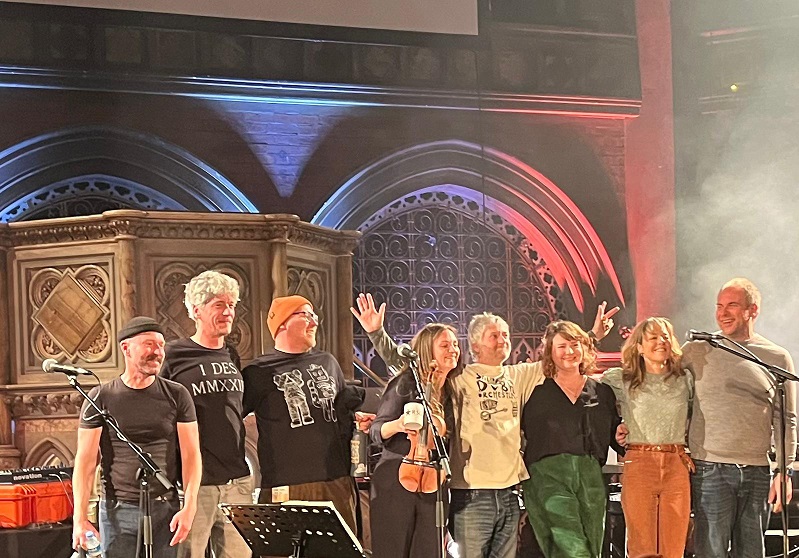
In concert – King Creosote @ Union Chapel, London

Union Chapel, London, 29 November 2024

by John Earls. Photo credit (c) John Earls

I fell in love with King Creosote (real name Kenny Anderson) in 2006 with the release of the special edition of KC Rules OK (which included superb sleeve notes by author Ian Rankin) and have been smitten ever since. He is a great singer-songwriter.

I first saw him live at London’s 100 Club in 2009 playing to about 100 people and then again at Union Chapel in 2011 where he performed the masterpiece Diamond Mine album with Jon Hopkins.

As an aside, I also met him on a bus in London in 2013. I was going to a concert at the Barbican and he hopped on with crutches and his ankle in a cast. He was utterly charming and it says something about him that he was on his way to play a gig (yes, on a bus and on crutches).

Needless to say I was looking forward to seeing him again at Union Chapel which is a stunningly beautiful venue. So let me get a couple of gripes out of the way.

Firstly, the sound system. Kenny Anderson is not just a superb singer – he is also a consummate wordsmith. It was therefore particularly disappointing that his words were often unintelligible (at least where I sat in the fifth pew). One can patch things up if familiar with the lyrics, but what a shame for those coming to KC for the first time. I’ve seen a number of live acts at Union Chapel (including, as mentioned, KC himself) without the same issue.

Secondly, the concert was performed in front of a screen which showed graphics accompanying the music. These were an interesting visual accompaniment and I get that they would be effective against the usual stage setup, but when gifted with such a magnificent backdrop as the wonderful stained glass East Window above Union Chapel’s pulpit and stage why obscure it? (again, this may have been more of an issue from my vantage point).

So to the concert which mostly consisted of a performance of the excellent 2023 I DES album in full. Inevitably, this will seem as much a review of that album (which I think will also be regarded as a masterpiece) as of the gig itself, for which KC was joined by an excellent seven piece band (including Emily Barker who performed a very good solo opening set) featuring acoustic guitar, accordion, fiddle, keyboards, synths, drum machines and percussion.

The performance effectively portrayed the album’s themes of love, loss and mortality, as well as its sense of optimism, hope and gratitude and opened with It’s Sin That’s Got Its Hold Upon Us with thumping beats and sweet strings.

We then had what Anderson has referred to as his “death trilogy” starting with the wonderful Blue Marbled Elm Trees. There can’t be a better song about one’s own funeral (I recommend listening to the fabulous episode of Nicola Meighan’s Kick Up The Arts: All Back To Mine with Anderson, where he says of this song “it had to be a jaunty death”). Burial Bleak and Dust complete the trilogy, which is then followed by the melancholic Walter de la Nightmare, the very bouncy Susie Mullen and Love Is a Curse.

The piano ballad Ides is one of the standout songs of the album (in my view it’s one of Anderson’s best ever), a perfect example of his unparalleled combination of voice and lyrics. Take the opening verse which amounts to a short story in itself:

When I said ‘excuse me, please’
You asked oh what did I want
I wanted someone to lie with on a Tuesday afternoon
Let’s say sometime around one o’clock
You must have looked shocked I fast changed tack
Right enough Thursdays are better for me
Once the clocks have gone back.

Mournful and beautiful, he sings, “But once I heard your voice / Like a punch to the chest / A kick in the gut / And a blow to the head all at once” and it takes my breath away.           

The I DES section of the show closes with Please Come Back I Will Listen, I Will Behave, I Will Toe the Line, shorter than the 13-minute album version but equally absorbing with fine backing vocals.

The rest of the concert consists of four numbers, a lovely So Forlorn, a lively No One Had It Better (from 2009’s Flick the Vs), Spystick (from 2007’s Bombshell) which (movingly for this reviewer) includes a taste of Not One Bit Ashamed (from KC Rules OK), and a groovy cover of Amanda Lear’s disco banger Follow Me. Kenny and the band then take a bow and are gone. As I left Union Chapel I said to myself “Thank God for Kenny Anderson”, a unique voice – lyrically, musically and literally.

John Earls is Director of Research at Unite the Union. He posts on Bluesky and tweets / updates his ‘X’ content at @john_earls

Published post no.2,370 – Friday 22 November 2024

In concert – Quatuor Danel: Shostakovich & Weinberg #7 with François-Frédéric Guy @ Wigmore Hall

François-Frédéric Guy (piano), Quatuor Danel [Marc Danel & Gilles Millet (violins), Vlad Bogdanas (viola), Yovan Markovitch (cello)]

Shostakovich String Quartet no.10 in A flat major Op.118 (1964)
Weinberg String Quartet no.11 in F major Op.89 (1965-6)
Weinberg Piano Quintet in F minor Op.18 (1944)

Wigmore Hall, London
Monday 25 November 2024

by Richard Whitehouse Photo (c) Marco Borggreve

This latest instalment in Quatuor Danel’s parallel cycle of string quartets by Shostakovich and Weinberg comprised one of the former composer’s most understated pieces followed with two of the latter’s most characteristic yet, at least in terms of expression, utterly contrasted works.

Written during just 11 days, the Tenth Quartet is something of a standalone in Shostakovich’s cycle – coming as it does between the four innately personal quartets that preceded it and the four related to members of the Beethoven Quartet (who premiered all except the first and last of this cycle) that followed. Yet, as its dedication to Mieczysław Weinberg suggests, this is no less specific in intent – hence the musing ambivalence of its initial Andante and visceral force of its scherzo. The Danel savoured their respective essence, cellist Yovan Markovich coming into his own in the ensuing Adagio with its emotionally restrained variations. The link to the finale was seamlessly effected, then the movement built methodically towards a heightened restatement of the passacaglia theme before tentatively retracing its steps to a wistful close.

Written months later, Weinberg’s Eleventh Quartet is by no means lesser by design or intent. Its fugitive opening Allegro exudes a scurrying motion such as resurfaces at key moments in the overall design, akin to that of the Shostakovich in equivocation, and if the scherzo could hardly be more different in its fleeting delicacy (the original such movement it replaced was likely much more demonstrative), the solemn alternation of ensemble and solo writing in its Adagio conjures up a similarly processional aura. Contrast is again pronounced in the finale where, instead of channelling the musical loose-ends towards a formal and expressive unity, Weinberg leaves matters in abeyance; despite (or because of) the most tentative recollection of that scurrying motion which flits across the already fragmented texture at the very close.

If the Danel had long mastered Weinberg at his most refractory, it proved equally adept with the communicative power of his Piano Quintet. At almost 45 minutes this is also his largest chamber work, its five movements unfolding as a discursive if never random sequence such that the furtive questioning of its opening Moderato finds accord with the unsettled humour of its ensuing Allegretto – an intermezzo next to the scherzo-like energy of its central Presto, in which the interplay between François-Frédéric Guy and the Danel was at its most incisive.

Much the longest movement, the Largo accumulates intensity through juxtaposing passages in rhythmic unison with those during which piano and strings predominate. Its impassioned culmination is exceeded by that of a final Allegro whose impetuous main ideas bring about    a climactic return to the work’s opening theme. Even more remarkable is what follows: the intensity soon subsiding prior to this movement’s initial idea returning, quietly transformed, as though to suggest its composer having been reborn as a sentient being and creative artist.

Hearing this work, performances of which have fortunately become more frequent these past two decades, is an experience like few others in the chamber domain; suffice to add that Guy and the Danel were as one in their realizing the scale and impact of this modern masterpiece.

You can hear the music from the concert below, in recordings made by Quatuor Danel -including their most recent cycle of the Shostakovich quartets on Accentus:

For more information on the next concert in the series, visit the Wigmore Hall website. You can click on the names for more on composer Mieczysław Weinberg, Quatuor Danel and pianist François-Frédéric Guy

Published post no.2,378 – Saturday 30 November 2024