Wigmore Mondays – Emerson String Quartet in Bartók and Brahms

emerson-quartet-2

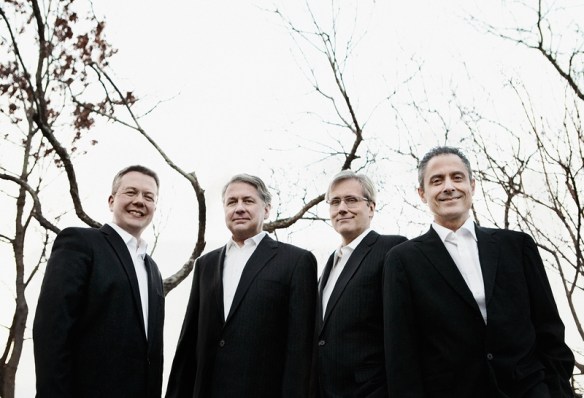
Emerson String Quartet – Eugene Drucker & Philip Setzer (violins), Lawrence Dutton (viola), Paul Watkins (cello) – Wigmore Hall, London, live on BBC Radio 3, 16 November 2015

Listening link (open in a new window):

http://www.bbc.co.uk/programmes/b06p50ql

on the iPlayer until 16 December

Spotify

In case you cannot hear the broadcast, here is a Spotify playlist of the music in this concert, as recorded by the Emerson String Quartet themselves:

What’s the music?

Brahms: String Quartet No.2 in A minor, Op.51/2 (1873) (32 minutes)

Bartók: String Quartet No.4 (1928) (26 minutes)

What about the music?

It is odd to think of Brahms suffering from any lack of conviction, given the consistently high quality of his output – but the shadow of Beethoven and Schubert was so long that he waited a long time before issuing any symphonies or string quartets. On the symphony front he waited until the age of 43 before publishing his first work in the form. The string quartets arrived a little earlier, the pair of works issued as Op.51 completed around his fortieth birthday.

They are extremely accomplished works, and as is the case with much of Brahms’s writing there is a lot going on in each part. Because of that it often sounds as though more than four stringed instruments are playing, and in the A minor work the Emersons perform here there is consistent melodic interest, Brahms often referring to several recurring ideas. This piece flows beautifully, and is clearly the work of an organised mind! Despite that there is clear emotion too.

The same could be said for Bartók, who achieves an incredible balance of structure in his String Quartet no.4 of 1928, while at the same time writing music of remarkable poise and power. This work is in five movements and is written like a mirror. Movements one and five are fast-ish sections carrying similar material, the instruments often working together. The second and fourth are ‘scherzos’ – fast music with a humourous side – though the humour here comes across as more devilish. The second movement is played with the mutes, while the second is wholly pizzicato (plucked). The third movement, the emotional centre, is a famous example of the composer’s night music, where a heady atmosphere is set by the other three instruments against a folk-inspired melody on the cello – which eventually transfers to violins and back.

Bartók’s Hungarian roots are very much on his sleeve here – but like Brahms he writes with his head as well as his heart, with not a note wasted.

Performance verdict

Electricity is in the air when the Emersons play Bartók, and something about the recent personnel change with Paul Watkins coming in seems to have fired the quartet afresh. It helps also that first violinist Eugene Drucker appears to be in much better health – back-wise at least – and these elements appear to have fired a new-found enthusiasm.

Watkins was a focal point in the third movement of what proved to be a stunning performance of the Bartók. When the Emersons recorded the six quartets of the Hungarian master in 1988 they laid down what for me were standard bearing feats of technical prowess. Here, at the Wigmore, they showed those were emphatically no fluke, and some of the sounds issuing from the four instruments I can genuinely say I have not heard from a string quartet before. The scratchy sound from Lawrence Dutton’s viola at the end of the second movement Scherzo, the weird, accordion-like chords halfway through the third – both were eyeopening moments.

The Brahms was inevitably a more sober performance but here too there was characterisation and much warmth, especially in the fast part of the scherzo and in the finale. Some of the composer’s quartet writing is extremely busy in this quartet, but under the Emersons we got clarity if perhaps an over-rich sound at times in the slow movement.

What should I listen out for?

Brahms

1:53 – the quartet begins with a smooth theme but with a certain amount of anxiety too. There are a lot of different melodic threads here but Brahms keeps them closely united. A lilting theme at 3:16 is a little more relaxed, but still with a lot of nervous energy going on elsewhere. When this theme comes back, at 8:05, the mood is a little sunnier – but elsewhere the anxiety seems to remain.

12:09 – the slow movement of the quartet, marked Andante moderato (which means ‘moderately, at a walking pace). This has a lyrical feel to it, and is given in a tender mood. Again Brahms works very smoothly, with little to no join between the different sections. The key of A major (as opposed to the overall key of the work, A minor) presents a much sunnier outlook too.

21:54 – a movement marked as a Minuet, which seems to acknowledge the historical use of this dance in the string quartet by Haydn and Mozart. Yet this is classic Brahms, with a slight syncopation running through the tunes and an elegance to the quartet writing. At 23:33 the mood changes with a much faster ‘trio’ section, the main material returning again at 24:51.

27:18 – a forceful tune begins this movement from the first violin, and is then taken up on the viola. A sweeter second theme then makes itself known at 28:07, but the work ends forcefully – almost defiantly – at 34:06.

Bartók

36:31 – Immediately the power of this work is set loose as the four instruments play closely together. There are jarring dissonances but also bittersweet folk melodies, passed between the instruments. Bartók often pairs the instruments in melody, as he does with the first violin and cello at 38:59. Then he explores contrasts between loud, jarring statements and really quiet answers, until a bruising passage brings the movement to an end at 42:33.

43:06 – the second movement is marked Prestissimo, con sordino­ – which means ‘very fast, with the mute’ – the small contraption each string player fits over their bridge to dull the sound. It gives an eerie effect, especially with the writing Bartók uses here, where the instruments sound like moths circling around a flame. The effect is that of night-time music – as it is also for the following:

46:50 – Bartók gets some really striking sonorities in his writing for strings here, with some held chords from the three upper instruments before a soliloquy from the cello at 47:11. The atmosphere is heady, and to get the most effect you are advised to listen in a quiet room or on headphones! Further solos from the violin follow, and the music becomes more animated, before the cello takes over again at 50:54.

52:59 – the fourth movement, a mirror of the second – only this time the instruments are required to use pizzicato – which is plucking the string. Sometimes Bartók asks them to twang against the fingerboard, which produces a snappy sound (53:45 for example). Even here there are striking melodies.

56:26 – a savage Hungarian dance begins, in a similar profile to the first movement, all players close together in range. The power of the unison playing is something to behold, especially as a lot of the time the players have been using double stopping (more than one string at a time). The frequent use of open strings leads to a coarse sound. The finish at 1:01:56 is particularly emphatic.

Encore

As an encore, not on the radio, the Emersons gave the Cypress No.3, a song by Dvořák which he arranged for string quartet. It is a beautifully warm piece of music.

Further listening

The Emersons’ Bartók recordings of 1988 were a landmark for the quartet, and it is well worth revisiting them. All six quartets are superbly performed, though one recommendation on its own would be the String Quartet no.2 – whose second movement Scherzo (the second track on Disc 2) has incredible forward drive.

Edinburgh String Quartet – Intimate Voices

Edinburgh-Quartet

Ben Hogwood visits the Edinburgh String Quartet on their home turf for an inventive program studying the intimacy of the string quartet
Queen’s Hall, Edinburgh, Wednesday 11 November

Schubert String Quartet in E flat major, D87 (1813)

Shostakovich String Quartet no.7 (1960)

Sibelius String Quartet in D minor, Op.56, Voces Intimae (1909)

Intimate Voices was the subtitle of this triptych from the Edinburgh String Quartet, an intriguing look at how the combination of two violins, viola and cello has become one of the main expressive forms in classical music.

To show how composers have approached the medium in different ways they presented a quartet by the teenage Schubert, a mature and compact example by Shostakovich and the only fully published example by Sibelius.

Of the three pieces it was perhaps this one – subtitled Intimate Voices – that carried the most penetrating emotional impact, played with passion and purpose by the quartet, whose dynamic control was especially impressive. The quiet moments, helped by an attentive Queen’s Hall audience, were a real window into Sibelius’ mind, and his string writing, which as the perceptive booklet note pointed out was boosted by his knowledge of stringed instruments through playing the violin, was interpreted with real style.

This piece was equalled in emotional impact by the Shostakovich, arguably the most effective of his fifteen quartets at making its mark in a very short space of time. Just twelve minutes pass in the String Quartet no.7 but in it we get deep into the thoughts of the composer. Shostakovich vividly illustrates his humour in the face of adversity but also the adversity itself, and the Edinburgh Quartet could be found warily treading forward as though worried what might be around the corner. Here again they paid exquisite attention to the quiet writing, so that when the third movement exploded out of the box it did so angrily and with maximum impact.

By complete contrast the first item in the program served notice that the sixteen year old Schubert was capable of going places. While taking obvious leads from Haydn (the second movement) and Mozart (the third) the String Quartet in E flat, published as D87 in the composer’s catalogue, is a beautifully crafted work that is by no means a copy. Schubert writes with confidence and melodic interest, the roots of his work in song already sown and making their most poignant effect in the first and third (slow) movements. The second movement was a blink-and-you-miss-it affair, with first violinist Tristan Gurney and cellist Mark Bailey helping to bring out the humour. Overall the intimacy between the players was as Gurney said in an insightful chat with the audience, essentially being a conversation between friends.

Gurney’s introduction was a key part of the enjoyment of this concert, showing that the theme Intimate Voices need not be restricted to the four players, but that the audience were included as well.

The Edinburgh String Quartet website can be accessed here

Tomasz Lis at Leighton House – Tchaikovsky and Chopin

tomasz-lis
Tomasz Lis

Richard Whitehouse on an intriguing recital from the Music at Unique Venues series
Leighton House, London Tuesday 10 November

Tchaikovsky: The Seasons, Op. 37b (1875-6)

Chopin: Preludes, Op. 24 – selection (1835-9)

Tomasz Lis (piano)

This evening’s recital formed part of the series Music at Unique Venues, aiming to combine the appeal of music and art by holding recitals at places not normally associated with live performance or, moreover, that are not often open to the general public. Although Leighton House has been accessible over much of the past century, not least for live music-making, a lengthy period of renovation had effectively taken it out of circulation; making performances such as that given tonight by the Polish pianist Tomasz Lis a much-needed act of redress.

Each half began with Lis placing the music in the context of fine-art from the same period. Thus he prefaced his account of Tchaikovsky’s The Seasons with consideration of those paintings A Rye Field and Winter by Ivan Shishkin (1832-98), whose deftly achieved realism found its complement in the understated and folk-inflected ethos of Tchaikovsky’s cycle; played with a winning combination of grace and eloquence by Lis, who pointed out it might have been titled ‘The Months’ were it not for the commercial acumen of its publisher.

The second half duly opened with Lis considering the paintings Souvenir de Mortefontaine by Jean-Baptiste-Camille Corot (1796-1875) and Fire at Sea by JMW. Turner (1775-1851); their powerful synthesis of feeling with depiction finding direct equivalent in the 24 Preludes of Chopin, 16 of which (Nos. 1-11 and 13-17) were heard here. Two-thirds of such a closely integrated cycle might have been in error, but Lis ensured this selection unfolded with a cohesion such that the A flat prelude rounded-off the sequence with requisite poise.

Add to this visual and musical feast the opportunity to enjoy the surroundings of the house made famous by Frederic, Lord Leighton (1830-96) out of opening hours, and the result was an evening as instructive as it was pleasurable. Tomasz Lis has recently released his debut album – featuring impromptus by Schubert, Chopin and Fauré – via Rondeau Productions (Klanglogo KL1511), which is well recommended. The Music at Unique Venues continues next February at Armourers Hall in the City of London and then in May at the Saville Club.

You can read more about the Music at Unique Venues series here

Meanwhile the website of Tomasz Lis is here

Wigmore Mondays – Barnabás Kelemen

barnabas-kelemen
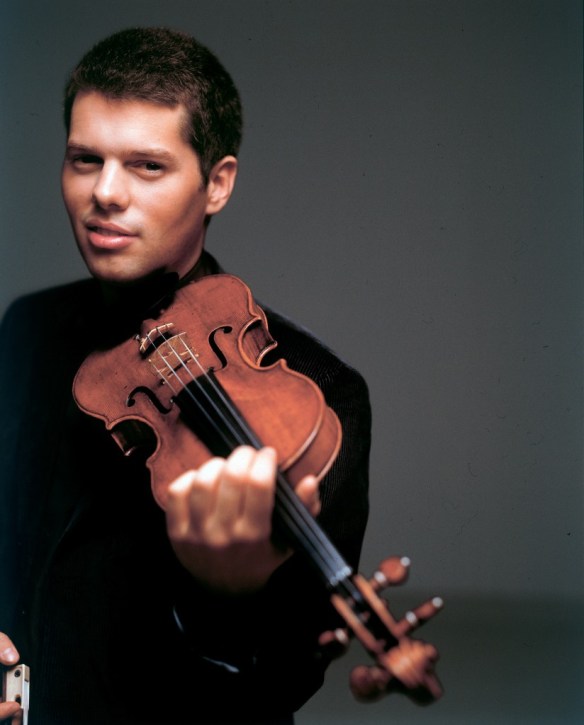
Photo (c) Laszlo Emmer

Barnabás Kelemen (violin) – Wigmore Hall, London, live on BBC Radio 3, 9 November 2015

Listening link (open in a new window):

http://www.bbc.co.uk/programmes/b06nrj16

on the iPlayer until 9 December

Spotify

In case you cannot hear the broadcast, here is a Spotify playlist of the music in this concert, from available versions on Spotify:

https://open.spotify.com/user/arcana.fm/playlist/7hpQWH2e75lnrwx3ibS4LU

What’s the music?

J.S. Bach: Partita No. 2 in D minor (1720) (30 minutes)

Ysaÿe: Violin Sonata No.3, ‘Ballade’ (1923) (6 minutes)

Paganini: 4 Caprices (from the 24 Caprices Op.1) (1802-17) (12 minutes)

Piazzolla: Tango Étude no.1 (1987) (3 minutes)

What about the music?

It’s quite possible to think of the violin as an ancestor of the guitar when you listen to this music. Some of it appears to be purely for show-off, especially when you get to the incredibly testing works by Ysaÿe, Paganini and Piazzolla, but when you look closer they are actually found to be musically proficient as well as technically demanding.

If Paganini was alive today I would imagine him behaving a bit like the guitarist Steve Vai, performing superhuman feats on his instrument but making sure at all times that not a note was wasted. That much is true in each of the famous Caprices, written for solo violin in a way that taxes all kinds of techniques with the performance of the instrument. The four here test the violinist’s ability with rapid string crossing, with playing three or four notes at the same time, and with rapid fingerwork.

Ysaÿe was also a virtuoso violinist, one who enjoyed dedications from Franck (his Violin Sonata) and Debussy (the String Quartet). Not much of his music is heard today, and when it is the Solo Violin Sonatas such as the one in this recital tend to be picked. Ysaÿe also taxes the violin but again ensures it is not just for display purposes. Piazzolla, meanwhile, was not known primarily as a violin composer, and his Tango Studies were originally written for the flute, but they transcribe naturally for the instrument, which can supply the rhythmic ‘snap’, as well as the other nuances that make the tango such an intense method of musical expression.

J.S. Bach’s Partitas for the solo violin come from a very different viewpoint. As in much solo Bach there are moments in these pieces where the listener feels as though they have entered a different time dimension, Bach’s treatment of his musical material so inevitable and so effortlessly calculated that it feels like the passing of time. The Solo Violin Partita no.2 is one of his most famous examples for a solo instrument, partly for the massive Chaconne with which it ends – a series of 64 variations on a small but ever-present loop.

Performance verdict

I wonder how many notes Barnábas Kelemen played in the course of this hour of music? Certainly Paganini ensured there were as many as possible in the selection of Caprices that he played, while Ysaÿe too packed a load into his brief but strikingly intense Solo Sonata.

Brilliantly played though this recital was, it could have done with a little more light and shade in the programming. The shade was to be found in the Bach, which was a really convincing account and was clearly a work close to Kelemen’s heart. He was relatively slow in the Allemande dance, which was an effective tactic as it meant the Gigue carried greater impact – though of course everyone was really waiting to see what he did with the Chaconne. Here Kelemen demonstrated a very firm grasp of the form, making a natural build through the 64 different variations, Bach’s vision growing in power and impact until it carried all before it.

Staying in the same key for the Ysaÿe was a brave but effective move, and this brief piece carried a Romantic intensity. It was good to be reminded of the Belgian composer’s genius, for his is not a voice often heard. Following this with Paganini was perhaps a step too far, like a mixed grill with no vegetables if you’ll pardon the parallel! That said, the Devil’s Laughter was brilliantly evoked in the last of the four caprices. Finally the Piazzolla, while harnessing the rhythms of the tango, was a bit too short to fully appreciate.

Kelemen is clearly a player of great ability – and although this recital might be better experienced in two takes, it demonstrates his technical prowess and keen musicality.

What should I listen out for?

J.S. Bach

1:42 – the Partita begins with a relatively slow dance, the Allemande. Kelemen does not use much vibrato to begin with, and his violin has a penetrating tone. As with much of the best Bach the music appears to unfold in a single, natural phrase.

7:08 – the Courante is much more purposeful, the notes quicker and the tone fuller. Bach drives the music on with a persuasive triple-time rhythm that Kelemen takes quickly. The tone of the instrument is also a bit brighter, the notes in a slightly higher register.

9:49 – the slow dance, the Sarabande­ – where the minor key really comes into its own. Here the violin is asked to do a lot of ‘multiple stopping’, which is playing more than one note at once, effectively making its own chords.

12:28 – the Gigue, another triple time dance that Kelemen takes at quite a lick, but which still has plenty of contrast with the repeats being used in each of the two sections. Bach gathers a lot of energy here, and as often uses the Gigue as the last dance form in his suites, but there is no feeling of finality here because we still have one movement to go…

17:47 – and that final movement is a massive one, the Chaconne, famously performed separately or reinterpreted for other instruments. The violin begins with a grand statement of a chord sequence which it then proceeds to spin out over 64 variations, mostly in the minor key but moving to the major at 24:44. Bach gives an enormous variety of colour, speed, attack, repose and musicality, starting relatively slowly but moving to passages of increasing difficulty and intensity, notably the string-crossing passage from 22:45, but this is also one of his most profound pieces of music when interpreted well. The music turns back to the minor key with impressive dramatic effect at 28:14.

Ysaÿe

33:08 – a slow beginning, acting as an introduction, before the sonata itself begins at 33:27 with a theme that sounds quite oriental. Although set in D minor the music rotates around that centre at quite a distance, and there is a lot of multiple stopping here. Despite the considerable virtuosity required there is a powerful musicality at the heart of this piece, which never uses display for the sake of it.

Paganini

40:37 – the Caprice no.1, almost laughably, is marked Andante (at a walking pace!) It certainly doesn’t begin that way, with a fiendish set of arpeggios facing the violinist. As the bow bounces across the string it is clear however that each of these notes is important, despite the obvious display tactics!

42:07 – the Caprice no.7 is much slower, and presents its theme in octaves – which any string player will know is an invitation for cramp! There is an eerie feel to the presentation of the notes, though soon Paganini can’t resist taking off at a great speed again. At 44:58 the music really goes out the blocks!

45:44 – the Devil’s Laughter of the Caprice no.13 is surely one of the most descriptive things Paganini wrote for the violin, and it crops up at disarming intervals in this piece, in and around the fiendish technical demands of the central section, set in a tempestuous minor key.

48:07 – the famous Caprice no. 24 was the basis of variations written by Rachmaninov and Lutoslawski (not to mention the South Bank Show theme!) but here it is in its original form, for solo violin. This Caprice is in itself a set of variations, and has a wonderful effect of tumbling pizzicato (plucking) at 50:34.

Piazzolla

53:31 – immediately the snappy tango rhythms are evident in the first tango etude, which sounds as though it was written for violin all along. The technical demands are not as extreme as some of the other music on the program, with a grasp of the tango rhythm the most essential part of the performance.

Further listening

https://open.spotify.com/user/arcana.fm/playlist/7hpQWH2e75lnrwx3ibS4LU

Taking Paganini’s Caprice no.24 as a starting point, the Spotify playlist above includes Rachmaninov’s famous Variations on a theme of Paganini for piano and orchestra, as well as Lutoslawski’s Variaions on the same theme for two pianos. Finally, it is a good chance to air one of six substantial concertos that Paganini wrote for violin and orchestra, works that are hardly ever heard in the concert hall these days. The second is one of the best, known as La Campanella because of the tune used in the last movement.


Igor Levit at the Wigmore Hall

igor-levit
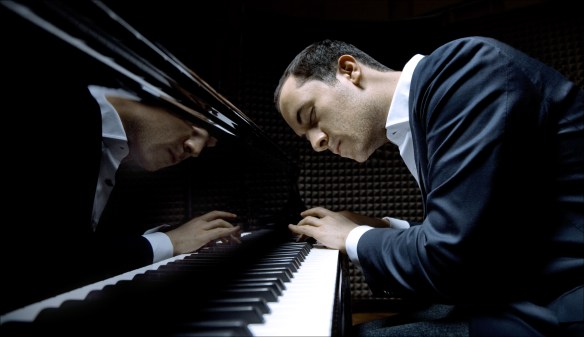
Igor Levit

Richard Whitehouse on another enterprising program from the Wigmore Hall
Wigmore Hall, London Thursday 5 November

Muffat: Passacaglia in G minor (pub 1690)

Shostakovich: Piano Sonata no.2 in B minor (1943)

Beethoven: Diabelli Variations (1819-23)

Igor Levit (piano)

Make no mistake, Igor Levit is among the most questing and (executively speaking) creative of younger pianists and it was an astute move by Wigmore Hall to make him a featured artist this coming season – Igor Levit Perspectives taking in a range of solo and chamber projects.

Levit’s latest recording comprises no less than three variation cycles by Bach, Beethoven and Rzewski (about which you can learn more by watching the video below). Avoiding any temptation to programme them as a single ‘marathon’ recital, tonight’s recital placed the Beethoven within a stimulating context. This opened with the Passacaglia from Georg Muffat’s Apparatus musico-organisticus, whose five variations on a deceptively functional theme were a blueprint for increasingly elaborate such sequences over the next two centuries. Levit’s account did not want for expressive depth or technical finesse.

A conceptual link between this piece and the finale of Shostakovich’s Piano Sonata no.2 was not hard to discern. Despite advocacy from such pianists as Emil Gilels, this latter work remains neglected compared to the composer’s orchestral and chamber music; its essentially introspective manner evident in an initial Allegretto whose respectively furtive and sardonic themes were delineated with simmering volatility. Nor was the central Largo lacking in that anguished restraint which Shostakovich was to mine extensively in his later string quartets; the (11) variations of the final Moderato unfolding with a cumulative intensity capped by the penultimate one in which Levit’s daringly slow tempo was justified by the desolation thereby conveyed, its successor then bringing this work full-circle to a decisive yet fatalistic degree.

After the interval, Beethoven’s Diabelli Variations and a performance that underlined the breathtaking imagination of a piece whose overall cohesion is afforded precisely through its sheer unpredictability. Not that Levit shied away from such disjunctiveness – witness the frequent and often lengthy pauses between groups of variations (which, interestingly enough, were by no means the customary or expected ones) – yet there was rarely, if ever, any feeling that this follow-through was governed other than by deep-seated formal logic and expressive conviction. Qualities equally true of the 10 additional variations that Beethoven inserted late in the work’s gestation, and which between them further point up the audacity of the overall concept as one in which Diabelli’s jejune theme is respected for all its intensive dismantling.

The biggest change came (as most often) with the modulation into C minor for variations 29-31, and a sequence that occupies a similar emotional domain to that of the ‘Arietta’ from the final piano sonata – though here the outcome is not transfiguration but the careering velocity of a double fugue in E flat; its progress finely articulated by Levit, who was nonetheless at pains to ensure its apex came with that credential interlude into the final variation – a minuet whose lucid poise brings with it a measure of calm then, at the close, bestows a benediction.

A pity the audience betrayed frequent signs of restlessness as the performance unfolded, but. Levit made no concessions to his listeners; any more than does Beethoven to his exponents – between them confirming a level of artistic integrity that should never be taken for granted.