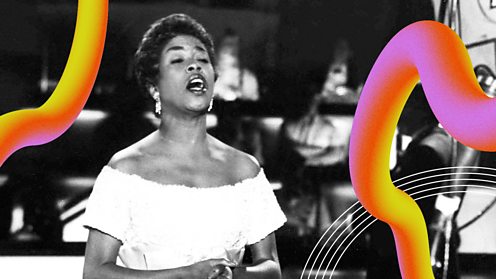
Arcana at the Proms – Prom 13: Sarah Vaughan – If You Could See Me Now

CHERISE, Lucy-Anne Daniels, Marisha Wallace, Lizz Wright, Clarke Peters, BBC Concert Orchestra / Guy Barker

Royal Albert Hall, London
Sunday 28 July 2024

reviewed by Richard Whitehouse Pictures (c) Andy Paradise

It has been customary in Proms seasons across the past decade to celebrate figures from those interconnected worlds of jazz, blues and soul. In this context, Sarah Vaughan (1924-90) was a natural choice as, though she rarely featured as a songwriter, her versatility across the musical spectrum meant she had few (if any) equals among her peers and even fewer successors. That tonight’s programme, and its four main singers, could do little more than touch on the relevant stylistic bases was itself tribute to one whose insisting ‘‘I am a singer’’ was not to be gainsaid.
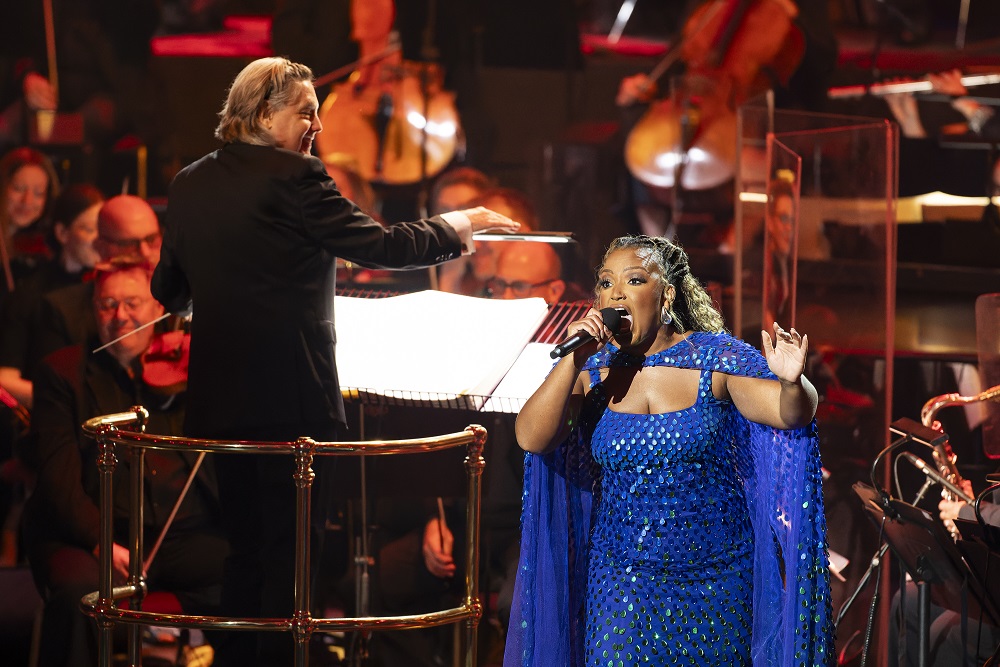
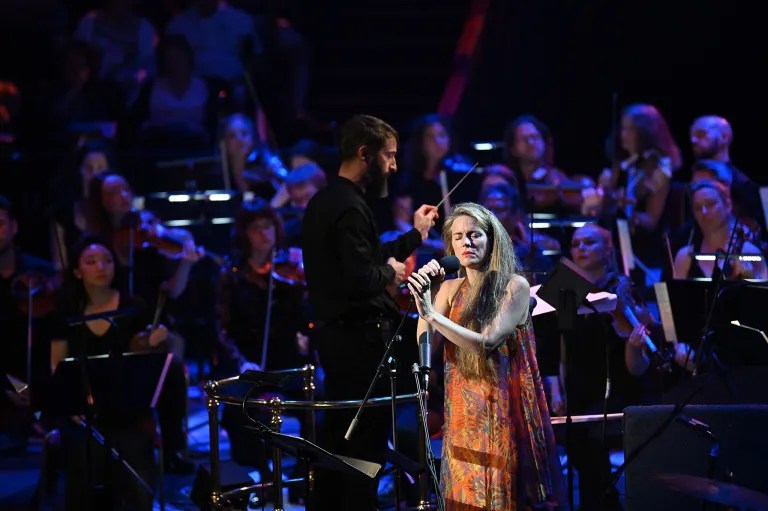
Marisha Wallace (above) pitched straight in with her no-holed-barred reading on I’m Gonna Live Till I Die, complemented by Lucy-Anne Daniels with an appropriately ‘sassy’ Nobody Else but Me then a soulful rendering of A Night in Tunisia (aka Interlude and surprisingly little heard as a vocal item). CHERISE (below) brought no mean pathos to I’ll Wait and Pray then no little wit to the catchy Mean to Me, while Clarke Peters made the most of his spotlight with a dextrous take on I Love the Rhythm in a Riff. Lizz Wright was eloquence itself in Tenderly, and despatched I Hadn’t Anyone Till You with a deft touch, then CHERISE gave a melting rendition of Misty (more affecting for the absence of affectation), but Daniels’s rather ‘by numbers’ scat rather undersold Sassy’s Blues – a pity given this was a rare Vaughan co-write. Wallace returned to round off the first half with a contrasting brace in which My Man, encompassing the wistful and dramatic in equal measure, proved a perfect foil to Great Day whose sheer vocal agility made for an undoubted showstopper with the BBC Concert Orchestra firing on all cylinders.
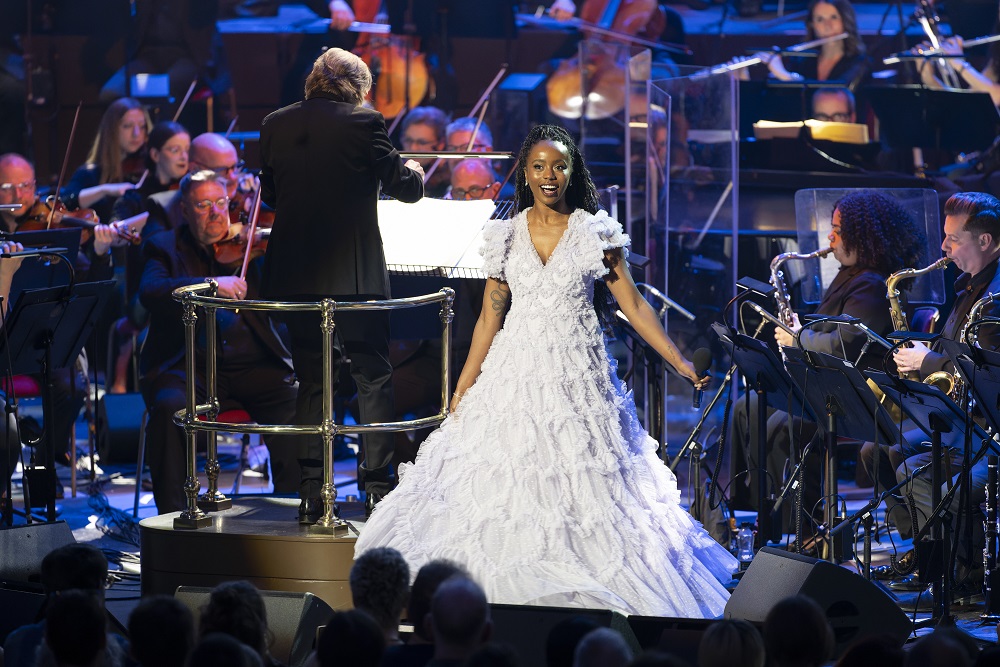
The orchestra came into its own at the start of the second half, its Bebop Instrumental Medley of standards by Thelonious Monk (‘Round Midnight, Little Rootie Tootie and Pannonica) and Dizzy Gillespie (A Night in Tunisia and Manteca) engaging reminder of the musical environs out of which Vaughan emerged. Daniels then sounded a plaintive tone in Body and Soul, with CHERISE’s insinuating take on Double Rainbow (whistling done to perfection) a reminder of Vaughan’s attraction to Brazilian music in later years. Wallace and Peters were a characterful double-act in Passing Strangers (without banishing memories of Kiki Dee and Scott Walker in their 1968 reading) while CHERISE was raunchiness incarnate in Don’t Be on the Outside, before Wright took the stage for a sequence comprising a moody Black Coffee, sultry Lullaby of Birdland then a confiding If You Could See Me Now which underlined just why this should have become a signature-tune for Vaughan.
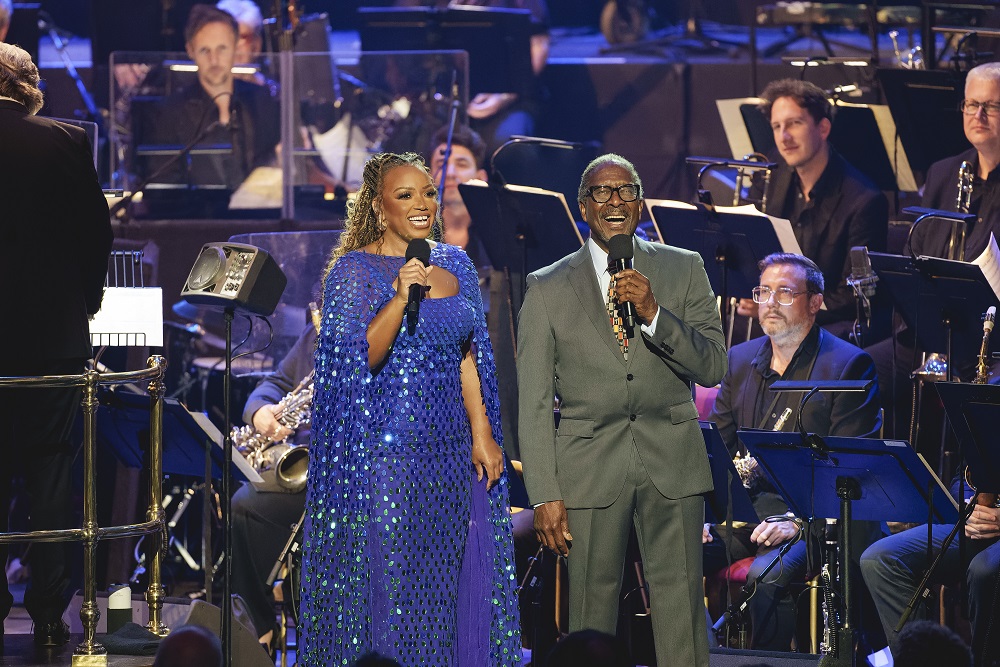
Daniels consequently upped the ante with a blithe I Cried for You, ideally complemented by Wallace with her genial take on Just a Little Lovin’. Although tonight was very much a showcase for vocal prowess, most of the items found space for at least one instrumental solo and rightly so, given the roster of ‘names’ in the BBCCO (a pity that woodwind and reeds were omitted from the personnel in the programme). As conductor (and arranger?), Guy Barker set his inimitable seal on proceedings which hopefully brought Sarah Vaughan a younger generation of admirers. All four vocalists (and Peters) returned for a send-off in the guise of an effervescent take on Perdido that assuredly brought the house down.
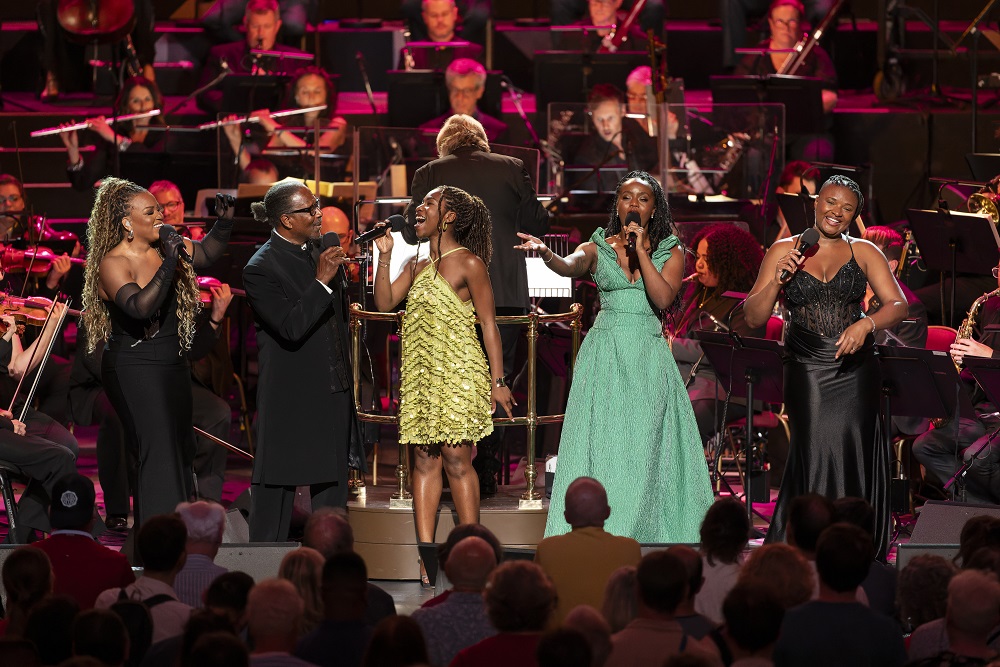
Prom 13: Sarah Vaughan – If You Could See Me Now. CHERISE Lucy-Anne Daniels Marisha Wallace Lizz Wright Clarke Peters presenter BBC Concert Orchestra Guy Barker conductor

The night’s program was as follows:

Curtis/Hoffman/Kent: I’m Gonna Till I Die
Kern: Nobody Else but Me
Gillespie: Interlude (A Night in Tunisia)
Treadwell/Valentine: I’ll Wait and Pray
Ahlert: Men to Me
Eckstine: I Love the Rhythm in a Riff
Gross: Tenderly
Noble: I hadn’t Anyone Till You
Garner: Misty
Vaughan/Jones: Sassy’s Blues
Yvain: My Man
Youmans: Great Day
Monk/Gillespie: Bebop Instrumental Medley
Green: Body and Soul
Jobim: Double Rainbow
Mitchell/Applebaum/Mann: Passing Strangers
Kelly/Watts/Wyche: Don’t Be on the Outside
Burke: Black Coffee
Shearing: Lullaby of Birdland
Dameron: If You See Me Now
Arnhelm/Lyman: I Cried for You
Mann/Weil: Just a Little Lovin’
Martínez: Perdido

You can watch this concert on the BBC iPlayer. For more on the 2024 BBC Proms, visit the festival’s website at the BBC. Click on the names for more information on Sarah Vaughan, and on the artists – CHERISE, Lucy-Anne Daniels, Marisha Wallace, Lizz Wright, Clarke Peters, the BBC Concert Orchestra and Guy Barker

Published post no.2,255 – Tuesday 30 July 2024

Arcana at the Proms – Prom 8: Nick Drake – An Orchestral Celebration

Olivia Chaney, Marika Hackman, BC Camplight, Scott Matthews, The Unthanks, BBC Symphony Orchestra / Jules Buckley

Royal Albert Hall, London
Wednesday 24 July 2024

reviewed by John Earls Pictures below (c) John Earls and (bottom) Chris Christodoulou

This November sees the 50th anniversary of the tragic death of the English singer-songwriter Nick Drake at the age of 26, having released just three albums of beautiful, bittersweet songs. Little known at the time, his reputation and influence has grown significantly.

This 2024 BBC Prom – an ‘orchestral celebration’ of his music – was destined to be something quite special and credit should go to British journalist and broadcaster John Wilson for proposing it.

Jules Buckley, here conducting the BBC Symphony Orchestra, has been involved in a number of BBC Proms over the years giving orchestral twists to contemporary music. Many of Drake’s songs were released at the time with string arrangements by Robert Kirby (it was good to hear Buckley pay tribute to Kirby who he referred to as “Nick Drake’s foil”) and these were developed, as well as some new ones added, by a number of other arrangers for this concert.

Following a gripping opening of the instrumental Introduction from Drake’s Bryter Layter album, BC Camplight gave excellent performances of Fly and Pink Moon which was deftly accompanied by strings and horns. Alas, his closing of the concert with Drake’s classic Saturday Sun didn’t quite cut it, being a bit too schmaltzy for this reviewer. However, the final all orchestral piece, an arrangement by Sam Gale of Horn, a sparse solo guitar piece from Pink Moon, was luminous and intense, culminating in a poignant solo trumpet.

Marika Hackman gave enchanting versions of Fruit Tree and River Man and her take on Time Has Told Me was a wonderfully smoky blues accompanied by drums, organ and guitar (Neill MacColl did some sterling work throughout the evening).

Scott Matthews opened his account with a wonderful Way to Blue with dramatic strings and timpani which, from where I was sitting, at times slightly overpowered his delicate voice, something rectified in the second half for his lovely performances of Northern Sky and From the Morning.

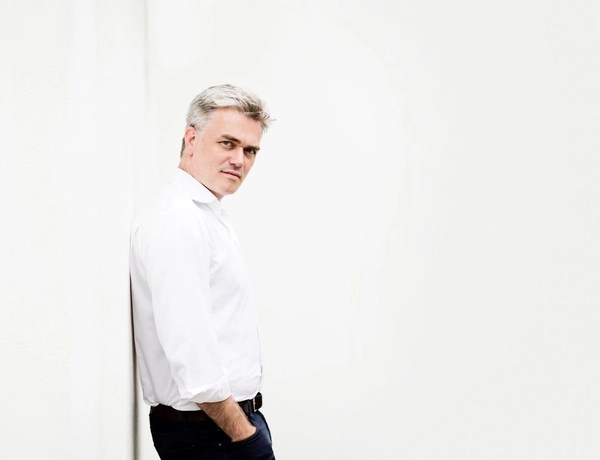
Olivia Chaney (above) gave a strong vocal performance of Hazey Jane I and a terrific version of At the Chime of a City Clock where the strings and horns were again particularly effective. Her solo piano rendition of Time of No Reply was outstanding.

Two of the most moving moments did not feature Nick Drake songs at all but those of his mother Molly. The Unthanks performed touching versions of What Can a Song Do to You? and Set Me Free and were joined by Drake’s sister Gabrielle reciting some of Molly’s poems in both cases. It was extremely affecting.

One can only imagine what Gabrielle Drake must have thought hearing the songs of her brother (and mother) performed in this way after so many years to a packed Royal Albert Hall that listened respectfully and lovingly. It was fitting testimony to the enduring quality of the music of an extraordinary songwriter.

This concert (including interval discussion with John Wilson, Radio 3 presenter Elizabeth Alker and Gabrielle Drake) is available on BBC Sounds until early October. For more on the 2024 BBC Proms, visit the festival’s website at the BBC, and click on the link to read John Earls’ review of Richard Morton Jack’s biography on Nick Drake: The Life. 

John Earls is Director of Research at Unite the Union and tweets / updates his ‘X’ account at @john_earls

Published post no.2,250 – Thursday 25 July 2024

In concert – Mary Bevan, CBSO / Edward Gardner: Schubert – Symphony no.9 & Songs

Mary Bevan (soprano), City of Birmingham Symphony Orchestra / Edward Gardner

Schubert
Rosamunde D797 – No. 3b, Romanze (1823)
Der Erlkönig D328 (1815, orch. Berlioz 1860)
Die Forelle D550 (1816, orch. Britten 1942)
Im Abendrot D799 (1825, orch. Reger 1914)
Geheimes D719 (1821, orch. Brahms, 1862)
Symphony no.9 in C major D944 ‘Great’ (1825-6, rev. 1828)

Symphony Hall, Birmingham
Wednesday 17 May 2024

Reviewed by Richard Whitehouse Pictures by Benjamin Ealovega (Ed Gardner), Victoria Cadisch (Mary Bevan)

July concerts no longer a consistent fixture in the City of Birmingham Symphony Orchestra’s schedule, it made sense to end the current season with the intended programme for the fourth and final volume of this orchestra’s Schubert cycle with former chief guest conductor Edward Gardner.

If not his final such project, the ‘Great’ was the final symphony that Schubert finished and the culminating orchestral work of his last decade. Now, as almost two centuries ago, it is not an easy work to being off – but this account hit the ground running with a flowing yet purposeful introduction that elided seamlessly with the initial Allegro. Gardner kept momentum on a sure yet flexible rein over those impetuous and capricious themes of its exposition; underlining the subtly eddying tension of its development and a propulsive coda whose link-up with the tempo of that introduction was marred only by the too emphatic final gesture. Respectively plaintive or consoling, the Andante’s alternate episodes were brought into eloquent accord – the fanfare -riven anguish at its climax then the stark fatalism towards its close being especial highlights.

The essential link between the scherzos of Beethoven and Bruckner, the third movement had the right buoyancy but also a suavity in keeping with the Viennese character of its dance-like themes, and complemented by those of its trio whose lilting elegance were tinged by wistful regret. Launched with a commanding call-to-attention, the Finale did not lack for vigour but, unlike so many performances, Gardner was mindful not to rush either here or in the capering second theme whose relentless string accompaniment was vividly rendered. The development more than fulfilled its purpose as an extended transition into the reprise, then the coda opened with a frisson of anticipation such as underpinned the closing pages as they powered towards the decisive but never headlong close to what was a convincing and engrossing performance.

Regarding repeats, Gardner observed that of the first movement’s exposition but not those in the second half during either scherzo or trio, and that of the finale’s exposition. This at least made matters easier for the players, and left options open for their inclusion in the recording.

That forthcoming release on Chandos will hopefully find room for the five songs that formed the first half of this concert, with each of them arranged by a different composer. The pensive Romanze from Schubert’s incidental music to Rosamunde was heard in the composer’s own orchestration, with the compact psychodrama of Der Erlkōnig in a resourceful and nowadays overlooked orchestration by Berlioz. The looping but not always ingratiating playfulness of Die Forelle was expertly attended to by Britten, while the pensive soulfulness of Im Abendrot summoned an appropriate response from Reger; the sombre resignation of Geheimnis making for a welcome encore in its orchestration by Brahms. Throughout the selection, Mary Bevan’s veracity of emotional response and her clarity of enunciation were qualities worth savouring.

This programme may have concluded the Schubert cycle by Gardner and the CBSO, though hopefully it will not see of this partnership in recorded terms – the symphonies of Schumann, and maybe Brahms, being well worth considering as additions to the orchestra’s discography.

For details on the 2024-25 season A Season of Joy, head to the City of Birmingham Symphony Orchestra website. Click on the names to read more about soprano Mary Bevan and conductor Edward Gardner

Published post no.2,243 – Thursday 18 July 2024

In concert – Katie Trethewey, University of Birmingham Voices, CBSO Chorus & Orchestra / Ludovic Morlot: John Luther Adams – Vespers of the Blessed Earth; Sibelius

Katie Tretheway (soprano), CBSO Chorus, University of Birmingham Voices, City of Birmingham Symphony Orchestra / Ludovic Morlot

John Luther Adams Vespers of the Blessed Earth (2021) [CBSO co-commission: UK premiere]
Sibelius Symphony no.2 in D major Op.43 (1901-02)

Symphony Hall, Birmingham
Thursday 9 May 2024

Reviewed by Richard Whitehouse

Almost eight years ago, the City of Birmingham Symphony Orchestra and Ludovic Morlot gave the UK premiere of John Luther AdamsBecome Ocean. Tonight they, with the CBSO Chorus and University of Birmingham Voices, gave that of his most recent large-scale work.

It may have been obliquely inspired by Monteverdi, but Vespers of the Blessed Earth is very much a humanist response to those ecological challenges of the present and, to this end, its texts have a concreteness and functionality which is wholly at the service of the music. Thus A Brief Descent into Deep Time sets words as depict the (reverse) geological evolution of the Grand Canyon, its emotional matter-of-factness in contrast to A Weeping of Doves with its unaccompanied setting of the call of the Papuan fruit dove in what is one of Adams’ most ravishing inspirations. Hardly less affecting is Night-Shining Clouds – an interlude, in the form of a chaconne, for strings that follows what the composer calls a ‘sub-harmonic’ series with its slowly spiralling descent to the depths for a graphic evocation of cloudly pollutants.

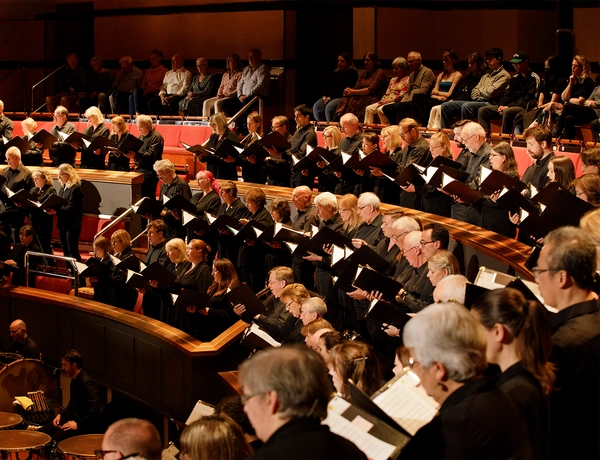
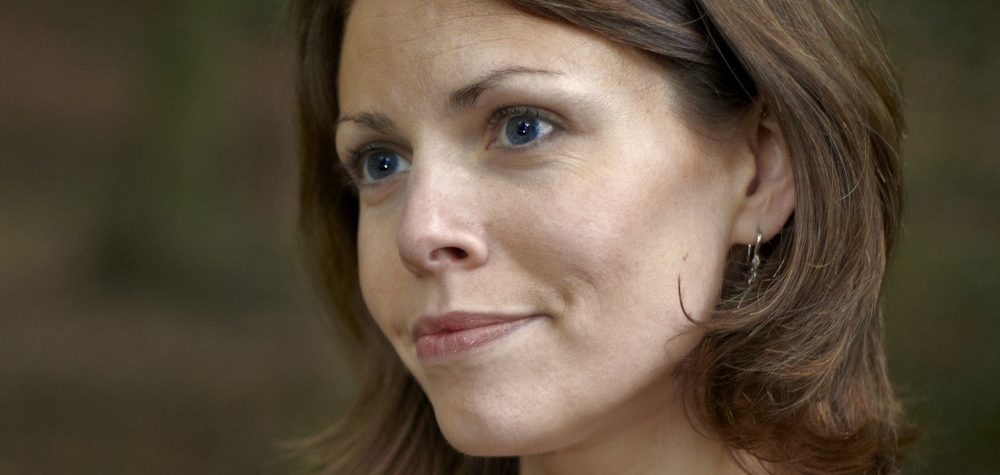
The fourth and climactic section, Litanies of the Sixth Extinction divides the choruses into four parts which between them chant the names of species in the process of or likely to face extinction – closing ominously with Homo Sapiens. It was here that an antiphonal placing of strings and percussion, along with choirs of woodwind and brass placed along either side of the upper circle, came into its own but, typically for Adams, the effect was one of cumulative if not intensifying emotion. Aria of the Ghost Bird followed with its transcribed rendering of the call from the now-extinct Kaua’i O’ō, tonight taken by Katie Tretheway (above) in what was a finale of the gentlest eloquence. It duly remained for offstage flute and chimes, here placed up in the grand tier, to see this inconsistent while always absorbing work to its wistful close.

In his thoughtful introductory remarks, Morlot spoke of the appositeness when juxtaposing Adams with Sibelius and the latter’s Second Symphony, which followed the interval, made his point admirably. Once the most popular such piece by Sibelius (and, indeed, of the last century), latter-day performances too often fight shy of its innate rhetoric or overt emotion. Without being disengaged, this account succeeded because of its methodical trajectory, not least a first movement whose restraint was never at the expense of its overall incisiveness.

With its stark contrast between conflict and consolation, the slow movement can easily fall into overkill but not here – Morlot evincing a keen sense of cohesion through to its baleful ending. The scherzo likewise secured keen cohesion from its alternate energy and raptness, then its surging transition into the finale brought an emotional frisson maintained through to an apotheosis whose grandeur never felt self-conscious or overbearing. Whether the triumph expressed is cultural or personal, the underlying essence of its affirmation was not in doubt.

It certainly set the seal on a memorable evening – one that confirmed the undoubted rapport between orchestra and conductor, while bridging the conceptual divide and almost 120 years between these pieces. Hopefully the CBSO and Morlot will be working together again soon.

Click on the link to read more on the current CBSO concert season, and on the names for more on soprano Katie Trethewey, conductor Ludovic Morlot, the University of Birmingham Voices and the CBSO Chorus. Meanwhile you can click on the name for more on composer John Luther Adams

Published post no.2,203 – Saturday 8 June 2024

In concert – Michael Collins, BBC Concert Orchestra / Martin Yates – The 17th English Music Festival @ Dorchester Abbey

Michael Collins (clarinet), BBC Concert Orchestra / Martin Yates

Carwithen Suffolk Suite (1964)
Delius Idyll de Printemps, RTVI/5 (1889)
Stanford Clarinet Concerto in A minor Op.80 (1902)
Vaughan Williams Richard II: A Concert Fantasy (1944) [World Premiere Performance]
Holst Symphony in F major H47 ‘The Cotswolds’ (1899-1900)

The Abbey, Dorchester-on-Thames
Friday 25 May 2024

Reviewed by Richard Whitehouse

This latest edition of the English Music Festival, also the first to take place entirely within the spacious ambience of the Abbey at Dorchester-on-Thames, began with the customary concert from the BBC Concert Orchestra and Martin Yates. As conceived for amateur players, Suffolk Suite by Doreen Carwithen feels nothing if not resourceful – whether in the regal opulence of Prelude, evocative poise of Orford Ness then the alternately rumbustious or genial humour of Suffolk Morris; the martial tread of Framlingham Castle bringing about a resolute close.

Recent years have seen renewed interest in Delius’ early orchestral work, Idylle de Primtemps an appealing instance of the composer harnessing Nordic influences to the impressionist style then emerging in his adopted home of Paris – resulting in this short yet atmospheric tone poem.

It was enticingly given by the BBCCO, which then partnered Michael Collins (above) for a revival of the Clarinet Concerto by Stanford. As with numerous concertante works from the period, this is a three-movements-in-one design. The preludial Allegro introduces two main themes, their development continued (albeit understatedly) in a central Andante that unfolds with mounting eloquence, before the final Allegro brings a transformed reprise of the initial themes on route to its decisive ending. As with the First Cello Concerto of Saint-Saëns or the Violin Concerto of Glazunov, this is a piece the accessibility of whose idiom belies the ingenuity of its formal thinking or appeal of its ideas, and Collins (who evidently last played the piece four decades ago) brought subtlety and insight to music which ultimately delivers more than it promises.

These EMF opening concerts regularly feature first performances, and this evening brought that of the ‘Concert Fantasy’ as adapted by Yates (above) from Vaughan Williams’ incidental music to a production of Richard II for a BBC radio production and subsequently shelved. As might be expected, this abounds in allusions to earlier VW works from the period (notably Job and the Fifth Symphony), but the skill by which the composer reflects salient events in Shakespeare’s play and ease with which these fuse into a relatively continuous whole is its own justification.

It made sense to feature a major work by Holst in this, the 150th anniversary-year of his birth as well as the 90th of his death, with his Cotswolds Symphony certainly a welcome inclusion. If the weight and intensity of its second movement, Elegy (In Memoriam William Morris), rather dwarfs those other three, this is less an issue when the overall sequence was as astutely balanced as here. Yates secured a keen response in the opening Allegro, the personality of its ideas here outweighing any short-windedness, while there was no lack of verve and grace in the Scherzo or of animation in the Finale. That Elegy, though, is the real highpoint and the BBCCO did not disappoint with the sustained plangency of its playing. Numerous of Holst’s early pieces qualify as his primary achievement pre-Planets and this is arguably the greatest.

It duly rounded-off a fine opening to this year’s EMF. Maybe a future such occasion could see the revival of Stanford’s once popular Third ‘Irish’ Symphony or, even more pressingly, the first hearing for over a century of Holst’s doubtless unfairly derided suite Phantastes?

Click to read more about the English Music Festival 2024 – and on the names for more on the artists Michael Collins, Martin Yates and the BBC Concert Orchestra. For more detail on the composers, click on the names to read more about Carwithen, Delius, Stanford, Vaughan Williams and Holst

Published post no.2,186 – Wednesday 22 May 2024