Allan Clayton (tenor), Kate Golla (piano), Lindy Hume (director), David Bergman (videographer)
Barbican Hall, London Wednesday 7 December 2022
Reviewed by John Earls
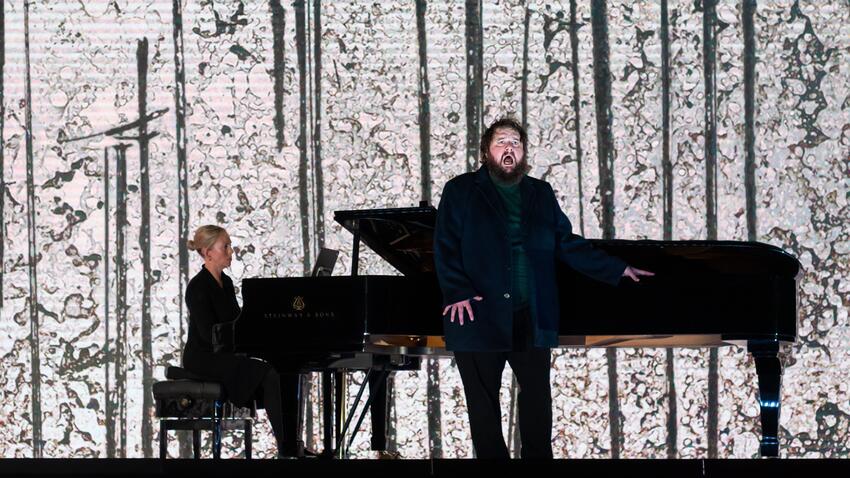
Before the start of this performance it was announced that Allan Clayton had a chest infection but didn’t want to disappoint the audience who were asked to bear with him. As it turned out there was nothing to bear with and it certainly didn’t disappoint.
Many people think that Schubert’s great song-cycle Winterreise shouldn’t be tampered with beyond concentrating on the singing and piano playing in this remarkable work of 24 songs. They would prefer a ‘straight’ concert performance such as that given by Ian Bostridge and Thomas Adès in this same hall in January 2015, which was indeed unforgettable (incidentally, Bostridge has written a magnificent book on Winterreise called Schubert’s Winter Journey: Anatomy of an Obsession).
This particular ‘production’ featured video projections of abstract paintings by the late Australian artist Fred Williams on two right-angled screens behind the piano. These gave a sense of landscape although not always the landscapes one might usually associate with this work. It was deftly and beautifully done. Full credit to David Bergman (videographer).
Credit, should also be afforded to director Lindy Hume and artistic director Paul Kildea. Clayton was allowed to wander around the stage although didn’t stray too far from the piano with the exception of cutting a strikingly remote figure at the side of the stage at the beginning and end. There was no overkill, just delicate touches of theatre such as Clayton lying down to sleep under the piano using his coat as a pillow in Rast (Rest). And I wasn’t the only one who chuckled (is one allowed to chuckle during Winterreise?) when a mocking finger was pointed at the pianist sounding the posthorn in Die Post (The mail-coach).
Kate Golla provided fine piano accompaniment. But it was Clayton’s show. Despite the aforementioned ailment his singing was clear, dramatic and immensely moving, Die Nebensonnen (Phantom suns) a case in point. This, combined with his considered theatricality, gave a real sense of going on the journey with him. This will come as no surprise to anyone who saw his stunning performance as Peter Grimes at the Royal Opera House earlier this year.
There is a risk that adding visual accompaniments to this masterpiece detracts (and distracts) from the power and atmosphere of the work itself. In this case they were respectful, complementary and engaging. It was an utterly compelling experience.
John Earls is Director of Research at Unite the Union and tweets at @john_earls
Vaughan Williams Fantasia on a Theme of Thomas Tallis (1910) Pritchard Violin Concerto ‘Wall of Water’ (2014) David Matthews Shiva Dances Op.160 (2021) Elgar Introduction and Allegro Op.47 (1905)
Zoë Beyers (violin), English String Orchestra / Kenneth Woods
Holy Trinity Church, Hereford Thursday 24 November 2022
Reviewed by Richard Whitehouse
Just a day after The Journey Home, the ESO reverted to its ‘String’ guise for this judiciously sequenced programme with two contrasted commissions framed by classics of the repertoire for string orchestra – these latter written not so far away from where this concert took place.
Acclaimed at its premiere in Gloucester Cathedral some 112 years ago, Vaughan Williams’s Fantasia on a Theme of Thomas Tallis has never been so popular as it has become this past decade. This performance did it justice – the placing of the ‘echo’ orchestra, behind the altar-screen in the imposing Victorian confines of Holy Trinity Church, abetting those antiphonal exchanges in the central section. Solo string quartet building steadily toward an impassioned culmination, from where Tallis’s theme is movingly recalled prior to the final evanescence.
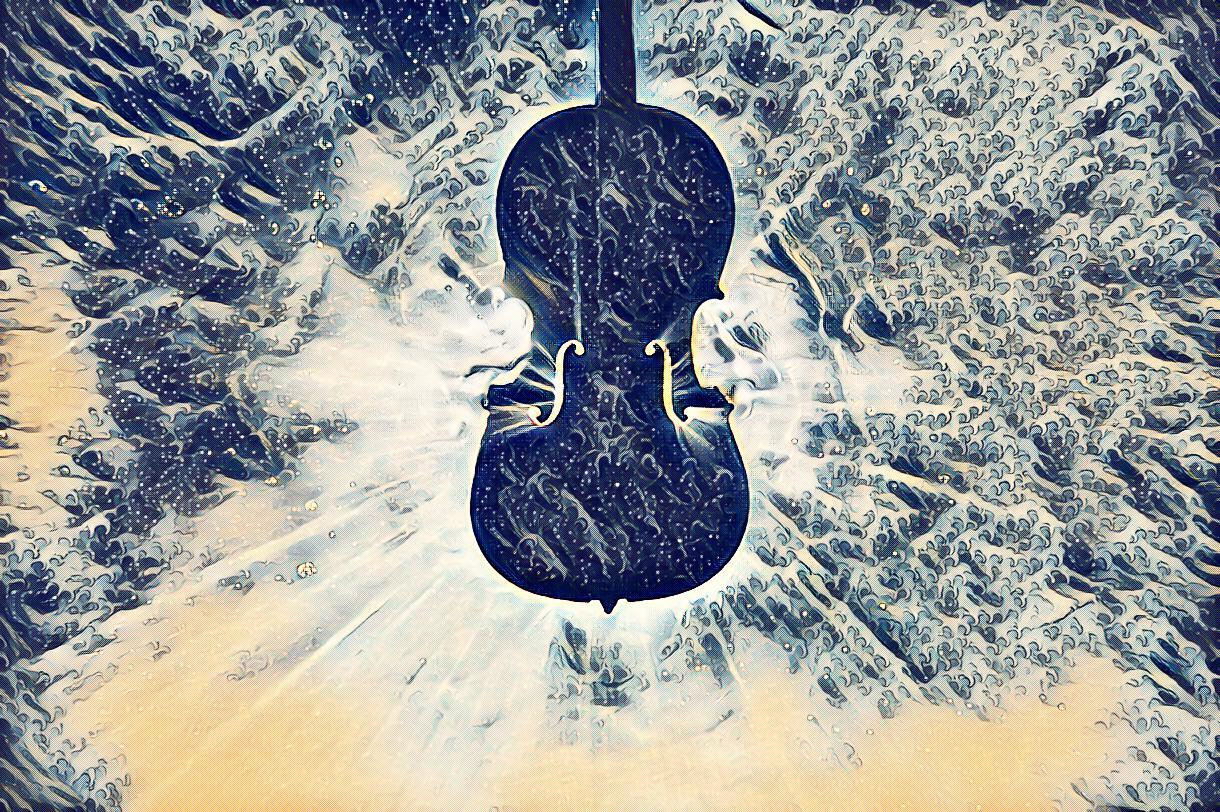
Next came the welcome revival of an earlier ESO commission by Deborah Pritchard. Inspired by an eponymous series of paintings by Maggi Hambling, Wall of Water is a violin concerto which makes tangible reference to these 13 canvases as it unfolds. Their projection to the rear of the orchestra underlying a visceral as well as imagistic allure, even though the work itself is fully intelligible on its own terms – not least with a three-movement trajectory coalescing out of continuous 13 sections. Elements of Penderecki and Lutosławski can be discerned over its course, but a distinct and engaging personality is also in evidence along with a technical finesse with regard both to the solo writing and that for the strings. Zoë Beyers gave a superb account of a piece which seems sure to enter the repertoire of 21st-century violin concertos.
As too does Shiva Dances by David Matthews. The combination of string quartet and string orchestra is a potent one (see below), of which the composer has availed himself fully in this continuous sequence likely inspired as much in a description of Hindu god Shiva by Aldous Huxley as by Indian classical music. Proceeding from a slow introduction given piquancy by its modal intonations, the work comprises four dances which between them outline the four elements: an impetuous workout that represents ‘earth’, a quixotic interplay for soloists and ensemble that of ‘water’, the scherzo-like agility of ‘air’, then a lively waltz for ‘fire’ – this latter building to a forceful restatement of the opening theme, before the coda opens-out the overall expression such that what went before is rendered from a more ethereal perspective.
Kenneth Woods secured an engaging account of this appealing work, as he did of Elgar’s Introduction and Allegro that concluded the evening. As he pointed out, its main melody is a rare instance of this composer using an actual folksong, yet that never entails a lessening of formal intricacy in what becomes a latter-day recasting of the concerto grosso – reaching its emotional apex in a developmental fugue that bristles with technical challenges. A tough test for the London Symphony Orchestra, with whom Elgar enjoyed a productive association.
Suffice to add the ESO was equal to this task as in the sustained fervency of the final pages. It rounded off another worthwhile evening from this always enterprising ensemble. December brings the seasonal performance of Handel’s Messiah, with further concerts in the new year.
Haydn Symphony No. 45 in F sharp minor, Hob.I:45 ‘Farewell’ (1772) David Matthews Le Lac Op.146 (2018) Barber Knoxville: Summer of 1915 Op.24 (1947) Mozart Symphony no.36 in C major K425 ‘Linz’
April Fredrick (soprano), English Symphony Orchestra / Kenneth Woods
Great Malvern Priory, Malvern Wednesday 23 November 2022
Reviewed by Richard Whitehouse
The English Symphony Orchestra’s season really hit its stride this evening with a programme featuring two major vocal works of the 20th and 21st centuries, heard alongside two notable while very different symphonies from near the start and towards the end of the Classical era.
As Kenneth Woods indicated, Haydn’s ‘Farewell’ Symphony would have been determinedly avant-garde to early listeners, and much of that innovative quality came over here. Not least in the initial Allegro, its jagged course and disjunctive tonal shifts only nominally countered by the Adagio’s increasingly fraught introspection. With its stark alternations in motion and phrasing, the Menuetto proved a telling foil to a finale where a turbulent Presto precedes an Adagio whose eloquence was sustained as the music subsides and musicians vacate the stage.
Whether or not this symphony would have been better placed at the end of this concert, it set up productive contrast with David Matthews’s Le Lac. Remembered more as statesman than poet, Alphonse de Lamartine was a crucial figure in French literature of the early Romantic period – his lengthy 1820 poem a remembrance of lost love comparable to verse by Shelley and Heine, and one whose slowly intensifying rapture is to the fore in this evocative scena. Two orchestral interludes aside, its formal and emotional progress is essentially determined by the vocal line; with which April Fredrick was at one in conveying the wistfulness but also anguish inherent of this music. The fastidious textures were no less finely delineated by the ESO, Woods sustaining a cohesive overall trajectory from earlier promise to ultimate loss.
Evidently it was Fredrick who had suggested juxtaposing this piece with Barber’s Knoxville: Summer of 1915, which pairing succeeded admirably in terms of underlining conceptual and expressive links between them. Its sense of loss may be psychological rather than personal, but an emotional force comes over tangibly for all this music’s overt restraint: James Agee’s poetic reportage summoning a response the more affecting for its restraint and in whose vocal part Fredrick was never less than attuned. Woods brought no mean sensitivity or character to orchestral writing such as eschews the rhetoric found in many of Barber’s earlier scores and so foreshadows the subtlety of those two decades hence. This is a work with few significant precursors or successors, and the present reading made the most of its singular atmosphere.
The evening concluded with the relative extroversion of Mozart’s ‘Linz’ Symphony – a piece whose having been written in four days doubtless occasioned its technical brilliance, yet also a formulaic quality to its actual substance. Not, however, in an Andante whose gentle pathos was to the fore, or a Menuetto whose brevity belies its resourceful use of woodwind. Woods found a winning effervescence in the initial Allegro, and if the second-half repeat in the final Presto may be one such too far, this music’s Haydnesque wit was never less than appealing.
It set the seal on a well-conceived and finely executed concert that, in pivoting between the established and unfamiliar (not only between but also within works) typifies thr resourceful approach to programming with which Woods and the ESO have now become synonymous.
Vaughan Williams Fantasia on a Theme by Thomas Tallis (1910) Tom Coult Pleasure Garden: Concerto for Violin and Orchestra (2020) (London premiere) Vaughan Williams The Lark Ascending (1914-20); Symphony no.9 in E minor (1956-57)
Daniel Pioro (violin), London Philharmonic Orchestra / Andrew Manze
Royal Festival Hall, London Wednesday 26 October 2022
Reviewed by Ben Hogwood. Concert pictures with thanks to the London Philharmonic Orchestra; picture of Andrew Manze (c) Benjamin Ealovega
Subtitled Visions of England, this concert from the London Philharmonic Orchestra and Andrew Manze was a celebration of Vaughan Williams, marking 150 years since the composer’s birth. As part of an extremely full conducting CV, Manze has a recently recorded cycle of the composer’s nine symphonies under his belt with the Royal Liverpool Philharmonic Orchestra, and clearly holds a special affection for his music.
Two of RVW’s most popular pieces began each half of the concert, but the main act was a relatively rare encounter with composer’s final symphony, completed a year before his death. The Ninth Symphony is a work needing repeated listening before its treasures can be fully revealed, but more recently it has started to get the performances it needs to make an impact. As Manze himself told us from the platform, it also has a deep resonance for the London Philharmonic Orchestra themselves. On the morning of 26 August 1958 they were rehearsing with the composer’s friend and advocate, Sir Adrian Boult, when news came through that Vaughan Williams had died.
This performance delved into the spidery textures that seem to provide a link to the afterlife itself, rather like one of Holst’s later Planets. Also evident were a series of cloudy, watery vistas, such as those found in Debussy’s Nocturnes. Manze probed deeply into the first movement, helped by the baleful colouring of three saxophones, beautifully managed by Martin Robertson, Tim Holmes and Shaun Thompson to enhance the unusual orchestral textures. The tension between the ‘home’ note of E and its immediate neighbour F was ideally weighted, the thoughtful mood tinged with a sense of foreboding.
These emotions underpinned a convincing performance, with references to earlier, angrier music from the Sixth symphony sharply noted and delivered. There were also moments of calm acceptance, as though the composer was reappraising his life with some satisfaction, the darkness held at bay by silvery strings and consoling woodwind.
The second movement, with its curious rhythmic profile, had nicely balanced syncopations, while the scherzo danced as though in an empty room, the music never quite leaving the leash on which it was held. Segueing directly to the finale, Manze’s control and passion could be felt in equal measure, a sense of resolution hard to come by but ultimately found as the music headed for its final three chords, the ‘E’ and ‘F’ finally resolving their dispute. This beautiful symphonic ending offered genuine light in the darkness, a similar sensation to Shostakovich’s final symphonic statement if seen through very different eyes.
The concert opened with the ubiquitous Fantasia on a Theme by Thomas Tallis, less elusive music perhaps but equally profound when casting its eyes back over time. This ideal concert opener speaks as loudly as it surely did in 1910, providing consolation for the fevered brow through subtle but far-reaching statements. On this occasion the performance did not quite have the ‘tingle’ factor, but it did feature beautiful string playing and finely wrought balance between the ‘choir’ of ten instruments, elevated a little at the back of the stage. Meanwhile the main orchestra could boast excellent contributions from four section principals, Pieter Schoeman and Tania Mazzetti (violins), Richard Waters (viola) and Pei-Jee Ng (cello).
The Lark Ascending holds a similarly treasured status among lovers of Vaughan Williams, remaining one of the calling cards of 20th century English music. In the right performance it creates a magical evocation of George Meredith’s lark, as it ‘drops the silver chain of sound’. Daniel Pioro played the solo part with great sensitivity and more than a little panache, choosing not to overindulge in a relatively straightforward opening sequence, but appearing to add a few extra ‘blue’ notes as the violin warmed to its characterisation, ‘lost on his aerial wings’. Manze’s pacing, initially quite fast, settled to a satisfying pace, with ideal balance between soloist and orchestra. The hall responded with commendable silence to the absolute quiet at the end.
A busy evening for Pioro included a role as soloist in the first London performance of Tom Coult’s Pleasure Garden. A four-movement concerto for violin and carefully chosen orchestra, it is effectively a compilation of four very distinct tableaus, taking its lead from constructed ‘natural spaces’ in and around congested living areas.
The first movement, Starting to rain – Zennyo Ryuo appears, found as vivid a portrayal of rain as you could wish to hear – in my mind I was checking the roof for a leak! Throughout the concerto Coult’s keen ear for orchestral colour was evident at every turn, as was his assured writing for violin, brilliantly played by Pioro. The coloristic effects were enjoyable and easy on the ear, harmonies largely consonant but never over-simplified, and the description of events in Dyeing the lake blue for Queen Victoria, Francesco Landini serenades the birds and The art of setting stones was easy to follow. The birds in particular were vividly portrayed by the soloist.
There was however a fragmented feel to the green spaces, as though they had not fully germinated, and this was exaggerated by the stopping of each movement to pause the descriptive process. When the piece did finally finish there was still an element of unfinished business, in spite of its 27-minute length. Repeated hearing would be welcome to give a more thorough appraisal and understanding, as the warm reception would suggest Coult hit the mark for the vast majority of listeners. His music has many attractive traits and he is a gifted orchestrator, so his is most definitely a space to keep under watch.
Mendelssohn Calm Sea and Prosperous Voyage Op.27 (1828) Elcock Wreck Op.10 (1998) [World Premiere] Britten Four Sea Interludes from Peter Grimes Op.33a (1945) Elgar Sea Pictures Op.37 (1899)
Kathryn Rudge (mezzo-soprano), English Symphony Orchestra / Kenneth Woods
Malvern Theatres, Great Malvern Saturday 15 October 2022
Reviewed by Richard Whitehouse
This first full-length concert in the English Symphony Orchestra’s new season focussed on the sea in all its varied qualities, taking in four works whose encompassing a span of almost two centuries also identified crucial aesthetic differences as to what music itself can express.
Not least as it comes between masterpieces of the early Romantic era (A Midsummer Night’s Dream and The Hebrides), Mendelssohn’s Calm Sea and Prosperous Voyage has often been overlooked on its own merits. Yet this concert overture, as inspired by two of Goethe’s best- known poems, is a fine example of the still-teenage composer’s prowess – Kenneth Woods securing a rapt intensity in its introductory phase, then steering its characterful continuation through to a grand while not unduly bathetic peroration with the sea accorded the final word.
From here to Steve Elcock’s Wreck is to encounter more elemental, even existential forces – what the composer refers to as a ‘‘symphonic allegory’’ portraying a ship’s struggle against intemperate weather at sea. This unfolds as a constantly evolving design, juxtaposing music of unchecked aggression with that of fraught serenity, while highlighting Elcock’s mastery of large-scale formal and expressive contrasts, toward a seismic culmination whose gradual subsidence makes possible the sustained closing section. Here, off-stage mezzo sings in an invented (hence unknown) language what he describes as ‘‘a message of salvation beyond despair, of consolation beyond grief’’ but even this is tempered by encroaching doubt. The ESO gave its all in a piece as demonstrably commended itself to the appreciative audience.
Marine vignettes rather than epics came after the interval. Woods had an audible grasp of the diverse moods in the Four Sea Interludes that Britten drew from his opera Peter Grimes, but more notable was his successful segueing between them – the keening plangency of Dawn leading into the equivocal assurance of Sunday Morning, emergent tonal and emotional blur of Moonlight, then the visceral conflict of Storm with its yearning oasis of calm and brutal closing onslaught. A few failings of ensemble hardly offset the intent continuity of the whole.
The ESO previously recorded Elgar’s Sea Pictures in an arrangement with chorus by Donald Fraser, but it was good to hear this song-cycle as Elgar realized it for mezzo – not least when Kathryn Rudge (taking her customary place at front of stage) proved so eloquent an exponent. The troubled pathos drawn from Roden Nole’s Sea-Slumber-Song was duly complemented by the whimsical charm of Alice Elgar’s In Haven (Capri) – tension rising accordingly for Elizabeth Barrett Browning’s Sabbath Morning at Sea, its larger emotional contrasts well defined. Expressive nuances in Richard Garnett’s Where Corals Lie might have been more subtly pointed, but there was no doubt as to Rudge’s identification here or in Adam Lindsay Gordon’s The Swimmer with its anxious though determined progress to certain affirmation.
It set the seal on a rewarding programme and fine start to what will hopefully be an eventful season for the ESO. More concerts will be announced soon, but for now the recent release of Adrian Williams’s First Symphony (Nimbus NI6432) confirms this as an orchestra on a roll.



 Arcana.fm