
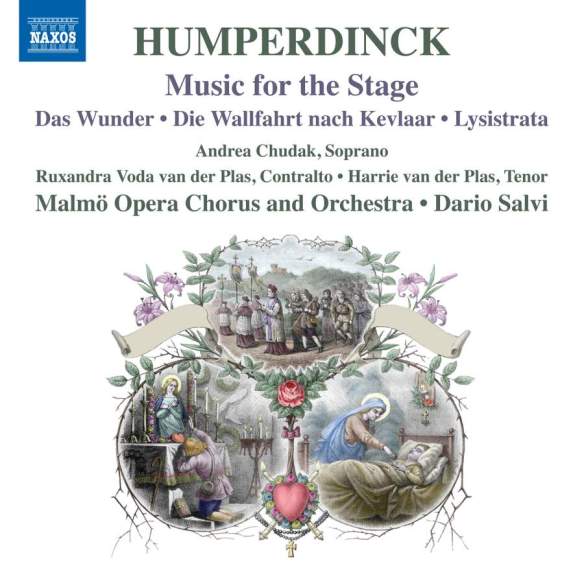
a Andrea Chudak (soprano); b Ruxandra Voda van der Plas (contralto); c Harrie van der Plas (tenor); d Robert Bennesh (organ); Malmö Opera Chorus and Orchestra / Dario Salvi
Humperdinck
Die Heirat wider Willen (1905) – Prelude to Act Two
Der Kaufmann von Venedig (1905) – Incidental Music (abce)
Das Wunder (1912) – Suite (arr. Lotter) (d)
Die Wallfahrt nach Kevlaar (1878) (acd)
Lysistrata (1908) – Incidental Music (e)
Naxos 8.574177 [73’27”] German texts can be found here: http://www.naxos.com/libretti/574177.htm
Producer / Engineer Sean Lewis
Recorded 13-17 August 2019 at Bengt Hall-salen, Malmö, Sweden
Written by Richard Whitehouse
What’s the story?
Naxos continues its exploration into late-Romantic byways with this selection of theatre and choral works by Engelbert Humperdinck, presented so as to confirm a composer whose music more than makes up for what it might lack in overall individuality with expressive generosity.
What’s the music like?
The recent appearance of William Melton’s biography (Toccata Press) was of great value in conveying Humperdinck as a figure both selfless and humane; and a composer whose output reflects these qualities so that a personable and appealing musical idiom is always to the fore.
The selection gets underway with the Prelude to the second act of The Forced Marriage, after Alexandre Dumas, and the most likely among Humperdinck’s ‘forgotten’ operas to be worthy of revival. At least, the glowering intensity of this music set in the Bastille suggests as much.
Humperdinck contributed music to several productions by Max Reinhardt, with that for The Merchant of Venice running the gamut from very brief vocal or instrumental cues to such as a lilting Sarabande and a Procession of Masks which exude an engaging verve. The Casket Song draws a winsome response from female soloists and chorus, while the most extended item is an orchestral commentary on the text In such a night whose (not unduly) Wagnerian overtones and gently emergent rapture ought to secure more regular hearings in its own right.
Despite a lavish ‘multi-media’ premiere at Covent Garden, the sanctimonious scenario of the film The Miracle sealed its fate. Adolf Lotter’s suite deserves better – the evocative Prelude for organ leading into the lively Procession and Children’s Dance, then a festive ‘Banquet Scene’ finds contrast with the chaste Dance of the Nuns. A whimsical March of the Army is itself juxtaposed with the plangent Death Motif, before the Christmas Scene bestows a typically glowing atmosphere which the Finale to Act One builds to an eloquent apotheosis.
Much the earliest work, the cantata after Heine’s ballad The Pilgrimage to Kevlaar established Humperdinck’s reputation and is still occasionally revived – though not in the original version recorded here. If those swirling textures of the first section remind one that Humperdinck was soon to prove an invaluable amanuensis for Wagner, the central section renders the brunt of the narrative with considerable fervency, before the final section tempers the ostensibly tragic turn of events with a forceful reaffirmation of belief prior to its warmly consoling conclusion.
Finally, to incidental music for Aristophanes’ Lysistrata – comprising a perky Entr’acte for brass and woodwind, a vaunting Festal Procession that juxtaposes then combines male and female voices, then a Closing Song that elaborates its woodwind melodies to piquant effect.
Does it all work?
Yes, bearing in mind that Humperdinck never sought to impress his personality on the task at hand. Within its self-imposed limits, the theatre music is always suited to what is portrayed on stage, with the Heine setting among the most persuasive instances of a much-maligned genre.
Is it recommended?
Indeed. The various vocal and choral contributions have all the requisite limpidity and poise, while the Malmö Opera forces acquit themselves with verve and elegance under the capable guidance of Dario Salvi – whose efforts in raising the profile of this music compels respect.
Listen & Buy
You can get more information on the disc at the Capriccio website, or purchase from Naxos Direct. Meanwhile for more information on the recent Toccata Press book on Humperdinck, you can head to their website
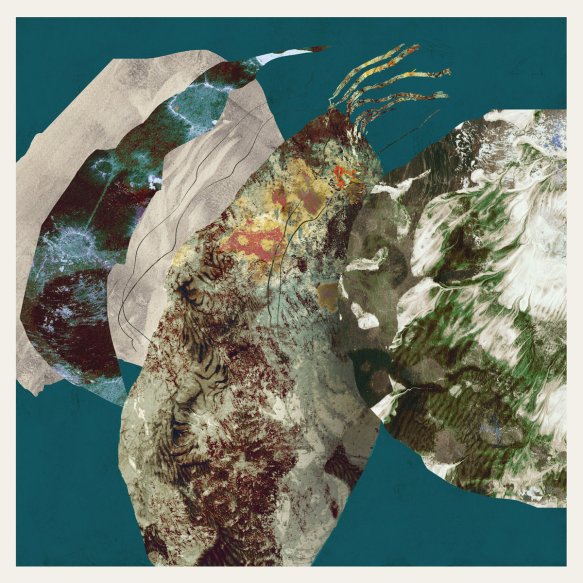

 Matthew Schellhorn (piano)
Herbert Howells
Phantasy (1917)
Harlequin Dancing (1918)
My Lord Harewood’s Galliard (1949)
Finzi: His Rest (1956)
Summer Idyls (1911)
Siciliana (1958)
Pavane and Galliard (1964)
Petrus Suite (1967-73)
Naxos 8.571382 [65’52”]
Producers Rachel Smith<
Engineer Ben Connellan
Recorded 19-21 August 2019 at The Menuhin Hall, Stoke D’Abernon
Written by Richard Whitehouse
What’s the story?
Naxos continues its coverage of Herbert Howells with this initial instalment (presumably one more to follow) of his piano music, all pieces being previously unrecorded and authoritatively rendered by Matthew Schellhorn in what is a notable addition to the composer’s discography.
What’s the music like?
Long before his death (at the age of 90), Howells’s reputation rested firmly on his output of choral and organ works. Only quite recently has his considerable earlier output of orchestral and chamber music received serious re-evaluation, so revealing one whose distinct change of outlook in his early forties came about as much through cultural as personal reasons. Modest in scope and dimension, his piano music features no extended or career-defining works, yet its technical poise and always idiomatic feel for this instrument makes for a rewarding listen.
The present selection interleaves miniatures and cyclical works in chronological order. As to the former, Phantasy finds the recently graduated composer assured in his handling of those impressionist aspects derived from Debussy and Ravel, while Harlequin Dreaming inhabits a world of Satie-esque whimsy and nonchalance as a reminder that Howells was then close friends with Bliss. Moving on to the Renaissance-inspired piano pieces of his later years, My Lord Harewood’s Galliard fuses its recherche manner with engaging harmonic astringency, whereas Finzi: His Rest is a pensively ambivalent in-memoriam to a younger colleague. The Siciliana is a languorous if non-indulgent take on the characteristic dance rhythm, while the Pavane and Galliard juxtaposes the confessional and combative with stark emotional acuity.
The suites come from either end of Howells’s career, with all that implies for a half-century timespan. Summer Idyls [sic] formed a part of his portfolio for the Royal College of Music; its stylistic indebtedness to the mid- and late Romantics – not least Rachmaninov – would soon be left behind, but the appeal in these evocations of rural environs no doubt familiar from his childhood endures. Pick of the seven is the wistful rumination of ‘Near Midnight’, with the central ‘Minuet Sine Nomine’ similarly dominating the Petrus Suite in its limpid refinement. Otherwise, the seven pieces evince a sinewy counterpoint and tensile linearity as are audibly a product of Howells’s late style, yet the origin of several in sketches made decades before confirms an overriding consistency of approach heightened by experience.
Does it all work?
Yes, allowing that Howells never sought to suffuse this music with the degree of emotional intensity reserved, at least in his maturity, for the larger choral works. Yet his quintessential expression is arguably to be found in those many shorter choral or organ pieces intended for liturgical purpose; in which case, the expressive focus and restraint of what is recorded here is its own justification. It could hardly have a more persuasive advocate than Schellhorn, who credits the late Stephen Cleobury for introducing him to the extent of Howells’s piano music.
Is it recommended?
Indeed. The closely unduly defined sound is ideal for piano music of this kind, and Jonathan Clinch’s annotations (along with a reminiscence by the pianist) are succinct and informative. The follow-up volume, mainly of better-known music, will doubtless prove just as rewarding.
Listen & Buy
You can listen to clips from the recording and purchase, either in physical or digital form, at the
Matthew Schellhorn (piano)
Herbert Howells
Phantasy (1917)
Harlequin Dancing (1918)
My Lord Harewood’s Galliard (1949)
Finzi: His Rest (1956)
Summer Idyls (1911)
Siciliana (1958)
Pavane and Galliard (1964)
Petrus Suite (1967-73)
Naxos 8.571382 [65’52”]
Producers Rachel Smith<
Engineer Ben Connellan
Recorded 19-21 August 2019 at The Menuhin Hall, Stoke D’Abernon
Written by Richard Whitehouse
What’s the story?
Naxos continues its coverage of Herbert Howells with this initial instalment (presumably one more to follow) of his piano music, all pieces being previously unrecorded and authoritatively rendered by Matthew Schellhorn in what is a notable addition to the composer’s discography.
What’s the music like?
Long before his death (at the age of 90), Howells’s reputation rested firmly on his output of choral and organ works. Only quite recently has his considerable earlier output of orchestral and chamber music received serious re-evaluation, so revealing one whose distinct change of outlook in his early forties came about as much through cultural as personal reasons. Modest in scope and dimension, his piano music features no extended or career-defining works, yet its technical poise and always idiomatic feel for this instrument makes for a rewarding listen.
The present selection interleaves miniatures and cyclical works in chronological order. As to the former, Phantasy finds the recently graduated composer assured in his handling of those impressionist aspects derived from Debussy and Ravel, while Harlequin Dreaming inhabits a world of Satie-esque whimsy and nonchalance as a reminder that Howells was then close friends with Bliss. Moving on to the Renaissance-inspired piano pieces of his later years, My Lord Harewood’s Galliard fuses its recherche manner with engaging harmonic astringency, whereas Finzi: His Rest is a pensively ambivalent in-memoriam to a younger colleague. The Siciliana is a languorous if non-indulgent take on the characteristic dance rhythm, while the Pavane and Galliard juxtaposes the confessional and combative with stark emotional acuity.
The suites come from either end of Howells’s career, with all that implies for a half-century timespan. Summer Idyls [sic] formed a part of his portfolio for the Royal College of Music; its stylistic indebtedness to the mid- and late Romantics – not least Rachmaninov – would soon be left behind, but the appeal in these evocations of rural environs no doubt familiar from his childhood endures. Pick of the seven is the wistful rumination of ‘Near Midnight’, with the central ‘Minuet Sine Nomine’ similarly dominating the Petrus Suite in its limpid refinement. Otherwise, the seven pieces evince a sinewy counterpoint and tensile linearity as are audibly a product of Howells’s late style, yet the origin of several in sketches made decades before confirms an overriding consistency of approach heightened by experience.
Does it all work?
Yes, allowing that Howells never sought to suffuse this music with the degree of emotional intensity reserved, at least in his maturity, for the larger choral works. Yet his quintessential expression is arguably to be found in those many shorter choral or organ pieces intended for liturgical purpose; in which case, the expressive focus and restraint of what is recorded here is its own justification. It could hardly have a more persuasive advocate than Schellhorn, who credits the late Stephen Cleobury for introducing him to the extent of Howells’s piano music.
Is it recommended?
Indeed. The closely unduly defined sound is ideal for piano music of this kind, and Jonathan Clinch’s annotations (along with a reminiscence by the pianist) are succinct and informative. The follow-up volume, mainly of better-known music, will doubtless prove just as rewarding.
Listen & Buy
You can listen to clips from the recording and purchase, either in physical or digital form, at the 
