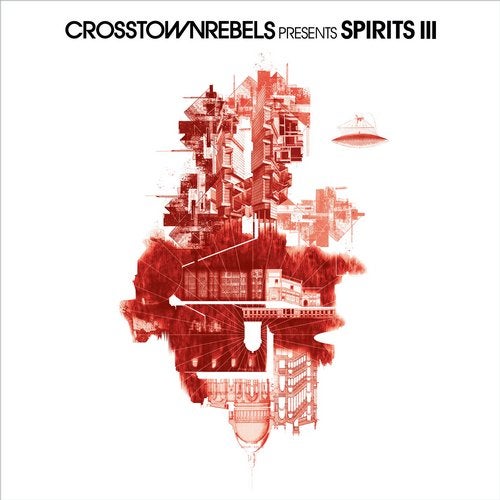
Let’s Dance – Crosstown Rebels present Spirits III (Crosstown Rebels)

Various ArtistsCrosstown Rebels presents Spirits III (Crosstown Rebels)

reviewed by Ben Hogwood

What’s the story?

In the press release for the latest instalment of their Spirits compilation, Crosstown Rebels founder Damian Lazarus explains why the series has become so important to him. He sees it as ‘a very important annual mission in which my focus is to uncover some of the most exciting new underground music and piece it together in a way that makes a statement for the label. In discovering new artists and putting them side by side with established people we are setting new agendas for sound and for the future. These are battle weapons, freshly unearthed anthems, deep experiments and awakenings’.

What’s the music like?

Very much in keeping with the press release. There are several striking cuts here, and as Lazarus says it’s a very healthy blend of the known names and new ones. Not surprisingly the known names includes Lazarus himself, and his Ergot starts proceedings with a deep track whose riff almost slips down the back of the music.

Elsewhere the chunky beats and bass of Denney and James Dexter’s Transcend are a hit, as is the brooding Creatures Of The Night from Aiwaska with Jimmy Wit an H. Arguably the most distinctive and memorable track comes from Cipy and Knowkontrol, whose Newark has a really good falsetto vocal as its main hook. Dennis Cruz gives a nice trumpet imitation of an elephant to add a bit of humourous deep jazz to Mother Earth, while Harry Romero reinforces his reputation for fine house music with the excellent It’s You, a kind of mini chant that really gets going over bleeps and a nippy beat. The tempo drops a bit for Eli & Fur at the end, their collaboration with Brothertiger She’s Just A Wanderer a loping piece of dub-house that works really well.

Does it all work?

Yes. It’s well laid out and delivered, and does exactly what a fan of Crosstown Rebels would want it to do.

Is it recommended?

Yes, for the above reasons! House music is the main name of the game here, but Damian Lazarus has put together a really good set of forward facing Spirits that deserve to be heard.

Stream

Buy

You can buy the compilation from the Phonica Records website here
Switched On – BUNKR: The Initiation Well Remixed (VLSI)

reviewed by Ben Hogwood

What’s the story?

BUNKR’s album The Initiation Well proved to be one of the sleeper electronic hits of 2019, showing off the ability of Brighton’s James Dean to present an album of really well thought out electronica.

Now as a companion piece he has commissioned an album’s worth of remixes, with eight very different interpretations ranging from Digitonal to preston.outatime.

What’s the music like?

Both calming and invigorating, in equal measure. The collection is presented in a logical order, so we begin with a dreamy Digitonal remix of For The Birds, setting the scene beautifully as the track is left in suspension, bisected by a soft piano.

Fujiya & Miyagi do a typically fuzzy take on Solitary Drift, with added flutter and distortion that suits it really well – and their own half-whispered vocals. Octavcat then ensure Solar Wings takes off with its broad chords and busy rhythm.

The upfront, block beats of preston.outatime take Left For Dust to a tougher dancefloor, while Jonathan Krisp gets some acidic squiggles going against the slow moving backdrop of The Initiation Well itself. East Of Eden acquires more bleeps and movement, a really nice glitchy bit of techno applied by Lextron, while the remix of Docking Procedure finds Infinite Scale going under the surface with a head-nodding bit of dub. Finally label heads Echaskech apply their typically robust beats to a heady remix of Left For Dust.

Does it all work?

Yes. Importantly this set of remixes works as an album too, such is the intelligent arrangement of different tempos, textures and beats. All the BUNKR originals are complemented but remain recognisably the work of Dean himself.

Is it recommended?

Very much so. If you liked the original album you’ll find this imaginatively realised remix collection complements it perfectly.

Stream

Buy

On record – Louis Lortie, BBC Philharmonic Orchestra / Edward Gardner – Saint-Saëns: Piano Concertos 3 & 5 (Chandos)

Saint-Saëns
Rhapsodie d’Auvergne Op.73 (1884)
Piano Concerto no.3 in E flat major Op.29 (1869)
Allegro appassionato in C sharp minor Op.70 (1884)
Piano Concerto no.5 in F major Op.103 ‘Egyptian’ (1896)

Louis Lortie (piano), BBC Philharmonic Orchestra / Edward Gardner

Chandos CHAN 20038 [66’51”]

Producers Mike George and Brian Pidgeon
Engineer Stephen Rinker

Recorded 13 January 2018 (Rhapsodie d’Auvergne), 20 & 25 February 2019 (other works), Media City UK, Salford, Manchester

Written by Ben Hogwood

What’s the story?

This is the second installment of Saint-Saëns piano concertos from Louis Lortie, Edward Gardner and the BBC Philharmonic Orchestra. It completes the cycle of five they have been recording for Chandos.

Saint-Saëns’ Piano Concertos tend to be overlooked in the concert hall, with only occasional performances for no.2 and no.5, which was written in part during a holiday in Egypt. Their neglect is unfortunate, as there is much to enjoy as the pieces unfold. The demands on the solo pianist may be considerable, but the rewards outweigh the effort required for sure.

What’s the music like?

This new release offers the Piano Concerto no.3 in E flat major, still a relatively early work, where Saint-Saëns builds on the influence of Beethoven and Liszt to create a piece with memorable themes and unusual formal devices. We then move to his later period and the Piano Concerto no.5, the ‘Egyptian’. This is a daring piece in the sense that Saint-Saëns was not following the trend of modern music set by the post-Wagner composers, or the new sound worlds offered by Debussy and Ravel. Instead he was writing for the virtuoso pianist in a descriptive and positive sense – conventional but stretching the established ‘rules’ of the concertos. This piece is ultimately fun and packed with tunes, while asking the soloist to achieve some pretty difficult technical feats. There is a faint exoticism capturing the carefree mood of the composer on vacation.

Topping up the positive outlook are the Rapsodie d’Auvergne and the Allegro appassionato, both shorter pieces for piano and orchestra with a similarly sunny outlook. The Allegro appassionato has more drive, while the Rapsodie is a breezy piece for the great outdoors. As the booklet writer Roger Nichols observes, it is based on a tune the composer ‘heard sung by a peasant washing her clothes in a stream in the Auvergne. As such, it is possibly the only folksong from France that Saint-Saëns ever included in his music’.

Does it all work?

Yes. This is extremely positive music, celebrating the combination of piano and orchestra with a good deal of energy.

The concertos are nicely balanced. The better known Fifth, stacked high with good tunes, finds Ed Gardner keen to develop its exotic air with the lush textures of the BBC Philharmonic strings in the first movement. There is a dramatic salvo to begin the second movement, where Lortie gets the melodic inflections just right, then an exotic minimalist passage towards the end, cutting to a real flight of fancy into the finale. Lortie gets a terrific substance to the sound of the lower end of the piano.

The Piano Concerto no.3 if anything fares even better, its status elevated well above the derivative thanks to the stress on its memorable themes. There is a heroic air to the piano part that Louis Lortie develops very nicely, and his commanding performance gives the piece its essential forward drive.

The Rhapsodie d’Auvergne is a bubbly piece, starting softly but gaining ground during the development of its theme. There are brief connections with Brahms before an effervescent and watery sequence, with excellent work in the right hand from Lortie.
Meanwhile the Allegro appassionato is a red-blooded affair very much in the vein of Liszt, asking the soloist for a few feats of athleticism while remaining close to the composer’s melodic heart.

Is it recommended?

Yes. This is an ideal release for banishing any lingering winter blues! There may be some really good recordings around already of the concertos, thanks to Stephen Hough and the City of Birmingham Symphony Orchestra under Sakari Oramo (Hyperion), and looking further back the classic 1980s recordings made by Pascal Rogé and the London Philharmonic Orchestra with Charles Dutoit (Decca).

These sparkling new versions, beautifully recorded, offer a great deal of passion and panache, and at the very least take their place alongside the best..

Listen

Buy

You can listen to clips from this disc and purchase a copy at the Chandos website here

On record – Craven Faults: Erratics & Unconformities (The Leaf Label)

Written by Ben Hogwood

What’s the story?

How refreshing to find an artist that keeps their self-promotion to a minimum. That said, it would be good to know more about Craven Faults at some point! The elusive biography on his record label site describes his moniker as ‘half-remembered journeys across post-industrial Yorkshire’.

In fact Craven Faults has been a thing for a while, with his well-received Lowfold Works EPs containing electronic music that shows off an ambitious grasp of musical structure. He is capable of stretching out his approach to minimal music into tracks of 20 minutes or more, using the barest of elements like Philip Glass does but building them up with oscillating synthesizers and drones.

Erratics & Unconformities is his first LP.

What’s the music like?

The Yorkshire reference is helpful, for as first track Vacca Wall establishes its shimmering content it feels like a look across the brooding landscape of the North Yorkshire Moors – but gradually opens out like the wings of a darkly shaded butterfly. This is music supported by a constant bass line, which tolls out like a deep bell, and a percussion track that never extends beyond a single kick drum, if at all.

The instruction from The Leaf Label to ‘put a 17-minute window in your diary and watch the video for Vacca Wall is worth following. In their words, ‘the rest of your inbox can wait, you need slowly unravelling analogue synthesizer arpeggios right now’:

With the mood set for the album, the next five tracks spread across nearly an hour, revealing different but often darker shades. The shorter Deipkier has a kick drum too, while Cupola Smelt Mill has sharper definition to the synthesizers and a bassline off the beat. Picking up the more industrial theme, Slack Sley & Temple is even darker, its brooding outlines giving the impression of a machine. This is the biggest track on the album, an expansive number of austere beauty.

Hangingstones regains some of the mood of the opening, while Signal Post has a more soothing drone at its base.

Does it all work?

Yes. Craven Faults has a distinctive style, and repeated listening brings out the rhythmic invention in his music, which is greater than you might at first think. It explains why he doesn’t need anything more than a kick drum.

Ultimately this album works best as a single unit in which to immerse yourself, drawing the listener in with its textures and spatial effects.

Is it recommended?

Yes, because there is some very fine music here – though it does come with the health warning that its dark nature is not necessarily ideal for the oppressively cloudy January days where it barely gets light!

Stream

Buy

On record – Manuel Barrueco, José Staneck, São Paulo Symphony Orchestra / Giancarlo Guerrero – Villa-Lobos: Guitar & Harmonica Concertos (Naxos)

Manuel Barrueco (guitar), José Staneck (harmonica), São Paulo Symphony Orchestra / Giancarlo Guerrero

Heitor Villa-Lobos
Concerto for Guitar and Small Orchestra (1951)
Sexteto Místico (1917-55)
Concerto for Harmonica and Orchestra (1955)
Quinteto Instrumental (1957)

Sexteto Místico: Cláudia Nascimento (flute), Layla Köhler (oboe), Douglas Braga (alto saxophone), Fábio Zanon (guitar), Rogério Zaghi (celesta), Suélem Sampaio (harp)
Quinteto Instrumental: Cláudia Nascimento (flute), Adrian Petrutiu (violin), Ederson Fernandes (viola), Adriana Holtz (cello), Suélem Sampaio (harp)

Naxos 8.574018 [60’04”]

Producer and Engineer Ulrich Schneider

Recorded 30-31 July (Guitar Concerto), 2-4 August 2017 (Harmonica Concerto), 29 April 2018 (Sexteto & Quintet), 2017 Sala São Paulo, Brazil

Written by Ben Hogwood

What’s the story?

Naxos make a significant addition to their series The Music of Brazil with works from the country’s favourite classical music son, Heitor Villa-Lobos. Villa-Lobos’ instrument was the guitar, and it takes centre stage for the much-loved Concerto, complemented by its cousin for harmonica and orchestra. Two chamber-sized pieces for six and five instrumentalists respectively complete an attractive line-up.

What’s the music like?

Warm and sunny – a perfect counterpart to the gloomy late mornings and early evenings of December!

The Guitar Concerto is especially good, a compact design with the small orchestra complementing the guitar perfectly. The piece has an easy going nature from the beginning but that doesn’t mean it’s insubstantial, as the wistful second theme proves. The slow movement is elegant but also keenly felt, with a thoughtful yet virtuosic cadenza that leads straight into the finale, which is crisp and incisive.

It is still unusual to hear the combination of harmonica and orchestra in a classical context, and the instrument’s piercing tone won’t necessarily appeal to everyone, no matter how good the performance. That said, Villa-Lobos, who wrote the Harmonica Concerto for the skilled American harmonica player John Sebastian, gives the main instrument plenty of good tunes and soulful inflections.

The small-scale works accompanying the concertos are both attractive too. The Sexteto Místico appears to have had a chequered history. Begun in 1917, when composers were exploring alternative sonorities in their chamber music, it was not published until final completion in 1955. It paints attractive colours of pastel shades, the addition of guitar and celesta giving it an exotic air, especially in the unison passages. Meanwhile the bigger Quinteto Instrumental feels more classical in its instrumentation and musical language, again using consonant harmonies that radiate sunshine. With a warm sonic picture the recorded sound is ideal.

Does it all work?

Much of it does. The Guitar Concerto receives an ideal performance that feels wholly authentic with the São Paulo Symphony Orchestra’s accompaniment. Their dialogue with Manuel Barrueco is beautifully observed and lovingly phrased under Giancarlo Guerrero‘s direction, and Barrueco gives an excellent account of a justly popular work.

José Staneck is on brilliant form in the Harmonica Concerto, with impressive virtuosity complemented by lyricism, but even that and a sensitive orchestral accompaniment do not quite win me over on the work. It could just be a case of unfamiliarity with the harmonica in this context though, so don’t let that put you off!

The sextet and quintet are ideal, sunlight streaming in on these affectionate accounts that capture the fluid writing for harp, guitar and celesta round the edges.

Is it recommended?

Yes. It’s great to see Villa-Lobos programmed in this way, and the disc has great warmth and hence enormous appeal. Barrueco’s version of the Guitar Concerto is a great modern complement to those made by John Williams, Julian Bream and Narciso Yepes, and the couplings show off the composer’s versatility and invention.

Listen

Buy

You can listen to clips from this disc and purchase a copy at the Naxos website here