On record: Magdalena Kozená, Christian Gerhaher, LSO / Sir Simon Rattle – Debussy: Pelléas et Mélisande (LSO Live)

Debussy Pelléas et Mélisande

Magdalena KozenáChristian Gerhaher, Gerald Finley, Bernarda FinkFranz-Josef Selig, Joshua BloomElias Madlër, London Symphony Chorus and Orchestra / Sir Simon Rattle

LSO Live LSO0790 (three SACDs and one Blu-ray, 160’46”)
Producer James Mallinson Engineers Jonathan Stokes, James Hutchinson
Dates Live performances at Barbican Hall, London on January 9th and 10th, 2016

Reviewed by Richard Whitehouse

What’s the story?

Sir Simon Rattle and the London Symphony Orchestra release their first opera collaboration on the LSO’s label. Debussy’s Pelléas et Mélisande is a work Rattle has conducted often (including London and Salzburg), and the present account confirms his identity with this most elusive of operas.

What’s the music like?

Premiered in 1902 after a genesis of almost a decade, Pelléas et Mélisande is Debussy’s only completed opera and his treatment of Maurice Maeterlinck’s symbolist drama is a high point of musical impressionism. This recording is derived from two performances at Barbican Hall, shorn of Peter Sellars’ ‘platform staging’ but its partial re-seating of the orchestra evident in numerous instances of balance. The result is to emphasize dramatic extremes, though without necessitating extremes of tempo in what is otherwise a finely integrated reading of real poise.

The cast is a strong one, and such reservations as there are centre on the title-roles. A model of clarity and lucidity, Christian Gerhaher is arguably too self-contained to convey fully the emotional eloquence of a figure whose actions can seem almost involuntary. No less secure technically, Magdalena Kožená is elegant if at times rather generalized in her assumption – rendering the notes with unerring accuracy yet not always conveying the inner radiance of one whose presence should be disconcerting through its very intangibility and equivocation.

Gerald Finley’s is among the finest recorded Golaud – conveying his moroseness and anxiety with palpable conviction though retaining a vital degree of empathy, while Franz-Josef Selig makes of Arkel a nobler and more substantial figure than is too often the case. Bernarda Fink brings warmth and pathos to the (too?) brief role of Geneviève, with Joshua Bloom shining in his cameos as the Doctor and Shepherd, but Elias Mädler is a little too mature in timbre to be ideal for Yniold – his exchanges with Golaud a heart-rending instance of innocence corrupted.

The London Symphony Chorus acquits itself admirably during its brief contribution, with the LSO playing as well as it has done for its new Music Director in terms of fastidiousness and subtlety; climactic peaks thereby feeling the more acute for their rarity. Compared to that of his Royal Opera staging, Rattle’s conducting is freer and less inhibited – touching on a wide expressive range without sacrificing attention to detail. Each of these five acts is shaped with scrupulous regard to the action at hand while being responsive to the emergent overall drama.

Does it all work?

Indeed, for all that Pelléas et Mélisande already has an extensive and impressive discography. Roger Desormière’s 1942 recording (Warner) remains the interpretative benchmark – while, among the more recent accounts, Claudio Abbado (DG), Bernard Haitink (Naïve) and Pierre Boulez’s DVD (DG) all have serious claims on the listener. Presentation over three SACDs and one Blu-ray, with the booklet containing a succinct introduction, synopsis and bilingual libretto, is unexceptionally fine – as also the sound, if with little sense of a tangible acoustic.

Is it recommended?

Yes, though the absence of a visual component on the Blu-ray might be thought something of a missed opportunity. Something LSO Live might like to reconsider before issuing Ligeti’s Le Grand Macabre, the next Rattle/Sellars/LSO project which is due in the coming months.

You can read more about this release at the LSO Live website, or you can listen on Spotify below:
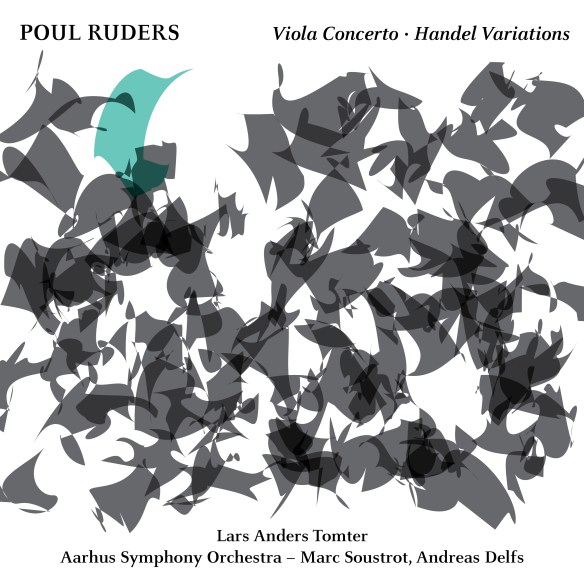
On record: Lars Anders Tomter, Aarhus Symphony Orchestra – Poul Ruders: Viola Concerto & Handel Variations (Dacapo)

Ruders Viola Concerto; Handel Variations

Lars Anders Tomter (viola); Aarhus Symphony Orchestra / Marc Soustrot (Viola Concerto), Andreas Delfs (Handel Variations)

Ruders
Viola Concerto
Handel Variations

Dacapo 8.226149 [65’53”]
Producers Preben Iwan, John Frandsen
Engineers Preben Iwan, Henrik Winther Hansen
Recorded 
December 11/12 2015 (Viola Concerto) and March 18-20 2017 (Handel Variations) at Symphonic Hall, Musikhuset, Aarhus

Reviewed by Richard Whitehouse

What’s the story?

Two sizable orchestral works from Poul Ruders (b1949), long among the most prolific of contemporary composers. In their very different ways they attest to a continuing musical evolution as inclusive as it is unpredictable, while never less than fascinating.

What’s the music like?

Not previously recorded, the Viola Concerto was composed during 1993-4 and premiered at the 1994 Proms. Although the lukewarm reception was ostensibly because of Yuri Bashmet’s less than committed rendering of the solo part (an early indication of his increasingly cavalier attitude in live performance), Ruders harboured doubts as to the success of the work itself and opted for a thorough revision in 2013. This involved scaling back the central movement, so it now forms an intensifying interlude between a first movement which unfolds as a continuous polyphonic texture, then a finale that elaborates on earlier material before coming full-circle in a pensive yet by no means tranquil coda. The favourable impression this piece now makes is also owing to Lars Anders Tomter’s assured handling of a solo part the more testing for its understated character, notably the cadenzas that alter the course of the latter two movements.

By contrast, the Handel Variations is Ruders at his most sardonic and even demonic. Written in 2009 to mark the 75th anniversary of the Aarhus Symphony Orchestra, this substantial 39-minute piece takes its cue from the Bourrée of Handel’s Water Music Suite no.1. The composer relates he had initially intended to write 74 variations on this briefest and most unassuming of themes (one for each year that Handel had lived), but the process of putting it ‘through the wringer’ proved so involving it took 90 variations before this had been played out. The result is among the most quixotic of Ruders’ latter-day works, as it runs the gamut of expressive possibilities while securing continuity by the follow-through of these variations. They also seem to merge into cohesive sub-groups, on their way to a climactic sequence whose affirmation is undercut by the lengthy final sequence which forms a conclusion of decidedly deadpan humour. Such fatalism is itself offset by the always inventive virtuosity of what might plausibly be heard as a large-scale ‘concerto for orchestra’.

Does it all work?

Almost certainly. If momentary doubts persist as to the overall focus of the Viola Concerto, these will likely prove illusory now that this piece has received the sympathetic rendering it needed, while the Handel Variations gives us the essence of an always arresting composer.

Is it recommended?

Indeed. The playing of the Aarhus Symphony Orchestra is well attuned to the very different emotional compass of both pieces and is idiomatically directed by conductors of whom it would be good to hear more in the UK. Stephen Johnson provides the informative if occasionally glib booklet notes.

You can read more about this release at the Dacapo website, while for more on Ruders himself, visit his website here

On record: Deutsche Staatsphilharmonie Rheinland-Pfalz / Mark Fitz-Gerald – Shostakovich: The Gadfly, The Counterplan (Naxos Film Music Classics)

Shostakovich The Gadfly, The Counterplan Bachchor MainzDeutsche Staatsphilharmonie Rheinland-Pfalz / Mark Fitz-Gerald

Shostakovich
The Gadfly, Op.97 (1955) – complete original score (ed. Fitz-Gerald)
The Counterplan, Op. 33 (1932) – excerpts

Bachchor Mainz, Deutsche Staatsphilharmonie Rheinland-Pfalz / Mark Fitz-Gerald

Naxos Film Music Classics 8.573747 [61’46”]
Producer Roland Kistner Engineers Bernd Nothnagel, Karl Haffner
Dates March 21st-24th, 2017 in Philharmonie, Ludwigshafen

Reviewed by Richard Whitehouse

What’s the story?

Mark Fitz-Gerald continues his pioneering series of Shostakovich film scores in their original orchestration with this disc of the composer’s music for The Gadfly, coupled with pieces that never made it to the final cut and excerpts from the most successful of his earlier film-scores.

What’s the music like?

Unlike that on the previous discs in this Naxos series (scores to New Babylon on 8.572824/5, Alone on 8.573747 and Girlfriends on 8.572138), the music for The Gadfly was very much a mainstream project for a composer struggling to find focus in the post-Stalin era. Alexander Faintzimmer’s adaptation of Ethel Voynich’s novel, essentially a romantic politicization of the Risorgimento among the mid-19th century Italian states, was a success with both Soviet officialdom and the public; while the 12-movemnet suite, as adapted by Lev Atovmian, has long been the most widely heard of Shostakovich’s film-derived scores. The present ‘urtext’ version was prepared and edited by Fitz-Gerald in conjunction with DSCH publishing house in Moscow and Paris (and has been published as Volume 138 of the New Complete Edition).

Despite its 29 individual cues averaging under two minutes, this sequence is (surprisingly?) cohesive in formal and expressive follow-through. Framed by the surging ‘Overture’ (track 1) and rhetorical ‘Finale (29), it follows the scenario closely. The famous ‘Romance’ is divided between the tracks ‘Youth’ and its reprise (4/25), with eloquent violin playing from Nikolaus Boewer, and its middle section is located elsewhere. Further highlights include the evocative ‘Dona nobis pacem’ (15) derived from Bach’s Mass in B minor, the infectious ‘Contredanse’ and ‘Galop’ for strings (19/20), and effervescent ‘Bazar’ (22) which became the well-known ‘Public Holiday’. Many of the other tracks are predominantly sombre or introspective, though the understated effectiveness of Shostakovich’s instrumentation offsets any risk of uniformity.

Also included are two organ cues excluded from the final score – including ‘Ave Maria’ (31), an ingenious reworking of a parody mass by Renaissance composer Antoine de Févin as was replaced by the Bach. The disc is completed by three excerpts from The Counterplan – made to commemorate the 15th anniversary of the Bolshevik Revolution, whose intermingling of personal relationships with construction in Leningrad is best remembered for its ‘Song of the Counterplan’. This emerges towards the close (34) to round-off these excerpts in fine style.

Does it all work?

Indeed. Fitz-Gerald secures a lively response from his Deutsche Staatsphilharmonie forces, with the various guitar and mandolin solos idiomatically taken, while Elke Voelker’s organ contributions are recorded with necessary ambient space. Those who know The Gadfly from the suite will find these frequently stripped-down orchestrations of the original film-score an unexpected pleasure. The sound is unexceptionally fine (volume levels in louder items can sound a touch manipulated), while John Riley’s booklet notes are detailed and informative.

Is it recommended?

Yes. This is a welcome act of restoration for film-music almost entirely known in a version approved though not undertaken by the composer. Hopefully this series will be continued – a recording of the complete score for The Counterplan would be a worthwhile next instalment.

You can read more about this release on the Naxos website, while for more on Mark Fitz-Gerald, visit his

On record: Eve Daniell, Roderick Williams & Simon Lepper – John Pickard: Songs (Toccata)

John Pickard Songs Eve Daniell (soprano), Roderick Williams (baritone), Simon Lepper (piano)

Pickard
The Borders of Sleep
Binyon Songs
The Phoenix

Toccata Classics TOCC0413 [61’01’’] English texts included
Producer/Engineer Michael Ponder
Recorded January 7th and 8th 2017 at St George’s, Bristol

Reviewed by Richard Whitehouse

What’s the story?

A further disc of music by John Pickard (b1963) from Toccata Classics, this time focussing on his output for voice and piano which to date comprises just three works, though these are no less personal than his more extensive contributions to the orchestral and chamber genres.

What’s the music like?

In his booklet notes, Pickard speaks of the difficulty in finding the right words for music thus intended. His works featuring baritone evince due discernment in those poets he has set. Not least the Binyon Songs – five settings of Laurence Binyon (1869-1943), the ubiquity of whose For the Fallen has detracted from a large and varied corpus. The present sequence is nothing if not representative – conveying abused benevolence in Nature, re-emergence in Sowing Seed and hectic transition in Autumn Song. The warm confessional of When all the world is hidden (a likely counterpart to Mahler’s Liebst du um Schönheit?) makes for a telling foil to the relatively expansive The Burning of the Leaves, affording closure through its insight into the immutable process of decay and renewal – an apotheosis as probing as it is profound.

Whereas the Binyon songs are a loosely related sequence, The Borders of Sleep is a song-cycle in formal intent and expressive scope. Here the texts are by Edward Thomas (1878-1917), considered a ‘wat poet’ (he died at Arras) though one whose poetry tends toward the speculative and even oblique. These concerns are pursued across the course of nine songs – taking in such as the sombre monotony of The Mill-Water, black irony of The Gallows and impermanence of Rain. The final settings comprise a fitting culmination: the mood of Last Poem, made concrete by its alternate title The sorrow of true love, transmuted into the fatalistic calm of Lights Out whose initial line also provides the title of this work and whose intimation of transcendence through the release of sleep affords its own benediction.

In contrast, the earliest piece here sets the earliest text, The Phoenix freely adapted from R. K. Gordon’s translation of a 10th-century Anglo-Saxon poem found in the Exeter Book. In fining down the expansive original (677 lines), Pickard has created a scena for soprano and piano where the evocation of this mythical bird’s demise and rebirth becomes metaphor for change and renewal; hence aligning it with the more recent poets featured here then, by extension, the underlying concerns to be found in even the most abstract among Pickard’s compositions.

Does it all work?

Very much so – not least when the performances are so attuned to the spirit and sensibility of Pickard’s music. A stalwart of English-song repertoire, Roderick Williams invests the Binyon and Thomas settings with unsparing emotional acuity, and if Eve Daniell experiences passing difficulty with pitching and intonation, her command of high-flown rhetoric in The Phoenix leaves no doubt as to her identity with this piece. Simon Lepper’s accompaniment is of the highest order, while recorded sound judges balance between voice and piano to perfection.

Is it recommended?

Indeed, and Pickard will hopefully add to his output for voice and piano in due course. In the meantime, acquire this disc and check out the composer’s orchestrations of his Binyon songs (also performed by Williams) on the English Music Records’ anthology Now Comes Beauty.

You can read more about this release on the Toccata Classics website, while for more on John Pickard, you can visit his website here

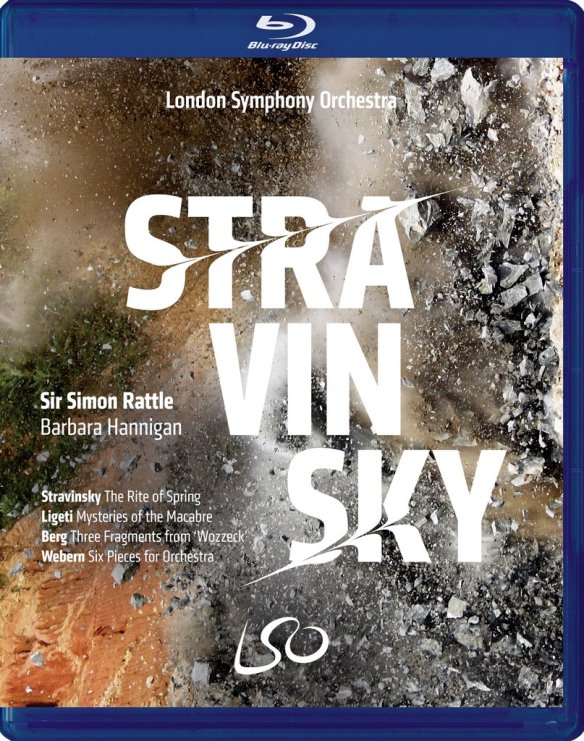
On screen: Barbara Hannigan, London Symphony Orchestra / Sir Simon Rattle – Stravinsky: Rite of Spring; Berg: Wozzeck Fragments; Ligeti: Mysteries of the Macabre (LSO Live)

Webern Six Pieces op.6 (1909/28)
Berg Three Fragments from Wozzeck, op. 7 (1923)
Ligeti arr. Howarth Mysteries of the Macabre (1992)
Stravinsky The Rite of Spring (1913)

Barbara Hannigan (soprano – Berg & Ligeti), London Symphony Orchestra / Sir Simon Rattle

LSO Live LSO3028 [84’58’’] One DVD and one Blu-ray disc

Reviewed by Richard Whitehouse

What’s the story?

Following on from its all-French programme (LSO3038), LSO Live here releases a further concert by the London Symphony Orchestra and Sir Simon Rattle on DVD and Blu-ray – once again a co-production with the digital channel Mezzo and in association with ARTE France.

What’s the music like?

Rattle has long been an advocate of Webern’s Six Pieces and made a fine recording of it in his Birmingham days. This LSO account is notable for its scrupulous attention to dynamics and tonal shading, even if such fastidiousness minimizes any real spontaneity in this elusive music. A case in point is the rather effortful climax to the explosive second piece, while the ‘funeral march’ fourth lacks underlying momentum on the way to its powerful though hardly unnerving culmination. Elsewhere, this music’s subdued introspection is tellingly conveyed.

The Three Fragments which Berg drew from Wozzeck follows on naturally. Focussing on the character of Marie enabled the composer to bring together three of this opera’s highlights for concert use, and Barbara Hannigan brings a probing characterization to the lullaby from Act One then the bible-reading scene from Act Three. She captures the naivety of the child at the close of the third fragment, before which the LSO comes into its own in a powerful while not unduly vehement interlude prior to the final scene – Rattle steering them through unerringly.

Hannigan returns in rather different guise for Mysteries of the Macabre that Elgar Howarth arranged from Ligeti’s opera Le Grand Macabre. This present-day staple of the coloratura repertoire lends itself to all manner of parody and if Hannigan’s juvenile delinquent might be felt inappropriate for a chief of secret police, her vocal contribution is uninhibited in its virtuosity. Rattle and his orchestra enter-into the music’s anarchic accordingly, the former’s joke at the expense of Nigel Farage seeming all too ironic in the light of subsequent events.

Rattle’s association with Stravinsky’s The Rite of Spring goes back to the outset of his career and hearing this account is a reminder of his prowess in music the LSO has itself played many times. Yet for all the consummate technical skill, there is a nagging sense of conductor and orchestra going through the motions to ultimately predictable effect (indeed, the performance from Peter Eötvös with the LSO later that season generated much more genuine excitement and sense of purpose). Easy to admire, there is little here to make one assess this work afresh.

Does it all work?

Absolutely in terms of a programme both cohesive and provocative. Things are more mixed in term of performances – with those of the Berg and (musically at least) the Ligeti as good as one is ever likely to hear, that of the Webern just a little too micro-managed overall and the Stravinsky a reminder that superb playing and expert conducting do not necessarily make for a gripping interpretation.

As an indication of Rattle’s association with the orchestra of which he subsequently became Music Director, there is much here that is enjoyable and engrossing

Is it recommended?

Yes, in terms of a concert to which one might wish to return on repeated occasions. Sound and vision leave little to be desired in either format, though post-production means that there is little sense of the orchestra performing in a tangible acoustic – Barbican Hall or otherwise.

For more information on this release, visit the LSO Live website