On record: BBC Scottish Symphony Orchestra / Martyn Brabbins – Sir Michael Tippett: Symphonies nos. 1 & 2 (Hyperion)

Tippett Symphonies nos. 1 & 2 BBC Scottish Symphony Orchestra / Martyn Brabbins

Tippett
Symphony no.1 (1944-5)
Symphony no.2 (1956-7)

Reviewed by Richard Whitehouse

What’s the story?

A new recording of Michael Tippett’s symphonies, following on from those by Colin DavisGeorg Solti (Decca, 1968-81) and Richard Hickox (Chandos, 1992-4) was sorely needed, and with his prowess in British music Martyn Brabbins would seem well placed to provide it.

Having begun his cycle of Vaughan Williams symphonies, Brabbins now embarks on those of Tippett, whose reputation seems to be on the ascent given the inevitable decline after his death in 1998. The BBC Scottish Symphony Orchestra may not have had a close association with this music, though the fact each of these recordings was preceded by a live performance at least ensure what is heard here are those interpretations intended by Brabbins rather than merely a run-through that comprises studio takes methodically assembled in post-production.

What’s the music like?

In the First Symphony, informed by the tragedies of war and personal loss, Brabbins handles the initial Allegro’s bracing polyphonic discourse with assurance – less unyielding than Colin Davis if not quite evincing the forward resolve of Richard Hickox. The exposition’s motivic elements are precisely individuated then vividly contrasted in the development, though there could have been greater intensity during the reprise before it reaches stasis in the coda. The Adagio is the highlight here, a passacaglia afforded focus by the expressive contrasts of its variations and cohesion by their near-symmetrical trajectory. Slower then either of his rivals, Brabbins secures greater momentum so that the sombre augmentation of the theme caps this sombre movement overall. The scherzo’s outer sections have the right rhythmic buoyancy, even if its songful trio is a little reticent, and while the twin subjects of the finale’s double-fugue are well delineated, the transition into the reprise lacks impetus; the climactic ‘stretto’ less potent than its disintegration in the coda, though this is likely what Tippett intended.

This remains a frequently impressive account, with that of the more wide-ranging Second Symphony only marginally less so. Its opening Allegro is the finest on disc – more flexible than Davis and less stolid than Hickox, while generating kinetic energy in the development and truly Beethovenian coda. If the Adagio feels less convincing, this is not through lack of insight on Brabbins’s part or finesse on that of the BBCSSO but rather a sense that the ideas in its mosaic-like construction are being juxtaposed without admitting that greater eloquence Hickox finds at a slower tempo and Tippett himself (NMC) conveys to rapturous effect. The scherzo is disappointing as, for all the wealth of detail uncovered, the underlying tempo is too staid for momentum to accrue so the climax feels less Dionysian than merely incisive. Some might also consider the finale too steady, yet Brabbins succeeds more than those before him in knitting the four parts of this fantasia-like sequence into an organic process of continuous variation through to a coda as brings the work forcefully but never overbearingly full-circle.

Does it all work?

Most of the time. As recorded in Glasgow’s City Halls, the orchestral sound has clarity and lustre well in advance of those earlier readings, even if the acerbities of Tippett’s scoring can seem a little too well-blended (the balance of trumpets in the outer movements of the Second Symphony being a case in point), hence a relatively high playback level is preferable. Oliver Soden’s annotations are informed and informative, though not free of occasional tautologies or affectations that one hopes will not feature in his forthcoming biography of the composer.

Is it recommended?

Yes. Whatever their difficulties in execution, the intrinsic musical qualities of Tippett’s symphonies cannot be doubted and this first instalment augurs well for the rest of the cycle. Nos. 3 and 4, as well as the early Symphony in B flat, are due from Hyperion later this year.

You can read more about this release on the Hyperion website, while for more on Sir Michael Tippett, visit the Tippett foundation. The BBC Scottish Symphony Orchestra can be found here, while more on Martyn Brabbins can be found here
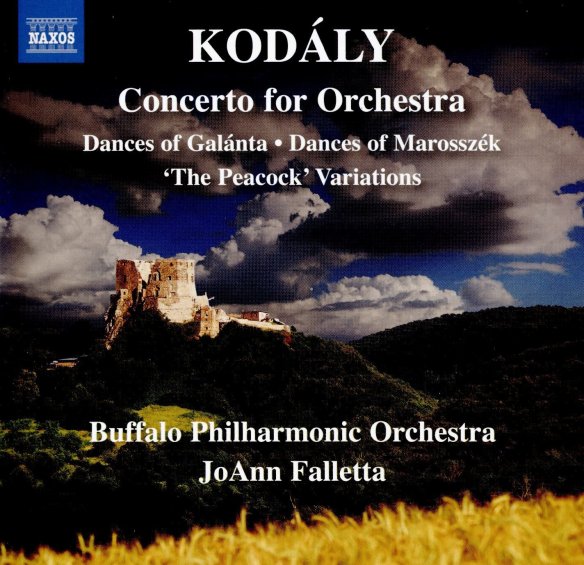
On record: Buffalo PO / Falletta – Kodály: Orchestral Works (Naxos)

Kodály Orchestral Works Buffalo Philharmonic Orchestra / JoAnn Falletta

Kodály
Dances of Galánta (1933)
Concerto for Orchestra (1939-40)
Variations on a Hungarian Folksong, ‘The Peacock’ (1938-39)
Dances of Marosszek (1930)

Reviewed by Ben Hogwood

What’s the story?

An exploration of the Hungarian composer’s colourful orchestral works from the Buffalo Philharmonic Orchestra and JoAnn Falletta, this disc includes established favourites (the Dances of Galánta and Peacock Variations), the underrated Dances of Marosszek and a relative rarity in the Concerto for Orchestra, completed for the Chicago Symphony Orchestra in 1940.

What’s the music like?

Richly scored and full to bursting with good tunes. The Dances of Galánta, the composer’s home for seven years in his youth, are a brilliant curtain raiser. As Edward Yadzinski says in the booklet note they are ‘a travelogue of gipsy spirit’. The tunes are rich with melodic ornaments and move between quick, energetic dances and slow, seductive ones.

The Dances of Marosszek (a region of northern Romania) should be better known. Originally written for piano, they begin with a surging theme in the cellos that casts a spell on the piece, heavy on allure but with some lovely softer contrasts.

The Peacock Variations are great fun, Kodály taking a legendary folk song and casting it in different speeds, harmonies and instrumentation to demonstrate its versatility. At times he reduces the orchestration, and brings solo instruments to the fore – notably in Variation XI, where cor anglais and woodwind are set against soft strings.

The Concerto for Orchestra is much more than a virtuoso showpiece, bringing in different sections of the orchestra into the Hungarian folk world. Bartók’s Concerto for Orchestra may be better known and more adventurous in its approach, but this is a fascinating alternative.

Does it all work?

Yes. This is extremely well performed, and the Buffalo string and winds are full of the flavour, if understandably not always getting to the heart of the folksy melodies. An interpretation from a ‘home’ orchestra almost always brings a higher level of authenticity when folk melodies are to the fore, but the Buffalo do still revel in the colour and tuneful abandon of these scores.

Is it recommended?

Yes. These may not be outright recommendations for each piece, perhaps, but they offer alternatives that show how well Kodály wrote for orchestra and how, in the Concerto for Orchestra, he could turn a potentially dutiful work commission into 20 minutes of fun.

You can head to the Naxos website for a podcast from conductor JoAnn Falletta on Kodály’s orchestral works ear this disc on Spotify here:

On record: BBC Symphony Orchestra / Martyn Brabbins – Vaughan Williams: A London Symphony (Hyperion)

Elizabeth Watts, Mary Bevan (sopranos), Kitty Whately (mezzo-soprano), Royal College of Music Brass Band (Variations), BBC Symphony Orchestra / Martyn Brabbins

Vaughan Williams
Symphony no.2, ‘A London Symphony’ (1918 version)
Sound sleep (1903)
Orpheus with his lute (1901/3)
Variations (1957)

Reviewed by Richard Whitehouse

What’s the story?

Following on from discs devoted to Elgar and Walton, Martyn Brabbins conducts the BBC Symphony Orchestra in this first instalment of his Vaughan Williams cycle, coupled with three relatively little-heard pieces from either end of the composer’s lengthy creative span.

What’s the music like?

Significantly, Brabbins has chosen the ‘second version’ of A London Symphony as revised in 1918 and published in 1920. Closer in its formal proportions to the streamlined 1933 revision than the expansive 1913 original, this features additional passages in the second and fourth movements, but it is the textural richness and subtlety which comes through most strongly in this account – among the most overtly alluring yet recorded. Rarely has Vaughan Williams’s later bemusement as to how he achieved such beauty of sound in this piece felt more apposite.

Beginning barely perceptibly, the opening movement unfolds from hazy evocation to one of London ‘in full swing’ and Brabbins captures such a progression unerringly – as he does that of the central interlude with its enfolding calm and opening-out of emotional space prior to a resumption of the earlier activity then a coda whose imposing rhetoric is never overbearing. Even finer is the ensuing Lento, outwardly a depiction of Bloomsbury Square one November afternoon though more pressingly a meditation on time and place which builds to climaxes of sustained expressive intensity. Brabbins gauges these superbly, then draws the extra material found in the coda into a seamless continuity of serene recollection. Rarely, moreover, have the numerous woodwind and string solos been rendered with such felicity as by the BBCSO.

A scherzo designated ‘nocturne’ might present problems of characterization and pacing, but neither is an issue here – Brabbins opting for a relaxed though never sluggish tempo such as underlines that teasing reticence to the fore in the fatalistic coda. The finale follows on with due inevitability – its heartfelt initial ‘cry’ launching a movement whose sectional unfolding feels more than usually cohesive as it takes in halting processional and forthright march on the way to a culmination where anguish and that sense of teetering on the brink are palpably conveyed. Brabbins takes his time in the ‘Epilogue’, slightly more extended than it became while evincing that steady emergence from anxiety to affirmation as brings the whole work affectingly full circle. Rarely have these closing pages conveyed so much of a benediction.

Does it all work?

Absolutely, and the fill-ups are a further enhancement. Heard in its version for three female voices, the setting of Christina Rosetti’s Sound sleep audibly anticipates Serenade to Music almost four decades hence – with Elizabeth Watts no less touching in that of Shakespeare’s Orpheus with his lute likely written for a staging of Henry VIII. Almost Vaughan Williams’s last completed work, Variations is better known as orchestrated by Gordon Jacob – though its intricately intertwined sections and final chorale are thrown into starker relief by brass band.

Is it recommended?

Indeed – not least when the sound has ideal spaciousness and definition, along with probing annotations by Robert Matthew-Walker. Fine as was Martin Yates’s recent account (Dutton), that from Brabbins is undoubtedly the recording of the ‘1920 London Symphony’ to go for.

For further information on this release, visit the Hyperion website, or the BBC Symphony Orchestra. You can also read more about Martyn Brabbins here

On record: Stephen Hough – Debussy: Piano Music (Hyperion)

Debussy Piano Music Stephen Hough (piano)

Debussy
Estampes (1903)
Images Set I (1905)
Images Set II (1907)
Children’s Corner (1906/8)
La plus que lente (1910)
L’isle joyeuse (1903/4)

Reviewed by Ben Hogwood

What’s the story?

This centenary-year collection from Stephen Hough takes in Debussy’s best-known suites for piano, simultaneously offering an ideal introduction to the composer’s music.

What’s the music like?

This disc is a great illustration of the strides Debussy made in piano music in the first decade of the 20th century. Starting with Estampes, Stephen Hough immediately shows the listener how the added note chords, elusive melodic figures and watery textures still create pictures of deep emotional substance. Every note counts with Debussy, and his music uses some particularly alluring chord progressions, creating pictures and moods unlike any composer of the day.

So too with both books of Images, the style further developed, while making more obvious references to the composers influential in Debussy’s development (the Hommage a Rameau for instance). The mood becomes more playful with Children’s Corner, much loved for its characterisations of infant toys. The Golliwogg’s Cake Walk is a big part of this, its winsome syncopations and catchy tune both reasons for its place as one of the composer’s best-loved pieces. It is a great example of a tricky piece made to sound simple.

Does it all work?

Very much so. Stephen Hough clearly loves these pieces; he knows just how he wants them to go, and in Children’s Corner he is not afraid to bring out the inner infant. Estampes and Images are richly coloured and commandingly played, the piano sound offering clean and precisely shaded pictures. Hough’s masterly command of the phrasing in La soirée dans Grenade is especially impressive, while Jardins sons la pluie is also brilliantly played.

The Images are lovely. Reflets d’ans l’eau melts under Hough’s soft touch, while Mouvements shows off the technical ability he has in spades, with flawless octave playing giving clarity above the whirl of notes beneath. By contrast Et la lune descend sur le temple qui fut is exquisitely restrained, Hough paying particular attention to the colour realised in his slow picture painting.

The addition of short pieces La plus que lente and L’isle joyeuse offer great space and colour, the icing on the cake of this recital.

Is it recommended?

Yes. If Debussy’s piano music is new to you, let this be the way in. If it is already familiar then these interpretations will bring it to life once more, exploring the composer’s love of the dance and also his ability to create sounds and textures placing the piano in a whole new context. Buy it and be transported away.

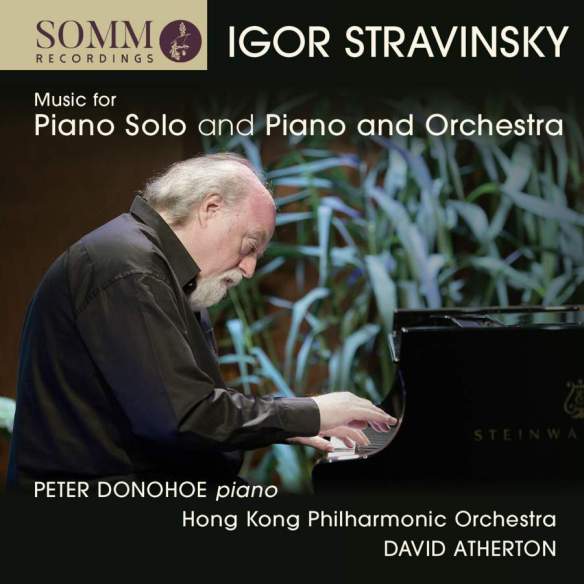
On record: Peter Donohoe – Stravinsky: Music for Piano Solo and with orchestra (Somm Recordings)

Stravinsky Music for Piano Solo and with orchestra Peter Donohoe (piano), Hong Kong Philharmonic Orchestra / David Atherton (Somm Recordings)

Stravinsky
3 Movements from Petrushka (1921)
4 Études Op.7 (1908)
Piano Sonata in F sharp minor (1903-4)
Piano Sonata (1924)
Serenade in A major (1925)
Piano-Rag-Music (1919)
Tango (1940)
Concerto for Piano and Wind Instruments (1923-4, rev.1950)
Movements for Piano and Orchestra (1958-9)
Capriccio for Piano and Orchestra (1929/1949)

Reviewed by Ben Hogwood

What’s the story?

Stravinsky’s output for piano is, perhaps not surprisingly, overshadowed by the blockbuster ballets. Yet, as recent collections from Steven Osborne and Jean Efflam-Bavouzet have shown, there is plenty to wonder at and enjoy here. Peter Donohoe takes up the mantle and goes one step further, providing an extra disc of the composer’s music for solo piano.

What’s the music like?

Extremely varied, and often spiky, exploring the piano’s capabilities as a rhythm instrument as well as a melodic one. Some of the solo works have a relatively dry musical palette, but all have interest and the earlier ones work especially well here.

The Four Études are virtuoso pieces with their roots in the language of Romantic Russian composers such as Tchaikovsky and early Scriabin. The two Piano Sonatas are a great illustration of the difference between early and middle period Stravinsky. The first, an expansive half-hour piece in F sharp minor draws inspiration from the composer’s teacher Rimsky-Korsakov as well as the Grand Sonata of Tchaikovsky. The composer had no time for it, declaring it ‘fortunately lost’ – unaware it was under lock and key in the National Library of Russia.

The Piano Sonata of 1924, a third of its length, inhabits a different world, ‘neo-classical’ Stravinsky compressing his music into forms derived from the 18th century. The perky Serenade and the short Piano-Rag-Music and Tango make a nice, sprightly contrast to the bigger works, as do the death-defying Three Movements from Petrushka. Always a spectacular experience, these sections from the ballet faithfully reproduce the colour of the orchestra and are a technical summit that pianists cannot resist conquering.

The works for piano with orchestra are fascinating. The Concerto for Piano and Wind has a stern face and is on occasion a bit caustic – the composer contrasting ‘sounds struck and blown’ in driving rhythms. In its slow music however there is a more intimate, even vulnerable heart. Movements, a set of five postcards dating from Stravinsky’s move away from conventional tonality, remain full of interest in their syncopations, tonal movement and snapshots of humour. Finally the three-movement Capriccio is a refreshing burst of energy in its outer movements, the last movement especially turning into a riot.

Does it all work?

Yes. Peter Donohoe is an expert guide to this music, his pedigree in Russian piano music almost unrivalled among his contemporaries. Those recordings of Prokofiev, Rachmaninov and Shostakovich serve him in good stead to present a consistent and illuminating portrait of Stravinsky in his very different phases.

He is a model of clarity in the trickier contours of the more modern works, making the most of the composer’s rhythmic impetus and bringing in humour when the chance allows. In the slow movement of the Concerto he sets the mood with a calming simplicity, enjoying heartfelt dialogue with the chorales of the Hong Kong winds.

In the more overtly Romantic music he is a model of virtuoso performance. The flurry of notes in the fourth Etude are superbly delivered, while in the grand Sonata in F sharp minor Donohoe makes a compelling case for the work despite its massive structure. The shorter pieces work well too, the spiky side to Stravinsky coming to the surface.

David Atherton, also a seasoned interpreter of the composer, secures excellent playing from the Hong Kong Philharmonic Orchestra wind in the Concerto especially, their block sounds beautifully rendered. Those sonorities are also beneficial to the Capriccio and Movements, which are suitably punchy. These are slightly older recordings, from the mid to late 1990s, but hold up extremely well.

Is it recommended?

Yes. The musical contents may not be as immediately appealing as the ballets, maybe, yet this is a collection rewarding closer inspection. Spending time with this music gives a greater insight into Stravinsky’s development as a composer, and even if you love the more Romantic side of Russian piano music the solo works bring their own rewards.