
On record: Purcell – Twelve Sonatas of Three Parts (Vivat)

purcell

The King’s Consort play Purcell’s collection of twelve sonatas published in 1683. In the words of the Vivat label website, they ‘combine French elegance, Italian vigour and delicious English melancholy with harmonic daring, extraordinary contrapuntal technique, ravishing dissonances and unique melodic ingenuity’. Clearly Purcell was anticipating a united Europe!

What’s the music like?

Purcell is one of the most obviously expressive composers of the Baroque period, and even his instrumental music has strong vocal qualities. His music here also experiences relatively rapid mood swings, the individual movements of the sonatas capable of switching quickly from grave, browbeaten music to melodies that are full of the joys of spring.

There are dances too, such as the one a minute or so into Sonata no.8, or the enjoyable repeated-note motif that closes out the first movement of Sonata no.2.

When the English melancholy does make itself known the results are rather special, such as the sumptuous beginning to Sonata no.6, where the strings make a sweet sound. By complete contrast the start of Sonata no.4 is relatively stark, bringing Purcell’s daring discords to the surface – before moving into a resolute faster section.

Does it all work?

Yes. There is some beautifully poised playing on this collection, as the staged entries in Sonata no.8 confirm. Violinists Cecilia Bernardini and Huw Daniel are blessed with beautiful, penetrating tones, and the continuo section – bass viol, theorbo and organ or harpsichord – alternates its colours sensitively and effectively, a prime example being the wonderful organ sound half way through the first movement of Sonata no.3. The fugue halfway the first movement of Sonata no.12 sums things up very nicely.

Is it recommended?

Yes. Purcell’s vocal music tends to get the headlines but this disc shows just how imaginative and effective his writing for instruments could be.

Listen

You can get a preview of each track from this disc on the Vivat website
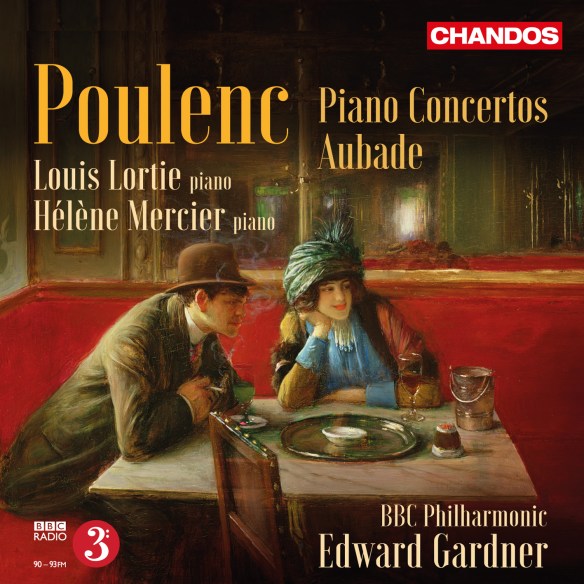
On record: Poulenc – Works for piano and orchestra

Featured recording: Poulenc – Works for piano and orchestra (Chandos)
poulenc-lortie

Louis Lortie, a French-Canadian pianist, teams up with conductor Ed Gardner and the BBC Philharmonic Orchestra for a disc presenting Poulenc’s complete music for piano and orchestra, as well as some of his works for two pianos. Here he is joined by regular duet partner Hélène Mercier.

What’s the music like?

Poulenc is well-loved among 20th century composers, often for his gift of writing bittersweet melodies that make the listener smile – such as the oboe theme that dominates the Rondeau section of the Aubade for piano and orchestra, the second work on this disc.

Poulenc is a cheeky composer, thumbing his nose behind your back in a sense, and as with most French composers the imaginative and colourful orchestrations bring the music to life. Every so often Poulenc throws in a turn of musical phrase that makes the listener smile, with an exaggerated gesture here or a knowing chord progression there.

This new collection from Chandos brings together an impressive range of writing. The Piano Concerto is perhaps not as popular as it might be, for it often sparkles in this performance, and that label certainly applies to the entertaining and multi-faceted Aubade from 1929. This work, Roger Nichols informs us in his authoritative booklet note, was written in one of the composer’s depressive bouts, and it tells the story of how the huntress Diana is driven to suicide by her own ‘love that the gods forbid’.

The brief works for two pianos included here are greatly affecting – the doleful Élégie and the free-spirited L’Embarquement pour Cythère especially – while the concise Sonata packs an energetic punch. When writing for two pianos and orchestra in the Concerto Poulenc must have had great fun, for this is full of frolics – but with the customary cautionary notes just beneath the surface.

Does it all work?

Yes. This collection is consistently entertaining, played with great enthusiasm and affection and recorded in such a way that the light and shade of the composer’s writing is fully revealed.

The Aubade is at times po-faced but has an almost ever present glint in the eye, as though it can’t resist cracking a joke amongst the downward thoughts. In the double concerto, Mercier and Lortie enjoy sparkling and spiky exchanges between pianos and orchestra, and in the finale there is what sounds like a clockwork mechanism towards the end.

The tender second movement of the Sonata for two pianos is beautifully done, before the finale scurries away.

Is it recommended?

Yes. Poulenc is a charmer on record, and can be enjoyably brash too. The performers here do him proud.

Listen on Spotify

This particular recording is not on the streaming service, but samples from each track can be heard here

Vaughan Williams and Sir James MacMillan – Oboe Concertos

macmillan-vw-daniel

Nicholas Daniel teams up with the Britten Sinfonia and Harmonia Mundi to present the recorded premiere of the Oboe Concerto by the recently knighted Sir James MacMillan. He couples this with a much shorter piece by the composer, One, and another British oboe concerto, the well-loved Vaughan Williams. Completing a varied cross-section of styles is Britten’s Suite on English Folk Tunes (A Time There Was), his final completed orchestral work.

What’s the music like?

MacMillan has written a bold Oboe Concerto, a substantial work lasting nearly 25 minutes that makes great technical demands on its soloist. It is a rewrite of an earlier piece for oboe and orchestra, In Angustiis, which responded to the horrors of 9/11. While the piece is essentially optimistic in tone, these thoughts can be felt in the second movement, essentially a lament, where the strings sigh painfully, and in a moment of deep thought that occurs towards the end of the first movement – in complete contrast to the jaunty, angular main material.

Vaughan Williams’ concerto is a lovely piece, its dreamy first theme coloured with strings to evoke a picture of hazy sunshine. Completed in 1944, it is a largely positive work in the face of the Second World War, especially in the third movement, where a dance plays out between oboe and strings.

Britten’s suite, as with so many of his orchestral works, is a model of economy, saying in fifteen minutes what many lesser composers would do in 25. It is extremely resourceful in its use of ten folk tunes, but it is also tinged with pain, the composer aware that he is in his last days – and this is felt in Daniel’s cor anglais solo in the tune Lord Melbourne.

One, the second MacMillan piece here also shows his love for his home country, based on a single, arching tune based on the traditional song of Scotland and Ireland.

Does it all work?

Nicholas Daniel is one of our finest oboists, and although even he admits to difficulties in learning the part for the MacMillan his playing is absolutely superb. The energy of that work contrasts with the soulful Vaughan Williams, an affectionate performance where the slightly reduced forces of the Britten Sinfonia (in comparison to a full scale orchestra) mean more detail can be heard and enjoyed. Turning his hand to a conducting role, Daniel teases out Britten’s subtle affection for folk tunes through the relative darkness of illness.

Is it recommended?

Yes – and how satisfying to listen to such a substantial contemporary piece for oboe, which could hardly have a better advocate than it does here.

With contrasting styles of music this disc is an unrestricted pleasure, and is recommended for all fans of classical music from these shores.

Listen on Spotify

This disc can be heard here:

Anne Quéffelec plays Scarlatti

Featured recording: Scarlatti – Sonatas played by Anne Quéffelec (Mirare)

scarlatti-queffelec

A disc of keyboard sonatas by Domenico Scarlatti, played by the highly respected French pianist Anne Quéffelec. With 550 of these works to choose from, she has made a thoroughly entertaining recital of 18!

What’s the music like?

You could play ten Scarlatti keyboard sonatas a week and still have 35 left over at the end of the year! The pieces are typically around four minutes in length, and often in two sections, each repeated. In that time Scarlatti explores the development of melodic ideas, the best known sonatas having many. In that sense Scarlatti is one of the first composers to have explored the idea of using the sonata as a principal means of expression.

Scarlatti recital discs are relatively common, but the best ones show off the extraordinary variety and inventiveness within these works, programming them so that they don’t become ‘samey’. It helps to have the key choices worked out well, too – twenty works in C major, for instance, will not a good disc make!

Although Scarlatti works well on the harpsichord, I would maintain the sonatas are more suitable for the piano. As Anne Quéffelec writes in the booklet, “to move from the harpsichord to the piano is already to open the doors to the wide-open spaces of liberty”. Quéffelec clearly loves Scarlatti and here, 45 years on from her recording debut, she returns to his music.

Does it all work?

It does so here – emphatically. Anne Quéffelec is a skilful and stylish player, and Scarlatti comes alive in her hands. A lot of this music is played with a smile on the face, and is beautifully clarified and expressed.

There are many examples of this, but the most enjoyable are the playful tumbling figures in the right hand of the G major Sonata (published as K103), the soft and lightly sorrowful D minor work (K54) and the magical, slow K144, also in G major, and seemingly the forerunner of a Mozart slow movement. This is followed by another G major sonata, K260 – a very odd piece, this, going to weird and unexpected harmonic lengths, delaying its sense of a resolution. The perky figures of the B flat major sonata, K551, anticipate Beethoven with their upward ascents.

Meanwhile the Sonata in D major, K145, is notable for its jarring dissonances and is probably the most enjoyable of all with its faux-politeness and then complete disregard for convention. Only just behind this are the bird-like calls of the first on the album, the C major sonata (K420). Even then the examples listed above are just a hint of what the album contains!

Is it recommended?

Without hesitation. It is not an insult to Scarlatti to say his music is great for working to in the right performances, for it inspires clarity of thought but also a few flights of fancy in its sudden tangents and deviations. Quéffelec channels all these and more in performances of obvious affection and flair.

Listen on Quboz

You can get a preview of Anne Quéffelec’s Scarlatti album here

Musorgsky – Pictures at an Exhibition, Songs and Dances of Death / Gergiev

Featured recording: Musorgsky – Pictures at an Exhibition, Night on Bare Mountain, Songs and Dances of Death (Ferruccio Furlanetto (baritone), Mariinsky Orchestra / Valery Gergiev (Mariinsky)

musorgsky-gergiev

A new all-Musorgsky disc by Valery Gergiev and his Russian charges, returning to the composer whose operas Gergiev has recorded with great success.

What’s the music like?

On paper this release is a brilliant way to start a Musorgsky collection, because it contains his two best loved works. Pictures at an Exhibition, appearing in its celebrated orchestration by Ravel, is a wonderful set of character pieces that fully captures an artistic exhibition and the viewer’s response to it. Night on Bare Mountain is equally vivid in its portrayal of a witches’ sabbath, and the right performance can strike genuine fear into the heart. Finally the Songs and Dances of Death for baritone and orchestra (not as depressing as they sound through opportunities taken for gallows humour!) appear in the orchestral version made by Shostakovich.

Does it all work?

It should do – because this is surely a home banker for Valery Gergiev, conducting both the music of his homeland and a composer in whose music he specialises. Yet something is awry, for two of the three live performances feel routine at best.

Pictures lacks spark and feels very polite, taking its time to reveal plenty of things in the score but rarely getting out of second gear, as though the exhibition has only a few days left to run. There is no edge to Gnomus, which should ideally be unhinged, and no sense of culmination in The Great Gate of Kiev, the work’s crowning glory. The Old Castle, while suitably mournful and featuring a lovely saxophone solo, drags its feet, while Bydlo, the old cart whose machinery lumbers down the track, has a disarmingly smooth passage here.

There are a few exceptions. The characterisation of Samuel Goldenberg and Schmuÿle is brilliant, thanks to a sharp trumpet portraying the latter character, while the clucking of The Ballet of Unhatched Chicks in their Shells is winsome. But overall this version lacks real excitement.

Sadly Night on Bare Mountain is little better, and sounds like a version going through the motions, with an incredibly limp final chord. There are moments where the electric charge is more pronounced, especially when the dance music comes in around 1’45”, but otherwise this is disappointing fayre with little sense of terror.

All this is redeemed by Ferruccio Furlanetto, the commanding singer chosen for Songs and Dances of Death. There is an incredibly strong resonance to his voice, effortlessly taking charge of the Lullaby, while hurling his all into the end of the Serenade and the fatal triumphalism of The Field Marshal. Gopak, the third song, starts with threadbare bass sounding appropriately ghoulish, the sentiments of the poem laid as bare as the orchestration. Gergiev is inspired here, completing a version that stands tall alongside any competition.

Is it recommended?

Overall, no – unless you are desperate for a recording of the Songs and Dances of Death. For Pictures, alternative versions include those conducted by Claudio Abbado and Carlo Maria Giulini, with Abbado again the choice for Night on Bare Mountain.

Listen on Spotify

You can judge for yourself by hearing the album on Spotify here