On record: Havergal Brian – Symphonies 2 & 14 (Dutton Epoch)

havergal-brian


Havergal Brian Symphonies – No. 2 in E minor (1931); No. 14 in F minor (1960)

Royal Scottish National Symphony Orchestra / Martyn Brabbins

Summary

Dutton continues its traversal of Havergal Brian’s symphonies in the company of the Royal Scottish National and Martyn Brabbins, whose live recording of the Gothic symphony from the 2011 Proms (Hyperion CDA67971/2) confirmed a Brian interpreter of real perception.

What’s the music like?

Brabbins and the RSNO make a persuasive case for the Fourteenth Symphony, unheard since its premiere by Edward Downes in 1969 and here receiving its first recording. In his seminal study of Brian’s symphonies (Kahn & Averill), the late Malcolm MacDonald considered this to be the worst of the whole cycle – but it has arguably greater cohesion than the comparable one-movement works on either side; notably with the brooding introduction that segues into a resolute Allegro then a ‘slow movement’ whose restiveness is typically Brian. The return of the Adagio as a formal pivot brings the most dramatic music, but neither the intermezzo nor Allegro sections that follows sustains momentum on the way to a brutally decisive coda. Less than the sum of its best parts, No. 14 is by no means the low-point as has often been credited.

Brian was never to hear his Second Symphony, its first performance by Leslie Head in 1973 followed in 1979 by a broadcast with Charles Mackerras. An earlier studio recording by Tony Rowe and the Moscow Symphony (Naxos 8.570506) did it scant justice, but Brabbins gets far closer to the heart of a work inspired by Goethe’s play Götz von Berlichingen, and described by Brian as representative of ‘‘MAN in his cosmic loneliness: ambition, loves, battles, death’’.

With its glowering woodwind and stark pizzicato strings over three sets of timpani, the first movement’s Adagio introduction is a striking invention and if the main themes of its Allegro are a little inflexibly drawn, Brabbins ensures their purposeful correlation through an eventful development and on to a coda that collapses into darkness. Even finer is the slow movement whose sequence of developing variations on a plangent cor anglais melody which finds Brian at his most questing harmonically; its dense textures scrupulously rendered here. The scherzo adds eight horns – making a total of 16 – organ and two pianos to a large orchestra, though its surging climactic pages are less memorable than the expectant and resigned music either side. A funereal procession, the finale’s Wagnerian gestures do not impede its powerful unfolding to an eloquent episode for divided cellos, before it builds to a baleful climax and fateful close.

Does it all work?

For the most part, yes. Undeniably among Brian’s lesser symphonies, the Fourteenth can at last be judged on its own terms (the central climax arresting in context), while the Second’s head-on confronting of late-Romantic symphonism at the height of European neo-classicism yields often impressive results; not least in the oblique rhetoric of its Andante (might Brian have heard Henry Wood’s Proms performance of Myaskovsky’s Silentium in 1929?). The status of Brian as one of the last century’s most individual composers is further reinforced.

Is it recommended?

Indeed. As on previous Dutton releases, the sound yields admirable detail within its spacious sound balance, with John Pickard’s notes as extensive as they are informative. A worthwhile coupling of these contrasted yet characteristic works from different periods of Brian’s output.

Richard Whitehouse

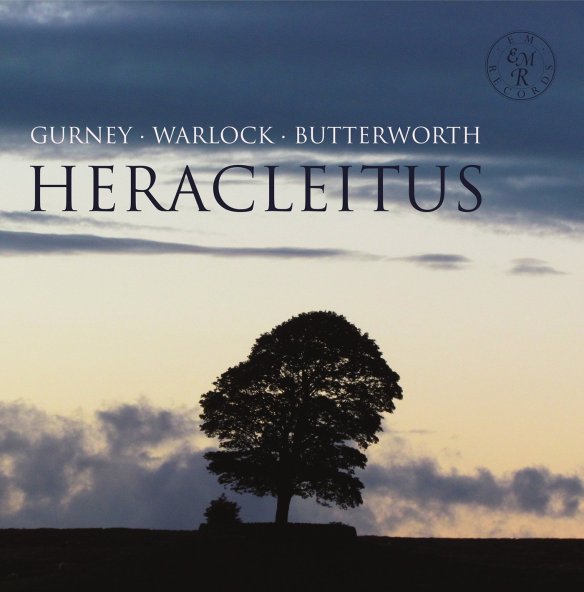
On record: Heracleitus (EM Records)

heracleitus

Butterworth: Songs (1910/11)*/** – When the Lad for Longing Sighs; Bredon Hill; On the Idle Hill of Summer; With Rue My Heart is Laden. Songa (1911/12)*/** – Fill a Glass with Golden Wine; On the Way to Kew

Gurney: Ludlow and Teme (1919)*/**/***. Adagio (1924)***. Songs*/** – The Cloths of Heaven (1918); Severn Meadows (1917); By a Bierside (1916).

Warlock: Songs */*** – Heracleitus (1917); Sweet Content (1919)

*Charles Daniels (tenor); **Michael Dussek (piano); ***Bridge Quartet [Colin Twigg, Catherine Schofield, violins; Michael Schofield, viola; Lucy Wilding, cello]

Summary

The centenary of the Battle of the Somme has seen various commemorations in music, with this latest release from EM Records among the most significant. It centres on two composers – one of whom died during the Somme offensive, while the other never recovered from being gassed at Passchendaele the next year. The disc also opens-out appreciation of their output in featuring autonomous pieces for string quartet and as accompaniment to several of the songs.

What’s the music like?

All these forces are brought together in Ludlow and Teme, Ivor Gurney’s song-cycle on verse from A.E. Housman’s collection A Shropshire Lad. A notable though unstable creative force in those years after the cessation of war, it was long considered among Gurney’s largest and most inclusive works; its expressive range more than compensating for any lack of sustained intensity across its six songs. One of these, ‘On the Idle Hill of Summer’, was set by George Butterworth prior to the War – his version confirming both a greater emotional lightness and textural subtlety which are no less apposite. Also included are two Butterworth settings of W. E. Henley, suffused by that dry wit and wistful charm emblematic of the Edwardian era. The disc closes with more Gurney – moving backwards in time so the pathos of W.B. Yeats’s The Cloths of Heavens, and poignancy of the composer’s Severn Meadows, is rounded-off by the eloquence of John Masefield’s By a Bierside in what ranks among Gurney’s greatest settings.

Two songs by Peter Warlock (aka Philip Heseltine, who seems to have avoided conscription via a mixture of guile and happenstance) are among several conceived with accompaniment for string quartet, and have been idiomatically arranged as such by John Mitchell. Of these, Heracleitus is a setting of W.J. Cory (after Callimachus) as evinces the influence of Bernard van Dieren in its sombre tread and harmonic richness, while that of Thomas Dekker’s Sweet Content exudes the chic vacuity which is often to be encountered in Warlock’s lesser songs.

The other two works are also first recordings. Odd that Butterworth’s Suite for String Quartet should have had to wait 15 years since publication, as it is the composer’s largest extant piece and offers valuable insight into his wresting with abstract forms. The opening Andante is well argued, though the Scherzando and Allegro might profitably have been integrated, while the fourth movement is insufficiently contrasted with a final Moderato whose faltering progress is indication of a project lacking the ultimate focus. Not so the Adagio from a String Quartet in D minor, seemingly the only surviving chamber work from Gurney’s final manic outburst of creativity and whose heightened emotion bodes well for a hearing of the complete work.

Does it all work?

Yes, when seen as an overall programme that skilfully interweaves its vocal and instrumental items to give a thoughtful and revealing portrait of the two main composers featured herein.

Is it recommended?

Indeed, not least as the contribution of Charles Daniels (best known for his interpretation and editions of Baroque music) is so attuned to the songs in question. Michael Dussek is as ever an attentive accompanist, and the Bridge Quartet continues its persuasive exploration of English music. Both recording and annotations are up to the customary high standard of EM Records.

Richard Whitehouse

For more information on their extensive catalogue of English music, visit the EM Records website

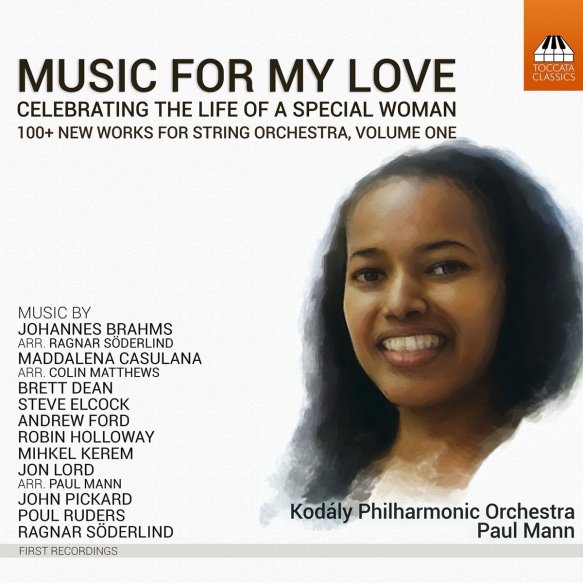
On record: Music For My Love (Toccata)

music-for-my-love

Brahms (arr. Söderlind) Von ewiger Liebe
Casulana (arr. C. Matthews) Il vostro dipartir
Dean Angels’ Wings (Music for Yodit)
Elcock Song for Yodit, Op. 23
Ford Sleep
Holloway Music for Yodit
Kerem A Farewell for Yodit
Lord (arr. Mann) Zarabanda Solitaria
Pickard …forbidding mourning…
Ruders Lullaby for Yodit
Söderlind 15 Variations on a Norwegian Folktune

Kodály Philharmonic Orchestra / Paul Mann

Summary

The Music For My Love project has its basis in the life, cut short by cancer, of Yodit Tekle – the Eritrean-born partner of Martin Anderson, whose desire to commemorate her in music led to his contacting those composers he knew personally, resulting in over 100 pieces for string orchestra which he intends to record for his Toccata Classics label. This first volume takes in eight pieces and three arrangements, ranging from around two minutes to a full quarter-hour.

What’s the music like?

Appreciably more varied in expression than might be expected given the context.

Among the original pieces, Robin Holloway has written a pensive elegy whose dance-like central section offers but minimal contrast, whereas Poul Ruders contributes a wistful and affecting lullaby. Mikhel Kerem’s miniature amply sustains its rapt atmosphere, while Andrew Ford takes an earlier vocal setting for his gentle round-lay. Steve Elcock conveys a consolatory mood via the subtlest of means, then Brett Dean draws on an earlier piano piece in music of ethereally diffused harmony. John Pickard draws more obliquely upon an earlier cello piece for what is the most animated of these works in its textural contrasts, while Ragnar Söderlind takes the Norwegian folksong Oh, the cooling wind as the basis for 15 variations whose cumulative impact feels a little diffused in context – for all that its emotional consistency is undeniable.

Among the arrangements, the late Jon Lord’s evocative sarabande for string quartet responds effortlessly to Paul Mann’s skilful adaptation. Framing the sequence overall, Söderlind makes of Brahms’s song a threnody of Grieg-like plaintiveness, whereas Colin Matthews draws out the assertive eloquence inherent in a madrigal by the still little-known Maddalena Casulana.

Does it all work?

Indeed, given that it would have been all too easy to assemble a programme unrelieved in its emotional range. Thanks to judicious sequencing of the pieces at hand, this disc amply fulfils its commemorative function while also making for an hour’s absorbing listen in its own right.

Is it recommended?

Absolutely, not least as the Debrecen-based Kodály Philharmonic Orchestra responds with commitment to Paul Mann’s direction. The sound endows the string textures with plenty of space and definition, while booklet annotations are as comprehensive as ever from Toccata.

Richard Whitehouse

Further instalments in this worthwhile project are much anticipated: in the meantime, read more about its continuation via the Toccata Classics website

On record: Now Comes Beauty – Commissions from the English Music Festival

now-comes-beauty

Richard Blackford Spirited (2013)

Paul Carr Now Comes Beauty (2009); Suddenly It’s Evening (2013)

Matthew Curtis A Festival Overture (2008)

Philip Lane Aubade Joyeuse (1986)

Paul Lewis Norfolk Suite (2013)

David Matthews White Nights Op.26 (1980)

David Owen Norris Piano Concerto (2008)

John Pickard Binyon Songs (2015)

Christopher Wright Legend (2013)

Roderick Williams (baritone – Pickard); Rupert Marshall-Luck (violin – Carr & David Matthews); David Owen Norris (piano); BBC Concert Orchestra / Owain Arwel Hughes (Blackford), Gavin Sutherland (all others)

EM Records

Summary

Over the decade of its existence, the English Music Festival has revived an impressive number of works from (not always deserved) obscurity and commissioned numerous others. Some of the latter are brought together on this set, with a stylistic range wider than might be supposed.

What’s the music like?

The discs adopt a roughly similar layout, each opening with an overture as makes for a lively curtain-raiser. How else to describe A Festival Overture by Matthew Curtis (b1959), its bustle offset by a lyrical melody redolent of those in Sullivan’s Irish Symphony, whereas Spirited by Richard Blackford (b1954) adds a hint of Adams-like minimalism to broaden the transatlantic appeal of his engaging piece. Of the two works featuring solo violin, White Nights by David Matthews (b1943) draws on Dostoevsky (via Bresson) and the composer’s own experiences in a haunting and eventful nocturne – later remodelled as the opening movement of his First Violin Concerto. More limited in its content and expressive range, Suddenly It’s Evening by Paul Carr (b1961) exudes a wistfully elegiac air that is no less fully conveyed by Rupert Marshall-Luck.

Carr also appears on the other disc with Now Comes Beauty, formerly a song then a motet before emerging as a miniature for strings ideal for the ‘Smooth Classics’ slot on Classic FM. Aubade Joyeuse by Philip Lane (b1950) is (to quote the composer) an ‘introduction and allegro’ that assumes mounting activity prior to its climactic fugato and vigorous close. Firmly in the lineage of British geographical pieces, Norfolk Suite by Paul Lewis (b1943) takes in the heroic setting of Castle Rising, evocative ruins of Wymondham Abbey, ruminative calm of Ranworth Broad and bustling jollity of Norwich Market over its appealing course. Further down the east coast, the Suffolk hamlet of Shingle Street had inspired Legend by Christopher Wright (b1954), its sombre yet affecting mood amply evoking the aura of this isolated place.

Of the works ending each disc, the Piano Concerto by David Owen Norris (b1953) is a three-movement entity on ostensibly Classical lines. The solo writing is as idiomatic and assured as might be expected from this fine pianist, with that for orchestra hardly less idiomatic. Yet after a well-argued Allegro, the Andante loses its way in misplaced rhetoric and emotional cliché, with the finale too reliant on its underlying jig rhythm prior to an overstretched and predictable apotheosis. ‘‘Keys have personalities’’ says the composer: his music could do with more of it.

Binyon Songs by John Pickard (b1963) might well have emerged as a song-cycle malgré-lui, but the motivic cohesion and expressive logic with which these unfold cannot be gainsaid. The first four may be relatively brief, yet the wrenching ambivalence of Nature, tenuous hope of Sowing Seed, tensile anger of Autumn Song and suffused rapture of When all the World is Hidden make their mark no less acutely than the expansive The Burning of the Leaves that makes for a cathartic ending. Roderick Williams sings with his customary poise and eloquence.

Does it all work?

Yes, in terms of the complementary and contrasting aspects which inform this collection as a whole. The set is further enhanced by the excellence of the BBC Concert Orchestra’s playing, with Owain Arwel Hughes making a welcome appearance in the two overtures and the rest of the programme directed with unstinting conviction by Gavin Sutherland. The recorded sound takes full advantage of Watford Colosseum’s spacious immediacy, while the booklet includes detailed overviews of each work and composer together with full texts for the Binyon settings.

Is it recommended?

Indeed. Since its inception, EM Records has amassed a notable catalogue of predominantly first recordings – with the present release among its most ambitious and rewarding. Uneven in overall quality though it may be, the best of the music here deserves the widest dissemination.

Richard Whitehouse

On record: The Panufnik Legacies II (LSO Live)

lso-panufnik-legacies-2

Colin Matthews, Max de Wardner, Evis Sammoutis, Christopher Mayo, Toby Young, Elizabeth Winters, Larry Goves, Raymond Yiu, Anjula Semmens and Edmund Finnis Panufnik Variations
Duncan Ward P-p-paranoia
Alastair Putt Spiral
Aaron Parker Captured
Kim B. Ashton Spindrift
James Moriarty Granular Fragments
Elizabeth Ogonek as though birds
Leo Chadburn Brown Leather Sofa
Bushra El-Turk Tmesis
Matthew Kaner The Calligrapher’s Manuscript

London Symphony Orchestra / François-Xavier Roth

Summary

Three years on and the Panufnik Legacies series continues with a disc no less substantial if perhaps less diverse than its predecessor. Beginning with a set of variations on the opening theme from what is arguably the Polish-born composer’s greatest work, this continues with nine pieces again by participants of the Panufnik Composers Scheme – all testament to the scope and ambition of the LSO Discovery project which has played a crucial, even decisive role in introducing many new composers to audiences at the Barbican and LSO St Luke’s.

What’s the music like?

Panufnik Variations comprises the ‘theme’ from that composer’s Universal Prayer (1969), followed by 11 variations that open-out its essence without always probing it in any depth. From this perspective, variations by Evis Sammoutis, Christopher Mayo, Larry Goves and Anjula Semmens (3, 4, 7 and 9) are the most perceptive, with that by Raymond Yiu (8) the most entertaining in its allusion to a more famous Panufnik work often revived by the LSO. Colin Matthews orchestrated theme, first and final variations in highly professional fashion.

Of the stand-alone pieces, Duncan Ward’s P-p-paranoia packs a fair degree of incident into compact proportions, while Alastair Putt’s Spiral takes a segment of the Fibonacci Sequence as basis for its accumulating impetus. Aaron Parker’s Captured evidently utilizes ‘‘looping techniques and ambient forms’’ for its four brief fragments without a context, then Kim B. Ashton’s Spindrift evokes abstract seascapes in its ebb and flow. James Moriarty’s Granular Fragments evolves his notions of timbre and texture over three subtly contrasted miniatures.

Elizabeth Ognek’s as though birds elides its three miniatures into a cohesive if unfocussed whole, whereas Leo Chadburn’s Brown Leather Sofa brings a de Chirico-like ethos to bear on his austere musical sculpture. Bushra El-Turk’s Tmesis draws on Arabic prosody for a piece abundant in gestures that ultimately lack distinction. Finally, Matthew Kerner’s The Calligrapher’s Manuscript looks to the model-books from Johan Hering in a lengthy (12-minute) work whose two parts respectively predicate textural density then melodic clarity.

Does it all work?

Yes, inasmuch that all of these pieces – each written between 2011 and 2013 – give notice of compositional techniques thoroughly absorbed and confidently handled. If there is a proviso, it is that most (but not all) of them seem almost too well suited to the premise of small-scale works designed to slot into an ostensibly mainstream programme without causing any undue provocation. That several composers operate in part outside of the classical domain feels of little consequence when the music in question follows so overtly a post-modernist template.

Is it recommended?

Certainly, though the greater stylistic range of the first Panufnik Legacies release (LSO Live LSO5061) is a better starting-point for those wishing to get a real sense of what this scheme is about. What is never in doubt here is the excellence of the London Symphony Orchestra’s playing as it tackles these pieces, or of François-Xavier Roth’s commitment to a cause made possible in part via the involvement of the Panufnik estate. Two years after that composer’s centenary, one can only hope his own music will retain more than a foothold in the repertoire.

Richard Whitehouse