Leif Segerstam, conductor of an intriguing series of Sibelius works for the stage on Naxos, where he directs the Turku Philharmonic Orchestra.
In recognition of 150 years since the birth of Finland’s greatest composer, Jean Sibelius, his countryman Leif Segerstam has been illuminating his music for the stage. In a year where the composer’s seven symphonies have been ubiquitous in orchestral concerts, it is really gratifying to have these new versions of relatively rare works made available – even more so since they are given here in complete rather than abridged versions.
What’s the music like?
Sibelius is a fascinating composer in this field, and is able to set a scene with little to no preparation. His economical treatment of melodies can come across as brusque, but he is never less than interesting and writes music that is occasionally puzzling but frequently moving.

Listeners will more than likely know the first number of Pelléas et Mélisande, At The Castle Gate, for the grand way it has provided the soundtrack to the BBC TV programme The Sky At Night.
Yet there is much else to discover in this music. Segerstam may not be as high powered as some conductors in his interpretation but the music is still deeply felt from the Turku Philharmonic strings, while there is a nice reedy woodwind sound.
The Adagio from Act 1 is notable for the sharp woodwind intervention and coarse strings, providing a chilling outlook, while there are some lovely colours in the opening to Act 3, where the influence of Tchaikovksy still evident.
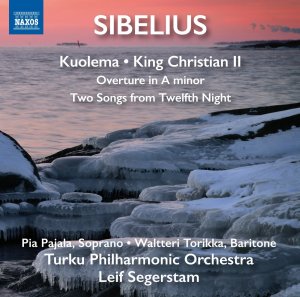
One of the numbers for Kuolema (Death) is one of the composer’s most popular encore pieces. Valse triste, as we know it, begins six scenes of music for a drama by Sibelius’ brother in law Arvid Järnefelt. Segerstam takes it slowly, but is poised and graceful throughout, as he is in the brooding Scene with Cranes, another Sibelius favourite.
Then he is joined by the fulsome baritone of Waltteri Torikka, who gives Paavali’s Song a convincing presence, while Pia Pajala is clear and crisp in Elsa’s Song. The last scene is strangely chilling, with the fateful tolling of bells.
The seven numbers Sibelius composed for the relatively early King Christian II, a Scandinavian historical play by his friend Adolf Paul, begin with a majestic Elegy, conclude with a tempestuous Ballade and include a substantial central Nocturne that proves surprisingly lively for the night time, building to a really impressive climax that reminds us how much sway Tchaikovsky holds over Sibelius’ early output. The whole score is beautifully performed, Segerstam clearly holding great affection for the romantic score.

It was satisfying to see Sibelius’s music for Belshazzar’s Feast making a comeback at the BBC Proms this year, and in Segerstam’s hands we enjoy a colourful opening procession and a penetrating flute solo in the Nocturno. Pia Pajala deserves special credit for a fulsome soprano solo in The Song of the Jewish Girl.
The two discs where the corners of Sibelius’s output are really deeply explored are those devoted to music for Jedermann (Everyman) and Scaramouche.
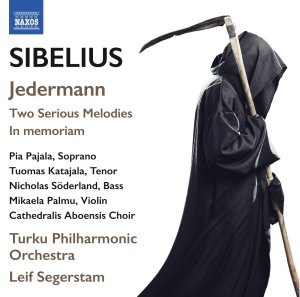
The former carries a chilling picture of a sabre-wielding Death on the cover and it is certainly very dark to start with, with some strikingly beautiful writing for strings that Segerstam is keen to bring out, especially when heard in a solo capacity in the Largo. There is more choral music in this score, sung with commendable spirit by the Cathedralis Aboensis Choir, and there is a memorable main tune that makes regular reappearances throughout. The sonorities become appreciably sweeter when the organ gets mixed in for the second part of the Adagio, but this is music that never really settles, and in the section marked ‘Con grande dolore’ there are some disarming sweeps from the strings.
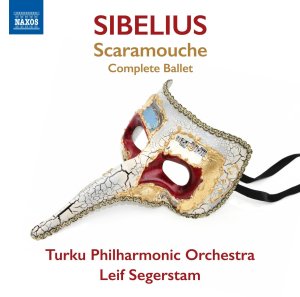
Scaramouche caused Sibelius a lot of problems in its composition, causing him to break a telephone on one occasion, but it still has some striking qualities. The bolero in Act 1 is a very curious stop-start dance where what sounds like a bandoneon is used, while in Scene 6 of Act 2 (again untitled) there is extreme uncertainty, both here and in the start of the successive number in the harmonies and wind colouring. Scene 9 conjures up a favourite Sibelius tactic, the bouncing of bows on the strings. So while a bitty score, Scaramouche still generates a good amount of interest and mystery.

Swanwhite is quite an elusive piece but once again is revealed to have a mixture of charm and mystery. The former quality can be found in the third number of Act 2, where there is a poised and rather lovely dialogue between flute and strings, but by contrast the fifth number wears a stern expression, especially through its clarinet part. There are however some moments of pure serenity in Swanwhite, and while at times its music seems to have a short attention span it nonetheless leaves a lasting impression.
The Lizard, far from a makeweight, is a fascinating piece that shows all the composer’s hallmarks in their early stages – though when hearing the music it sounds a lot later than its publication number, Op.8, might suggest. The sweeping violas, the cold and often eerie unison string lines, and the shivers from tremolo strings around 17 minutes in – all are hallmarks of the mature composer and mark him out as an orchestral colourist of the highest quality.
One of the appealing qualities of Segerstam’s discs is the programming, as alongside the stage works he takes the opportunity to include rarely-heard items such as two songs from Twelfth Night, the Overture in A minor, and many more. These help put the Sibelius output in context, and while they might not be classed as masterpieces the works do still contain moments of inspiration and originality. While the Overture in E major may be an obvious early work, Scene de Ballet gets out the castanets to good effect, before finishing in typically abrupt manner. There is a glint in the eye of the waltz Musik zu einer Szene, and a graceful Valse lyrique. The Overture in A minor could only be by Sibelius, and offsets its stern brass with increasingly active strings before suddenly cutting to a brighter, energetic outlook. The Cortège is a piece of grand ceremony though still has its subtleties, while the Processional is a solemn piece. Meanwhile the short Menuetto has Sibelius’ own stamp on it, richly coloured and quite grounded, before once again stopping suddenly.
These are then extremely valuable additions to the Sibelius discography, and are highly recommended to those looking to progress beyond the ubiquitous symphonies. Though the symphonies make one of the twentieth century’s finest collections in the form, Sibelius was a much deeper composer than that – and in these recordings Segerstam proves that beyond doubt.
Does it all work?
Frequently. These are fascinating pieces, though listeners are advised to read the booklet notes either during or before hearing so that Sibelius’ acute scene setting can be fully appreciated.
Is it recommended?
Yes – especially to those who have gotten to know Sibelius through his symphonies. The stage works reveal the composer in a different light, and provide a substantial complement. They also show his remarkable powers of musical concentration and orchestral colouring.
Listen on Spotify
Pelleas https://open.spotify.com/album/2Hd0S5a6jiOzDziBVJ3uNR
Kuolema https://open.spotify.com/album/5NfQh1uva2xxerW8yNbqlr