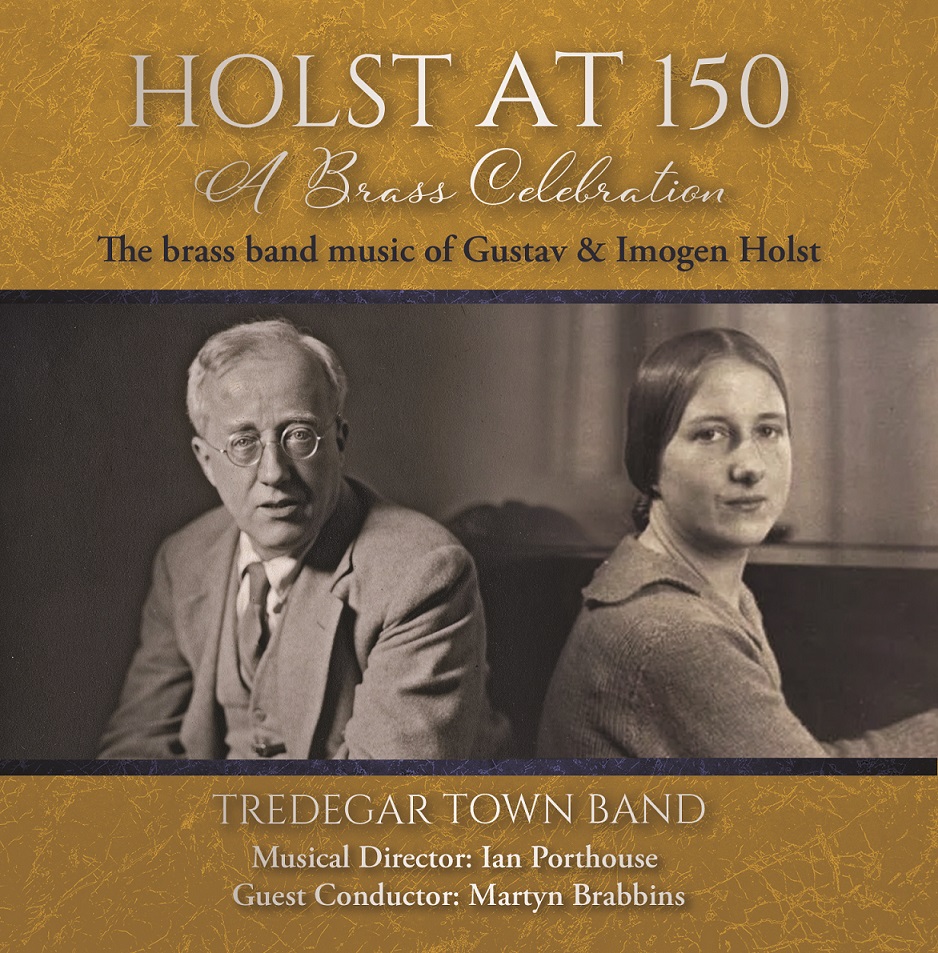
On Record – Tredegar Town Band / Ian Porterhouse, Martyn Brabbins – Holst at 150: A Brass Celebration (Doyen)

Gustav Holst
Suites for Military Band Op.28:
no.1 in E flat major (1909)
no.2 in F major (1911)
The Perfect Fool Op.39 (1918-22) – Ballet Music (all arr. Littlemore).
A Fugal Overture Op.40 no.1 (1922; arr. Wheeler)
Mr Shilkret’s Maggot (1932; arr. Hindmarsh)
A Moorside Suite (1928)
Imogen Holst
The Unfortunate Traveller (1929; ed. Hindmarsh)
Glory of the West (1969)

Tredegar Town Band / Ian Porthouse and Martyn Brabbins (A Moorside Suite)

Doyen DOYCD435 [74’37’’]
Producer Adam Goldsmith Engineer Daniel Lock
Recorded 18-19 May 2024 at Jack Williams VC Hall, The Works, Ebbw Vale

Reviewed by Richard Whitehouse

What’s the story?

The 150th anniversary of his birth, and 50th anniversary of his death, is an ideal opportunity to reassess the legacy of Holst in all its variety; not least with this anthology of his music for brass band that also finds space for her contribution to the medium by his daughter Imogen.

What’s the music like?

Typical and inimitable Holst – but, as he only wrote one work for the medium, much of this release consists of arrangements. The two Suites for Military Band were obvious candidates: the First Suite’s Chaconne emerges with renewed pathos, as too its whimsical Intermezzo or rumbustious March; no less idiomatic is the Second Suite with its recourse to traditional tunes in such as the effervescent initial March, then the final Fantasia with its memorable rendering of the Dargason. Philip Littlemore is an expert arranger here as of the Ballet Music from the opera The Perfect Fool – the sections that evoke ‘earth’ and fire’ lacking a degree of panache, but that of ‘water’ hardly less magical in this guise. Alastair Wheeler proves no less adept in capturing the impetus of A Fugal Overture, while Paul Hindmarsh gives what ought to be a new lease of life to the ‘jazz-band piece’ designated Mr Shilkret’s Maggot praised but never played by its commissioner. Imogen Holst’s 1967 orchestral arrangement as Capriccio rescued it from oblivion, but this new incarnation makes even more of its recalcitrant humour.

Mention of Imogen leads one to her pieces for brass band, both included here. Compact and characterful, her suite The Unfortunate Traveller was initially more successful as transcribed for strings, though Hindmarsh’s edition adds percussion and clarifies the brass texture as was doubtless intended. Its sure highlight is the winsome Interlude, conjuring a discreet though tangible profundity subsequently glimpsed with The Glory of the West – seven variations on said Morris Dance which confirms music written for amateurs need not involve compromise.

This just leaves A Moorside Suite, a work such as transformed the standing of test-pieces for brass band with that understated acuity surely unique to this composer. Whether in its gently satirical Scherzo, wistful Nocturne whose gradual building to a soulful culmination makes for the highlight of this collection, then a March which fuses energy and eloquence to round off the sequence with irresistible elan – this is Holst at his most engaging and communicative. Music, moreover, Martyn Brabbins clearly relished the chance to conduct for this recording.

Does it all work?

Absolutely, both in this piece and elsewhere, as long-standing music director Ian Porthouse puts the Tredegar Town Band exactingly and admirably through its collective paces. At the forefront of the modern brass-band movement, the latter is ideally placed to find this music an audience outside of its customary domain. That it succeeds is clear from the fact that one listens to this programme without thought of the medium or its context; rather, the emphasis is on those qualities of inspiration and substance as are hallmarks of any worthwhile music.

Is it recommended?

Indeed. Recorded with requisite clarity and definition, and featuring informative annotations by Hindmarsh and Littlemore, this is a significant release in Holst’s anniversary year and an evident first choice for acquiring a representative cross-section of his music in this medium.

Listen & Buy

You can listen to samples and explore purchase options on the World of Brass website Click on the names for more on conductors Ian Porthouse and Martyn Brabbins, the Tredegar Town Band, and for more on the composers Gustav Holst and daughter Imogen Holst

Published post no.2,307 – Friday 20 September 2024

On Record – Benjamin: Picture A Day Like This (Nimbus)

George Benjamin
Picture a day like this (2021-23)

Woman – Marianne Crebassa (mezzo-soprano)
Zabelle – Anna Prohaska (soprano)
Artisan/Collector – John Brancy (baritone)
First Lover/Composer – Beate Mordal (soprano)
Second Lover/Composer’s Assistant – Cameron Shahbazi (countertenor)
Mahler Chamber Orchestra / Sir George Benjamin

Nimbus NI8116 [60’09’’] English libretto included

Producer & Engineer Etienne Pipard
Live performance, 5 July 2023 at Theâtre du Jeu de Paume, Aix-en-Provence

Written by Richard Whitehouse

What’s the story?

Nimbus continues its long association with the music of George Benjamin by releasing his most recent opera, as recorded during its initial production at the Aix-en-Provence Festival and here featuring an impressive line-up of musicians under the direction of the composer.

What’s the music like?

Surprising as was the emergence of Benjamin as an opera composer, he has consolidated his standing accordingly – the ‘lyric tale’ Into the Little Hill (NI5964) duly followed by the full-length Written on Skin (NI5885) then Lessons in Love and Violence (NI5976). In spite of its greater length, Picture a day like this marks his return to the intimacy and understatement of that first venture in terms of its reduced cast and chamber forces – for all that the underlying ‘theme’ seems nothing if not significant in its consideration of life above and beyond death.

Unfolding across seven scenes, the narrative relates a Woman’s search for a ‘happy person’ to redeem the death of her child – during which she encounters a pair of Lovers, a retired Artisan and a renowned Composer; their happiness and contentment in each case pure self-deception. After a despairing monologue, she meets a Collector whose attempted empathy leads her to a garden where the arcadian aspect proves as illusory as the contentment of Zabelle: one whose ostensibly tragic story still enables her to glimpse a future beyond what she has experienced.

Musically this work finds Benjamin at his most subtle and often rarified though never merely inscrutable. Understandably eschewing those respectively sustained expressive build-ups then jarring histrionics of his previous two stage-works, the present opera focusses on incremental changes of emphasis both vocally and instrumentally to maintain a fluid if always perceptible momentum. Allied to this the texture has a poise and finesse, notable even by the standards of this composer, as largely mitigates any sense of the drama played out at an emotional remove.

It could hardly be bettered in terms of performance. Marianne Crebassa brings eloquence and no little fervour to the Woman, while Anna Prohaska evokes Zabelle with mounting gravitas. The other singers are nothing if not attuned to their doubling of roles – notably John Brancy’s fractured Artisan, Beate Mordal’s unfulfilled Composer and Cameron Shahbazi’s narcissistic Lover. Long an able exponent of his own music, Benjamin secures playing of responsiveness from the Mahler Chamber Orchestra as he steers this work forward with audible inevitability.

Does it all work?

Yes, providing one accepts that Benjamin’s idiom is inward if not necessarily inward-looking and elusive without its being inaccessible. The ethos of this opera is likely to be experienced at a remove from the drama it articulates, with the listener becoming absorbed in the onstage action but never coerced into an intended response. That what one takes from listening to it is no more permanent than it is predetermined is itself testimony to the conviction of Benjamin’s and librettist Martin Crimp’s fashioning a parable simultaneously of its own yet outside time.

Is it recommended?

Indeed, given the fascination of its subject, the nature of its treatment and the assurance of its realization. Hopefully a DVD presentation of this or the subsequent Royal Opera production will be forthcoming. Even if or when it appears, this release can be strongly recommended.

Watch

Buy / Further information

For purchase options and more information on this release, visit the Nimbus website.

Published post no.2,303 – Tuesday 17 September 2024

On Record – The Silver Abduction: The Silver Abduction (Lightwell Recordings)

by Ben Hogwood

What’s the story?

Not much is known about The Silver Abduction…but all you really need to know is that this is the first record from a collaboration between Andy Dragazis (the man behind Blue States) and singer Allison Brice (who has previous with The 18th Day Of May and Lake Ruth).

Their short descriptive biography over on Bandcamp suggests a combination of ‘lush orchestral melodies, church reverb drenched drums intertwined with Allison’s haunting vocals and lyrics.

What’s the music like?

This album is a slow burner, and with repeated listens it starts to become a real treasure. Dragazis has a great deal of experience on beautifully voiced pop songs, and here he makes some richly coloured productions over which Brice can work her magic.

The lyrics themselves suggest wistful, lovelorn situations that are given real meaning by Brice, who sings with deep emotion. There is definitely a pop sensibility that suggests Stereolab, Broadcast or Saint Etienne – the latter on Remember My Heart especially, which is a pop treasure.

Thermocline is a winsome combination of Dragazis’ orchestral palette and Brice’s flexible vocals, while Careful On The Ways is a wistful, late summer beauty. Quarter To Two tells a vivid story, while the closing Cecile is a waltz in what feels like an empty fairground.

Does it all work?

It does. These are pop songs with depth and subtle but lasting expression, and the album is ideally structured. Brice could pretty much be singing about stocks and shares and still make a lasting impression – that she’s not makes the album even more meaningful.

Is it recommended?

Definitely. The Silver Abduction are a treasure, and hopefully this is the start of a lengthy musical relationship. A beauty!

For fans of… Saint Etienne, Dubstar, Kinobe, The Sundays

Listen and Buy

Published post no.2,301 – Saturday 14 September 2024

On Record – Masayoshi Fujita: Migratory (Erased Tapes)

by Ben Hogwood

What’s the story?

A new album from Masayoshi Fujita, whose exploits with the vibraphone and marimba have seen him explore new sounds in music inspired by nature.

Fujita returned to his native Japan from Berlin in 2020, locating with his family in the mountains of Kami-cho, Hyōgo – where he turned an old kindergarten into a recording studio. The first album released on his return, Bird Ambience, put Arcana under its spell with its enchanting and expressive writing.

To his well-known mix of marimba, vibraphone and synthesizer, Fujita now adds vocals from Moor Mother and Hatis Noit, with guest contributions on saxophone (Osamu Fujita) and shō (Mattias Hållsten).

What’s the music like?

Listening to Fujita’s music is akin to glimpsing a rare bird in bright evening sunshine. His compositions are notable for their rare beauty, and on Migratory he captures the climate of late summer sunshine. It’s easy to imagine where these works were composed, with a great deal of light and space but also brightness that makes the music glint at the edges.

Pale Purple is an especially beautiful composition, with soft drones and half-conscious thoughts on the marimba given wonderful colours by the shō. Moor Mother excels on Our Mother’s Lights, where the brightly coloured textures shimmer in response to the voice. There are lovely, soft tones on the restful Desonata, while the tone painting on In A Sunny Meadow is uncanny, and rather beautiful. Valley, meanwhile, is a mere breath of wind, drawing the listener in with its subtle bass sounds.

Does it all work?

It does. Fujita writes fluently and gracefully, the bright tones of his music lifting the mood.

Is it recommended?

Yes. If you’ve been following Fujita’s career you will not be surprised to learn that his masterful way of writing for vibraphone and marimba remains unchanged, but the addition of extra instruments here mean the music blossoms, extra colours added to his spectrum.

For fans of… Terry Riley, Laraaji, Bing & Ruth, Harold Budd

Listen and Buy

Published post no.2,301 – Saturday 14 September 2024

On Record – Helen Field, David Wilson-Johnson, soloists, Millennium Sinfonia / James Kelleher: Havergal Brian: The Cenci (Toccata Classics)

Brian
The Cenci (1951-2)

Helen Field (soprano) Beatrice Cenci
David Wilson-Johnson (baritone) Count Cenci
Ingveldur Ýr Jónsdóttir (contralto) Lucretia
Stuart Kale (tenor) Cardinal Camillo/An Officer
Justin Lavender (tenor) Orsino/Bernardo
Jeffrey Carl (baritone) Giacomo/Savella/First Judge/Second Judge
Nicholas Buxton (tenor) Marzio/Third Guest/A Cardinal
Devon Harrison (bass) Olimpio/Colonna/Third Guest
Serena Kay (soprano) First Guest/Second Guest
The Millennium Sinfonia / James Kelleher

Toccata Classics TOCC0094 [two discs, 101’32’’]
Producer & Engineer Geoff Miles Remastering Adeq Khan
Live performance, 12 December 1997 at the Queen Elizabeth Hall, Southbank Centre, London

Reviewed by Richard Whitehouse

What’s the story?

Toccata Classics fills a major gap in the Havergal Brian discography with this release of his opera The Cenci, given its first hearing 27 years ago by a notable roster of soloists with The Millennium Sinfonia conducted by James Kelleher, and accorded finely refurbished sound.

What’s the music like?

The third among the five operas which Brian completed, The Cenci emerged as the second of its composer’s seminal works inspired by Percy Bysshe Shelley (1792-1822). While his ‘lyric drama’ on the first two books of Prometheus Unbound (1937-44) had set its text almost word for word, Brian was ruthless in adapting his ‘tragedy in five acts’ – the outcome being a rapid traversal of a drama whose themes of incest and parricide made it publicly unstageable in the UK until 1922, some 103 years after publication in Livorno where it had partly been written.

Two further operatic treatments emerged either side of that by Brian. Berthold Goldschmidt’s Beatrice Cenci (1949-50) won first prize in the Festival of Britain opera competition in 1951 but itself went unheard 1988 (ironically enough, in a concert performance at Queen Elizabeth Hall), and Alberto Ginastera’s Beatrix Cenci (1970-71) went unstaged in his native Argentina until as recently as 2015. Whereas both these operas centres on the heroine of Shelley’s play, Brian’s focusses more on its ensemble as to content with the emphasis shifting from father to daughter as it unfolds. Compared to the poised yet rather self-conscious lyricism favoured by Goldschmidt or the full-on expressionism of Ginastera, moreover, its often circumspect and sometimes oblique emotional demeanour renders Shelley’s drama from an intriguing remove.

Not its least fascination is the Preludio Tragico that, at 14 minutes, is less an overture than an overview of what ensues – akin to Beethoven’s Leonora No. 2 in its motivic intricacy and expressive substance – which would most likely warrant a balletic or cinematic treatment in the context of a staging. Perfectly feasible as a standalone item, this received its first hearing in 1976 and was recorded by Toccata Classics in 2009 (TOCC0113). Ably negotiated by his players, Kelleher’s lithely impulsive account accordingly sets the scene in unequivocal terms.

What follows are eight scenes which encapsulate this drama to compelling if at times reckless effect. The initial three scenes correspond to Shelley’s first act and culminate with the gauntly resplendent Banquet Scene, but Brian’s fourth scene goes straight to the play’s fourth act with the despairing exchanges of Beatrice and Lucrecia. The fifth scene finds daughter and mother in a plot to murder Count Cenci that soon unravels, then the last three scenes take in Shelley’s fifth act as fate intervenes with Beatrice, Lucretia and stepbrother Giacomo facing execution. Save for a crucial passage where the Papal Legate arrives to arrest Cenci, omission of which jarringly undermines continuity in the fifth scene, Brian’s handling of dramatic pacing leaves little to be desired – the one proviso being the excessive rapidity with which certain passages, notably several of Cenci’s, need to be sung that would have benefitted from a slight easing of tempo. Musically, this is typical of mature Brian in its quixotic interplay of moods within that context of fatalism mingled with defiance as few other composers have conveyed so tangibly.

Does it all work?

Very largely, owing to as fine a cast as could have been assembled. Helen Field is unfailingly eloquent and empathetic as Beatrice, with such as her remonstrations at the close of the fifth scene and spoken acceptance at that of the eighth among the highpoints of mid-20th century opera. David Wilson-Johnson brings the requisite cruelty but also a sadistic humour to Count Cenci, and Ingveldur Ýr Jónsdóttir is movingly uncomprehending as Lucretia. The secondary roles are expertly allotted, notably Justin Lavender’s scheming Orsino and stricken Bernardo. The Millennium Sinfonia responds to Brian’s powerful if often abrasive writing with alacrity under the assured guidance of James Kelleher, and if the sound does not make full use of the QEH’s ambience, its clarity and immediacy tease unexpected nuance from the orchestration.

This set comes with two booklets. One features the libretto devised by Brian, duly annotated to indicate omissions or amendments (yet a number of anomalies in this performance remain unaccounted for). The other features Shelley’s own preface to the first edition, with articles by Brian afficionados including John Pickard’s informative overview of the music and Kelleher’s thoughts on its performance. Charles Nicholl’s speculations as to the ‘real’ Beatrice Cenci are more suited to activities on a culture cruise than to Brian’s opera but are entertaining even so.

Is it recommended?

It is indeed. The Cenci is unlikely to receive further performances (let alone staging) any time soon, so this reading gives a persuasive account of its manifest strengths and relative failings. Kelleher is ‘‘formulating plans to return to conducting’’ and ought to be encouraged to do so.

Listen & Buy

You can listen to samples and explore purchase options on the Toccata Classics website Click on the names for more on conductor James Kelleher and to read more about the opera at the Havergal Brian Society website

Published post no.2,298 – Wednesday 11 September 2024