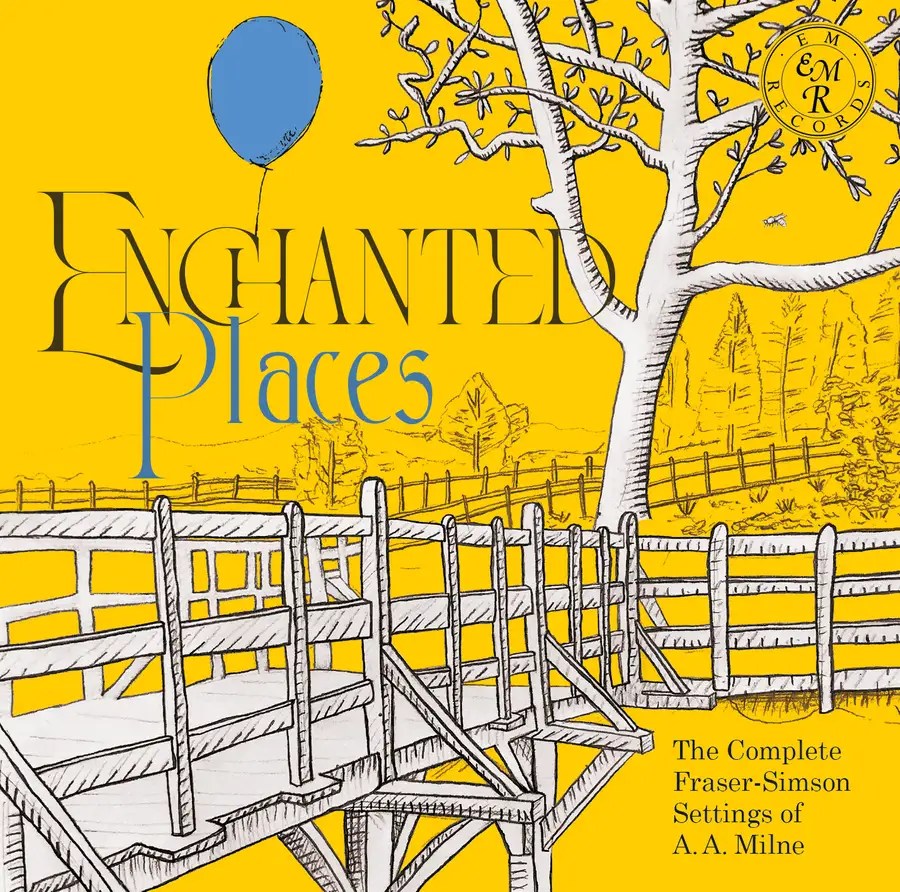
On Record – Enchanted Places: The Complete Fraser-Simson Settings of A. A. Milne (EM Records)

Grant Doyle (baritone) and John Kember (piano) with Brian Sibley (narrator)

EM Records EMRCD082 [two discs, 2h29m17s]
Producers Grant Doyle, John Kember Engineer Nick Taylor
Recorded 2019 and 2020 at Porcupine Studios, Mottingham, London

Reviewed by Richard Whitehouse

What’s the story?

EM Records continues its coverage of lesser-known and neglected English music with this complete traversal of A. A. Milne settings by Harold Fraser-Simson, more than appropriate when this year coincides with the centenary of Milne’s first collection of poems for children.

What’s the music like?

One among a notable generation of ‘light music’ composers, Fraser-Simson (1872-1944) had a brief if successful career with his songs and musicals; his musical comedy The Maid of the Mountains enjoyed one of the biggest West End successes during the latter years of the First World War and is still occasionally revived (the complete score was recorded by Hyperion in 2006). Although Simson’s star waned after the mid-1920s, his settings of Milne’s poems from the collections When Were Very Young (1924) and Now We Are Six (1927) have kept his name alive. Along with Milne’s books of short stories, these centre upon his son Christopher Robin and the latter’s nursery toys – above all, his bear Winnie-the-Pooh. They have held their own, moreover, throughout an era when the Disney franchise has continued to grow exponentially.

The songs themselves were published in six books between 1924 and 1929, alongside Milne’s poems with illustrations by Ernest Shepard which had graced the original collections. Private recordings were made at this time by Cicely Fraser-Simson with her husband as pianist, while Christopher Robin recorded several for HMV in 1927, and they have continued to attract the attention of singers both amateur and professional. Nor have the poems lost their appeal for subsequent generations of composers (Oliver Knussen drawing on a selection of them in his 1970 opus Hums and Songs of Winnie-the-Pooh), but Fraser-Simson’s settings have retained their charm along with a pathos accrued over the intervening decades. The present recording features 10 songs recorded for the first time to make this collection complete in all respects.

Does it all work?

Yes, not least given the quality of these performances. A seasoned exponent of opera, Grant Doyle gets to the heart of these settings – his singing of a warmth and precision that offsets any risk of sentimentality. Nor can his diction be faulted – no potential purchaser is likely to be without Milne’s original books but having them to hand is hardly necessary – while John Kember accompanies with subtlety and discretion. Devotee of all things Pooh, Brian Sibley narrates his handful of texts with due feeling for their unforced and often ingenious scansion.

This might not be the only way to realize these settings (a comparably extensive collection by Volante Opera Productions (Prima Facie) features seven singers), but the consistent and characterful nature of Doyle’s approach is its own justification. Those wishing to sample this release should go to The King’s Breakfast (CD2, tracks 26-29), essentially a cantata in which singer, narrator and pianist are joined by four other musicians to deftly imaginative effect, or evergreens Vespers (1, 39) and Buckingham Palace (2, 3) which emerge newly minted here.

Is it recommended?

Yes. The sound has an ideal combination of clarity and definition, while Sibley’s booklet notes on composer, author and project could hardly be bettered as an informed introduction. Put the Disney treatment aside and enjoy these settings for the winsome humour as initially intended.

Listen

Buy

You can explore purchase options for this album at the EM Records website. For more information on the artists click on the names of Grant Doyle, John Kember and Brian Sibley

Published post no.2,091 – Sunday 18 February 2024

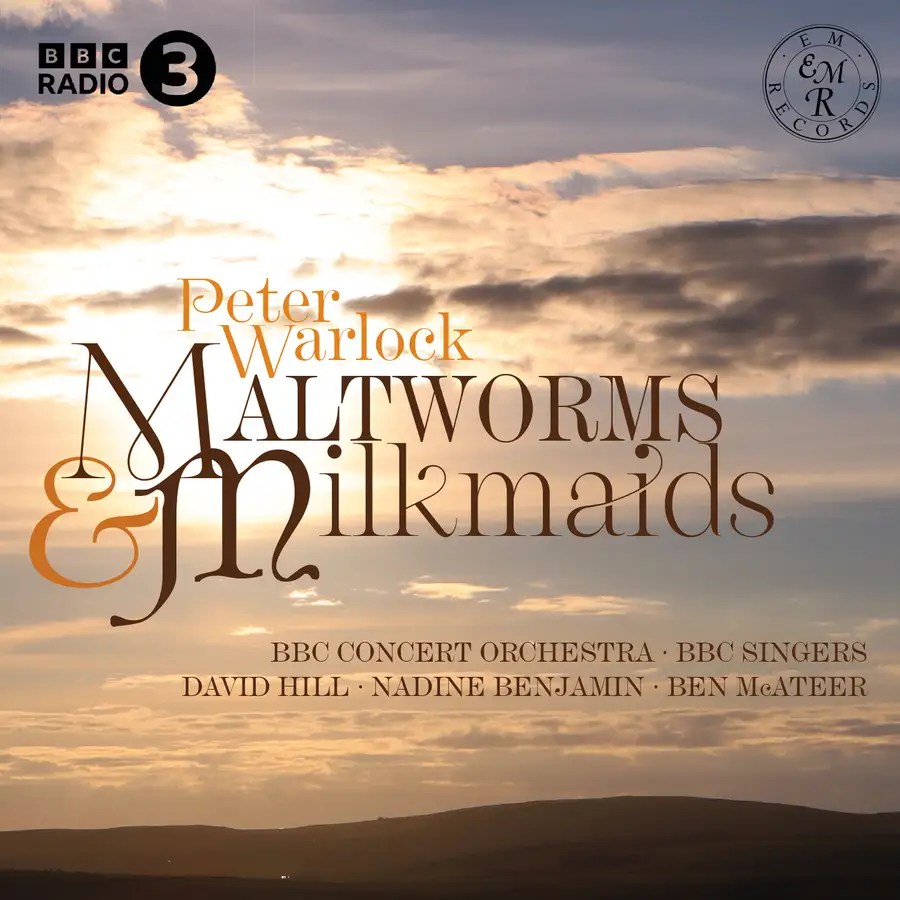
On Record – Maltworms and Milkmaids: Warlock and the Orchestra (EM Records)

Warlock
As Ever I Saw (1918, orch. anon)
An Old Song (1917-23)
Mr Belloc’s Fancy (1921/30, orch. Frederick Bye)
Captain Stratton’s Fancy (1921, orch. Peter Hope)
Serenade (1921-2)
Milkmaids (1923, orch. Henry Geehl)
Adam Lay Ybounden (1922, orch. Reginald Jacques)
Little Trotty Wagtail (1922, orch. David Lane)
The Birds (1926, orch. anon)
The Country-man (1926, orch. Gerrard Williams)
Yarmouth Fair (1924, orch. Kenneth Regan)
Sorrow’s Lullaby (1926-7)
One More River (1925)
Maltworms (1926, with E. J. Moeran)
Capriol (1926-8)
A Sad Song (1926)
Pretty Ring Time (1925)
The First Mercy (1927, orch. Fred Tomlinson/John Mitchell and William Davies)
Three Carols (1923)

Nadine Benjamin (soprano), Ben McAteer (baritone), BBC Singers, BBC Concert Orchestra / David Hill

EM Records EMRCD080 [73’52”] English texts included. Orchestrations by Warlock unless stated
Producer Neil Varley Engineer Robert Winter
Recorded 14-16 January 2022 at the Colosseum, Watford

Reviewed by Richard Whitehouse

What’s the story?

The always enterprising EM Records issues yet another ‘first’ in the guise of this collection featuring the songs with orchestra by Peter Warlock (aka Philip Heseltine), which includes many of those orchestrated by others with two-thirds of them here recorded for the first time.

What’s the music like?

Although his output barely extended beyond a decade and centred largely upon miniatures, Warlock left a substantial legacy of songs whose piano accompaniments mostly respond well when arranged for larger forces. Most of them are divided between soprano and baritone, in which latter Ben McAteer fairly captures their essence – whether the modal poise of the early If Ever I Saw, the heady (slightly forced?) jollity of those ‘fancies’ inspired by Mr Belloc and Captain Stratton, or the deftly barbed humour of Milkmaids. He draws tangible pathos from The Countryman and panache from Yarmouth Fair, with the rumbustious One More River and uproarious The Cricketers of Hambledon duly given their head. A highlight is the first recording of Maltworms, co-written with Ernest Moeran and rendered with suitable levity.

Nor is Nadine Benjamin other than fully attuned to the sentiments of her selection. Hence the soulfulness of A Sad Song or limpidity of Pretty Ring Time, both heard in what are Warlock’s only orchestrations of his solo songs, with The First Mercy an eloquent setting of words by frequent collaborator Bruce Blunt. Most affecting, though, is Sorrow’s Lullaby where soprano and baritone combine for a lengthy and often plangent setting of Thomas Beddoes in which the stark introspection of Warlock’s masterpiece The Curlew is never far beneath the surface.

The BBC Singers make their presence felt in the carol Adam Lay Ybounden and the whimsical Little Trotty Wagtail and winsome The Birds. No compromise is brooked in the rousing Fill the Cup, Philip or wistful choral incarnation of The First Mercy, then a closing trio of carols takes in the capricious Tyrley, Tyrley, the serene Balulalow and the aminated As I Sat Under a Sycamore Tree for a suitably rousing conclusion. Warlock would surely have approved and, had he known of the Singers’ recent travails, doubtless have responded in no uncertain terms.

The BBC Concert Orchestra gives of its best throughout under the astute direction of David Hill, duly coming into its own with the three orchestral pieces that Warlock completed. The evergreen suite Capriol is heard in its seldom heard and appealingly astringent version for full orchestra, the Serenade commemorates Delius’s sixtieth birthday in suitably rapturous terms, and the little-played An Old Song exudes a potent atmosphere as indicates what might have been possible had Warlock felt able to realize his musical ambitions on a larger canvas.

Does it all work?

It does, especially when heard in the continuous sequence as presented here. Warlock might increasingly have fretted about his ability as a composer, but the best of what he did achieve is sure to keep his name alive well beyond the approaching centenary of his untimely demise.

Is it recommended?

It is and not least when the presentation – with full texts, together with detailed notes from David Lane (vice-chairman of the Peter Warlock Society) reflects the always high standards of EM Records. In the words of a latter-day songster, ‘‘a splendid time is guaranteed for all’’.

Listen

Buy

You can explore purchase options for this album at the EM Records website. For more information on the artists click on the names of David Hill, Nadine Benjamin, Ben McAteer, BBC Singers and BBC Concert Orchestra. For more on all things Warlock, click on the name to head to the Peter Warlock Society

Published post no.2,078 – Monday 5 February 2024

On Record – Estonian National Symphony Orchestra / Neeme Järvi – Lalo: Orchestral Works (Chandos)

Lalo
Overture to Le Roi d’Ys (1875-88)
Namouna: Valse de la cigarette from Namouna; Suite no.1; Suite no.2 (1868-71)
Symphony in G minor (1886)

Estonian National Symphony Orchestra / Neeme Järvi

Chandos CHAN 20183 77’22”
Producer and Engineer Kaspar Karner
Recorded 6-8 June 2022, Estonia Concert Hall, Tallinn, Estonia

Reviewed by Ben Hogwood

What’s the story?

After a successful album of French Music for the Stage, the Estonian National Symphony Orchestra and Neeme Järvi team up for more 19th century explorations, alighting on a composer the octogenarian pioneer has somehow not previously recorded.

Their chosen program brings together several companion pieces by Édouard Lalo, returning to the stage for suites from his ballet Namouna and the overture to his opera Le Roi d’Ys, before adding the Symphony in G minor as a substantial complement.

What’s the music like?

Lalo was a tuneful composer throughout his career, and these works are full to bursting with attractive melodies and colourful orchestration. The structure of the album is ideal, starting with the overture to his only opera, Le Roi d’Ys. This occupied him for 12 years, by which time the overture had changed complexion, becoming a dramatic standalone piece that could work well as a concert opener, especially with its brassy ending.

The Namouna Suites are full of charm and elegance, but are also shot through with fantasy and more than a little glamour. Initially Lalo was not given a storyline to work with, and when he was given an outline of a story from Casanova’s Memoirs he suddenly had little time to complete the work. Ill health ensued, but thanks to fellow-composer Charles Gounod helping with the orchestration he was able to get the characterful work across the line. It is full of good ideas,

Finally the Symphony in G minor, completed in the same time period as more famous cousins by Franck (in D minor) and Saint-Saëns (the Organ symphony). Its relative neglect is unfortunate, for it is a fine piece if looking a little further back for its inspiration, incorporating influences from Mendelssohn, Schubert and possibly Bizet. It is carefully structured and develops its material quite studiously, but there is an attractive lightness of touch to some its themes, some welcome weight in the Scherzo and finale, and a touching tenderness to the slow movement where the strings come to the fore. The convincing finale generates a good deal of positive energy, Lalo’s musical arguments adding up to a satisfying finish.

Does it all work?

It does – thanks to excellent performances. Järvi, of course, is a seasoned professional, but the orchestra follow his sleights of hand to the letter. The Valse de Cigarette from Namouna is a particular delight, playing around with the rhythm to induce a smile, while the brass at bring extra power and panache whenever they are employed, emphasising the Wagnerian links. The colourful shading of Namouna is aided by the Chandos engineers, who give the orchestra the ideal depth, while the performance of the Symphony in G minor has clarity and poise.

Is it recommended?

It is, enthusiastically. Lalo’s orchestral music is still underrepresented in the concert hall, but there is a growing body of highly proficient recordings of the extremely likeable works hovering round the edges of his output. This attractive album goes straight into the top bracket of modern recordings of his music.

Listen

Buy

You can explore purchase options for this album at the Presto website

Published post no.2,077 – Sunday 4 February 2024

On Record – Rone: D’Argent et De Sang (Original Series Soundtrack (InFiné)

by Ben Hogwood

What’s the story?

The InFiné press release for this soundtrack does a fine job of setting the brief for the most recent soundtrack release from Rone. The French musician and composer has been tasked with writing a score for D’Argent & De Sang (originally titled Tikkoun), produced by Curiosa Films and directed by multi-César winning showrunner Xavier Giannoli.

Rone mixes orchestral textures with electronic elements to ‘symbolize the heterogeneity of the worlds that intersect on the story’. The story is that of the Carbon Tax scam, and Rone talks about how ‘we needed repetition and redundancy to highlight the theme of obsession, which is central to Xavier’s work – and to support the developments in the investigation and its characters’.

What’s the music like?

There is no doubt that Rone is a composer to watch, as his skill in blending orchestral and electronic music is becoming ever more accomplished and imaginative.

With D’Argent & De Sang he succeeds comfortably in following the brief, and the theme of obsession is hammered home. It helps for the listener to know the plot beforehand, as it explains Rone’s continued return to the main theme – but he is clever enough to set it in different context and give it different musical meaning.

The twinkling, shimmering opening pages of Tikkoun present the recurring theme, imaginatively scored. We here the sequence in various guises, from forthright string quintet to steely piano, expressively played by Vanessa Wagner. Rone’s pair of Electronic Variations are serene, in contrast to the grainy strings that darken the mood on Stress, with the use of creeping quarter tones. dRONE03 is ominous, while Jackpot is a powerful climax, combining the strings and electronics to good effect.

Does it all work?

It does – though there is the familiar issue with listeners to soundtracks that some ideas do not get developed as much as you would like, simply because Rone is following the brief. That said, his work is consistently rewarding, from the orchestra that bloom on headphones or widescreen, or the intimacy of the single piano.

Is it recommended?

It is – this is impressive stuff from the Frenchman, who is really carving a name for himself as a composer of some repute.

For fans of… Max Richter, Daft Punk (the TRON soundtrack), Jean-Michel Jarre and Vanessa Wagner

Listen

Buy

Published post no.2,061 – Friday 19 January 2024

On Record – Soloists, Transylvania State Philharmonic Choir & Orchestra / Lawrence Foster – Kodály: Te Deum & Psalmus Hungaricus; Bartók: Cantata Profana & Transylvanian Dances (Pentatone)

Kodály
Budavári Te Deum (1936)
Psalmus Hungaricus Op.13 (1923)
Bartók
Transylvanian Dances (Erdély táncok) Sz. 96 (1931)
Cantata Profana Sz. 94 (1930)

Luiza Fatyol (soprano, Te Deum), Roxana Constantinescu (mezzo-soprano, Te Deum), Marius Vlad (tenor, Te Deum and Psalmus Hungaricus), Ioan Hotea (tenor, Cantata Profana), Bogdan Baciu (baritone, Te Deum and Cantata Profana), Junior VIP, Children’s Choir (Psalmus Hungaricus), Transylvanian State Philharmonic Choir & Orchestra / Lawrence Foster

Pentatone PTC 5187071 [64’14”] Texts and English translations included

Executive & Recording Producer Job Maarse Balance Engineer & Editing Erdo Groot Engineer Lauran Jurrius
Recorded May 2022, Radio Studio of Radio Cluj, Romania

Written by Ben Hogwood

What’s the story?

Here is a chance to gain an insight into the choral music of two 20th century Hungarian composers known predominantly for their orchestral works. Bartók and Kodály were born just a year apart, and while their music is fiercely proud of their heritage their musical trajectories extend well beyond Hungary. Kodály stayed largely within Europe but brought back influences from Paris, while Bartók reluctantly emigrated to the US in late 1940.

Psalmus Hungaricus was Kodály’s first major post-war composition, in 1923. It is a landmark in his output, using for its text a Hungarian paraphrase of Psalm 55. Kodály uses a tenor soloist for the central dramatic role, the choir taking up their position as commentators. The Budavári Te Deum, completed 13 years later, marks the 250th anniversary of the liberation of Buda Castle from the Turks. While referencing Gregorian chant, Kodály incorporates references to Hungarian melodies and ornamentations in a dramatic setting.

In 1930 Bartók completed his first major work for chorus and orchestra. Cantata profana has Transylvanian roots, and Oana Andreica’s booklet note gives the context of its libretto, starting from two Romanian ‘colinde’ – ballads sung during the Christmas season but with a wide range of subjects well beyond the birth of Christ. Such is the case here, Bartók dramatising a myth of nine sons turned into stags. The cantata charts their fate and their father’s conflicting emotions, expressed by a baritone soloists. The Transylvanian Dances are a complementary addition, a short trio of works for small orchestra containing five traditional songs.

What’s the music like?

The Budavári Te Deum is a thrilling start to the album. This is red-blooded choral writing, Kodály diving in headlong to a high octane first section. He challenges choir’s higher sections, who respond admirably to the loud dynamic, retaining impressive clarity in the part writing. The work’s climactic points are notable for their power and passion.

This performance of the Psalmus Hungaricus has the authentic inflections to the melody, its bracing start turning to contemplation. Tenor soloist Marius Vlad inhabits the full tone and strong line demanded by Kodály, and sung so memorably by Ernst Haefliger in the legendary recording with Ferenc Fricsay. This makes for a fine digital alternative, with the choral response both full-bodied and unified. The meaningful counterpoint between Vlad and the Transylvanian woodwind in the middle section (Te azért lelkem) is especially memorable.

Bartók’s Cantata profana starts ominously, with an underlying menace that grows steadily as the hunt in the story progresses. Again the choral passages are well drilled, especially when in league with the percussion. The passionate tenor solo (Ioan Hotea) and fulsome bass (Bogdan Baciu) prove to be ideal foils, alighting on some spicy chords. There is little consolation at the end, in spite of the relative calm this performance leaves.

The Transylvanian Dances are over in a flash but leave a charming impression, with rustic themes. The recording is much closer, taking the action indoors to the tavern rather than outside in the wilds.

Does it all work?

Very much so. There is an adjustment to be made for the Transylvanian Dances, with the smaller ensemble and closer recording, but the performances justify the means. The choral works are a resounding success, brilliantly performed and with electric singing from the Transylvania State Philharmonic Choir, especially in the high passages. The orchestra match them under Lawrence Foster, who secures incisive rhythms and impressive clarity from such large forces.

Is it recommended?

It certainly is. This is an enterprising and very accessible coupling of three thrilling choral works, revealing fresh insights into the Hungarian composers.

Listen

Buy

For more information on this release and for purchase options, visit the Pentatone website