Switched On – Peter Kruder & Roberto Di Gioia – ,,——–,, (PEYO Records)

by Ben Hogwood

What’s the story?

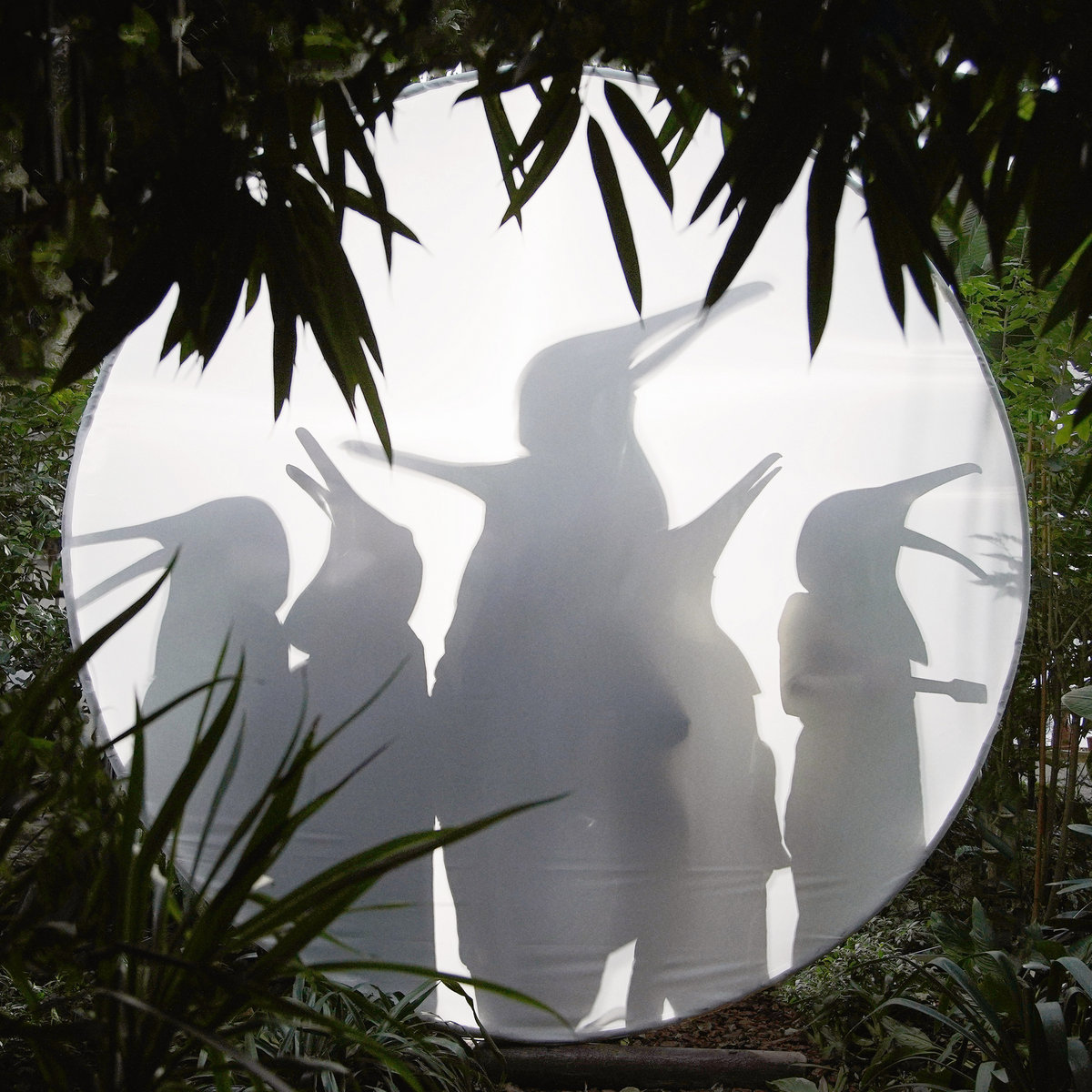
Peter Kruder and Roberto Di Gioia are old acquaintances, with a friendship going back nearly 20 years, but they have never worked together in music until now.

The two created a number of demos, with Munich-based Di Gioia playing piano against his Viennese-based friend on electronics. They discovered the impact of their music when playing to friends, all of whom were impatient to hear the new album. Said album was not a thing then, but thanks to good-natured nagging it became a project, culminating in the release of ,,——–,,.

The origin of the album name is not known, retaining its air of mystery.

What’s the music like?

Conversational. These two artists have a knack of finishing each other’s sentences, even though the musical means they are using are very different. Di Gioia, naturally, will often lead with his thoughts on the piano, but Kruder more than matches him with electronic insights and studio perspectives.

The music itself is deceptively simple but searching too. Bella Arp has softly oscillating arpeggios with a searching melody, while Endless has a bell-like figure that Di Gioia spins through some atmospheric sound patterns from Kruder. Sequenz shows that the pair can do movement too, spinning a syncopated figure that steadily gains momentum.

Kusine Limusene, the most substantial track on the album, contrasts a thoughtful piano phrase with very low electronics, the two elements striking up a conversation before the second stage of the track features block chords on the piano, which suggest Di Gioia to be an admirer of Claude Debussy. This is backed up by Rache, where those full-bodied chords assume greater prominence, before retreating to the background so that Kruder’s spacious backdrops can be admired.

Clock Tick Tock is a little more sinister, its minimal material stripped back to suggest the onset of time. Meteoriten Schluckauf is more fragmented still, but even more effective, as the piano and electronics talk in a kind of musical morse code.

Shorty shows how effective and meaningful these two areas can be, with an elegant line on the keyboard in octaves from Di Gioia shadowed at a difference by a low bass drone. Lonely Jupiter has a similar balance, though Kruder pans out the production for a more expansive view. On occasion Kruder places the piano in a kind of weather system, or goes further still by suggesting the instrument might be falling through space, as in No Love On The Enterprise.

Does it all work?

It does, in a way that having an intimate conversation can make each party feel better. There is music of deep feeling here, and the relative simplicity of the music means it is expressed that bit more powerfully.

Is it recommended?

It is. A fascinating meeting of musical minds.

Listen

Buy

You can explore purchase options and listen to clips at the Decks website

On Record – This Is The Kit: Careful Of Your Keepers (Rough Trade)

by Ben Hogwood

What’s the story?

Kate Stables and her band return with a fourth album, their first in three years. It is described as chronicling ‘a world of mistakes and mishaps, cruel circumstances, and universe-driven surprises. It’s a record that embraces the concept of outrospection – the idea that you get to know oneself by developing relationships and empathic thinking with others’. Lyrically the album looks at how to navigate change, and how we respond to it.

Realising the production is Gruff Rhys, who has at his disposal a surprisingly large ensemble, deftly used.

What’s the music like?

Softly compelling. Stables has a voice that draws the listener in, and because she sings clearly it is easy to relate to her thoughts. This is especially the case on the single Inside Outside, whose paired lyrics raise as many questions as they do answers. Similarly, Take You To Sleep, with its insistent vocal line and rippling guitar, has tension between the contradictions in its lyrics.

After these questions, More Change has a spring in its step, but is also playfully furtive. “If we hold hands, will anybody see?” asks Stables. Her voice is sweetly toned in the upward looking Scabby Head And Legs, a refreshingly straight talking number beautifully dressed by Rhys.

Then comes the title track, stripped back and revealing, seemingly set in a quiet room catching the light at the end of the day. Stables sings of ‘only just surviving’, but there is still resolve in her voice as the dappled light plays tricks in the arrangements.

Doomed Or More Doomed is a questioning number, Stables raising her voice to the sky, Rhys’ arrangement rich in colour. Stuck In A Room is also questioning, fretful even, before Stables lowers her voice for Dibs, a thoughtful coda.

There are some lovely production touches overseen by Gruff Rhys, such as the open air brass that cast their thoughts on Goodbye Bite halfway through, or the fluttering saxophone solo that breezily closes off Take You To Sleep.

Does it all work?

It does. Stables has the ability to draw the listener in to hang on every word, and while some of the music here is elusive, hers is a thought provoking vocal. The instrumentation is beautifully shaded to complement her unique voice.

Is it recommended?

It is – fans will take to it immediately, while those enjoying songs that are introverted and cryptic yet full of personality will find a great deal to enjoy here.

Listen

Buy

On Record – IzangoMa: Ngo Ma (Brownswood Recordings)

by Ben Hogwood

What’s the story?

IzangoMa are a 15-piece ensemble from Pretoria, South Africa, led by vocalist / guitarist Sibusile Xaba and the DJ and producer Ash Kgabo, whose credits also include keyboards, snare drum and drum machine.

Xaba had the idea of expanding their musical collaboration to include his students from Mozambique, who he had nurtured for years and had seen grow into experienced musicians.

Their debut album, whose name translates from Zulu as ‘from / by my mother’ is built on themes of creation, heritage and female energy.

What’s the music like?

Memorable. There is some remarkable music-making on this album, as IzangoMa embrace structures big and small to communicate compositions of striking intensity.

Right from the off this album is a call to arms, Agenda Remember throwing down the gauntlet with a herald-like vocal. This leads to a flurry of bird song and syncopated percussion on Birds (Of A Feather), then a descriptive evocation of the twinkling City Lights. Le Nna Mfana is more intense, with Xaba singing of “surrender to the almighty”.

These four compositions are effectively a prelude to the centre of the album, where two extended, compelling meditations take over. The first of these, Mgung u Ndlovu, starts with saxophone and guitar in extended conversation, before the vocals take over in what sounds like a hymn to nature. Ngo Ma is more animated as it tells its story, with Xaba’s intense delivery the feature.

After these there is still plenty to enjoy, especially the Tribute To Johnny Dyani, a tribute to the late member of the Blue Notes. “Yes you photo man, yes you video man, we love you, we really really do!”, sings Xaba.

Does it all work?

It does. Occasionally chaotic but never dull, this is an album full of musical invention and lyrical warmth.

Is it recommended?

Yes, enthusiastically. This is an inspirational collaboration, part celebration and part meditation. More please!

Listen

Buy

On record – Ellen Nisbeth, Norrköpping Symphony Orchestra / Christian Lindberg – Pettersson: Symphony no.15, Viola Concerto, Fantaisie (BIS)

pettersson-15

Ellen Nisbeth (viola), Norrköpping Symphony Orchestra / Christian Lindberg

Pettersson
Symphony no.15 (1978)
Viola Concerto (1979)
Fantaisie for solo viola (1936)

BIS BIS 2480SACD [67’37”]

Producers Stephan Reh, Marion Schwebel
Engineers Bastian SchickMarion Schwebel

Recorded 13-17 January 2020 at Louis de Geer Concert Hall, Norrköpping (Symphony & Viola Concerto); 29 May 2020 at Petruskyrkan, Danderyd, Sweden (Fantaisie)

Written by Richard Whitehouse

What’s the story?

Christian Lindberg nears the close of his Allan Pettersson cycle for BIS with this coupling of two of the composer’s late works, both of which had previously been issued on this label and are now added to its extensive series of recordings with the Norrköping Symphony Orchestra.

What’s the music like?

Although following-on directly from the Second Violin Concerto [BIS2290], Pettersson’s 15th Symphony might be thought of as forming the end of a trilogy with its predecessors (1976 and 1978) – a sequence becoming more compressed in scale as it becomes less volatile in content. At barely 36 minutes No. 15 was its composer’s shortest symphony since the 11th, but this is not to suggest any lack of drama or eventfulness in a score as finds Pettersson grappling with existential issues key to his thinking since at least the Second Symphony of 25 years earlier.

As so often in this cycle, the salient ideas are heard at the outset: here, ejaculatory chords on brass over side-drum, then wistful lines for viola and violin over lower strings. What follows seems less an extended evolution than an elaboration and intensification – during the course of which a more conciliatory mood takes precedence, though the coda proves to be as tonally oblique as it is emotionally ambivalent. Dividing the present recording into 11 tracks enables listeners to navigate their own route through this absorbing and wholly characteristic piece.

The Viola Concerto has a curious history – its existence not even known about until after the composer’s death; its manuscript suggesting a work complete as a formal entity if lacking in textural detail. Whether or not Lindberg had any input in this latter respect, the solo part has been edited by Ellen Nisbeth and hence sounds appreciably more integrated into the musical content than hitherto. Conceptually the work continues from the Second Violin Concerto and 16th Symphony with saxophone [BIS2110] in its eliding between concertante and symphonic domains; such that the viola line can be heard as a motivic ‘backbone’, affording focus to the sparse orchestral texture and channelling its expressive essence to an ending at once forceful yet provisional. Concerto or not, this is a notable as well as valuable addition to its repertoire.

In between these works comes Fantasie for solo viola, composed when Pettersson was in his mid-20s and still a practitioner on this instrument rather than a composer. Alternately soulful and incisive, this is eloquently rendered by Nisbeth and makes a worthwhile inclusion here.

Does it all work?

Yes, assuming familiarity with at least several of Pettersson’s earlier symphonies. In the 15th, Lindberg steers a more cohesive course than does Leif Segerstam [BIS680] or Peter Ruzicka [CPO9990952] with more idiomatic orchestral playing than either. As to the Viola Concerto, Nobuko Imai [BIS480] is no less sympathetic an advocate but her tone is a little too rounded for this music, whose idiom Nisbeth has down to a tee. Sound is comparable to earlier issues from this source in clarity and perspective, with decent booklet notes by Per-Henning Olsson.

Is it recommended?

Indeed. Those who have been following this cycle will be pleased Lindberg has been given the go-ahead to record all the symphonies. With just Nos. 3, 8, 10 and 11 to go, the end is in sight for this traversal of one of the most significant symphonic cycles from the post-war era.

Stream

Buy

For more information on this release visit the BIS website

Depeche Mode – Are People Good?

Tonight I am seeing Depeche Mode live for the first time. Excitement is building, especially given the quality of their new album Memento Mori – though we will of course miss the presence of keyboard player ‘Fletch’, who sadly passed away in May 2022.

The most recent Depeche Mode to be played on the radio has been People Are Good, a fine new single that has a ring of Kraftwerk’s Computer Love about it. It is effectively a considered update to one of the band’s best singles from 1984:

People Are Good seems to be impressing a more thoughtful approach on people…but is there a lyrical sting in its tale?

As for tonight, I will report back – firstly via a gig review for musicOMH, then a considered response for these pages.

Happy weekend!

Ben