
On Record – Royal Liverpool Philharmonic Orchestra / Domingo Hindoyan – Debussy, Dukas & Roussel (Onyx Classics)

Debussy Prélude à l’après-midi d’un faune L86 (1894); Jeux, L133 (1912)
Dukas La Péri (1911)
Roussel Bacchus et Ariane Op.43 – Suite no.2 (1931)

Royal Liverpool Philharmonic Orchestra / Domingo Hindoyan

Onyx Classics ONYX4224 [68’07″’]
Producer Andrew Cornall Engineers Philip Siney, Christopher Tann
Recorded 20-21 January, 24, 25 & 27 February 2022 at Philharmonic Hall, Liverpool

Reviewed by Richard Whitehouse

What’s the story?

Domingo Hindoyan’s first release as Chief Conductor of the Royal Liverpool Philharmonic Orchestra is a sequence of French ballet music which stretches across almost three decades, taking in that broad stylistic succession from Impressionism to Neo-Classicism as its remit.

What’s the music like?

Belatedly acknowledged as one of the defining masterpieces from the 20th century, Debussy’s Jeux is more familiar in the concert hall, where its myriad of formal subtleties and expressive nuances can more fully be savoured. Without ever feeling rushed, Hindoyan’s take is an alert and impulsive one – lacking just a last degree of mystery in its opening and closing pages, but with its larger sections maintaining a flexible momentum and those calmer interludes exuding a tangible expectancy. A reading, then, which would rank high on any shortlist of recordings.

Almost two decades on, Roussel’s Bacchus et Ariane ballet inhabits a very different aesthetic. Effectively its second act, the Second Suite is not lacking for any sensual appeal – witness the interplay of violin and viola in its ‘Introduction’ (eloquently rendered by Thelma Handy and Nicholas Bootiman), or mounting fervour of The Kiss then ingratiating poise in Dance of Ariadne and Bacchus. Hindoyan has their measure, duly taking the final Bacchanale at an impetuous if never headlong tempo that builds to an apotheosis of finely controlled abandon.

Although it achieved notoriety via Nijinsky’s choreography (and dancing) in 1912, Debussy’s Prélude à l’après-midi d’un faune was fully established as a game-changer in Western music – its opening flute melody (languidly played by Cormac Henry) setting in motion a sequence of episodes whose content is only marginally less remarkable than those seamless transitions between them. Ensuring an unbroken continuity, Hindoyan summons a response of unforced rightness in music whose essence is only made explicit as the last notes resonate into silence.

Finally, to Dukas and La Péri which proved his final work of any real consequence. After its brass delivers a lusty rendering of the Fanfare, the orchestra makes the most of this ‘poème dansé’ – whether in its crepuscular initial stages, the sweeping melody that duly comes to the fore then that orgiastic passage which sets in motion a gradual if unfaltering approach toward the main climax. Suitably uninhibited here, Hindoyan rightly places greatest emphasis on the ensuing postlude – its mingled radiance and regret surely as affecting as any music of this era.

Does it all work?

Yes, in terms of individual works. Hindoyan is evidently at home in this music, and the RLPO clearly relishes playing music not at the forefront of its programmes during recent years. The Roussel seems a little out of context, those ‘symphonic fragments’ from his earlier ballet Le festin de l’araignée would have been more appropriate, with Debussy’s Prélude replaced by Ravel’s Valses nobles et sentimentales for a cohesive selection of French ballet music from just before the First World War. Hopefully Hindoyan will tackle these pieces in due course.

Is it recommended?

Indeed. The RLPO’s playing is abetted by the spaciousness and definition of sound obtained from Liverpool’s Philharmonic Hall, and Andrew Stewart pens succinctly informative notes. The association between orchestra and conductor looks set to go from strength to strength.

Listen

For more information on this release, and for purchase options, head to the Onyx Classics website. For more on the artists, head to the websites of the Royal Liverpool Philharmonic Orchestra and their principal conductor Domingo Hindoyan.
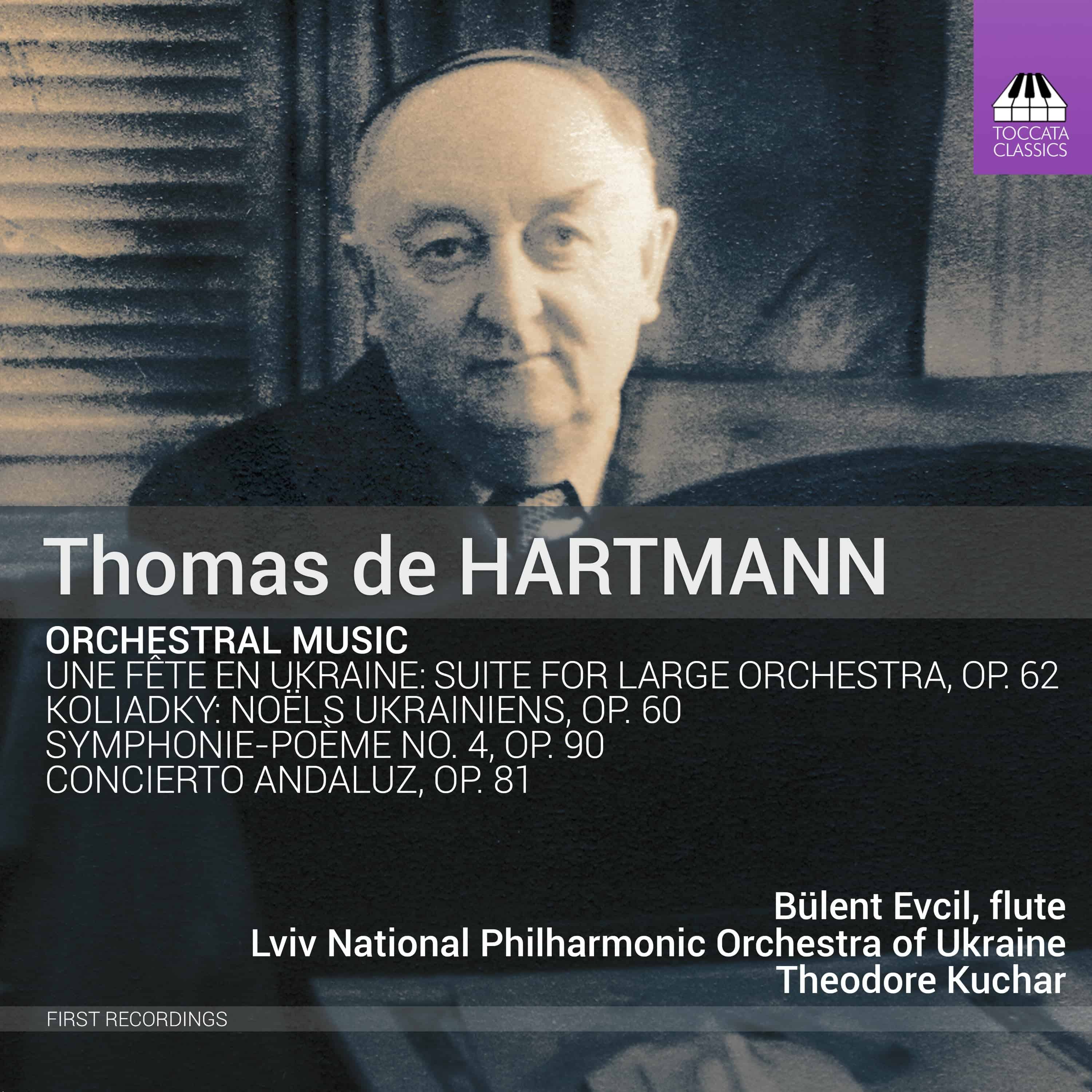
On Record – Bülent Evcil, Lviv National Philharmonic Orchestra of Ukraine / Theodore Kuchar – Thomas de Hartmann: Orchestral Music (Toccata Classics)

Thomas De Hartmann
Koliadky – Noëls Ukrainiens Op.60 (1940)
Une fête en Ukraine Op.62 (1940)
Concierto Andaluz Op.81 (1949)
Symphonie-Poème no.4 Op.90 (1955)

Bülent Evcil (flute), Lviv National Philharmonic Orchestra of Ukraine / Theodore Kuchar

Toccata Classics TOCC0633 [65’43″’]
Producer Andriy Mokrytskiy Engineer Oleksii Grytsyshyn
Recorded 11-13 September 2021 at National Philharmonic Hall, Lviv, Ukraine

Reviewed by Richard Whitehouse

What’s the story?

Toccata Classics continues its explorations with this release of orchestral music by Thomas de Hartmann (1885-1956), his posthumous reputation largely centred on his association with the Armenian philosopher George Gurdjieff but whose own music is well worthy of revival.

What’s the music like?

Although the Noëls Ukrainiens might appear as the descendent of folk-inspired sets by such as Rimsky-Korsakov or Lyadov, de Hartmann seeks rather to evoke the essence of this music than by quoting traditional melodies. The initial Chant spiritual for strings is a pertinent case in point – its textural and expressive restraint characteristic of what follows, notably the more developed final numbers: the chorale-like solemnity of La veille de l’Épiphanie, simmering fervour of Adieu, Koladá and Mussorgskian vigour of Goussak for an effervescent ending.

In his later years de Hartmann tackled the symphonic genre, albeit from a typically personal vantage in his Symphonie-Poèmes. The fourth of these remained unfinished at his death, with only its initial movement fully orchestrated. Over little more than five minutes, it provides a fair encapsulation of the composer’s later thinking – not least through an elaborate and often imaginative orchestration which accentuates formal obliqueness and expressive disjunctions. Intriguing as it is to speculate what came next, this remains a cohesive statement as it stands.

Written for Jean-Pierre Rampal then taken up by equally illustrious flautists such as Marcel Moyse, the Concierto Andaluz packs a considerable amount into its 10 minutes. Whether in the plaintive lyricism of the Entrada y Romanza, the fleet-footed and capricious Scherzino that is Juego – its winsome trio providing for necessary contrast, or the sultry evocation of Cante y Juerga, this is something of a hidden gem from the repertoire of concertante works for flute and deserving of greater exposure. Bülent Evcil leaves no doubt as to his advocacy.

Arranged from an eponymous ballet celebrating Catherine the Great, Une fête en Ukraine is de Hartmann at his most engaging. Not least the festive Ouverture, with its antecedents in the Russian ‘silver age’, or regal eloquence of Fanfare et Sarabande. The final three items are most substantial – the suitably fanciful imaginings of Incantation et danse du Chamane, the plangent modality of Nocturne, then the panache of Danilo Coupor (an English dance popular among Russian nobility in the early 19th century) which brings a scintillating close.

Does it all work?

Pretty much. That all four of these pieces are from de Hartmann’s maturity means that such influences as there were of earlier composers, primarily the melodicism of Tchaikovsky and harmonic innovations of Rimsky, have been subsumed into a more astringent while always eventful idiom. Both the shorter pieces would make attractive additions to a concert, and the larger collections each feature several items that are worth encountering in their own right – maybe as encores to round-off a programme from one of the more enterprising orchestras.

Is it recommended?

Yes, not least with the Lviv National Philharmonic giving of its best under the astute direction of Theodore Kuchar. Unexceptionally fine sound, with exceptionally detailed annotations from John R. Mangan and Evan A. MacCarthy. A follow-up volume of de Hartmann is imminent.

For more information on this release, and for purchase options, head to the Toccata Classics website. More on Thomas de Hartmann can be found here – while you can click on the artist names for more on Bülent Evcil, Theodore Kuchar and the Lviv National Philharmonic Orchestra of Ukraine

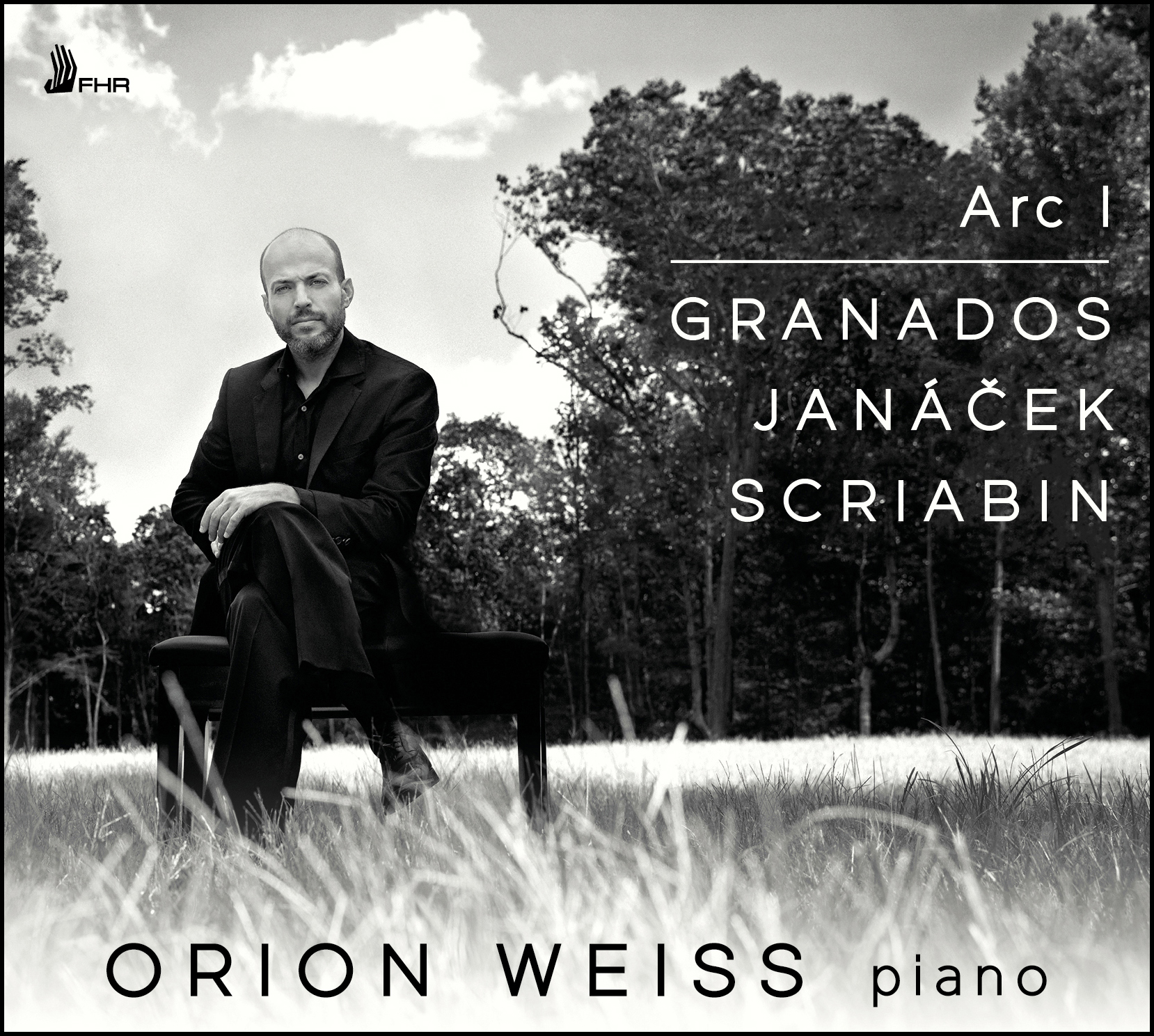
On Record – Orion Weiss: Arc 1: Granados, Janáček & Scriabin (First Hand Records)

Granados Goyescas Op.11 (1911)
Janáček In the Mists (1912)
Scriabin Piano Sonata no.9 in F major Op.68, ‘Black Mass’ (1913)

Orion Weiss (piano)

First Hand Records FHR127 [74’51”]
Producer David Frost; Engineer Silas Brown
Recorded 22-24 May 2014 at SUNY Purchase Performing Arts Center, New York

Reviewed by Richard Whitehouse

What’s the story?

First Hand Records issues the first instalment of another planned trilogy (see also The Future is Female with Sarah Cahill), the Arc series being a traversal by Orion Weiss across a century of piano music with intermittent forays into conceptually related pieces by earlier composers.

What’s the music like?

Focussing on music from before the First World War, this first volume is dominated (at least in terms of length) by Goyescas – the cycle of piano evocations in which Granados both paid homage to the illustrious Spanish artist, while extending the potential for large-scale formal design associated primarily with Liszt. That the composer subsequently transformed this into a one-act opera says much for the original’s motivic interconnections, such as Weiss further emphasizes throughout an interpretation in which characterization and cohesion are as one.

The listener is guided from teasing melodic interplay in Flattery, via the (mostly) confiding intimacy of Conversation at the Window then encroaching fear of separation in Fandango by Candlelight and its pained experiencing in Laments, or The Maiden and the Nightingale. A tragic climax arrives in the ballade Love and Death; after which, Serenade of the Ghost offers an ironic epilogue. Weiss renders this methodical yet visceral sequence with no mean insight, drawing out that pathos seldom far beneath the surface of Granados’s mature music.

If the Spanish composer was realizing his vision despite – or even because of – his success as composer and performer, In the Mists finds Janáček combating those vicissitudes of personal and professional failure. Hence the tonally and expressively oblique nature of its initial three sections, such as Weiss articulates with notable emphasis on their volatile mood-swings and frequent welling-up of emotion. All of this is duly thrown into relief by the final Presto with its gradual yet, as here, inexorable tendency towards ultimate fragmentation and dissolution.

Much has been written over the past century about those occult and even satanic connotations of Scriabin’s Ninth Sonata, whose Black Mass subtitle was only added after the event and at the prompting of another. Once again, it is the harnessing of such fluid and increasingly violent expression to a formal follow-through as precise as it is fastidious which gives this music its uniqueness. Weiss ensures an audibly cumulative build-up that, in the closing stages, achieves a claustrophobic intensity which could be considered liberating or annihilating as one prefers.

Does it all work?

Yes. Although it is not hard to locate alternative recordings for each of these pieces of at least comparable value, their juxtaposition within this context makes for a programme absorbing in its overt contrasts yet satisfying in its overall cohesion. Whether or not Weiss has performed this in recital, the trajectory towards an even greater self-absorption and inward intensity feels as inescapable as the presentiments of world conflict which lie behind much of what is heard here. Future volumes will doubtless offer a changing perspective and maybe a ‘way forward’.

Is it recommended?

It is. The sound has a lucidity and detail ideal for piano music from this period, with Weiss’s annotations succinct but also pertinent to his interpretations. This series is a notable addition to his extensive discography, further information about which can be accessed at his website.

Listen

For further information on this release, head to the First Hand Records website, and for more information on Orion Weiss, head to his website

On Record – Sarah Cahill: The Future is Female, Vol.1: ‘In Nature’

Beglarian Fireside (2001)
Bon Keyboard Sonata in B minor, Op.2/5 (1757)
Carreño Un rêve en mer (1868)
Dillon Birds at Dawn, Op. 20 No. 2 (1917)
Gribbin Unseen (2017)
Jambor Piano Sonata ‘To the Victims of Auschwitz’ (1949)
Kaprálová Dubnová preludia, Op.13/1 & 3 (1937)
Kashperova Au sein de la nature – no.3: Le Murmure des blés (1910)
Mendelssohn-Hensel Lieder Op.8/1 & 3 (1846)
Watkins Summer Days (2020)

Sarah Cahill [piano, voice (‘Fireside’)]

First Hand Records FHR131 [71’32”]
Producer/Engineer Matt Carr
Recorded 15-28 August 2021 at St. Stephen’s Church, Belvedere, California

Reviewed by Richard Whitehouse

What’s the story?

First Hand Records has issued the first instalment in a planned trilogy devoted to piano works by female composers ranging across the past three centuries, played by Sarah Cahill who has made both the reviving and commissioning of this music a mainstay of her performing career.

What’s the music like?

As Cahill relates in an introductory video (below), The Future is Female is a project to record music by women composers from the Baroque era through to the present-day. Loosely based around the theme of nature, this first volume opens with music from the cusp of the Classical era: Anna Bon, Venetian-born and Prussian-educated, whose primary keyboard work is Six Sonatas published as her Op. 2 – the fifth comprising three relatively substantial movements which finds influences from C.P.E. Bach being put to productive use.

The music of Fanny Mendelssohn-Hensel has now started to come into its own, her extensive output for piano well represented by two from a set of Vier Lieder published as her Op. 8 and akin to the Songs without Words of her brother Felix in their respectively limpid and poetic moods. Exerting considerable influence as pianist and administrator, the Caracas-born Teresa Carreño wrote little in later life, making this teenage Étude-méditation the more striking for its suffused intensity. Equally highly regarded as a pianist, Leokadiya Kashperova brings an impressionist deftness to this movement from her piano suite In the Midst of Nature, whereas Fannie Charles Dillon yields an even lighter touch through an extract from Eight Descriptive Pieces with its pioneering though always subtle approach on the notation of various birdsong.

Long remembered through her association with Martinů, the short-lived Vitĕzslava Kaprálová was an able composer whose piano output includes April Preludes – elusive miniatures which pivot around without ever losing a sense of tonality. The sure highlight is the Piano Sonata by Agi Jambour, its recollection of Budapest during the Nazi occupation inspiring a piece whose three movements take in fraught passion, an Epitaph of sombre poise, then a finale of stark resolve. Of the three living composers, Eve Beglarian features the recitation of a poem by the teenage Ruth Crawford-Seeger within the context of an improvisatory piano backdrop. Deidre Gribbin pens a forceful study of London at a time of social and cultural upheaval, then Mary D. Watkins’s capricious evocation of children at play ends the recital on a more hopeful note.

Does it all work?

Yes. Although not all these pieces are of comparable value, the chronological approach such as Cahill favours makes sense in terms of a stylistic evolution in writing for piano; a parallel (rather than alternative) trajectory through 250 years of Western art music. There can be few reservations concerning either the sound, as good as it gets in terms of clarity and perspective, or the pianist’s detailed and informative annotations. At least half of this selection should be featured in the repertoire of pianists, male or female, which says much as to its overall worth.

Is it recommended?

Indeed. The second volume is imminent with the third in preparation, making for a series as inclusive as it is wide-ranging. Cahill has already amassed a significant discography – further information can be found at her website, which also gives details of her forthcoming recitals.

Listen

For further information on this release, head to the First Hand Records website, and for more information on Sarah Cahill, click here. For more information on the composers, click on the names of Leokadiya Kashperova, Vitĕzslava Kaprálová, Agi Jambor, Eve Beglarian, Deidre Gribbin and Mary D. Watkins

On Record – English Symphony Orchestra / Kenneth Woods – Adrian Williams: Symphony no.1, Chamber Concerto (Nimbus Alliance)

Adrian Williams
Symphony no.1 (2020)
Chamber Concerto: Portraits of Ned Kelly (1998)

English Symphony Orchestra / Kenneth Woods

Nimbus Alliance NI6432 [70’31’’]
Producers/Engineers Phil Rowlands, Tim Burton
Recorded 8 April 2021 (Chamber Concerto), 1-2 December 2021 (Symphony) at Wyastone Concert Hall, Monmouth

Reviewed by Richard Whitehouse

What’s the story?

This latest release in the English Symphony Orchestra’s 21st Symphony Project features its most ambitious instalment yet in the First Symphony by Adrian Williams (b1956), coupled with a no less eventful piece by this ‘dark horse’ among British composers of his generation.

What’s the music like?

Although having written various orchestral works, Williams had never tackled the symphonic genre before prior to being the ESO’s John McCabe Composer-in-Association in 2019 (he is currently its Composer Emeritus) but has confronted the challenge head-on. Playing almost 50 minutes and scored for an orchestra including triple woodwind, five horns, four trumpets and four percussionists with harp, piano and celesta, the work is evidently a summation of where its composer felt he had reached over the course of his musical odyssey. Yet for all its textural complexity and its pervasive richness of thought, this is music created out of basic motifs; the initial three notes generating the first movement’s main themes, as well as essentializing that longer term tonal goal as remains a focal point towards which intervening activity is directed.

From its imposing Maestoso epigraph, the opening Stridente unfolds against the background of (without necessarily adhering to) sonata-form design – its motivic components drawn into a continuous and frequently combative evolution purposefully unresolved at the close. There follows a Scherzando that eschews ternary design for a through-composed format proceeding by tension and release to a decisive ending. The expressive crux of the whole work, the Lento evinces a plangent and desolate tone whose sparse textures and elliptical harmonies re-affirm that ‘less is more’ maxim. Despite its Energico marking the finale unfolds with slow-burning momentum, made the more cumulative by channelling its motivic evolution toward a Dolente apotheosis whose outcome proves as inevitable formally as it feels transcendent emotionally.

The artist Sidney Nolan was latterly a neighbour of Williams, his powerfully un-romanticized evocations of famed Australian outlaw Ned Kelly directly influencing this Chamber Concerto. Its pungent opening sets wind quintet against string quartet, with double-bass and harp adding subtle contributions as the piece unfolds. The inward central section builds towards a febrile culmination – after which, wind and strings are drawn into a monody which brings a resigned though hardly serene ending. A purposeful overall trajectory ensures cohesion at every stage.

Does it all work?

Absolutely. These are impressive piece in terms of their ambition but also realization. There are considerable technical challenges on route, but they are met with conviction and no little resourcefulness by an expanded ESO which is often tested but never fazed. Kenneth Woods directs with his customary attention to detail as goes a long way toward clarifying music that is ‘complex and luminous’ in spirit as by design. Williams has evidently been waiting for this opportunity to contribute to the symphonic tradition and his execution rarely, if ever, falters.

Is it recommended?

Indeed. The recording is as focussed and spacious as is necessary, and there are informative notes from composer and conductor. Next from this source is a release of concertos by Philip Sawyers, then one of symphonic works by the current Composer-in-Association Steve Elcock.

This recording is released on Friday 7 October 2022.

You can watch the world premiere of Adrian Williams’ Symphony no.1 on the English Symphony Orchestra website, and you can listen to clips from the recording at the Presto website. For more information on the composer, visit the Adrian Williams website – and for more on Sidney Nolan click here. Click on the names of Kenneth Woods and English Symphony Orchestra for their websites.