Switched On – Amphior: Another Presence (Glacial Movements)

amphior

reviewed by Ben Hogwood

What’s the story?

This was made during the first Covid lockdown, described by its author as ‘a strange vacuum of feeling lonely and isolated’. However Amphior – aka Mathias Hammerstrøm – emerged from the period with a positive outcome, connecting with himself as a person and addressing some long-held feelings on introversion and sensitivity. Another Presence allowed him to express those feelings and be more himself in the process.

What’s the music like?

Haunting. It is possible to hear what sound like disembodied voices in many of these tracks, and though they are not noticeably lyric-based there is a primeval vocal quality to a lot of Amphior’s writing.

Void, the first track, has wisps of sound in the middle ground, some of them vocal, above a distorted and cracked profile underfoot, like standing on a large geological feature in a cold wind. The voices become more ominous in the course of the second track Phantasm, as does the darker musical language. After these two heavier pieces of music, Imaginary Shelter is just what’s needed, a comforting wash of sound and soothing harmonies. Dream Traveler offers the same welcoming cushion, though is consciously on the move, with that sounds like slow footsteps in the snow. The slow walking continues, with gradually changing vistas, as Sleepwalker takes in a range of colours both dark and light, before Pathfinder pans right out again. The warm colours of Another Presence find Amphior returning to a settled harmonic base, from which What Was Lost offers thick ambience if a hint of unresolved conflict, before ultimately fading away on the wind.

Does it all work?

Yes. Through the eight tracks here Amphior captures both the claustrophobia and strange, twisted freedom lockdown seemed to offer in equal measure, the qualities complementing each other while never becoming fully satisfying. Here the music is ultimately satisfying, finding its resolution from darker thoughts and feelings earlier on.

Is it recommended?

Yes. Another Presence is an affecting and occasionally disquieting listen, moving at a very slow pace as it examines feelings and experiences held deep beneath the surface. Ultimately those examinations bring forward a positive and deeper calm, the listener able to appreciate the long form ambience of this extremely descriptive album.

Stream

Buy


On record: Steve Elcock: Orchestral Music, Volume Three (Toccata)

elcock-3

Steve Elcock
Symphony No. 6 Op.30 ‘Tyrants Destroyed’ (2017)
Symphony No. 7 Op.33 (2020)
Manic Dancing Op. 25 (2015)

Marina Kosterina (piano, Manic Dancing), Siberian Symphony Orchestra / Dmitry Vasiliev

Producer/Engineer Sergei Zhiganov
Recorded 21-25 June 2021, Philharmonic Hall, Omsk

Toccata Classics TOCC0616 [75’54”]

Reviewed by Richard Whitehouse

What’s the story?

Toccata Classics continues its survey of Steve Elcock’s orchestral music with a third volume that features two of his most recent symphonies alongside his piano concerto malgré-lui, each demonstrating a visceral immediacy and a quixotic individuality as previously encountered.

What’s the music like?

After the Beethovenian dialectic of his Fifth Symphony, Elcock concentrated on smaller scale projects prior to its successor. Cast in two movements (the first slightly longer), this might be felt to emulate another totemic Fifth, that by Nielsen, but Elcock’s Sixth is a wholly different proposition. The opening Molto moderato unfolds incrementally and even hesitantly from its subdued beginnings on lower strings, so making the baleful climactic processional the more unnerving when it suddenly arrives. Nor does the ensuing Allegro bring any real catharsis – its gradual and methodical build-up (via that cumulative harmonic and rhythmic intensifying found in Pettersson but which Elcock has made his own) at length culminating in a vehement peroration which would seem to fulfil the remit of this work’s subtitle in unequivocal terms.

Three years on and the Seventh Symphony sees a very different approach. Here every aspect speaks of intended equivocation, the single movement redolent of Elcock’s Fourth in variety of incident yet eschewing its tonal and textural complexity for an overt transparency abetted by relatively modest instrumentation and modally informed clarity of content. Vestiges of an expanded sonata design can be sensed in the stealthy alternation of slower and faster tempos, leading to a central developmental crux as brings in its wake less a reprise than the statement of a melody evidently heard in a dream but whose eloquence and poise seem nothing if not tangible. From here the music heads back towards its modal origins, then it evanesces away for what is the deftest and most affecting conclusion in any of Elcock’s symphonies thus far.

Placed between these symphonies as (necessary) shock-absorber, Manic Dancing is another of Elock’s concertante pieces. The integration of piano and orchestra recalls the Sinfoniettas Giocosa and La Jolla by Martinů, even if the febrile velocity of its outer Allegros could hardly be mistaken for urbanity. The central Largo in the emotional heart in every sense – its limpid opening offset by a restiveness to the fore in twin climaxes, with cadenza-like facets emerging out of the texture before the animated music resumes its designedly manic course.

Does it all work?

Indeed, not least in underlining the overt distinctiveness of Elcock’s symphonies as taken on their own terms. As before, the playing of the Siberian Symphony Orchestra leaves nothing to chance in bringing out the sheer imagination and richness of the orchestral writing, with Dmitry Vasiliev ensuring that formal cohesion remain paramount. Marina Kosterina contributes animated and resourceful pianism, and those who have responded positively to earlier volumes in this series (TOCC0400/0445) will be gripped or maybe even a little disconcerted by this latest addition.

Is it recommended?

Yes, not least with sound of clarity and impact comparable to earlier instalments, and detailed notes from Francis Pott. Toccata will hopefully continue its series of Elcock’s chamber music, while the English Symphony Orchestra has recorded his Eighth Symphony for future release.

Listen

Buy

For further information, audio clips and purchase information visit the Toccata Classics website. For more on Steve Elcock you can visit the composer’s website

Switched On – mōshonsensu: A Strange Dystopian Tundra (Rednetic)

moshonsensu

reviewed by Ben Hogwood

What’s the story?

mōshonsensu is the moniker for Daryl Robinson, a UK producer making a fresh start under a pseudonym of Japanese origin. The commentary for his new album speaks with refreshing honesty of the importance of IDM and ambient music during the plight of a depressive episode in his life.

A Strange Dystopian Tundra could easily be a description of the landscape as we currently view it, as Robinson notes. “For me it represents dark times but also better times ahead hopefully. This album is combined with glitched beat patterns, melodic beauty and ambience woven together in a heuristic nature.”

What’s the music like?

Robinson’s music is equal parts meaningful, mysterious, uplifting and just occasionally troubling. In these respects it is an accurate reflection of feelings we have had throughout the last few years, but ultimately there is solace to be found in the ambient contours of his work.

Mystical Minds is a wonderful way to start, a track with a light touch but rich colours turning golden in the mind’s eye of this particular listener. Some of the mōshonsensu titles are amusing – Tedious Cricket, anyone?! – but in fact this is a track with a slowly rippling rhythm against a more distant hook line. The Detectives Walk In The Tundra is a striking addition, featuring a penetrating vocal from Jo Joyce, her contribution becoming a concentrated vocal refrain that sticks in the head. Sea Of Sound feels just like scattered footsteps on a shoreline, its beats allowed to run free, while Feel Down Innit also has busy activity, percussion flitting across the broad picture behind, like moths unwilling to settle – in this case possibly an effective depiction of anxiety and the fight against troubled thoughts.

Tribe has a serene but uncertain treble line, while Lost & Found Tape is a curious combination of angelic voices and grubby electro beats, a kind of inner city collage between the street and the church. Disposition Intact heightens this contrast, with big beats and airy voices, becoming a longer study of remote beauty.

Does it all work?

It does. The more you hear this album the more the emotional investment becomes clear, and yet it operates well on a surface level too.

Is it recommended?

Yes. By making an album that acknowledges the importance of ambient music to counter stress, mōshonsensu successfully faces the problem and gives us the obvious solution. As its title implies, A Strange Dystopian Tundra is not an easy ride, but it leaves the listener in a better place for hearing it.

It is also a timely reminder that to describe music as ambient does not short change the effect it can have on the listener.

Stream

Buy


Switched On – Franck Vigroux: Atotal (Aesthetical)

Franck_Vigroux_Atotal_Artwork_LP_3000

reviewed by Ben Hogwood

What’s the story?

The music for Atotal is half of an intricate story. To quote from the press release, Franck Vigroux created it as an audiovisual performance with regular collaborator Antoine Schmitt, their aim ‘to reconstruct in order to better deconstruct the processes of imposition of will by repetition and absolute synchronism, to propose a breach to a potentially life-saving decoincidence. The total work of art, when pushed to its paroxysm of absolute coincidence of the perceptions of a captive spectator, is similar to the techniques of mental manipulation of totalitarian regimes, proceeding by annihilation of the critical mind, repetitive semantic pounding, subliminal messages.’

Got that?! It bears reading a few times, along with the rest of the detail on Vigroux’s Bandcamp page, because the more you read it the more you realise how much thought the pair have put into the work.

What’s the music like?

The success of this album depends on how Vigroux’s music sits on its own, without visuals, as a single work of art. The answer is emphatic, for Atotal is never less than a powerful encounter for the listener, to the extent where it can be overwhelming on headphones. Certainly the images conjured up in the listener’s mind are very close to Schmitt’s pictures in the excerpt here:

The blasts of white noise circling around a two-note riff on Swinging Total are an illustration of how Vigroux creates a great deal from minimal beginnings. By contrast Atotal010 is well within itself, with remote breathing noises giving a primal, intimate air. Lame is another thrilling rush, a widescreen vortex of sound underpinned by a big beat, while Accelerando has similarly big textures but is disorientated, like the processing of a large machine.

Vigroux works his sparse material into the thrilling forward drive of Communication, and his writing has lots of spatial, semi-industrial elements to it. He can be caustic in style, but the likes of Perdu find him in descriptive mood, with flickers of sound near and far. Communication is again sparse material but has a thrilling forward drive. Side Total contrasts wave effects with blocks of sound, while Total Primus is great, a substantial track with rumbling bass and purer tones in the treble, not to mention a lumbering rhythm.

Does it all work?

It does, but a certain amount of caution should be advised – in a good way. This is music that can often hit its target square between the eyes, and while the effect can be thrilling it is not for every mood, being a treble espresso of music at times!

Is it recommended?

Very much so. Vigroux’s music is always worth exploring, his approach always interesting – and the music for Atotal is no exception to that rule.

Stream

Buy


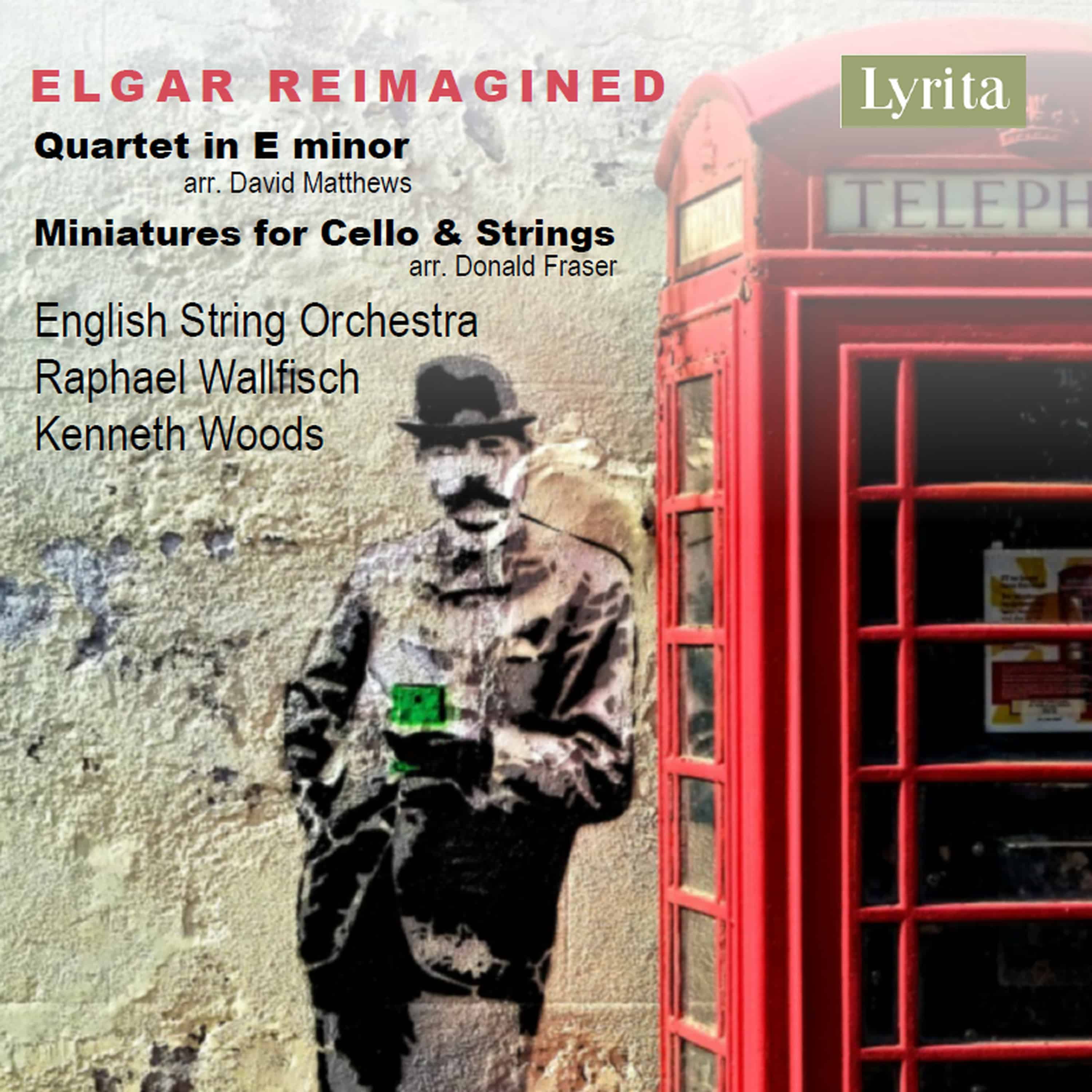
On record – Elgar Reimagined (Raphael Wallfisch, English String Orchestra / Kenneth Woods (Lyrita)

elgar-reimagined-disc

Elgar arr. Matthews String Quartet in E minor Op. 83 (1918)
Elgar arr. Fraser Miniatures for Cello and Strings: Chanson de Matin, Op.15 No. 2 (1899). Chanson de Nuit, Op.15 No. 1 (1899). The Wild Bears, Op. 1b No. 6 (1908). Nimrod, Op.36 No. 9 (1899). Romance in D minor, Op.62 (1910). Sospiri, Op.70 (1914). Mazurka, Op.10 No.1 (1899). Pleading, Op.48 (1908). In Moonlight (1904). Salut d’Amour, Op.12 (1888). Adieu (1933)

Raphael Wallfisch (cello), English Symphony Orchestra / Kenneth Woods

Producer Phil Rowlands Engineer Tim Burton

Lyrita SRCD 394 [69’27”]

Recorded 22 September and 9 October 2020 at Wyastone Concert Hall, Monmouth

Written by Richard Whitehouse

What’s the story?

This new release by the English String Orchestra focuses on Elgar, a composer championed by this ensemble throughout its 44 years of existence, whose music is given an appealing and (for the most part) instructive appraisal across the programme of arrangements featured here.

What’s the music like?

The principal work is the String Quartet in E minor, arranged by David Matthews. Second in a wartime triptych of chamber pieces, it is less introspective than the Violin Sonata preceding it but less emotionally charged than the Piano Quintet which came after, while arguably the most finely proportioned – not least in terms of the subtle transformation of thematic elements across and between its movements. In this guise, it follows on from the Serenade then Introduction and Allegro as the hitherto missing large-scale work for string orchestra of Elgar’s high maturity.

Matthews has been mindful to equate the soloistic with the ensemble potential of this music, so the result is neither straightforward transcription nor radical re-conception. The opening Allegro discreetly evokes an autumnal rumination as sets the tone for much of what follows; even finer is the central Piacevole, its main theme suffused with an intensity whose extent is only revealed at the close. If the emotional acuity of the final Allegro is marginally diffused, there is no absence of purposeful intent as the music proceeds to a coda of terse decisiveness.

The remainder of this programme comprises a sequence of Miniatures, arranged for cello and strings by Donald Fraser and played by Raphael Wallfisch. Ostensibly an 11-movement suite, its efficacy in terms of smaller groupings and even individual encores should be self-evident.

Chanson de Matin launches proceedings in mellifluous fashion, and if the cello’s assumption of the melodic line is slightly to the detriment of the original scoring, that could hardly be said of Chanson de Nuit whose sombre contours and inward character are unerringly realized. Nor does The Wild Bears lose out on vivacity, and if the arrangement conjures up Saint-Saëns, this only serves to underline the importance of ‘Second Empire’ French music on Elgar’s thinking. The cello’s dominance in Nimrod rather detracts from the subtlety of this Enigma Variation’s instrumentation – conversely, the Romance brings soloist and strings into even closer accord than the composer’s version with orchestra. The highlight here is Sospiri, which presents one of Elgar’s finest inspirations in a striking new light. Lighter fare comes in the robust tread of the Mazurka, followed by an eloquent take on the song Pleading. In Moonlight (adapted from In the South) responds well to such limpid treatment, as does Salut d’Amour in conveying its essence without cloying. A wistful take on the piano piece Adieu provides an affecting close.

Does it all work?

Very largely. The idiomatic nature of the String Quartet is enhanced by the ESO’s committed playing under Kenneth Woods, a follow-up to their recording of the Piano Quintet in Fraser’s orchestration (Avie), while Raphael Wallfisch’s conviction in the Miniatures is undoubted.

Is it recommended?

Indeed, not least as the quality of the playing is abetted by the naturalness of the sound and informativeness of annotations by Matthews and Woods. Heard together, these two parts of Elgar Reimagined make for desirable listening in this 165th year since the composer’s birth.

Listen

Buy

You can discover more about this release and make a purchase at the Lyrita website.  For more information on the artists, click on the names for Raphael Wallfisch, Kenneth Woods and the English String Orchestra – and for the arrangers, David Matthews and Donald Fraser