On record – Havergal Brian: Symphonies 3 & 17 (New Philharmonia, Royal Philharmonic Orchestra / Stanley Pope) (Heritage)

brian-heritage

Brian
Symphony No. 3 in C sharp minor (1931-2)
Symphony No. 17 (1960-61)

Ronald Stevenson, David Wilde (pianos, Symphony no.3); New Philharmonia Orchestra (Symphony no.3), Royal Philharmonic Orchestra (Symphony no.17) / Stanley Pope

Heritage Records HTGCD153 [67’26”]

Recorded 12 January 1974 and 23 June 1976 at BBC Maida Vale Studios, London

Written by Richard Whitehouse

What’s the story?

Heritage has followed its release of Charles Groves’s centenary accounts of Havergal Brian’s Gothic Symphony (Part One) and In Memoriam with this first official issue of the composer’s Third and Seventeenth Symphonies, as given in their first performances under Stanley Pope.

What’s the music like?

Although he left few commercial recordings, the London-born and Geneva-based conductor Pope (1916-95) was highly regarded in music from the 19th and 20th centuries. These studio performances are among the best premieres that Brian received, not least the Third Symphony which at almost 55 minutes is his lengthiest after the Gothic. Little is known about its genesis, but the 20-minute opening movement has a complexity and emotional breadth that suggest a suitably high-flown inspiration. Two pianos mark off crucial junctures in its formal trajectory, besides enriching the texture vis a concertante underpinning such as surges forth in the stark chordal cadenza prior to the coda. Had Brian stopped there, this would still have been among his most ambitious symphonies, and the three remaining movements afford intrigues aplenty.

The slow movement continues in similar fashion in its combining of textural audacity with a melodic immediacy (notably for flute and violin) as makes this an ideal entry-point for those new to Brian, and though its expressive ambience is by no means easy to define, a feeling of heroic fatalism comes to the fore during the climactic stages and in a coda of moving pathos. By contrast the scherzo is as direct in its appeal as anything that Brian wrote, not least a trio whose ingratiating charm provides suitable contrast with the boisterous music on either side. With its slow overall tempo, the finale builds in sonorous paragraphs – to whose Brucknerian grandeur Pope is especially attentive – toward a stormy culmination and heightened recall of earlier ideas; thence into an epilogue whose unequivocal finality is rare in Brian’s maturity.

Nearly three decades later, the Seventeenth Symphony offers a very different perspective on Brian’s creative outlook. Last in a series of five single movement such pieces, it is markedly elliptical as to formal unfolding and expressive follow-through – yet, even more than with its masterly predecessor, a continuous and metamorphic ingenuity is perceivable right from the pensive introduction then throughout the three- (or even four-) in-one sequence that follows. Confident and yet ruthless in its triumphalism, the coda is decidedly music for its ‘present’.

Does it all work?

Almost. The Third is the most inclusive of Brian’s orchestral symphonies in its intricacy of texture and (ambivalent) range of expression. Drawing four such diverse movements into a cohesive whole is no easy task, but Pope succeeds more completely than does Lionel Friend (Hyperion) and probes more fully than Adrian Leaper (Naxos) the disquieting obliquities of the Seventeenth. The playing of the New Philharmonia and Royal Philharmonic orchestras is testament to the skill of British players in tackling such complex music on limited rehearsal.

Is it recommended?

Yes. Heritage has done a fine job in opening-up the 1970s sound (the BBC’s notoriously dry Maida Vale studio) and John Pickard contributes his usual insightful notes. The 1974 account of Brian’s choral Fourth Symphony would be an ideal next candidate for such rehabilitation.

Listen

Buy

You can discover more about this release at the Heritage website, and you can read more about Havergal Brian here
Switched On – vaghy: Minimalism (Théque Records)

vaghy

reviewed by Ben Hogwood

What’s the story?

After 20 years of playing as part of a band, Hungarian pianist Tamás Vághy is striking out on his own, with little more than a piano and some electronics. His aim was to strip music back to its bare elements, and to rediscover his own art as a performer and composer.

While vaghy plays the piano for the main melodic lines, he also provides the accompaniment through a clutch of analogue synthesizers and even a heavily manipulate zither.

What’s the music like?

Minimalism is a brave title for a new album, for although in this case it means a ‘back to basics’ approach, it also forms in the listener expectations that vaghy’s style will be close to that of Steve Reich or Philip Glass.

That proves not to be the case, but not in a bad way, for this is a thoughtful and often enlightening piece of work. It is also not a straightforward piano album, thanks to vaghy’s treatment of sounds. This is immediately apparent on the opening Rush, with dampeners applied to the tones so that the piano makes a lovely, mottled sound.

vaghy writes with a good deal of movement in his music, but with a stillness at the heart of it where the listener can position themselves. The style also bears similarities to Michael Nyman’s piano work but the tones are lighter on the ear and more evocative.

As Minimalism progresses so there is increased light and shade – the former present in the airy touches of Backwash, which has a lovely rippling effect. The latter qualities are evident in the darker Tripping, with its shuffling rhythm track.

Meanwhile the likes of Lonely and Dawn Light find a special, inward-looking intimacy, while Intention has a lovely turn of phrase and some complementary effects with the Moog, which blossom to a full-bodied and powerful conclusion.

Does it all work?

Yes – Minimalism has enough craft and descriptive colour to stand out from the crowded field in solo keyboard repertoire. Its loops become strangely hypnotic and the attention to detail invested by vaghy is repaid through music of character and subtle shades of colour.

Is it recommended?

Yes. If you like keyboard players such as Nils Frahm then vaghy’s music will definitely appeal, and its subtleties will work their hypnotic touch on many a listener. This is a quiet album – and if you make space for it, the rewards are plenty.

Stream and Buy


On record – Lindberg: Aura, Marea & Related Rocks (Finnish Radio Symphony Orchestra / Hannu Lintu) (Ondine)

lindberg

Lindberg
Aura (1993-4)
Related Rocks (1997)
Marea (Tide) (1989-90)

Emil Holmström, Joonas Ahonen (pianos/keyboards), Jani Niinimäki, Jerry Piipponen (percussion) (all in Related Rocks), Finnish Radio Symphony Orchestra / Hannu Lintu

Ondine ODE1384-2 [66’59”]

Producer Laura Heikinheimo; Engineers Anna-Kaisa Kemppi, Antti Pohjola, Enno Mäemets October 2019 and bDecember 2020 at Music Centre, Helsinki

Recorded October 2019 and December 2020 (Marea) at Music Centre, Helsinki

Written by Richard Whitehouse

What’s the story?

Ondine continues its extensive coverage of Magnus Lindberg with this retrospective volume of works mainly written in the 1990s; at a time when the Finnish composer was moving away from his overtly avant-garde stance to an accommodation with the contemporary mainstream.

What’s the music like?

It was when Lindberg was writing Aura that Lutosławski died, hence the memorial dedication of a piece which represents a conscious summation of what the younger composer had striven for to that time. Its almost 40-minute duration and its division into four movements led some commentators to attribute a symphonic conception; something that the predicating of gestural over motivic continuity effectively refutes. That said, the initial section does have a feeling of exposition in its respective dynamism and stasis; ultimately arriving at a seismic unison chord from which its successor unfolds along the lines of ‘slow movement’ with an initial emphasis on the rhetorical interplay of brass and strings, followed by an evocative episode with tuned percussion and woodwind to the fore. Another unison leads to the third section, its animated motion nominally akin to a scherzo though with only a halting momentum on the way to the final section; a finale inasmuch as it takes the piece through to a threnodic conclusion, albeit with only a tangential bringing of the overall structure formally and expressively full circle.

Although the trajectory of Lindberg’s output thereafter was toward greater harmonic clarity and tonal directness, there have been numerous ‘curve balls’ – not least Related Rocks with its electronic gloss on the favourite modernist line-up of two pianos and two percussionists. Nor is there anything remotely proscriptive about one of this composer’s most effervescent and playful works (not least via a doubtless coincidental allusion at one point to the theme-tune of the 1970s snooker programme Pot Black), as retains its appeal a quarter-century on.

Finally, to Marea – central piece in an informal trilogy of works for chamber orchestra that exemplify Lindberg’s music towards the end of his first decade of creative maturity. At just 12 minutes, it might also be considered a template for those curtain-raisers often found in the composer’s recent output; though the level of incident and intricacy of texture, underpinned by an upward-striving trajectory, evinces a simplification too often replaced by superficiality once the composer arrived at an idiom lending itself gratefully to international commissions.

Does it all work?

Mainly, given Lindberg was seeking to extend his musical language onto a wider expressive canvas without veering towards the diluted idiom often informing his idiom thenceforth. No doubt that, whatever its formal issues, Aura stands among of the crucial orchestral works of its period and Hannu Lintu’s take is a worthy successor to the pioneering account from Oliver Knussen (DG). Marea summons a feisty response by the Finnish Radio Symphony Orchestra, while those keyboardists and percussionists render Related Rocks with scintillating virtuosity.

Is it recommended?

Indeed. Those who dislike the rebarbative feel of Lindberg’s early music or are unpersuaded by his latter-day output ought to find something worth engaging with in these pieces. Neither the high-impact sound nor booklet notes by Kimmo Korhonen leaves anything to be desired.

Listen

Buy

You can discover more about this release at the Ondine website. You can read more about Lindberg here. The Finnish Radio Symphony Orchestra are here, and their conductor Hannu Lintu’s website can be accessed by clicking here.

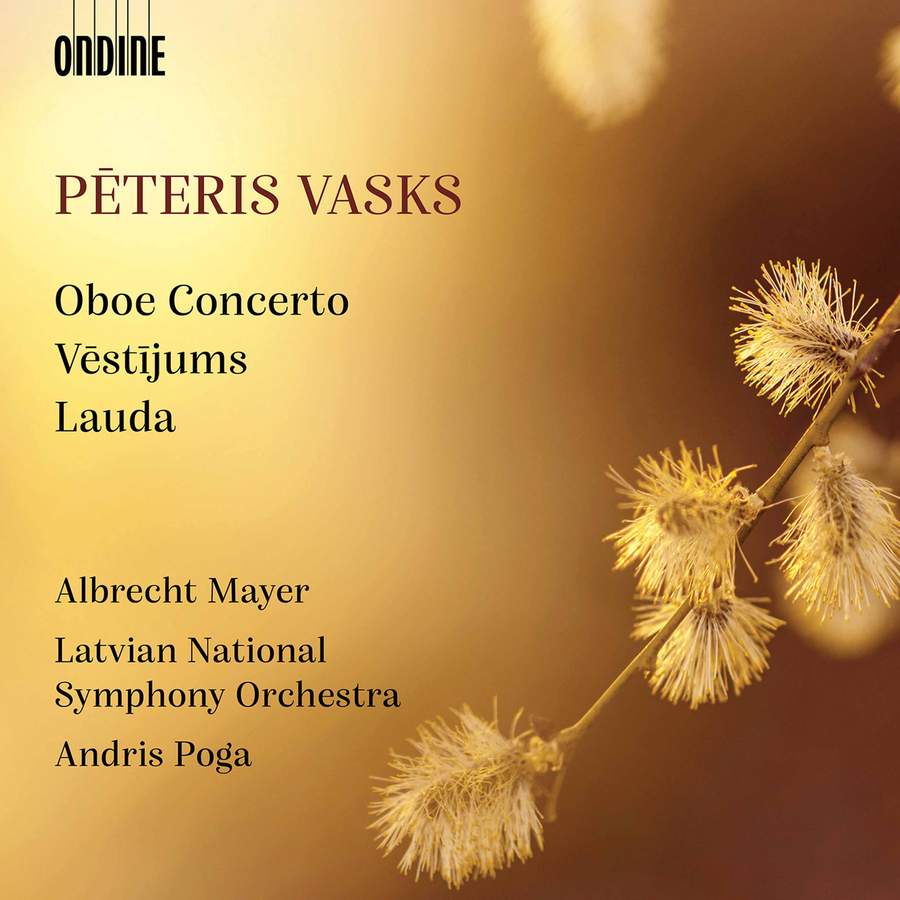
On record – Vasks: Oboe Concerto, Message & Lauda (Albrecht Mayer, Latvian National Symphony Orchestra / Andris Poga) (Ondine)

vasks-ondine

Vasks
Oboe Concerto (2018)
Message (Vēstijums) (1982)
Lauda (1985)

Albrecht Mayer (oboe), Latvian National Symphony Orchestra / Andris Poga

Ondine ODE1355-2 [68’37”]

Producer / Engineer Normunds Šnē

Recorded 16-17 and 20-21 July 2020 at Great Guild Hall, Riga

Written by Richard Whitehouse

What’s the story?

Ondine continues its coverage of Pēteris Vasks (b1946) with this release featuring his recent Oboe Concerto, alongside pieces from the 1980s, in what is a viable overview of the music of his maturity and reminder of his status as the leading Latvian composer of his generation.

What’s the music like?

Premiered in October 2018 with the performers on this recording, the Oboe Concerto is the seventh concertante work Vasks has written (his third for woodwind) and, at over 33 minutes, is on a sizable scale. Of its three movements, Morning pastorale has a preludial function in the way that the soloist emerges gently and wistfully against a discreet orchestral backdrop. This gradually builds to a climax, at whose apex the Scherzando begins with its lively interplay between soloist and orchestra – at length subsiding into a secondary ‘trio’ theme of piquant elegance. There follows an animated development, culminating (just before mid-point) in a plaintive cadenza then return to the opening music, prior to a coda of some fervency which   is held over at the start of Evening pastorale. The soloist duly comes to the fore for a calm soliloquy, building towards a forceful climax before a return to the mood of the opening and a whimsical leave-taking. A limited range of expression might leave this work seeming over-long but, with Albrecht Mayer pacing it superbly, the larger design more than sustains itself.

Of the two earlier pieces, Message – scored for two pianos, strings and percussion – reflects the impact of minimalist traits in its relatively static harmonies and rhythmic repetition, while Lutosławski (then completing his influential Third Symphony) and Górecki (then in his most overtly minimalist phase) can be detected in passages of textural freedom that afford contrast with those of expressive directness. Vasks himself comes through during the climactic stages, the music’s restrained fervour heightened on the way to a culmination of scintillating impact.

Although only his second major work for full orchestra, Lauda is typical for the way Vasks builds its cumulative structure through a dovetailing of instrumental groupings over a steady rhythmic undertow such that an inexorable momentum comes gradually, even unexpectedly to the fore. The journey is a stealthy and eventful one that draws both modal and plainchant elements into its emotional orbit; with the brass assuming dominance as the title is evoked in a resounding climax which leaves woodwind then strings musing plaintively in its wake.

Does it all work?

Yes, in the main. Whatever the stylistic variety across his output of several decades, Vasks remains a relatively self-effacing composer who never seeks to gain listeners’ attention by overly demonstrative means. His is rather an incremental and slow-burning approach which yields its musical rewards often in retrospect, as is true of the Oboe Concerto and – albeit to   a lesser degree – of those other works here. It helps that the playing of the Latvian National Symphony Orchestra, under the assured direction of Andris Poga, is so attuned to his music.

Is it recommended?

Yes, and not only to those who have already acquired previous releases from this source. The sound is up to Ondine’s usual standards in its clarity and realism, along with detailed booklet notes from Orests Silabriedis. Hopefully Vasks’s recent Sixth Quartet will be recorded soon.

Listen

Buy

You can discover more about this release at the Ondine website. You can read more about Vasks here, and click here to read more on soloist Albrecht Mayer. The Latvian National Symphony Orchestra are here, while conductor Andris Poga’s website can be accessed by clicking here.

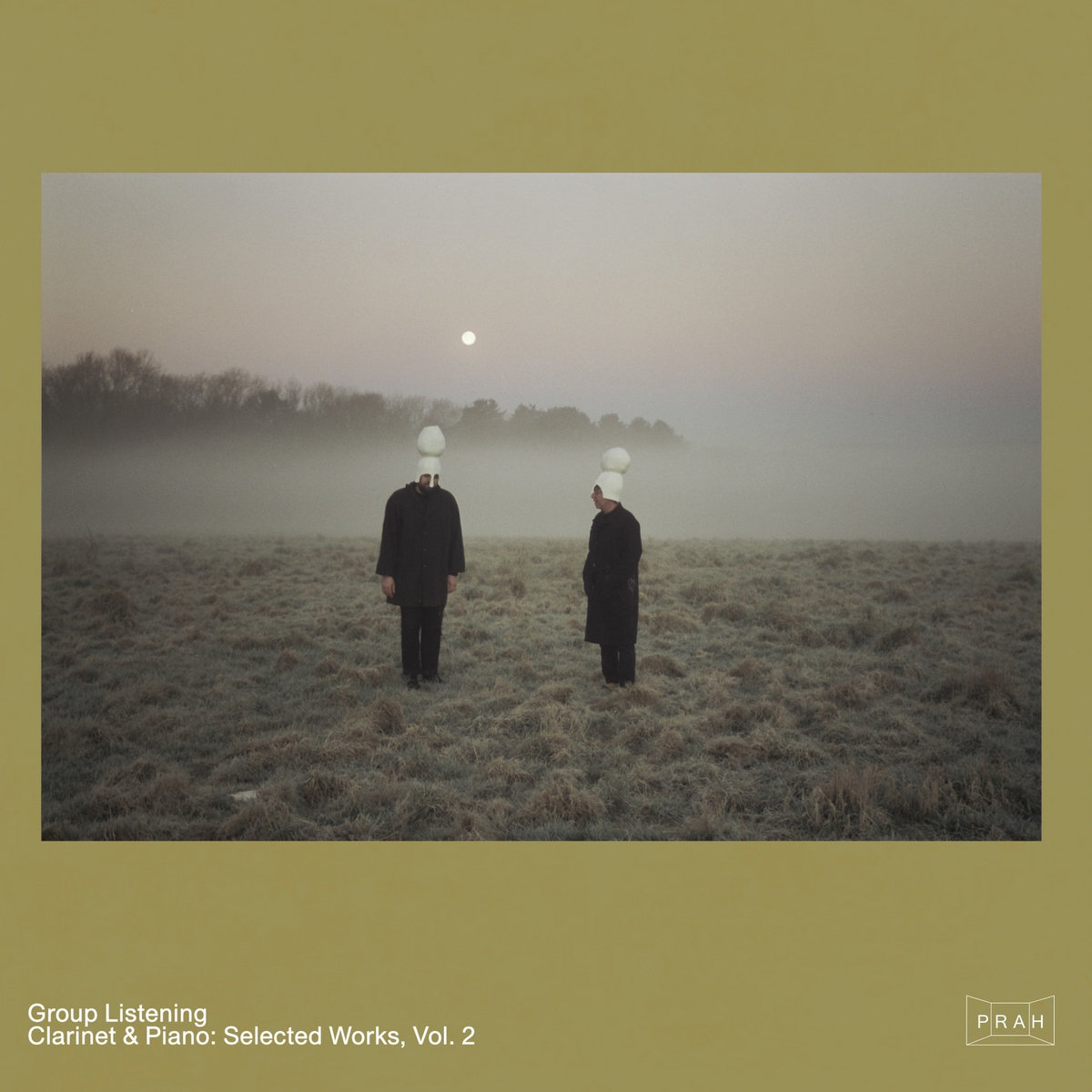
On Record – Group Listening: Clarinet & Piano: Selected Works, Vol. 2 (PRAH Recordings)

group-listening

reviewed by Ben Hogwood

What’s the story?

The first Group Listening album was such a success that clarinettist Stephen Black and pianist Paul Jones have returned for a second instalment. The project celebrates their favourite music – a wide range of electronica, Krautrock and dance-infused classics – by rearranging it for clarinet and piano, with a few electronic twists on the side.

In the course of their work the pair can bring new life to tracks we all thought we knew.

What’s the music like?

Rather special. Both performers play with a great deal of expression, really bringing the music to life and highlighting parts we hadn’t reckoned with before. They are clever with their arrangements, too, giving the melodic lead to the piano on occasion. Robbie Basho’s Blue Crystal Fire is one such example, where Black explores the throaty lower end of the clarinet register while Jones’ piano spins out the tune.

Much of the music is bright and positive, and the first track – a spacious arrangement of Beverly Glenn-Copeland’s Sunset Village – sets the mood perfectly. The appearance of the theme to the 1970s kids tv show Camberwick Green is a humourous shock, joyfully played by both performers, before we hear a radical reworking of Laraaji’s All Of A Sudden. This is where a few risks can go a long way, in this case with the help of a one-touch keyboard rhythm effect.

The Group Listening cover of Malcolm Neon’s Y Cwsg is playful, while Hollywood Dream Trip – originally by Syrinx – is expansive. The original work Five Hundred Miles is unexpectedly poignant, eavesdropping on phone conversations and messages while the instruments work softly voiced conversations of their own. The steady ticking of Seeland has a similar, meditative effect.

Does it all work?

It does – like looking at familiar pictures from unexpected angles and discovering more about them. What really comes across is the love these two musicians have for the music they have arranged and played.

Is it recommended?

Yes. This set of selected works is a blend of cover and remix, throwing new light on music that is revealed to have more dimensions with every listen. A subtly joyous experience.

Stream

 Buy