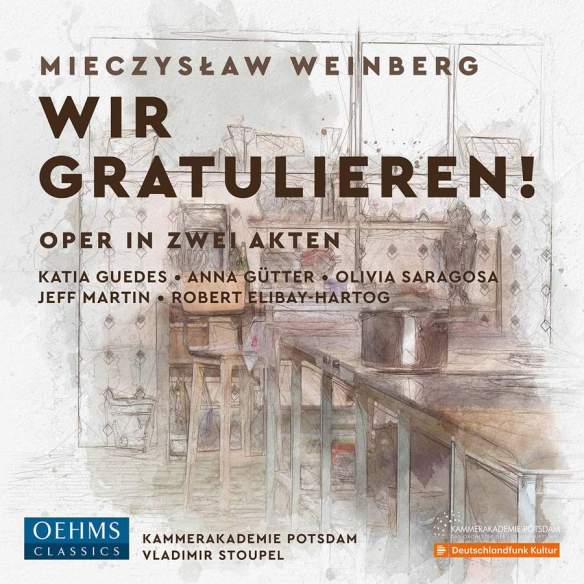
On record: Weinberg: Wir Gratulieren! (Congratulations!) – Vladimir Stoupel (Oehms Classics)

Weinberg arr. Henry Koch
Wir Gratulieren! (Congratulations! orig. Mazl tov!) Op.111 (1975)

Beylya – Olivia Saragosa (contralto), Reb Alter – Jeff Martin (tenor) Khaim – Robert Elibay-Hartog (baritone) Fradl – Anna Gütter (soprano) Madame – Katia Guedes (soprano), Kammerakademie Potsdam / Vladimir Stoupel

Producer Hein Laabs Engineer Henri Thaon
Recorded 23 September 2012, Werner-Otto-Saal, Konzerthaus, Berlin

Oehms Classics OC990 [two discs, 80’23”]

Reviewed by Richard Whitehouse

What’s the story?

Oehms Classics issues this first recording of a one-act opera by Mieczysław Weinberg, taken from a live performance in Berlin to the German translation by Ulrike Patow, as adapted by the composer from the drama by Sholom Aleichem (indirectly of Fiddler on the Roof fame).

What’s the music like?

Those having heard Weinberg’s first opera, the powerfully dramatic The Passenger (Neos or ArtHaus), or his last, the darkly inward The Idiot (Pan Classics) will find Mazl tov! something different again.

By the mid-1970s, the composer felt able to pen an intrinsically Jewish opera with recourse to the song and dance idioms familiar from the Yiddish theatre of his Warsaw youth, and a decidedly sardonic tone not far removed from the interwar stage works of Weill or Eisler. Any risk of provoking Soviet officialdom was offset by a vein of Socialist optimism in the ‘masters versus servants’ scenario, culminating in a ‘things will be different’ outcome. Divided into two acts (55 and 25 minutes), the narrative allows for incremental though subtle development of the four protagonists as they move as if pre-destined to their double wedding.

Does it all work?

Yes, inasmuch that this music, played in an adept reduction for chamber orchestra by Henry Koch, is itself characterful as well as ideally suited to the domestic tragicomedy at hand. Each of the four main singers is allotted their share of the limelight, without these soliloquys either detracting from or impeding the onward flow of the drama, and those familiar with Weinberg will detect various motifs or phrases that re-emerge in the symphonies and string quartets he was to write across the next decade – making for a work as central to his output as any other.

As to the cast, Olivia Saragosa brings no mean pathos to the cook Beylya, recently widowed and in thrall to an ungrateful mistress, while Jeff Martin evinces humour and no little stealth as Reb Alter, the travelling bookseller whose radical thinking motivates all those around him. Robert Elibay-Hartog is no less persuasive in the role of Khaim, servant from a neighbouring estate whose charm and panache gradually win over the maid Fradl, whose initial monologue summons the most affecting music of the entire opera and who arguably emerges as the most liberated by the close. Katia Guedes is equally arresting as Madame, her cameo appearances galvanizing the drama not least in the final scene as she is faced down by her moral superiors. Note that Weinberg’s alternative, more expressively ambivalent ending is used at this point.

Is it recommended?

Indeed. Vladimir Stoupel secures a vibrant response from the musicians of Kammerakademie Potsdam, heard to advantage within the confines of the chamber hall at Berlin’s Konzerthaus, even if those demands of a live performance mean balance with the singers is not consistent. The booklet is attractively produced with full artist biographies and production sketches, but Arno Lücker’s introductory note is only adequate and the German-only libretto has numerous entries printed under the wrong singer. An English translation is available online (see below).

Hopefully, an alternative recording or production of Mazl tov! – preferably with the original orchestration and in Russian – will emerge in due course. For now, however, this lively and capable production should engage and amuse listeners as audibly as it did its Berlin audience.

Listen

Buy

For further information, audio clips and purchase information visit the Presto website

On Record – Rick Wakeman & The English Rock Ensemble: The Red Planet (Snapper)

reviewed by Ben Hogwood

What’s the story?

The Red Planet marks a much-heralded return to progressive rock for Rick Wakeman. The prolific keyboard player and composer has been working on the album for a good while, having been captivated by the three missions currently in progress from Earth to Mars, not to mention some of the pictures received by NASA.

Wakeman, who has made three albums previously about the universe beyond Earth’s orbit, has enlisted the talents of three prodigious talents – guitarist Dave Colquhoun, bassist Lee Pomeroy and drummer Ash Soan. The English Rock Ensemble, as they are known, are given equal billing with the keyboard player.

What’s the music like?

Some of Wakeman’s strongest in years. There is a great deal of passion and imagination here, with Wakeman’s characteristically brilliant keyboard work more than matched by his protagonists and friends. It is important to recognise the connection of personalities, because as Rick told Arcana in an extensive interview, their creative spirit and comradeship were big elements of The Red Planet’s success.

The album works really well because of a really good balance between excess and restraint! The familiar strengths of progressive rock are exploited in prodigious drum fills, creative keyboard solos, twisted bass lines and epic guitar work, but each of the four musicians knows when to pull back and concentrate on evocative scene-setting. The latter quality means the likes of Arsia Mons and The North Plain, both portraits of their respective areas on Mars, are more descriptive and have the necessary light and shade.

As Wakeman admits, a lot of fun was had with the making of this album, and it comes through right from the off, and the imposing church organ of Ascraeus Mons. Meanwhile in the final and most extensive picture, Valles Marineris, the spirit of Holst is channeled through the oblique rhythms and stabbing counterpoint.

Between the two imposing outposts there is much good music. The descriptive Tharsis Tholus has attractive flute voicing, while Arsia Mons has one of the album’s most memorable riffs, not to mention superb drumming from Soan. Wakeman himself comes right to the fore on Olympus Mons, with some typically probing keyboard athletics near the end, while he leads with a soaring synthesizer on Pavonis Mons. Meanwhile a wonderfully gritty keyboard sound takes over on The North Plain, shaking off the mysterious, ghostly piano of its opening strains.

Does it all work?

Yes. Anyone with an interest in Wakeman or his on / off band Yes will recognise the keyboard style but will also applaud the attention to detail and relative restraint shown in the course of this hour-long triumph.

Is it recommended?

Yes, as a thoroughly enjoyable album. Anyone with an interest in progressive rock will want to hear it – but happily The Red Planet gives us the notion of getting away from our own habitat for a while, which I’m sure we’ve all fantasized about in the last few months!

Stream

Buy

You can buy The Red Planet from Rick Wakeman’s website here

Switched On – Fhloston Paradigm: Right Where You Are (Cosmic Lounge Music)

reviewed by Ben Hogwood

What’s the story?

Floston Paradigm is one of the many aliases for King Britt, and has been active since 2012. The celebrated Philadelphia musician and producer describes it in his Bandcamp biography as ‘is a manifestation of afro-futurist ideals, based in an electronic music landscape. The purpose is to transmit the omni-versal message of divine abstractions into aural pleasing tones’.

The time would seem right for its revival, and this new four track album was released to coincide with Bandcamp’s day of sharing their royalties with artists. Dedicated to ‘a world of peace, love and equality for all’, the music is designed to think along the same lines as the blue sky and heady clouds of the cover.

Whether that can be achieved in real life, of course, is another matter – but it is a reminder of the hugely important part music continues to play as the Coronavirus pandemic shows no sign of letting up.

What’s the music like?

Not surprisingly, very relaxing indeed. King Britt has all the assurance of an experienced hand in this repertoire, and the four tracks between them make an extremely calming whole lasting just under an hour.

There is no rush to go anywhere, and as the 22-minute opening track Friday Sombers develops we fall slowly under the spell of its bubbling bass part and slow moving treble lines, which occasionally glint at the edges as though caught by a particularly intense ray of sun. There are little acidic synthesizer sounds that flicker around the picture, like the embers of a fire, while the harmony remains grounded to an omnipresent pitch centre of C. Gradually the track breaks up, like those embers on the fire, until we are left with fragments of indistinct melody.

Mercury’s Portal returns to the same pitch centre with pure tones, birdsong and what sounds like footsteps crunching leaves and / or snow. The pure tones soon give way to a probing piano line, but the textures remain full of light until broader and more jagged tones make themselves known. Now the shadows lengthen, but the music remains airy.

A Moment For Self is more propulsive, with broad strokes around the edges while a more probing synth line forces its way through in mid-range. Again the musical breaths are long, as they are in the final ReBalancing The Theory, which starts with rain and a watery, sustained loop. This is more mellow, the music sinking back to earth gradually, where it becomes more noise-based and fades to the distance.

Does it all work?

Yes – because all of it is just the one track, and with absolutely no hurry or pressure King Britt creates the safest of musical spaces. It is one the listener can completely give over to, or they can apply a more critical ear and appreciate the subtle movements and texture changes. Either way it works well.

Is it recommended?

Yes. From personal experience Right Where We Are achieves exactly what its maker wanted – bringing the listener to a ‘place of center’. If only it could do the same to all those causing friction on the planet at the moment!

Stream and Buy

On record: Bruch: Symphonies & Overtures – Bamberger Symphoniker / Robert Trevino (CPO)

Max Bruch
Symphony no.1 in E flat major Op.28 (1868)
Symphony no.2 in F minor Op.36 (1870)
Symphony no.3 in E major Op.51 (1882)
Lorely Op.16 – Overture (1863)
Hermione Op.40 – Prelude (ed. Jacob); Funeral March; Entr’acte (1871)
Odysseus, Op. 41 – Prelude (1872)

Bamberger Symphoniker / Robert Trevino

Producers Torsten Schreier, Michaela Wiesbeck
Engineers Christian Jaeger, Markus Spatz
Recorded 2-5 January & 8-12 July 2019, Joseph-Keilberth-Saal, Konzerthalle, Bamberg

CPO 555252-2 [two discs, 149’04”]

Reviewed by Richard Whitehouse

What’s the story?

CPO continues its coverage of Max Bruch with his complete symphonies, finely rendered by the Bamberg Symphony Orchestra and conducted by Robert Trevino with the same insight and perception he brought to his recent Malmö traversal of Beethoven symphonies (Ondine).

What’s the music like?

Seldom encountered in the concert hall, Bruch’s symphonies have been recorded frequently these past three decades – with cycles from such conductors as Kurt Masur (Philips/Decca), James Conlon (EMI/Warner) or Richard Hickox (Chandos) and at least three others. Trevino is at least the equal of any, not least because the playing from his Bamberg forces has all the warmth and eloquence this taciturn music requires; with the acoustic of the Joseph Keilberth Room affording clarity and definition in Bruch’s often densely layered orchestral textures.

This recording of the First Symphony is the first to restore the Intermezzo that Bruch placed second in what was originally a five-movement structure. Here its wistful charm offers subtle contrast between the slow-burning momentum of the opening Allegro and Mendelssohnian impetus of the Scherzo. The sombre grandeur of the Quasi Fantasia functions as extended introduction to the Finale – its vaunting energy featuring what must be the nearest in any of these works to a ‘catchy tune’, on the way to a coda whose affirmation is equally uninhibited.

It may be much less approachable, but the Second Symphony is undoubtedly the finest of this cycle. Formally innovative, too, in that its three movements – each of them moderately paced and gradually cumulative – builds from salient motifs all derived from a ‘motto’ idea stated at the outset and which duly returns to crown the finale. Coolly received at its premiere and then accorded only grudging respect, this remains a highpoint of Bruch’s output as also of German mid-Romanticism, and Trevino does full justice to its deep-seated logic and cumulative power.

Bruch evidently conceived his symphonies as a triptych, but he laboured over completing his Third Symphony – by which time, the first two of Brahms’s cycle had shifted the symphonic goalposts irrevocably. That said, the restrained initial movement has a delightful insouciance, while the Adagio evinces a ruminative poise worthy of Dvořák. The bustling Scherzo (better placed second) feels a little too generic, however, while the short-winded Finale hardly rises above the routine. Bruch thereafter essayed concertos and suites, but no further symphonies.

Does it all work?

Yes, allowing Bruch was very much a product of that century between the Napoleonic and First World wars when cultural, as opposed to societal change was incremental rather than radical. Excerpts from his operas Loreley and Hermione (the latter’s Prelude disfigured by Wolfgang Jacob’s crude ‘concert ending’) and his oratorio Odysseus fill-out the picture of a composer who, if his innate conservatism may have been wielded increasingly out of spite rather than conviction, wrote appealing music which did not lack for integrity of purpose.

Is it recommended?

Indeed. Those who have heard Ray Chen’s engaging account of the First Violin Concerto (Decca) will be aware of Trevino’s identity with this music and so it proves here, in what is a welcome addition to Bruch’s discography as the centenary of his death fast approaches.

Listen

Buy

For further information, audio clips and purchase information visit the Presto website

Switched On – Peter Broderick: Blackberry (Erased Tapes)

reviewed by Ben Hogwood

What’s the story?

This is a surprise release from Peter Broderick, the Oregon multi-instrumentalist giving us his first vocal album in five years, since Colours of the Night in 2015. The release will not be as much of a surprise to Broderick’s followers, however, as they are used to his prodigious output on several musical levels. While more recently he has been lending violin to Tim Burgess‘ band, Broderick still finds the time to write his own classically-infused music and the sort of song-based material we find here.

The whole of Blackberry was recorded in Broderick’s home in south east London, an environmentally friendly album in concept and execution.

What’s the music like?

Subtle, meaningful, light-hearted and affecting. Broderick recognises the need of listeners to have something consoling in the times in which we find ourselves, but he offers a few witticisms along the way. Stop And Listen and But are both quirky songs littered with wordplay and wry observations, Broderick’s sonorous voice working well with the humour.

As the album progresses however so the music becomes more deeply affecting – and the thread of environmental awareness, which runs through the album, comes more to the front. Blackberry itself is a celebration of foraging, and is really nicely done, while the wordplay on The Niece is clever. Broderick’s voice has folk music inflections without directly using traditional source material.

The soft but compelling storytelling of What’s Wrong With A Straight Up Love Song leaves its understated mark, Broderick working really well with a longer structure of nine minutes on the album’s centrepiece. The soft brushstrokes of Let It Go are lovely, as are the autumnal strings on What Happened To Your Heart.

Does it all work?

Yes. The humour in the opening songs might not strike a chord with everyone but it is an essential part of Broderick’s carefree style, and works really well. His skill in orchestration and songwriting, meanwhile, comes through at every opportunity.

Is it recommended?

Definitely. Seasoned collectors of Peter Broderick’s music will be used to spending a bit of money to keep up with his prolific output, but that’s because they will argue the outlay reaps musical dividends. That is very much the case once again.

Stream

Buy