Let’s Dance – Various Artists: The Ladies of Too Slow To Disco Vol.2 (How Do You Are?)

Various Artists – The Ladies of Too Slow To Disco Vol.2 (How Do You Are?)

reviewed by Ben Hogwood

What’s the story?

First, an explanation. If you are understandably wondering how something called Too Slow To Disco is put under the ‘Let’s Dance’ banner, then let me try to justify! For six years now, DJ Supermarkt has been making annual compilations of West Coast pop music, mostly from the 1970s, under the Too Slow To Disco label. In doing so he has anticipated the revival of so-called ‘yacht rock’, assembling a mixture of well-known and little-known names under the banner.

The compilations are well-planned and are on the slow side…but they could definitely be experienced in a club environment, or by the pool – hence their inclusion under Let’s Dance. And let’s face it, this is very high quality, song-based chill out music.

What’s the music like?

The first Ladies of Too Slow To Disco gained a lot of interest, with a Guardian piece exploring where some of its singers are now, and the second hits the same sweet spot. The songs are drawn from 1974-1982, and on this volume DJ Supermarkt looks to strike out further in the directions of soul, gospel and jazz.

The journey is a successful one, on the way enjoying the very smooth grooves of Marti Caine‘s Love The Way You Love Me, which if anything is ‘out-slinked’ by Diane Tell‘s Mon Ami-E. Linda Tillery sings beautifully of how she would ‘like to get to know you in a special kind of womanly way’, while Martee Lebous raises positive thoughts on the rather lovely For David. Lulu makes an appearance too, with the slow but very smooth funk of I Love To Boogie.

Each of these songs tells a story, and most of them have accomplished arrangements, such as the subtle brass colouring applied to Nicolette Larson‘s Baby, Don’t You Do It, while there is a good deal of funk around too – the best saved for the star of the show, Elkie BrooksThe Rising Cost Of Love.

Does it all work?

Yes. Anyone following this series will know the amount of work that goes in to digging out the tracks, but arranging them in the most coherent order is also a skill that DJ Supermarkt has in abundance. Not a hair is out of place here!

Is it recommended?

Yes. For breeezy sounds in the heat of the summer Too Slow To Disco has prove to be a series that is hard to equal, and for poolside holiday listening it has no equal. The ladies on this instalment fit seamlessly into an increasingly long list of excellent (and educational) compilations!

Stream

Buy

Switched On – Julianna Barwick: Healing Is A Miracle (Ninja Tune)

reviewed by Ben Hogwood

What’s the story?

Julianna Barwick has enjoyed a near-constant stream of productivity in the last decade, but for many reasons Healing Is A Miracle feels like a defining moment. Apart from being her first album for the Ninja Tune family it marks the point where, after 16 years, she moves from East Coast to West, from New York to Los Angeles.

The title is a reference to the ability of the human body to recover itself after sustaining damage, Barwick marvelling at the way cuts and bruises heal themselves – and it appears to be a metaphor for the next stage of her life too. The recording methodology was also different, using monitors instead of headphones for the first time, which proved a revelation.

Healing Is A Miracle includes three collaborations, each with a close friend.

What’s the music like?

Barwick makes some of the most emotive ambient music you can imagine. While some producers opt for the distanced approach, allowing their music all the room it needs to operate away from human contact, Healing Is A Miracle offers further evidence of a rare ability to make ambient music right from the heart.

Despite the intimacy she achieves with the vocal material in particular, her studies in reverberation have resulted in enormous, cathedral-like textures. Inspirit, the first track on the album, is a softly recurring chant but with a big, surrounding echo, and when Barwick adds the bass sounds to the mix the music stops you in your tracks with its heart stopping beauty.

The collaborations are really nicely judged. Jónsi’s voice works in close harmony with Barwick on In Light, the Sigur Rós vocalist just below the melody but closely matched, before the big beats open the music outwards, seemingly toward the stars. Oh, Memory has a greater delicacy in the company of Mary Lattimore, its weightless vocals hanging on the wind, while Nod, with Nosaj Thing, builds layers on a breathy loop before adding beats, after which it pans out again to a consoling coda.

The title track has long, sustained keyboard sounds that hang on just a bit longer than the vocals, giving an even greater feeling of space. Flowers has striking sonorities, scaling mountainous heights but with an earthbound bass presence too, which grows to take over the track completely.

Does it all work?

Yes. With Julianna Barwick the listener really does inhabit a whole new world, and if escapism or mental clarity is what you are searching for then you have definitely come to the right place.

Is it recommended?

Wholeheartedly. Even within the output of one of the most consistent ambient artists, Healing Is A Miracle is a touchstone, an album where everything falls into its natural place. For an emotive out of body experience, you would really struggle to do better.

Stream

Buy

On Record – Dan Michaelson: Colourfield (Village Green Recordings)

reviewed by Ben Hogwood

What’s the story?

Dan Michaelson is known principally for his work as a respected Americana singer, with five albums to his name with the Coastguards, and two as a solo artist. More recently, however, his explorations have taken him towards descriptive instrumental music, with a soundtrack for the film Blowin’ Up in 2018, not to mention three seasons’ worth of music for the three series of underground TV hit Detectorists.

Working under a self-confessed influence from the music of John Adams, Steve Reich, Anna Thorvaldsdottir and Caroline Shaw, Michaelson started work on his own solo album of instrumental music, collaborating with violinist Galya Bisengalieva and Robert Ames, the violist who also conducts the London Contemporary Orchestra.

What’s the music like?

Very accomplished. Michaelson takes the name checked influences and works them really well, creating his own pictures that evolve slowly but very surely. The woodwind and piano colouring in Colourfield II is reminiscent – in a wholly good way – of Steve Reich’s work in his Variations for winds, strings and keyboards.

Coulourfield III has the most memorable theme, a suitably heroic horn line, while by contrast Colourfield IV has lovely dappled shades, with stately strings that gradually pick up more energy. Colourfield IV is atmospheric too, with shimmering harmonics and tremolo, a strong sense of the wood on these stringed instruments actually creaking.

Michaelson is equally at home in smaller and larger structures – and the second and fifth pieces extend beyond ten minutes with ease and control.

Does it all work?

Largely. Michaelson creates some vivid pictures but just on occasion the feeling persists that more melodic elements would raise the profile of the music. The textures are undeniably beautiful, as are the harmonic progressions, but it sometimes needs an extra line, such as a vocal or solo instrument, to elevate it to something truly memorable.

Is it recommended?

Yes. Even with the melodic reservation taken into account, there is some beautiful music here which really holds its own on repeated listening. Michaelson’s scoring is ideally weighted, and any of these numbers would be the ideal foil for visual material. It will be interesting to see where he goes from here.

Stream

Buy

Switched On – Laurence Pike: Prophecy (The Leaf Label)

reviewed by Ben Hogwood

What’s the story?

Laurence Pike is on the crest of a creative wave. After an impressive output as drummer with PVT, he has joined forces with Luke Abbott and Jack Wyllie of Portico Quartet as Szun Waves, releasing their self-titled debut in 2016. Since then he has reeled off three albums as a solo artist, and Prophecy, his latest, shows his love for instinctive working continues.

The record is his response to the deepening global climate emergency but in particular hones in on the destructive wildfires wreaking havoc across Australia. The cover art, Goldens by Australian artist Gemma Smith, reflects his concerns in a striking image.

What’s the music like?

Instinctive. Pike works a very effective blend of pre-prepared material and improvisation, striking a balance between the two that feels just right.

He has close attention to detail with the brushstrokes of his percussive work matching up to broader musical sequences. Death Of Science bubbles with tension, creating quite a foreboding atmosphere. Ember is evocative, with a slightly distorted vocal and a distant but reassuring piano. The title track has a nice ambient backdrop while percussion clicks and whirs around.

New Normal is eerie both musically and in the fact its title was coined before the Covid pandemic, and it features clicks and brushes with a soft but insistent harpsichord motif.
Nocturnal noises continue into Born Under Saturn but with a softly voiced backdrop, before the musical camera pans out further on Rapture, the higher pitches suggesting we have taken to the air.

Pike’s use of percussion is never less than interesting but frequently sets vivid nocturnal pictures. Arguably the best is saved for last, with Echoes Of Earth underpinned by a steady but very sonorous chime, creating a rather beautiful epilogue.

Does it all work?

Yes. Pike’s uses the army of percussion at his disposal with a painter’s touch, and his brush strokes are commendably subtle at times. The way he combines the percussion instruments with subtle melodic loops or atmospheres is very effective, and the album works well both on headphones and surround sound.

Is it recommended?

Very much so. Laurence Pike’s work goes from strength to strength, and this particular episode is both effective and deeply felt.

Stream

Buy

Switched On – Rival Consoles: Articulation (Erased Tapes)

reviewed by Ben Hogwood

What’s the story?

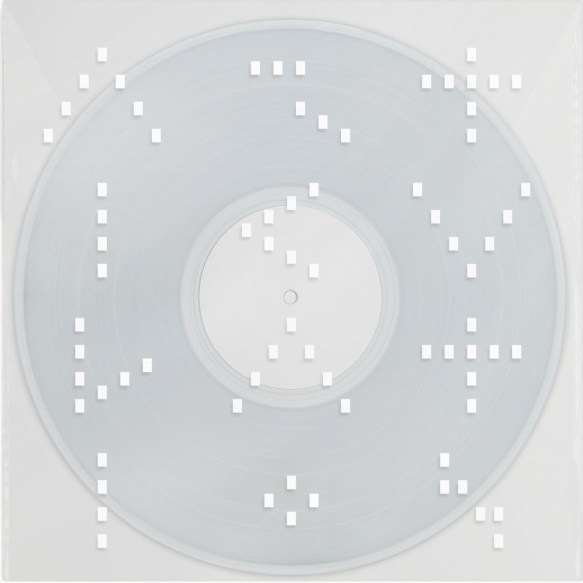
Articulation is the fifth album for Erased Tapes from Rival Consoles, the name under which Ryan Lee West releases much of his music. The inspiration for this album is György Ligeti, not in an explicitly musical sense but in the art of making music from a graphic score. The idea behind this was to get away from the computer and start with patterns, shapes or structures drawn by hand. This would generate musical solutions. Two of the initial scores sketched out by West are shown below:


Articulation


Sudden Awareness of Now

What’s the music like?

Articulation has less obviously musical content than its predecessor Persona. There are admirable and often striking sounds and textures achieved through this music, which often creates powerful pictures and atmospherics. Yet while the chord progressions are strong there is not so much of a melodic strength in depth.

Opening track Vibrations On A String is a study in tonal colour, moving between distortion and a more consonant sound until a forthright beat kicks in. There is a tension between the energy of the beats and the slow four-note progression of the string itself.

Forwardism and Articulation follow similar paths, with relatively minimal means. The former strips back to beats and jagged atmospherics, while the latter takes a more active broken beat and spins threads around it. Melodica is much warmer, the beats retreating and the music panning out a little, the approach allowing for more improvisation, while Still Here resembles an extended peal of mid-range electronic bells, delivered without beats.

Most impressive and enduring is the final Sudden Awareness of Now. With a dazzling array of textures applied to its central riff it crackles with energy, sending out trance-like pulses but surrounded by a warm haze of sound.

Does it all work?

Yes, in terms of conforming to West’s blueprint, but the shift away from computer towards drawings has not necessarily given the music more emotion. If anything, it sounds more processed, a collection of sounds rather than melodies. It is very effective for mood-setting and creating colours but does not always leave a lasting impression.

Is it recommended?

Articulation is an easy recommendation for Rival Consoles devotees, but it does not yet come across as his strongest album. Time will tell if it has the same staying power as other Erased Tapes releases, but for now Articulation is easier to admire than an album with which to form a strong emotional bond.

Stream

Buy