Online concert – Members of Klangforum Wien @ Agrigento 2025 – Jorge E. López: String Quartet

by Richard Whitehouse

Members of Klangforum Wien ([Annette Bik and Judith Fliedl (violins), Paul Beckett (viola), Andreas Lindenbaum (cello)]

Long synonymous with the Valley of the Temples, among the glories of Classical civilization, Agrigento is a city of the present and not least with Teatro dell’Efebo – a venue appropriate to a programme such as Symposion, presented by Klangforum Wien as part of Agrigento 2025.

According to Klangforum’s website, ‘‘The Symposion project takes up the theme of cultural intoxication which goes back to antiquity. This ancient social practice has inspired an evening with music of our time, perceived in the slowly changing conditions of collective and relaxed inebriation…’’. The actual programme was highly wide-ranging as to content and aesthetic (a full listing can be accessed via the link below), taking in pieces by European composers from the mid- or later twentieth century and concluding with Terry Riley’s (over?) influential In C.

Before that, however, came a second hearing (following its premiere in Salzburg last January by the Oesterreichisches Ensemble für Neue Musik) of the String Quartet by Jorge E. López. Written during the winter of 2022-23, this piece follows on from his radiophonic composition Im Innersten: János Bolyai stirbt (previously reviewed on Arcana) while drawing on elements from his Fifth Symphony which, completed in 2023 after a five-year gestation, still awaits its first performance. Each of the Quartet’s two movements duly picks up on elements from either of those in the larger work, though this is not a case of reworking or even paraphrasing earlier material but rather the oblique evoking of it in terms of that creative application of Surrealism which has proved a mainstay of López’s compositional ethos throughout the past half century.

The first movement is prefaced by the title ‘‘Wie man wird, was man is’’ (How one becomes, what one is), which the composer feels appropriate for music that pivots constantly and with increasing desperation between rhetorical aggression and a wrenching eloquence – its motivic elements altering constantly though with a tangible sense of evolution as dynamic as it seems unpredictable. Towards its close this process mutates into a more sustained expression which might have become a ‘slow movement’, had it not opted to close in a becalmed ambivalence.

Barely a third of its predecessor’s length, the second movement is prefaced by the title ‘‘Was denach kommt’’ (What then follows) and picks up on a lengthy fugato such as rounds off the corresponding movement of the composer’s Fifth Symphony. Its musical subject is none other than the nursery rhyme Three Blind Mice – source for orchestral works by Joseph Holbrooke and Havergal Brian – which here unfolds erratically while never haphazardly across the four instruments and on to an unequivocal conclusion the more affecting through its very inanity.

This account from the members of Klangforum Wien was as impressive as it was committed, evidently subtler and more sombre than that by OENM in Salzburg but with an undeniable grasp of the oblique yet always vital logic which is a hallmark of López’s music in ensuring its fascination and overall conviction. One hopes more performances will follow (the highly regarded Chaos Quartet of Vienna has expressed interest) and that the composer, who has recently finished his Variations for Orchestra, will embark on a successor before too long.

Published post no.2,545 – Monday 26 May 2025
Online concert – ESO Digital: Steve Elcock – Wreck

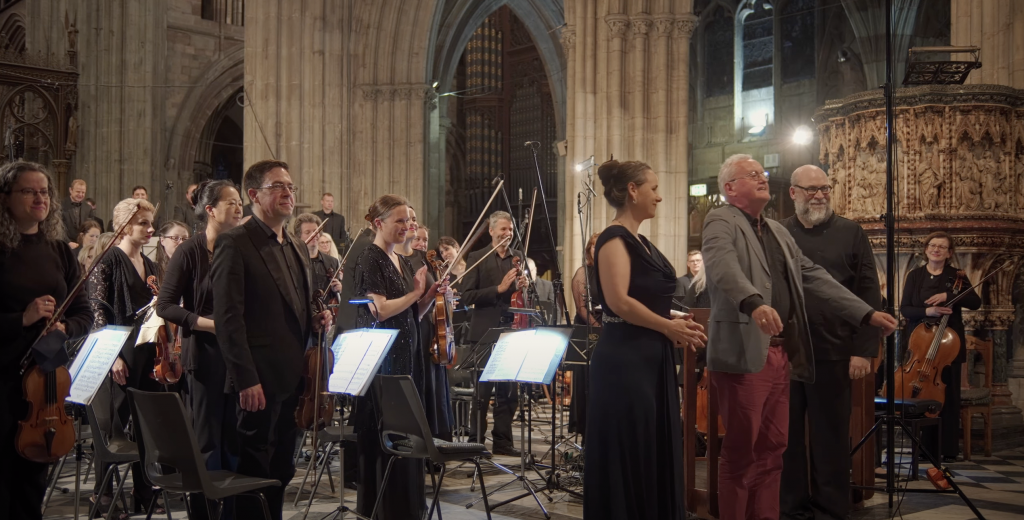
The latest addition to ESO Digital, the online concert arm of the English Symphony Orchestra, is the world premiere performance of Wreck, the orchestral piece by Steve Elcock.

This is the concert Arcana’s Richard Whitehouse saw at the 2022 Elgar Festival, at the Malvern Theatres in Great Malvern. You can read his review here.

Described by its composer as ‘‘a message of salvation beyond despair, of consolation beyond grief’’, Wreck is performed by mezzo-soprano Kathryn Rudge, with the English Symphony Orchestra conducted by Kenneth Woods. Click here to go to the ESO website and watch the performance.

Published post no.2,416 – Monday 18 January 2025

World Violin Day – Glazunov Violin Concerto

As today is World Violin Day, here is a suitable piece to take us into the weekend! Hilary Hahn and the WDR Sinfonieorchester Köln under Semyon Bychkov oblige…

Published post no.2,392 – Friday 13 December 2024

In concert – Steven Isserlis and Friends – Fauré at the Wigmore Hall (5)

Steven Isserlis (cello) – with Joshua Bell, Irène Duval (violins), Blythe Teh Engstroem (viola), Connie Shih, Jeremy Denk (pianos)

Fauré Dolly Suite Op.56 (1894-6)
Enescu Pièce sur le nom de Fauré (1922)
Ravel arr. Garban Berceuse sur le nom de Garbriel Fauré M74 (1922)
Koechlin Hommage à Gabriel Fauré Op.73bis (1922)
Fauré Cello Sonata no.2 in G minor Op.117 (1921)
Fauré String Quartet in E minor Op.121 (1923-4)

Wigmore Hall, London
Tuesday 5 November 2024

Reviewed by Richard Whitehouse Picture (c) Wigmore Hall Trust

So to the final concert of this series, curated by cellist Steven Isserlis and centred on Fauré’s larger chamber works in the centenary of his death. The last of five concerts was rounded out in its coverage by including his most popular work for piano duet, along with miniatures from several pupils of one who was held in equal esteem as a teacher.

It is doubtless as easy to describe the Dolly Suite with patronizing charm as it is to play it so but, with Jeremy Denk and Connie Shih an alert if always sensitive partnership, there was no likelihood of this latter. A limpid take on the evergreen Berceuse was followed by no less a deft rendition of Mi-a-ou; the ineffable charm of Le jardin de Dolly made a telling foil to the skittish evocation (of a dog) that is Kitty-valse, then the searching poise of Tendresse created a delightful contrast with that affectionate send-up of Chabrier in Le pas espagnol.

Quite why the journal Le Revue chose Fauré’s 77th year to publish an edition devoted to his music is unclear, but it did enable seven former students to express their admiration through miniatures that encapsulate his own idiom as surely as theirs. Hence the intricate texture and enfolding harmony of Enescu’s Pièce, the pert elegance of Ravel’s Berceuse arranged (from its violin-and-piano original by Lucien Garbon), then the gently inflected wit of Koechlin’s Hommage to remind one of the latter composer’s service to Fauré as sometime orchestrator.

These three items were engagingly played (and introduced) by Denk, and it seemed a pity the other four (by Aubert, Ladmirault, Roger-Ducasse and Schmitt) could not have been included – perhaps at the start of the second half – given the appositeness of the programme. This first half ended with the Second Cello Sonata which, while it resembles its predecessor in form, is appreciably more forthcoming as to expression. It is evidently a work that Steven Isserlis first played as a teenager, and there could be no mistaking his identity with the close-knit dialogue of its opening Allegro, pathos bordering on the elegiac of its central Andante that started out as music commemorating the centenary of Napoleon’s death, and effervescence of a finale as endows what is otherwise typical late Fauré with a genial humour never less than captivating.

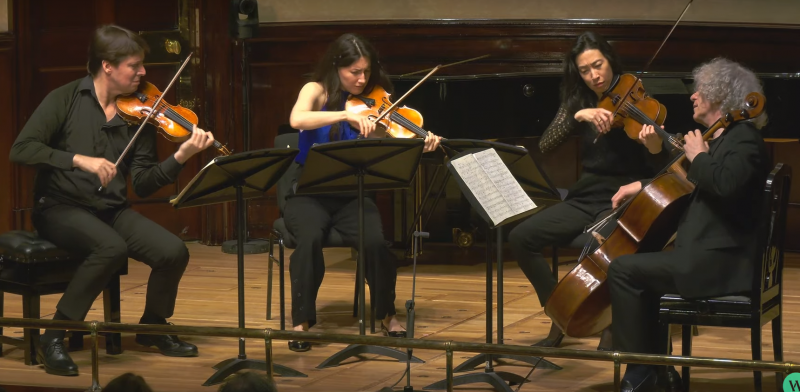
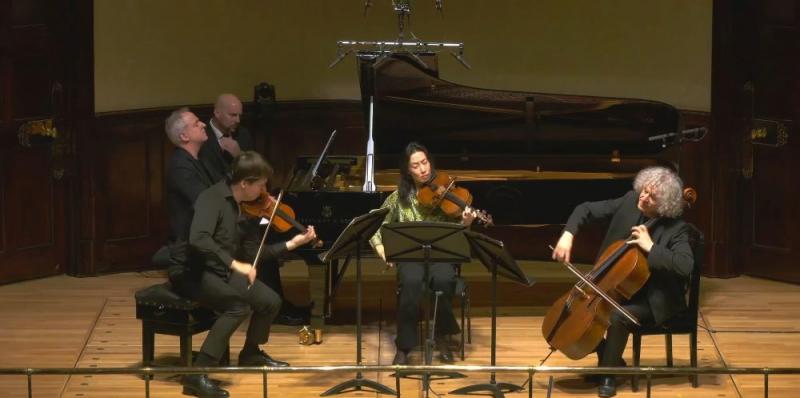
After the interval, this series ended in the only way possible with the String Quartet that was Fauré’s last work. In his initial remarks, Isserlis mentioned how long it had taken for him to ‘get’ this piece and, indeed, its three movements each unfolds in a seamless polyphonic flow which can feel disconcerting even in the context of the composer’s other late chamber works. Whether or not they play it frequently, Joshua Bell, Irène Duval, Blythe Teh Engstroem and Isserlis audibly had its measure – their steady though always flowing tempo for its Allegro moderato ideally complemented by the luminous radiance of its Andante; before its Allegro elides elements of scherzo and finale in music whose dextrous pizzicato writing and gently cumulative intensity conveys an affirmation that speaks of a challenge, and a life, fulfilled.

As a work and as a performance, it set the seal in the only way possible on a series of concerts through which the quality and substance of Fauré’s chamber music could not have been more eloquently confirmed, which is just as should be expected from a retrospective of this nature.

You can watch the concert below, thanks to the Wigmore Hall YouTube channel:

For more information on the Fauré series, visit the Wigmore Hall website – while you can also read Arcana’s interview with Steven Isserlis about the French composer

Published post no.2,355 – Thursday 5 November 2024

In concert – Steven Isserlis and Friends – Fauré at the Wigmore Hall (4)

Steven Isserlis (cello) – with Joshua Bell, Irène Duval (violins), Connie Shih, Jeremy Denk (pianos), Quatuor Agate [Adrien Jurkovic, Thomas Descamps (violins), Raphaël Pagnon (viola), Simon Iachemet (cello)]

Fauré Cello Sonata no.1 in D minor Op.109 (1917)
Enescu Violin Sonata no.2 in F minor Op.6 (1899)
Fauré Piano Trio in D minor Op.120 (1922-3)
Ravel String Quartet in F M35 (1902-03)

Wigmore Hall, London
Monday 4 November 2024

Reviewed by Richard Whitehouse Picture (c) Wigmore Hall Trust

Tonight’s instalment of the Wigmore Hall series focussing on Fauré’s larger chamber works was also the most cohesive in its alternating two of the composer’s late pieces with formative ones by Enescu and Ravel for what was a fascinating programme of echoes and anticipations.

While not necessarily the weakest of those works played in this series, Fauré’s First Cello Sonata is the least remarkable – the melodic content reduced to barest essentials such that its main motifs can verge on the anonymous. That said, its opening Allegro is a model of formal economy and expressive restraint, Steven Isserlis and Connie Shih being no less perceptive in the pensive musing of its central Andante or the urbanity of a final Allegro whose ‘commodo’ aspect was always evident. Less may not always be more, but it is rarely less than appealing.

Less often heard than its successor, Enescu’s Second Violin Sonata is no less significant. Its composer’s first masterpiece, much of the fascination lies in the degree to which its melodic ideas evolve across and between each of the three movements for a potent demonstration of motivic unity. This was something Irène Duval conveyed in ample measure, yet without ever neglecting that reticent or sometimes ominous quality characterizing much of its content – at least until the quixotic finale channels these diverse elements towards a resolution achieved almost despite itself. Throughout, Jeremy Denk’s pianism was a model of lucidity and poise in a performance which went all the way in confirming this work as one of the three greatest masterpieces by a teenager – the other two being written 74 years earlier, then 72 years later. (presumably Mendelssohn’s Octet and a piece to be confirmed! – ed)

Fascinating how much Enescu’s precocity resembles Fauré’s maturity in what was the latter composer’s penultimate work. Compact almost to a fault, the Piano Trio is dominated in all respects by a central Andantino whose melodic eloquence has intensified almost to the point of ecstasy by its close, not least as rendered by Joshua Bell, Isserlis and Denk in what was a near-ideal performance. Succinctness almost gets the better of the outer movements, though it would be churlish not to acknowledge the tensile energy of its opening movement and the exhilaration of a finale whose element of syncopation marks Fauré’s nearest approach to the jazz idiom. Interesting as it is to hear this piece with clarinet as was originally intended, its interplay of violin, cello and piano is no less inevitable than in the parallel work by Brahms.

The well-regarded Quatuor Agate duly took the stage for Ravel’s String Quartet, evidently a work for which Fauré expressed only muted enthusiasm. Superbly played though a little self-regarding interpretively, this account was at its best in its latter stages – the inward rapture of its slow movement in pointed contrast to the volatility and ultimate decisiveness of its finale. The opening movement at times verged on expressive inertia and the scherzo’s deft humour was rather self-conscious, but the overall conviction of this performance still came through. Seemingly the Agate will not be playing Fauré’s String Quartet which forms the culmination of tomorrow’s concert and of this series; one that also includes the Second Cello Sonata and music written in tribute to a composer whose greatness could hardly be doubted now as then.

You can watch the concert below, thanks to the Wigmore Hall YouTube channel:

For more information on the Fauré series, visit the Wigmore Hall website – while you can also read Arcana’s interview with Steven Isserlis about the French composer

Published post no.2,354 – Wednesday 5 November 2024