
Online Concert: Jean-Guihen Queyras @ Wigmore Hall – Bach, Saygun & Britten

Jean-Guihen Queyras (cello)

J.S. Bach Cello Suite no.1 in G major BWV1007 (c1720)
Saygun Partita for solo cello Op.31 (1955)
Britten Cello Suite no.1 Op.72 (1964)

Wigmore Hall, Monday 20 November 2023 1pm

by Ben Hogwood

There is now a wide variety of repertoire from which the unaccompanied cellist can choose, yet this was emphatically not the case in the days of Johann Sebastian Bach. His six suites opened the door for the instrument to become a purveyor of melody and emotion, even if those facets were left largely unexplored until the 20th century.

Writing for solo stringed instruments went out of fashion in the Romantic period, until the rediscovery of Bach’s works by Pablo Casals towards the end of the 19th century – from which this highly original music reached its rightful platform. The First Cello Suite of the six is a delightful work, written at a standard rewarding those of an intermediate ability with music that repays decades of listening and practising.

Jean-Guihen Queyras brought to it a freshness bringing the most from the music. His unaffected manner with the Prelude found serenity amid a relatively relaxed sequence of string crossing, the cellist’s careful thought giving the music space. This set a theme maintained by the nicely voiced Allemande, then a bracing and rustic Courante reminding us of the dance origins of these pieces. The elegant Sarabande was particularly beautiful, with tasteful ornamentation applied on the section repeats, before a spirited first Minuet was offset by the brief but contemplative second in the minor key. A lively Gigue concluded an excellent performance. Bach will always be work in progress for cellists, but it was clear just how enjoyable that process is for Queyras.

From the well-known Bach we travelled to Turkey to experience the relatively unheard Partita of Ahmet Adnon Saygun, a composer regarded as the first exponent of Western classical music in the country, and whose orchestral music has travelled relatively well. Queyras removed the fourth movement of five from this performance, which nonetheless made a powerful impact. Starting with a drone in the lower reaches, the Lento first movement climbed melodically to an expressive outpouring, totally secure in the French cellist’s hands. A restless, edgy Vivo followed before emotive inflections were found in the Adagio, the melodic lines alternately probing or softly turning inwards. The Allegro moderato was deceptive to start with, initially meandering in mid-register before crossing the cello with emphatic lines, before the music relented to the drone of the opening once more. On this evidence, the chamber music of Saygun – a composer with a prolific output – is definitely worth exploring in more detail.

Like Bach, Britten also based his first cello suite in G major – the third of his works dedicated to the great cellist Mstislav Rostropovich, after the Cello Sonata and Cello Symphony. With a mixture of contrasting dances and tempi, the work has a recurring Canto section, on which Britten typically writes a number of varied repeats. This performance began in commanding fashion, before Queyras repeated the melody in a plaintive voice, getting closer to the true heart of the suite.

For although there was music of immense power this is essentially nervy night-time music. In this performance the Fuga often retreated to the shadows, offering some furtive if slightly playful harmonics at the end. The Lamento was lost in thought to begin with while the Serenata, played pizzicato throughout, evoked another world. So too did the Marcia, its ghostly evocations of flute and drum cutting to assertive, red-blooded music. The Bordone was troubled, the pitches of its drone creating great tension in this interpretation – before the scurrying finale found sure-footed ground.

This was a technically flawless recital from Queyras, a captivating trio of pieces atmospherically cast in half light on the Wigmore Hall stage. His encore was music from György Kurtág, a master of solo instrument composition. His typically compressed but intense Az Hit, where a diatonic melody developed outwards before drawing back in, finished with a charming two-note signature.

For more livestreamed concerts from the Wigmore Hall, click here

Online Concert: Esther Yoo & Jae Hong Park @ Wigmore Hall – Debussy, Grieg, Rachmaninoff & Vieuxtemps

Esther Yoo (violin), Jae Hong Park (piano)

Debussy Violin Sonata in G minor (1916-7)
Grieg Violin Sonata no.3 in C minor Op. 45 (1886-7)
Rachmaninoff Vocalise Op. 34 no. 14 (1915)
Vieuxtemps Souvenir d’Amérique on ‘Yankee Doodle’ Op.17 (pub. c1845)

Wigmore Hall, Monday 6 November 2023 1pm

by Ben Hogwood

This was the first recital given in the UK by the relatively new team of violinist Esther Yoo and pianist Jae Hong Park – but on this evidence, many more will follow. Yoo has been a regular concert giver for ten years now, having joined the BBC Radio 3 New Generation Artist scheme in 2014, so it is easy to forget she is still just 29. Park, meanwhile, took first prize at the Busoni-Mahler Foundation Competition in 2021 and, at the age of 24, looks set for a fine future as soloist and chamber pianist.

The duo began with a fresh take on Debussy’s oft-heard Violin Sonata, his final completed work. The first movement has meaningful if short melodic cells and quickly changing moods, which both performers characterised to great effect, with Yoo’s intonation and phrasing particularly impressive. The second movement was lighter, before the Finale set off at quite a lick, Yoo’s commanding and very impressive virtuosity giving the music a great deal of energy. This was Debussy with a fresh coat of glossy paint, but with a great deal of feeling and understanding too.

Following the Debussy with Grieg’s third essay in the genre was a particularly smart move, as the two composers have closer parallels than one might think. The Violin Sonata no.3 in C minor is a particularly fine work, closely adhering to sonata principles while allowing the performers plenty of room for flights of fancy and characterisation. Both clearly love this work, for the crisp attack of the first movement was immediately gripping, the turbulent passages given the requisite drama. Yoo was fully invested in the fantastical aspects of Grieg’s writing, the violin dreamily floating at some points while swooping with full tone at others. Park ensured the forthright piano writing was delivered at just the right level, too, offering substantial support when needed. The slow movement had an appealing singing style, responding to Grieg’s marking of Allegretto espressivo alla Romanza, while the harmonic twists and turns of the third movement were high on red-blooded drama.

The pair followed with a set of extended encore pieces, beginning with a tasteful account of Rachmaninoff’s versatile Vocalise, which works particularly well in the Michel Press & Josef Gingold arrangement used here. Yoo’s long phrases were nicely floated, but in the following Souvenir d’Amérique on ‘Yankee Doodle’ by Belgian composer Henri Vieuxtemps she took the opportunity to go for broke. This is a great audience piece, with a brilliant send-up of the familiar theme, allowing for portamento, spiky snaps, quickfire left hand pizzicato and much more. In these hands it was a proper showstopper!

Then we heard a Korean folksong, the poignant Milyang Arirang – which, with its pentatonic melody, was not too far removed from the language of the Rachmaninov. A passionate central section and a free, rhapsodic coda were delightful – as was an extra bonus, an affectionate account of Elgar’s Chanson de matin.

For more livestreamed concerts from the Wigmore Hall, click here
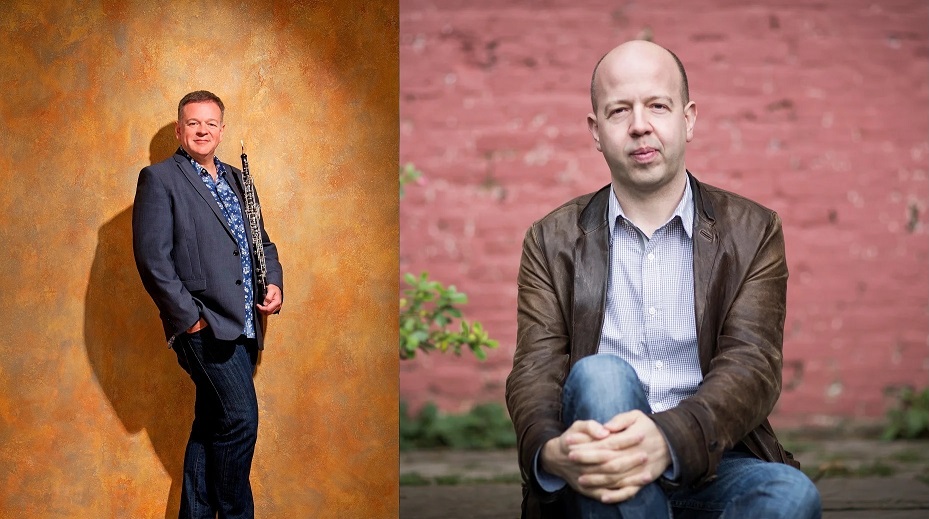
Online Concert recommendation: Nicholas Daniel & Huw Watkins @ Wigmore Hall

Nicholas Daniel (oboe, picture (c) Eric Richmond), Huw Watkins (piano, picture (c) Benjamin Ealovega

by Ben Hogwood

Here is a nudge in the direction of a very fine concert given at the Wigmore Hall yesterday by oboist Nicholas Daniel and pianist Huw Watkins.

They were in the company of three fine living composers – Althea Talbot-Howard, Michael Berkeley and David Matthews – whose music features in the concert, alongside works by Clara and Robert Schumann, and an arrangement for oboe and piano of a Mozart violin sonata.

Talbot-Howard’s contribution is to rework an attractive sonata for flute and harp by Joseph Bologne, Chevalier de Saint-Georges, for oboe and piano, another stage in the concert rehabilitation of this remarkable 18th century composer.

You can watch a lovely, affirmative hour of music on YouTube below:

For more livestreamed concerts from the Wigmore Hall, click here

Published post no.1,995 – Tuesday 31 October 2023

Online Concert: Wayne Marshall @ Wigmore Hall

Wayne Marshall (piano)

Wigmore Hall, Monday 9 October 2023 1pm

by Ben Hogwood

And now for something completely different…presenting Wayne Marshall on the piano at the Wigmore Hall, delivering the latest BBC Radio 3 Lunchtime Concert without a script.

Marshall is renowned for his abilities as an improviser, but even he had not tried this approach before, whereby the whole hour’s music took place at the suggestion of the audience – both in the venue, via submissions placed in a box beforehand, and over X / Twitter, where listeners made their own suggestions.

The results are actually remarkable, a testament to the power of music in the moment. Try watching the concert online without knowing what will come up – but if you want a guide for repeat listening, timings can be found at the bottom.

5:51 – Erroll Garner Misty
11:48 – John Williams Hedwig’s Theme (Harry Potter)
18:34 – Gershwin I Got Plenty O’ Nuttin (Porgy & Bess)
25:06 – J.S. Bach Toccata and Fugue
34:33 – Rachmaninov Rhapsody on a Theme of Paganini – as though played by Art Tatum
40:30 – Stevie Wonder You Are The Sunshine Of My Life
44:25 – Cole Porter Let’s Do It (Let’s Fall In Love)
50:03 – Copland Fanfare for the Common Man
56:00 – Stravinsky The Rite of Spring

For more livestreamed concerts from the Wigmore Hall, click here

Online Concert: Chouchane Siranossian, Leonardo Garcia Alarcón, Balázs Máté @ Wigmore Hall – Bach, Schmelzer, Farina & Walther

Chouchane Siranossian (violin), Leonardo Garcia Alarcón (harpsichord), Balázs Máté (cello)

J.S. Bach Violin Sonata in G minor BWV1021 (1732-5)
Farina Sonata quinta detta ‘La Farina’ (pub. 1626)
J.S. Bach Violin Sonata in C minor BWV1024: Adagio; Fugue in G minor BWV1026 (before 1712)
Walther Passacaglia from Sonata no.7 (pub. 1688)
Krikor Naregatsi Improvisation on Havun Havun
Locatelli Sonata in D minor for solo violin Op.6/12 (pub. 1737)
Schmelzer Violin Sonata ‘Victori der Christen’ (c1683-4)

Wigmore Hall, Monday 5 June 2023 1pm

by Ben Hogwood

This attractive programme of works for wind ensemble began with a rarity.

September is a prominent line in the sand in the course of the classical music year. The Proms ends, everyone else gears up for the start of an Autumn season, and a fresh wave of creativity begins.

The resumption of the BBC Radio 3 Lunchtime Concert on Mondays at the Wigmore Hall is always a prominent part of the changing of the guard, and the choice to begin the new season with violinist Chouchane Siranossian, harpsichordist Leonardo Garcia Alarcón (both above) and cellist Balázs Máté was an inspired one.

The trio gave a recital based on their Bach Before Bach album of November 2021, bringing forward some of the master’s work for violin and harpsichord but putting it in the context of contemporaries Walther and Schmelzer, as well as some inspired earlier choices.

Bach himself began the programme, the Violin Sonata in G major BWV1021 featuring some effortlessly stylish playing. Siranossian has a particularly beautiful tone and a sense of ornamentation that fits this music instinctively. The same can be said for the fluent harpsichordist Alarcón, an expressive player of exceptional balance, complemented by the burnished tones of cellist Máté. A songful Adagio gave way to an enormously enjoyable, quickfire Vivace, which itself led to a tasteful, florid Largo, led by legato harpsichord. An attractive Presto finished an uplifting account.

We then had a rare opportunity to hear the music of Carlo Farina, whose work is not often heard in concert. With performances like these he deserves much better, for the Sonata quinta detta featured lively passagework and darker colours, the music glinting at the edges as the violin became prone to passionate outbursts over rich harmonies. Siranossian selected a shorter bow for this music, playing to the snappy, playful interjections.

Two Bach movements followed, cleverly linked – a deeply profound Adagio, given great depth and character by the violinist, then a virtuosic Fugue, a very tricky proposition given Bach’s writing but brilliantly played. Walther’s Passacaglia, meanwhile, was a fiery complement, setting out the main theme in relatively polite tones but then liable to explosive outbursts of virtuosity.

After all this activity came the brilliantly timed Improvisation on Havun, Havun, from 10th century Armenian monk Krikor Naregatsi. This introduced a remarkable stillness to the concert, time standing still as the violin turned ornamental phrases over a drone from the cello’s open A and D strings. Siranossian segued straight into the Locatelli, a solo sonata with daring feats of virtuosity here but retaining some of the bird-like qualities found in the Naregatsi. Her impeccable intonation and bow control were striking, but the music reached a truly exalted level in the fifth movement Capriccio ‘prova dell’intonazione’, the sky truly the limit for the violin’s highest register!

There was also a bold opening to Schmelzer‘s pictorial sonata Victori der Christen, with multiple stopping and very descriptive writing, especially in the slow and sorrowful sections. To complement the drama of the Schmelzer, Siranossian introduced the first movement of the Sonata in D major from Georg Muffat. This was another excerpt from the trio’s disc, but one whose sunny countenance was the perfect foil – and which put the seal on a remarkable concert with playing of an exceptional standard.

You can listen to Bach Before Bach via Spotify below:

For more livestreamed concerts from the Wigmore Hall, click here