Filmed at Worcester Cathedral, Saturday 4 June 2022
by Richard Whitehouse
The English Symphony Orchestra’s concerts at last year’s Royal Jubilee Elgar Festival have already yielded several online performances of note, with In the South perhaps the finest yet in terms of vindicating a work that can all too easily fall victim to its seeming ‘indulgencies’.
The main issue is in setting a tempo flexible enough to accommodate this concert overture’s extended sonata design without it becoming episodic. At around 24 minutes, this unhurried take was mindful of Worcester Cathedral’s expansive acoustic and utilized it to the music’s advantage. The surging initial theme, its speculative transition and suave second theme duly emerged with a formal continuity – the underlying tension carried through to a development whose impulsiveness was maintained despite (even because of?) the intervening first episode.
Evoking the grandeur of ‘empires past’, this episode necessitates astute handling so that its implacability avoids bathos. Kenneth Woods judged it accordingly, and if his tempo for the second ‘canto populare’ episode felt just a little reticent, its expressive raptness (along with Carl Hill’s playing of its indelible viola melody) more than compensated. Nor was there any loss of continuity across the reprise of the opening themes, with Woods’ gradual building of momentum at the start of the coda ensuring an irresistible but never overbearing apotheosis.
Certainly, the response suggested anyone who may previously have harboured doubts about this piece was won over on this occasion. Further evidence of this orchestra and conductor’s empathy with this music as augers well for the First Symphony at this year’s Elgar Festival.
Boccherini String Quintet in D minor Op.13/4 (1772) Cello Sonata no.2 in C minor (pub. 1772) Cello Concerto no.7 in G major (pub. 1770)
Wigmore Hall, Monday 20 March 1pm
by Ben Hogwood
Steven Isserlis has been a passionate advocate of the music of Luigi Boccherini for a number of years. One of his very first recordings, made for Virgin Classics, brought together a selection of the prolific composer’s works for cello, two of which were heard in this Wigmore Hall lunchtime concert.
Boccherini was born in Italy in 1743, but made his name and much of his living in Spain, where he lived from 1768 until his death. A prodigious cellist, he joined the string quartet in the court of Don Luis in Madrid and wrote himself into the musical equation, making an unusually weighted quintet with two cellos, a combination that became his calling card with over 100 works. While Mozart would go on to write for a string quintet with two violas in the late 1780s, Boccherini achieved a very different balance. His works may be functional in origin but they show fresh invention, distinctive colours and generous melodic appeal. Unfortunately that appeal has not regularly transferred to the concert hall, at least not in the UK – but on this evidence, where Boccherini’s music brightened a spring lunchtime, they should be available on the NHS!
We heard the String Quintet in D minor Op.13/4 from 1772, from early in the Madrid vocation – but clearly Boccherini was already at home in the two-cello idiom. A rich D minor setting found Tim Posner’s cello initially leading with a sonorous tune, before a genial second section in F major assigned plenty of melodic interest to each of the five players. With a relatively congested texture there was nonetheless a beautiful combination of melodies, though the development clouded over in outlook a little.
The second movement Andante gave first violinist Jonian Ilias Kadesha greater prominence, the other four instruments accompanying at walking pace. Soon the texture thinned to three for an extended cello solo, Isserlis’ wonderful tone rising to a high trill with graceful elegance. Boccherini didn’t leave his second cellist out, either, with Posner also enjoying a rich solo rising to the heights. The finale was a quickly executed fugue, with plenty of counterpoint to enjoy and a distinctive sighing chromatic motif passed between the instruments.
Boccherini wrote frequently and fluently for his principal instrument, including many sonatas with harpsichord. Isserlis and Maggie Cole gave a stylish performance of the Sonata in C minor, a work they have enjoyed since recording it in 1988. The assertive beginning established the home key with a strong theme, leading to more lyrical and ornamented melodic content. Isserlis proved very secure in the upper register, especially with a rising motif towards the end of the first movement. A soulful Largo followed, increasing florid and with a lovely resolution at the end. The economical piece soon cut to a triple time third movement, mixing chirpy motifs with longer, flowing passages with chords from the cello.
It is thought Boccherini wrote 12 concertos, of which the Cello Concerto no.7 in G major is one of the most popular. For this performance the group took an authentic figuration, all seven players on stage with Isserlis in the centre, flanked by first violin (Irène Duval) and viola (Eivind Ringstad). They were his foils in the solo passages, Isserlis revelling in the cello’s free spirit while they enjoyed busy counterpoint of their own. The bright figurations had a spring in their step, like a march Isserlis showing impeccable high register intonation. A grand cadenza sealed the deal in the first movement, while the perky finale had violins bright as a button and both cellos in their high reaches. In between was a radiant Adagio, set in B flat major and featuring some particularly beautiful and longer-phrased, ornamented melodies. This was one of those pieces where music making was a pleasure, pure and simple, with music suited to the rustic outdoors.
Perhaps inevitably – as Isserlis joked to the audience – there was an encore in the form of a popular snippet. Boccherini’s Minuet, itself from a string quintet, is his best-known movement and is often played separately on the radio. This concert proved there is a whole lot more where that came from.
You can listen to recordings of the works in this program on the Spotify playlist below, including Isserlis’ own versions of the sonata and concerto:
For more livestreamed concerts from the Wigmore Hall, click here
Mozart Sonata for piano and violin in B flat major K454 Den første sommerfugl (1784) Brahms Violin Sonata no.1 in G major Op.78 (1878-9)
Wigmore Hall, Monday 20 March 1pm
by Ben Hogwood
This was the first time violinist Francesca Dego and pianist Alessio Bax had performed together in public – but had that fact not been given to us by BBC Radio 3 announcer Andrew McGregor, the unsuspecting audience would have assumed they had been playing together for years. Both demonstrated an innate understanding of the music in this attractive programme, which had equal portions of light and shade.
Much of the light was found in the Mozart, his K454 violin sonata written during a phase where he was especially preoccupied with the key of B flat major. Around the violin sonata, regarded as one of the three crowning masterpieces in the form, sit the string quartet nicknamed the Hunt (K458) and the Piano Concerto no.18 (K456), the B flat neighbours evidence of a period where Mozart seems to have been especially fertile.
His stimulus on this occasion was the Italian violinist Regina Strinasacchi, a figure with whom the Italian Dego – a Mozart specialist herself – possibly felt an affinity. In detailing her affection for the work in the concert notes, Dego noted how Strinasacchi had studied at the Ospedale della Pietà, where Vivaldi once taught, before meeting Mozart in Vienna.
The piece made a winsome impression here, Dego showing how, in Mozart performance, less can so often be more. The pair enjoyed a poised introduction, Dego lingering on the last note before a sparkling Allegro moderato opened up ahead. There was definitely an air of spring to this movement, with burbling piano figures and bright violin melodies ideally balanced by the two.
The slow movement took time for thought, enjoying the space afforded to an operatic violin line, though never lingered unnecessarily. Dego’s tone was especially enjoyable here. The finale was very nicely done, with breezy humour and opportunity for virtuoso display for both instruments, tastefully taken.
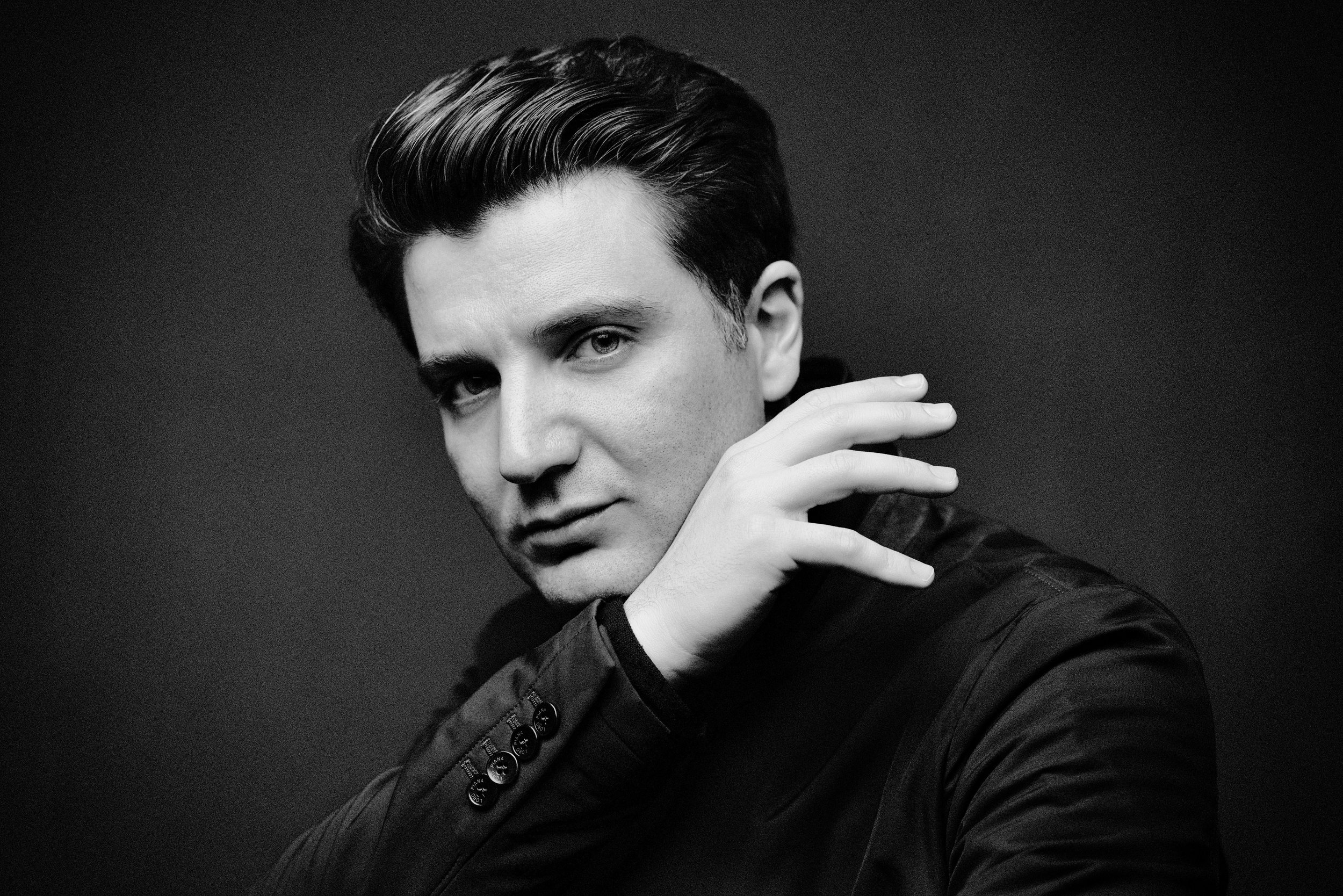
Alessio Bax Pianist
Photo: Marco Borggreve
As with several of his first forays into a new musical form, Brahms took several attempts before he was happy to publish his Violin Sonata no.1, which was completed just after the Violin Concerto. It is an attractive work with memorable themes, but a shadow fell over its composition due to the fate of Felix, the son of Clara Schumann and Brahms’s godson, who contracted tuberculosis, from which he died.
Dego and Bax brought this melancholy to the slow movement, the music turning hollow at the extremes of the piano register, Bax’s shaping of the low phrases especially expressive. The soft coda was bittersweet, a mood which carried over into the slow movement. Whereas the first movement had plenty of room given to its attractive melody, the finale pushed forward, Brahms looking to blossom into an exultant major but ultimately remaining troubled by the frequent reappearance of the minor key. There was however a good deal of energy and ultimately the sonata ended positively, the light and shade of this performance having given it a deeper perspective.
Dego introduced a bold encore choice, the second movement Tarantella of Busoni’s Violin Sonata no.2 – a work that should be heard in the concert hall far more often. On this evidence, a recording would be most welcome, given the musicality the two performers brought to this fine recital.
For more livestreamed concerts from the Wigmore Hall, click here
Nordheim Den første sommerfugl (1982) Martinů Sonatina for trumpet and piano (1956) Shostakovich 4 Romances on Poems by Alexander Pushkin Op. 46 (1936-7) Piazzolla Café 1930 from Histoire du Tango (1986) Grieg 6 Songs Op. 48 (1884-8) Gershwin Prelude No. 2 in C sharp minor (c1923-6); By Strauss (1936) Weill Youkali (1934) Kreisler Toy Soldiers March (1917)
Wigmore Hall, Monday 6 March 1pm
by Ben Hogwood
What a joy to see the partnership of trumpeter Tine Thing Helseth and pianist Kathryn Stott renewed at Wigmore Hall, united in an original program of trumpet originals and imaginative arrangements from vocal sources.
Dreamy lines from the piano introduced the concert’s first item, Arne Nordheim’s Den første sommerfugl (The First Butterfly), full of spring promise as the insect’s flight gracefully orbited the hall. Helseth’s trumpet line was a lyrical one, speaking faintly of folk song. From here the pair moved straight into the compact and winsome Sonatina for trumpet and piano, one of the Czech composer Martinů’s miniature gems. Written while experiencing homesickness in New York, the work began with a gruff introduction from the piano, its repeated note figurations taken up by the trumpet in fanfare-like salvos generating a good deal of energy. Gradually this subsided into more poignant thoughts, the composer revealing his softer centre, and by the bittersweet chorale with which the work ends the sense was that of a composer looking for his fortunes to change. Both performers caught that shift of focus.
Next up was an imaginative choice, an arrangement of Shostakovich’s Four Pushkin Songs. The vocal lines transfer to the trumpet with surprising accuracy, both artists playing in such a way that the original spirit of the songs was fully maintained. Regeneration, the first song, was thoughtfully done, held notes on the trumpet carrying above delicate figuration on the piano. Premonition was an easy amble in triple time, but the fourth song, Stanzas, held the cycle’s emotional centre. A substantial song, as long as the other three combined, it began with a stern introduction from Stott before a compelling dialogue unfolded.
Complementing this was a beautifully floated account of Piazzolla’s Café 1930, tastefully augmented by Stott’s rhythmic attention to detail. The melodies really sang from Helseth’s trumpet, any breathing challenges overcome with deceptive ease. As she said at the end, a bit of Piazzolla is never wrong!
Helseth’s announcements between the groups of pieces were nicely done, with an easy charm that also showed how much the two artists were enjoying themselves. This much was clear again in six songs by Grieg, grouped together as Op.48 but once again transcribing with relative ease for the trumpet. Gruss (Greeting) featured a lovely depiction of bells, an outdoor scene, while Lauf der Welt was a rustic march. Helseth’s characterisation of Die verschwiegene Nachtigall (The secretive nightingale) was nicely done. Zur Rosenzeit (Time of roses) presented bright colours, while the final Ein Traum (A dream) was especially full of feeling.
We moved to a stylish Gershwin duo, starting with an account of Prelude no.2 that was especially enjoyable when the main theme returned with the mute in the trumpet. By Strauss was also a highlight, enjoying the Viennese waltz send-up, while Weill’s Youkali was a soave tango. Finally Kreisler’s Toy Soldiers March was a perky account, led off by the piano with crisp fanfares. Topping a highly enjoyable concert was an encore of Piazzolla’s Libertango, led off with a swing by Stott and played with great panache by Helseth, including pitch slides to perfection.
For more livestreamed concerts from the Wigmore Hall, click here
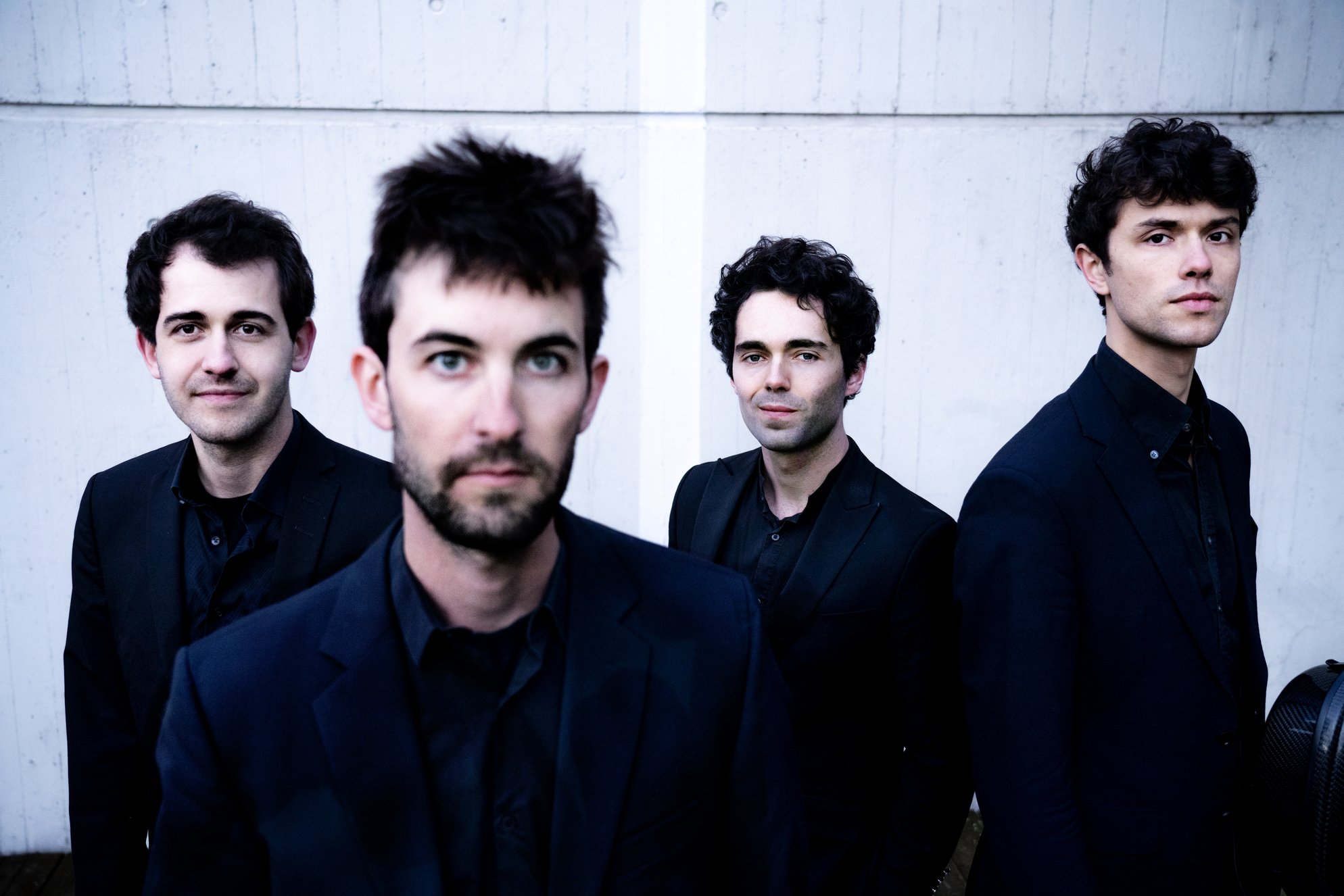
Vision String Quartet [(Florian Willeitner, Daniel Stoll (violins), Sander Stuart (viola), Leonard Disselhorst (cello)]
Shostakovich String Quartet No. 8 in C minor Op. 110 Mendelssohn String Quartet No. 2 in A minor Op. 13
Wigmore Hall, Monday 27 February 1pm
by Ben Hogwood
Vision String Quartet are a dynamic young ensemble based in Berlin, who play with great freedom – foregoing printed music and playing standing up (save for the cello of course). Neither of these attributes are gimmicks, for they suit an ensemble who have a charismatic presence and gave two performances of substantial minor key string quartets with passion and attention to detail. The program presented an interesting juxtaposition, the pieces written in very different circumstances but using the string quartet medium to air very private thoughts.
The String Quartet no.8 is the most played in Shostakovich’s canon of 15 string quartets – and arguably receives a disproportionate coverage when compared to the other fine works in the cycle. Yet in a good performance it makes an extremely powerful connection with its audience, as they learn the circumstances in which the composer wrote it.
In 1960 Shostakovich was in fear of his life, and the Eighth Quartet was his unofficial epitaph. An autobiographical work, it contains quotes from some of his most successful and important earlier works, including the Piano Trio no.2, the First and Fifth Symphonies and the recently completed Cello Concerto no.1. It begins with a sombre Largo, which the ensemble played with great sincerity. It is sometimes argued that it takes a Russian quartet to fully understand these works, and certainly the Borodin String Quartet interpretations loom large over whoever dares to take them on, but this performance took the plunge with impressive surety.
Technically the quartet were superb, the lower parts of viola and cello driving the faster passages with obdurate figures. Meanwhile first violinist Florian Willeitner found a suitably plaintive tone over the held drone from the other three instruments when the music almost came to a standstill, a most moving part of the first movement. The torrid second movement gritted its teeth, while in the chilling fourth movement, the rat-a-tat motion (thought to depict gunfire or the Russian authorities knocking on the door) left a lasting impression. The Vision players were keen to emphasise the dissonances throughout, and this approach carried all the way through to the final resolution, which was all the more telling as a result.
After this performance Mendelssohn’s String Quartet no.2 in A minor was warm in comparison, yet this is not one of the composer’s sunniest works, written as it was in the grip of an unrequited love.
Affectionately played, the first movement caught the right tension between major and minor key, with an airy outlook from Willeitner’s first violin, but with the increasing incursion of the minor key something of a shadow fell over the music. The temperature warmed appreciably for the second movement, its figures delicately sung and balanced with attractive countermelodies from around the quartet.
The third movement was a subtle charmer, its subject responding well to an unfussy presentation and subtle rubato, the Vision happy to manipulate the lilting dance rhythms rather tastefully. A skittish end cut to a vigorous, almost violent set of tremolos ushering in the presto finale, which fizzed with energy and enthusiastic interplay. The Vision Quartet secured a really nicely paced finish, winding down to a seraphic major key coda which was thoughtful and radiant.
As an encore the quartet delved into their new album Spectrum for Copenhagen, a collaborative work penned by the four instrumentalists themselves. A persuasive rhythm took shape over a cello ostinato figure, given out by the quartet with drive and passion. The piece had a rustic air which spoke of the outdoors, offering a promise of spring after two wintry works.




 Arcana.fm