On Record – Peter Herresthal, Jakob Kullberg, Bergen Philharmonic Orchestra, John Storgårds – Nørgård: Symphony no.8, Three Nocturnal Movements, Lysning (BIS)

Peter Herresthal (violin) and Jakob Kullberg (cello) (Nocturnal Movements), Bergen Philharmonic Orchestra / John Storgårds

Nørgård
Lysning (2006)
Symphony no.8 (2011)
Three Nocturnal Movements (2015)

BIS BIS-2502 [54’20’’]
Producer Hans Kipfer Engineers Matthias Spitzbarth, Håkan Ekman (Nocturnal Movements)
Recorded 29 & 30 August 2019 (Nocturnal Movements), 4 & 5 February 2022 2022 at Grieghallen, Bergen

Reviewed by Richard Whitehouse

What’s the story?

His activities as a composer may effectively have ceased, but Per Nørgård (1932-) remains a defining figure in post-war European music and this latest release from BIS collates three wholly characteristic pieces, including a double concerto which is also his last major work.

What’s the music like?

Playing a little over 25 minutes, the three movements of the Eighth Symphony each pursues its intriguing take on an established form (sonata, ternary then rondo) which emerge with a renewed fluidity and flexibility. The opening movement continually evolves its main ideas   in a gradual if cumulative curve of activity, culminating in the heightened crystallisation of motifs on tuned percussion. The central Adagio emerges across densely luminous waves of sound that recall earlier Nørgårdian practice from an arrestingly new perspective; one whose expression admits an almost confiding intimacy. The finale deftly complements this with its artfully ratcheting percussion and infectious rhythmic gyrations on route to a coda of purest radiance; the fitting close to a symphonic cycle that ranks with the finest of the post-war era.

A crucial factor of Three Nocturnal Movements is its having been a collaboration with cellist Jakob Kullberg and developed from the viola concerto Remembering Child of three decades earlier. The outcome comprises two substantial movements that frame a ‘nocturnal’ cadenza. The opening Allegro finds the solo instruments deeply embedded within an orchestral texture whose clarity enables motivic interconnections to emerge with due precision, underlining the airy momentum which carries this music towards its predictably unexpected close. Whatever its provenance, the central Andante is of a piece with those on either side – its limpid gestures and intonational punning a throwback to this composer’s preoccupations from more than half a century earlier, but now imbued with an aura no less affecting for its valediction. The final (undesignated) movement is the most demonstrative with its frequently percussive outbursts and those abrupt though never jarring changes in course that keep the attentive listener fully attuned to a discourse such as builds incrementally toward its wistfully fulfilled conclusion.

The earliest work here, Lysning makes for an ideal ending. Its title translating as ‘Glade’, this is the last of its composer’s pieces for strings and takes the Nordic miniature as template for a study in discreet yet potent contrasts of sonority and emotion that lingers long in the memory.

Does it all work?

Yes, not least because Peter Herresthal and Jakob Kullberg have premiered earlier concertos by Nørgård for their respective instruments, while John Storgårds had previously recorded the Second, Fourth, Fifth and Sixth Symphonies and gave the premiere of the Eighth of which he is dedicatee. This recording ideally complements that from Sakari Oramo (Dacapo 6.220574), focussing less on its overall symphonic cohesion than on the continual unpredictability of its renewed Classicism, and it is difficult to imagine more persuasive readings of the other works.

Is it recommended?

Very much so, in the hope Storgårds may yet complete his Nørgård cycle with the First, Third and Seventh Symphonies. Sound is up to BIS’s customary standards in clarity or perspective, while Kasper Rofelt’s annotations evince long familiarity with the composer’s unique idiom.

Listen

Buy

You can explore purchase options for this recording at the Presto website. Click on the names for more on the artists – John Storgårds, Peter Herresthal, Jakob Kullberg and the Bergen Philharmonic Orchestra – and for more on the composer Per Nørgård

Published post no.2,166 – Thursday 2 May 2024

Online review – BBC Radio 2’s Piano Room: Pet Shop Boys

by Ben Hogwood

If you’ve been keeping an eye on Arcana lately you will know that we in turn have been keeping a close eye on the month of largely superb music we’ve enjoyed from the BBC Radio 2 Piano Room.

Having watched Bruce Hornsby, and recommended a further five ‘best’ songs from the month, I finally got round to watching the Pet Shop Boys‘ trio of tracks from the Maida Vale studios and the BBC Concert Orchestra. Neil Tennant and Chris Lowe are no strangers to the orchestra, with a Proms performance and a ballet score under their belts – so this was an obvious and welcome choice to close a season that has shown – again – how pop and orchestral music can complement each other so well in the right environment.

They started with the most obvious candidate – Left To My Own Devices, probably the most orchestral of their hits to date. Now fully realised with the BBC forces, it sounded wonderful, and I always wish someone would make a remix based around the chord they reach where Neil sings about setting “Che Guavara and Debussy to a disco beat”. This was a joyous performance.

The next was a likely candidate too, the most recent single Loneliness, transposed down a tone but still sounding mighty fine to these ears. Neil Tennant’s voice still has the purity it had in the 1980s but on a song like Loneliness the aching emotion in the song felt clearer, with excellent support from the backing singers and the exquisitely voiced BBC Concert Orchestra, piquant woodwind to the fore.

The big surprise was saved until last. Mott The Hoople‘s All The Young Dudes was completely reinvented in this performance. I have to be honest and say I’m still not sure about the final version – but that’s on me, not Tennant or Lowe! The reason for my lack of wholesome praise at this point is because the original is so well known, and this cover is a more or less complete reinvention – making you hear the song in a whole new light. Tennant obviously loves the track and his vocal was powerful and on point, while the electronic / acoustic balance was thick and fuzzy but in a way that looks set to suit the chromatic harmony. An effective cover version for sure…and hopefully one to grow into!

You can watch the whole Pet Shop Boys piano room session on the BBC iPlayer

Published post no.2,100 – Monday 26 February 2024

Online review – BBC Radio 2’s Piano Room: Five of the best

by Ben Hogwood

Today (23 February) saw the conclusion of BBC Radio 2’s Piano Room month, which has been taking place every weekday for the last month.

For anyone new to the concept, it consists of a well-known pop artist delivering three songs in the company of a piano and the BBC Concert Orchestra. Generally they follow the format of something old, something new and something borrowed (which may of course be blue!) in the form of a cover version. We began with Bruce Hornsby on Monday 31 January (a performance already appraised by Arcana) and ended today with Pet Shop Boys.

The Piano Room has proved to be an enormously uplifting spectacle over the last few years, and a fascinating one too – the equivalent of watching a famous actor appearing on the West End stage. There are two things that often shine through in the course of a session. One is obvious, being the artistry of the main act in question, and their ability to breathe new life into their songs or well-chosen covers. The other is not so immediate, being the quality of the orchestral arrangements and the sheer ability of the BBC Concert Orchestra, who deliver their lines with incredible poise and great expression.

Here, then, are five top performances Arcana has had the pleasure to hear this month, in addition to the Bruce Hornsby already reviewed…bearing in mind that as I type this I haven’t yet heard Pet Shop Boys doing Left To My Own Devices!

Rick Astley – Never Gonna Give You Up

The sign of a song with ultimate staying power is its versatility – and when it can be sung like this, in a version that bears very little resemblance to the original, you realise again just what a brilliant song this is. Somehow the arrangers and Rick have worked in a pizzicato part for the violins that comes from Ed Sheeran’s Shape Of You – a very different love song, but one that fits this template hand in glove.

It also shows how Rick Astley has grown as a vocalist, making music that matches his experience but also his youthful approach:

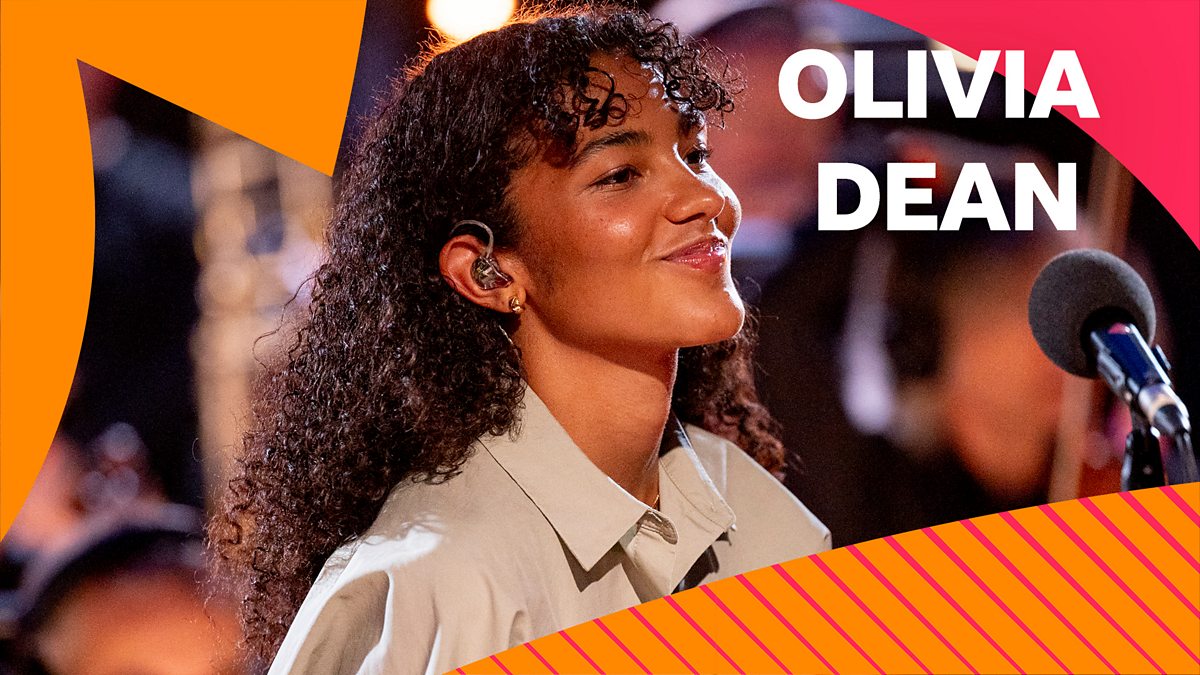
Olivia Dean – Suzanne (Leonard Cohen cover)

This is an extraordinary cover version from Olivia Dean. Sumptuous strings begin and end the arrangement (made by Sam Gale) and Dean sings in a way that recognizes Leonard Cohen’s ability to wring great emotion from relative simplicity. She intones the verse and brings a swell to the chorus, giving the song a deep resonance. This is capped by the fragility of the closing violin solo, a moment of pure but devastating clarity (played – I am almost sure – by Charles Mutter). I haven’t been able to keep a dry eye watching it yet!

Jess Glynne – Everywhere (Fleetwood Mac cover)

This was a very pleasant surprise. I find I respect Jess Glynne rather than connecting directly with her music, though her Rather Be collaboration with Clean Bandit and her own Don’t Be So Hard On Yourself have shown their staying course, and Hold My Hand is on a TV advert several times a day. I wasn’t prepared for how much I would warm to this cover – sensitively done, a lovely ‘less is more’ vocal sung with evident affection, and some great work from the band (especially bass player Dishan Abrahams). Casting aside a well played but rather unnecessary reference to David Bowie’s Under Pressure towards the end, this is a beautifully made cover, which you can view from 16’50” on this link

Crowded House – Four Seasons In One Day

This short song gains an unexpectedly emotive orchestral prelude, made possible through a broad cello solo to set the scene before the song comes in. Neil and Tim Finn’s evocative songwriting makes an effortless leap from intimate voice and guitar to band and orchestra, telling the story in just as much detail as before – yet boosted by a beautiful string arrangement. You can view from the start of this link

Gabrielle – A Place In Your Heart

How does Gabrielle do it?! For 30 years now she has held the keys to an increasing array of radio friendly songs, and under the guise of an orchestra they blossom into even fuller colours. This, her most recent single, is a beauty – and touchingly sung, too, in an arrangement that adds a great deal of depth to the song. You can view from 7’23” on this link

And finally…what a lovely tribute the orchestra gave to Radio 2 DJ Steve Wright, playing his Big Show jingle in tribute to the DJ who died unexpectedly on 13 February:

You can watch the full set of Bruce Hornsby in the Radio 2 Piano Room by clicking here

Published post no.2,097 – Friday 23 February 2024

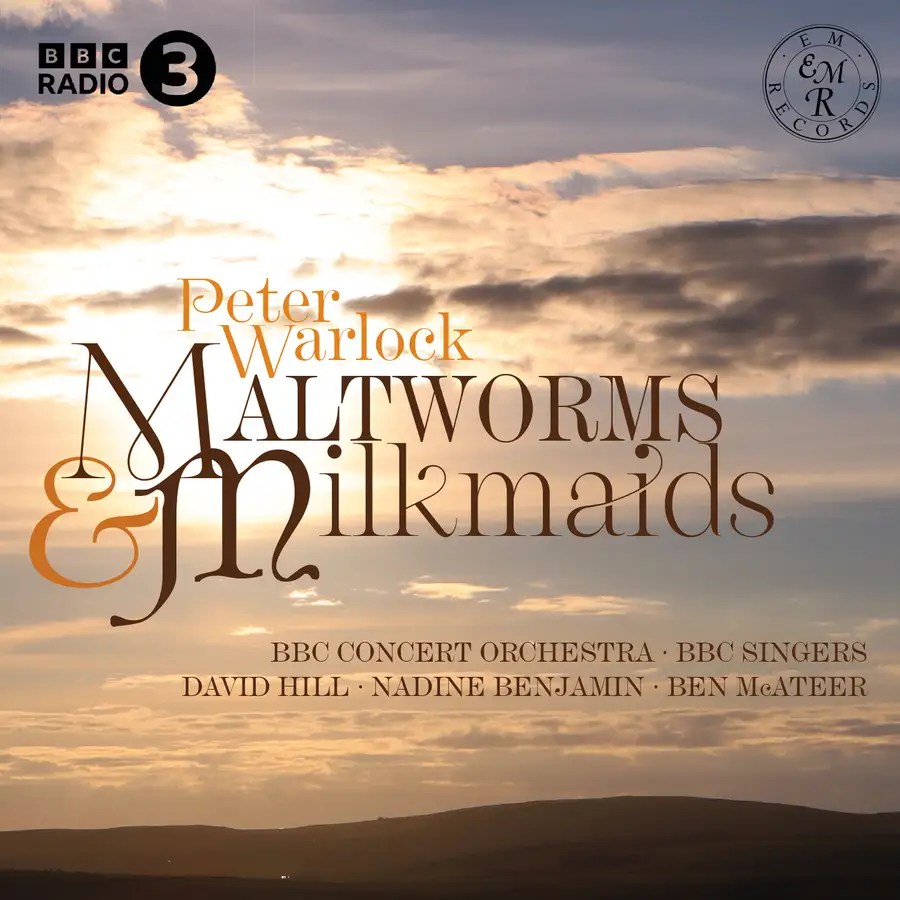
On Record – Maltworms and Milkmaids: Warlock and the Orchestra (EM Records)

Warlock
As Ever I Saw (1918, orch. anon)
An Old Song (1917-23)
Mr Belloc’s Fancy (1921/30, orch. Frederick Bye)
Captain Stratton’s Fancy (1921, orch. Peter Hope)
Serenade (1921-2)
Milkmaids (1923, orch. Henry Geehl)
Adam Lay Ybounden (1922, orch. Reginald Jacques)
Little Trotty Wagtail (1922, orch. David Lane)
The Birds (1926, orch. anon)
The Country-man (1926, orch. Gerrard Williams)
Yarmouth Fair (1924, orch. Kenneth Regan)
Sorrow’s Lullaby (1926-7)
One More River (1925)
Maltworms (1926, with E. J. Moeran)
Capriol (1926-8)
A Sad Song (1926)
Pretty Ring Time (1925)
The First Mercy (1927, orch. Fred Tomlinson/John Mitchell and William Davies)
Three Carols (1923)

Nadine Benjamin (soprano), Ben McAteer (baritone), BBC Singers, BBC Concert Orchestra / David Hill

EM Records EMRCD080 [73’52”] English texts included. Orchestrations by Warlock unless stated
Producer Neil Varley Engineer Robert Winter
Recorded 14-16 January 2022 at the Colosseum, Watford

Reviewed by Richard Whitehouse

What’s the story?

The always enterprising EM Records issues yet another ‘first’ in the guise of this collection featuring the songs with orchestra by Peter Warlock (aka Philip Heseltine), which includes many of those orchestrated by others with two-thirds of them here recorded for the first time.

What’s the music like?

Although his output barely extended beyond a decade and centred largely upon miniatures, Warlock left a substantial legacy of songs whose piano accompaniments mostly respond well when arranged for larger forces. Most of them are divided between soprano and baritone, in which latter Ben McAteer fairly captures their essence – whether the modal poise of the early If Ever I Saw, the heady (slightly forced?) jollity of those ‘fancies’ inspired by Mr Belloc and Captain Stratton, or the deftly barbed humour of Milkmaids. He draws tangible pathos from The Countryman and panache from Yarmouth Fair, with the rumbustious One More River and uproarious The Cricketers of Hambledon duly given their head. A highlight is the first recording of Maltworms, co-written with Ernest Moeran and rendered with suitable levity.

Nor is Nadine Benjamin other than fully attuned to the sentiments of her selection. Hence the soulfulness of A Sad Song or limpidity of Pretty Ring Time, both heard in what are Warlock’s only orchestrations of his solo songs, with The First Mercy an eloquent setting of words by frequent collaborator Bruce Blunt. Most affecting, though, is Sorrow’s Lullaby where soprano and baritone combine for a lengthy and often plangent setting of Thomas Beddoes in which the stark introspection of Warlock’s masterpiece The Curlew is never far beneath the surface.

The BBC Singers make their presence felt in the carol Adam Lay Ybounden and the whimsical Little Trotty Wagtail and winsome The Birds. No compromise is brooked in the rousing Fill the Cup, Philip or wistful choral incarnation of The First Mercy, then a closing trio of carols takes in the capricious Tyrley, Tyrley, the serene Balulalow and the aminated As I Sat Under a Sycamore Tree for a suitably rousing conclusion. Warlock would surely have approved and, had he known of the Singers’ recent travails, doubtless have responded in no uncertain terms.

The BBC Concert Orchestra gives of its best throughout under the astute direction of David Hill, duly coming into its own with the three orchestral pieces that Warlock completed. The evergreen suite Capriol is heard in its seldom heard and appealingly astringent version for full orchestra, the Serenade commemorates Delius’s sixtieth birthday in suitably rapturous terms, and the little-played An Old Song exudes a potent atmosphere as indicates what might have been possible had Warlock felt able to realize his musical ambitions on a larger canvas.

Does it all work?

It does, especially when heard in the continuous sequence as presented here. Warlock might increasingly have fretted about his ability as a composer, but the best of what he did achieve is sure to keep his name alive well beyond the approaching centenary of his untimely demise.

Is it recommended?

It is and not least when the presentation – with full texts, together with detailed notes from David Lane (vice-chairman of the Peter Warlock Society) reflects the always high standards of EM Records. In the words of a latter-day songster, ‘‘a splendid time is guaranteed for all’’.

Listen

Buy

You can explore purchase options for this album at the EM Records website. For more information on the artists click on the names of David Hill, Nadine Benjamin, Ben McAteer, BBC Singers and BBC Concert Orchestra. For more on all things Warlock, click on the name to head to the Peter Warlock Society

Published post no.2,078 – Monday 5 February 2024

On Record – Estonian National Symphony Orchestra / Neeme Järvi – Lalo: Orchestral Works (Chandos)

Lalo
Overture to Le Roi d’Ys (1875-88)
Namouna: Valse de la cigarette from Namouna; Suite no.1; Suite no.2 (1868-71)
Symphony in G minor (1886)

Estonian National Symphony Orchestra / Neeme Järvi

Chandos CHAN 20183 77’22”
Producer and Engineer Kaspar Karner
Recorded 6-8 June 2022, Estonia Concert Hall, Tallinn, Estonia

Reviewed by Ben Hogwood

What’s the story?

After a successful album of French Music for the Stage, the Estonian National Symphony Orchestra and Neeme Järvi team up for more 19th century explorations, alighting on a composer the octogenarian pioneer has somehow not previously recorded.

Their chosen program brings together several companion pieces by Édouard Lalo, returning to the stage for suites from his ballet Namouna and the overture to his opera Le Roi d’Ys, before adding the Symphony in G minor as a substantial complement.

What’s the music like?

Lalo was a tuneful composer throughout his career, and these works are full to bursting with attractive melodies and colourful orchestration. The structure of the album is ideal, starting with the overture to his only opera, Le Roi d’Ys. This occupied him for 12 years, by which time the overture had changed complexion, becoming a dramatic standalone piece that could work well as a concert opener, especially with its brassy ending.

The Namouna Suites are full of charm and elegance, but are also shot through with fantasy and more than a little glamour. Initially Lalo was not given a storyline to work with, and when he was given an outline of a story from Casanova’s Memoirs he suddenly had little time to complete the work. Ill health ensued, but thanks to fellow-composer Charles Gounod helping with the orchestration he was able to get the characterful work across the line. It is full of good ideas,

Finally the Symphony in G minor, completed in the same time period as more famous cousins by Franck (in D minor) and Saint-Saëns (the Organ symphony). Its relative neglect is unfortunate, for it is a fine piece if looking a little further back for its inspiration, incorporating influences from Mendelssohn, Schubert and possibly Bizet. It is carefully structured and develops its material quite studiously, but there is an attractive lightness of touch to some its themes, some welcome weight in the Scherzo and finale, and a touching tenderness to the slow movement where the strings come to the fore. The convincing finale generates a good deal of positive energy, Lalo’s musical arguments adding up to a satisfying finish.

Does it all work?

It does – thanks to excellent performances. Järvi, of course, is a seasoned professional, but the orchestra follow his sleights of hand to the letter. The Valse de Cigarette from Namouna is a particular delight, playing around with the rhythm to induce a smile, while the brass at bring extra power and panache whenever they are employed, emphasising the Wagnerian links. The colourful shading of Namouna is aided by the Chandos engineers, who give the orchestra the ideal depth, while the performance of the Symphony in G minor has clarity and poise.

Is it recommended?

It is, enthusiastically. Lalo’s orchestral music is still underrepresented in the concert hall, but there is a growing body of highly proficient recordings of the extremely likeable works hovering round the edges of his output. This attractive album goes straight into the top bracket of modern recordings of his music.

Listen

Buy

You can explore purchase options for this album at the Presto website

Published post no.2,077 – Sunday 4 February 2024