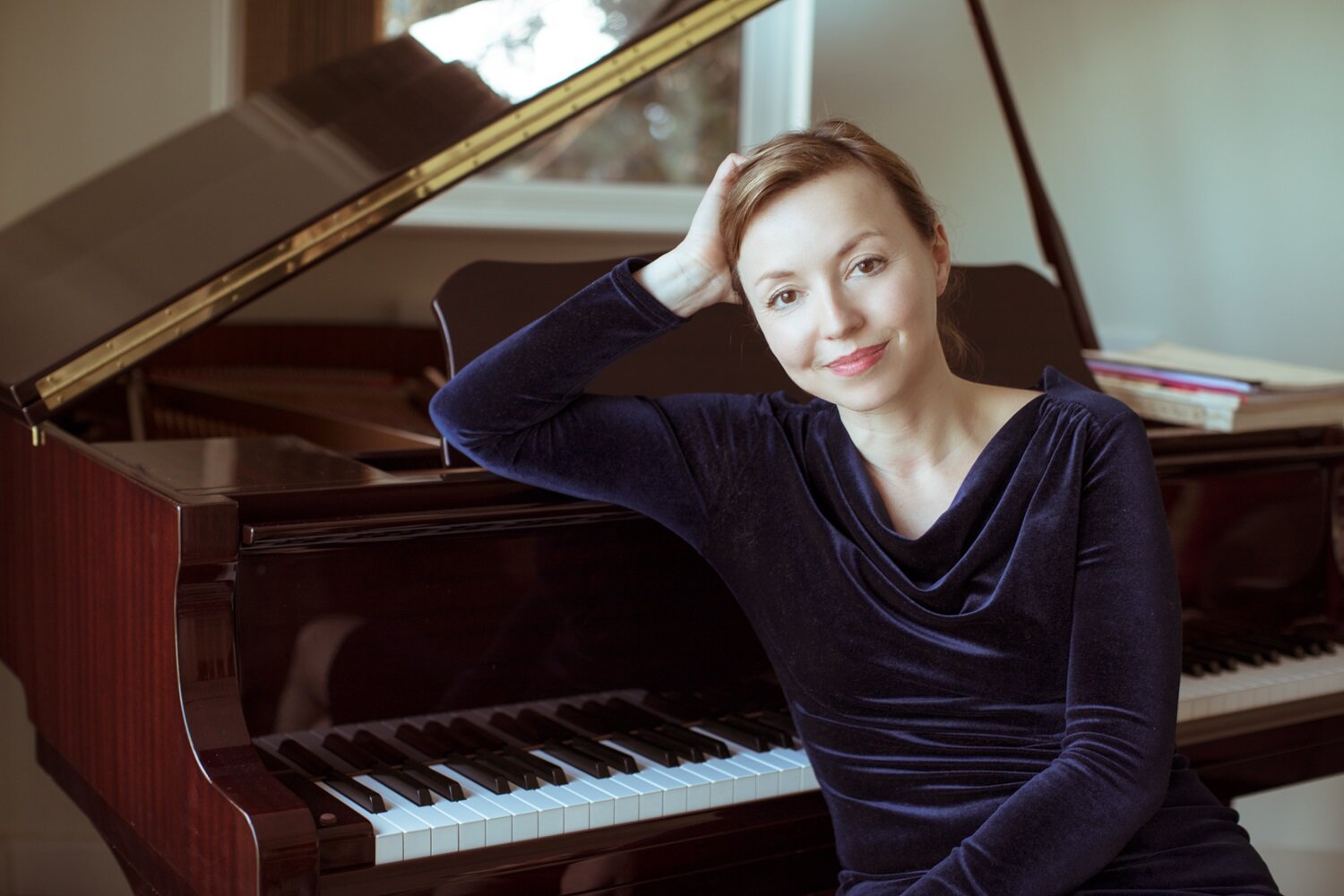
Vaughan Williams Piano Quintet in C minor (1903, rev. 1905) The Lark Ascending (1914, rev, 1919) Romance (c1914) Fantasia (quasi variazioni) on the ‘Old 104th’ Psalm Tune (1949)
Mark Bebbington (piano), Duncan Riddell (violin, Piano Quintet, Lark), Abigail Fenna (viola, Piano Quintet, Romance), Richard Harwood (cello, Piano Quintet), Benjamin Cunningham (double bass, Piano Quintet), City of London Choir, Royal Philharmonic Orchestra / Hilary Davon Wetton (Fantasia)
Resonus RES10311 [64’53’’]
Producer Adam Binks Engineers Dave Rowell (Piano Quintet, Fantasia), Adam Binks (The Lark Ascending, Romance)
Recorded 8, 9 June, 25 July 2022 at St John’s Smith Square, London
Reviewed by Richard Whitehouse
What’s the story?
Mark Bebbington assumes centre-stage for this diverse collection of pieces by Ralph Vaughan Williams, ranging across almost a half-century of his output as well as providing an effective showcase for his (unjustly criticized) piano writing heard here within three different contexts.
Does it all work?
One from a number of early chamber works as have only been revived and published in recent years, the Piano Quintet finds its composer seeking an accommodation between the Germanic and French models. The opening Allegro drives its fiery and wistful main themes through an intense development and curtailed reprise to an uneasy close, while the Andante contrasts the hymnic eloquence of its outer sections with the agitation at its centre. Most distinctive is the closing Fantasia, whose five variations on a plaintive theme shared between piano and strings evince no mean motivic ingenuity or expressive variety as they build to a fervent conclusion. Bebbington and the RPO players make a persuasive case for this uneven yet absorbing piece.
The two duo works make for a telling contrast in themselves. Although now ubiquitous in its orchestral incarnation, The Lark Ascending as originally conceived with piano is appealing and evocative in its own right – not least given with unforced pathos by Duncan Riddell and accompanied by Bebbington with sensitive understatement. Probably dating from the same time, the Romance seemingly went unheard in the composer’s lifetime (one of several pieces intended for but never played by Lionel Tertis) and received its first public hearing in 1962. Its build-up to an impassioned climax and return to its initial serenity is a familiar trajectory though one which is flawlessly carried through here, as least as rendered by Abigail Fenna.
Forward some 35 years to the Fantasia (quasi variazioni) on the ‘Old 104th’ Psalm Tune – a piece whose infrequent performance is explained by the unlikely scoring for piano, chorus and strings but also the hybrid nature of its conception; the forthright nature of its four choral settings duly offset by the formal and expressive freedom of its alternating piano ‘cadenzas’ on route to a powerfully, even starkly drawn coda. Bebbington acquits himself with aplomb in the latter, while the City of London Choir and Royal Philharmonic Orchestra respond with confidence to Hilary Davon Wetton, though perhaps this might have been the ideal occasion to revive the piece with accompaniment for string quartet as heard at its first private hearing.
Does it all work?
Almost. The follow-through of this selection is unusual to say the least, but its distinctiveness of content is undoubted – as, too, the quality of these performances. This is now the seventh version of the Piano Quintet and arguably the finest yet, the duos can stand comparison with any predecessor while that of the Fantasia has greater cohesion than the benchmark account by Adrian Boult with Peter Katin (EMI/Warner). Those familiar with Bebbington’s previous discs of VW’s piano music or early Fantasy (both Somm) will find comparable insights here.
Is it recommended?
Indeed. The recalcitrant acoustic of St John’s, Smith Square here yields the requisite warmth and no little clarity, while Nigel Simeone’s notes are informative if (purposely?) contentious on occasion. Anyone who is wanting to acquire some or all of these works need not hesitate.
The composer talks about her new work for the London Philharmonic Orchestra, a revival of her opera Four Sisters and how the Russian-born, UK-based composer channels her feelings on the conflict in Ukraine.
Interviewed by Ben Hogwood
Arcana is in conversation with composer Elena Langer. Born in Russia but moving to study in this country two decades ago, she is full of anticipation at the weekend she has coming up. On Saturday 18 March the London Philharmonic Chorus and Orchestra, together with soloist Kristina Blaumane, will give the first performance of The Dong With The Luminous Nose, a major new piece for the forces.
Exercise is uppermost in Langer’s mind when we are connected to our call, however. “I’m rehearsing with the chorus tonight”, she says, “and after our call, I’m going to have a swim. I love cold water swimming, and I go to Hampstead Heath, where there is a well-known ladies’ pool.” Given the temperature on the day we talk is a little above freezing, this is a brave move. “Yes, it’s cold – but it will be a quick swim, and it gives you a kick for the rest of the day. It means I will be nice and well-behaved with the chorus!”
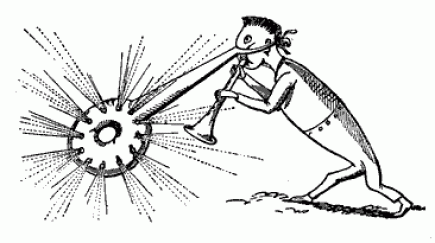
As you will have gathered, Elena has a healthy sense of humour, and a zest for life too. The primary reason for our conversation is to talk about a major new choral piece receiving its world premiere in the Royal Festival Hall soon. The Dong With The Luminous Nose is a setting of a nonsense poem by Edward Lear (illustrated below), though as we quickly establish it is a work of several layers. “It’s not nonsense as such, it is a love story”, she explains. “The Dong is broken hearted, and went mad – but it’s told in the right way.”
She recalls her first encounter with the poem, “maybe about 10 years ago. A journalist friend introduced me to it, and I really liked it – and then forgot about it. Then at the right time I remembered, because when I was asked to write this piece for chorus and orchestra I found it difficult to find the right text. Often composers set religious texts that don’t resonate, and I love setting poems, but poems for the chorus quite often feel wrong – the words never quite come across as they should. With The Dong it is a poem, but it’s a little opera for chorus. It tells a story, and you follow it, and it felt like the perfect vehicle for the task.”
The opening lines of The Dong set a telling scene: “When awful darkness and silence reign over the great Gromboolian plain”. Elena reveals how she set them to music. “I started with a big solo cello, a concentrated line. The cello represents the Dong or his longing, his soul. She is playing that solo, and that tells the story in music from beginning to end. Then the music continues in the very low registers of the orchestra, tremolo – and tam-tam, with low bassoon and trombones, low double basses too. I only used the basses in the beginning and introduce the timbres of the chorus gradually. The story is told by the basses, and then the tenors, who begin on the word ‘light’, and then all the female chorus only appears when it says “The Dong, The Dong”. We are introduced to every layer of the piece gradually, because there are lots of layers, all with the big chorus and the cello.”
With so many forces at her disposal, is it tempting to use them too much? “I have them and I like using everything a lot, but obviously it should make sense. The cello tells the story and follows the climaxes and moods of the text. It’s a strange genre – a cantata on one hand, but at the same time it’s a cello concerto because sometimes the cello is in competition with the chorus or the orchestra, and there are some instrumental bits which make it slightly symphonic.”
Rather than copy established formats, Elena has sought an original approach. “I tend to not think about what genre I’m writing in, like making new film”, she explains. “It’s not a romantic comedy, or a drama – it has everything – a bit like a good salad! This approach runs through my operatic work, when you have these resources and you use them as tools to make the drama and to have an effect on the audience. I want to tell the story as precisely as I can with my resources.”
The cello part is written for Langer’s good friend Kristina Blaumane, principal cello of the London Philharmonic Orchestra. “She’s an old friend of over 20 years, and she has this passionate, romantic side to her personality, with big emotions. I hope the cello part does that – it’s quite virtuosic, and it requires this soulful, deep, rich sound, which she has in her instrument. She looks wonderful on stage and tells the story in a dramatic way!”
Delving deeper into the story itself, the title – The Dong With The Luminous Nose – brings up a parallel with the young Shostakovich, and his first satirical opera The Nose. Would the story have appealed to him, possibly? “The plot is the opposite, as the nose disappears”, points out Langer, “so you have two noses! But you’re right, I love this in Russian literature where you get this fantastical thing which comes from Gogol, and runs through the work of Daniil Kharms, a Leningrad poet who behaved in a very eccentric way, and who I’m sure was influenced by the English tradition of Lewis Carroll and Edward Lear. It’s fantastical and surreal, but at the same time dramatic and real. All kinds of political, horrible things are happening around us, and I don’t feel like the kind of artist who comments directly on direct events.”
Elena qualifies her observation. “My survival technique is escapism, using music as something that when I write I am in control of my notes. I build this world, but I’m not in control of the rest of the world. The events – the real events – seem like a dream. In a way it’s my lament, to comprehend the world and what’s happening, done through this crazy little creature The Dong, who goes mad and loses what’s important to him.”
Inevitably, talk turns to the conflict in Ukraine. Elena may have lived in the UK for over 20 years, but the links are still strong. “I love being here, and I am in some way detached, but in some way not. I still have friends in both places, but I don’t want to run around with flags. I want to express how I feel in my own way.”
Langer’s music is indeed deeply expressive, as attendees to the Royal Philharmonic Society Awards, heard at the Queen Elizabeth Hall recently, will attest. Soprano Anna Dennis, oboist Nicholas Daniel and pianist John Reid gave a moving performance of her song Stay, Oh Sweet. It confirmed Langer’s intensely vocal approach to composition – even when writing for voices. “Yes, I think so”, she agrees, “and my cello writing for Kristina proves that. I see every instrument of the orchestra as a voice, rather than some composers who work the other way round.”
Coincidentally, on the night The Dong receives its premiere, Langer’s one-act opera Four Sisters will be performed in a new production by the Royal Conservatoire of Scotland in Glasgow. It is part of an appealing program, the 2012 opera paired with César Cui’s A Feast in Time of Plague.
“It should be fun!” she says with amusing understatement. “Four Sisters was commissioned 12 years ago by Dawn Upshaw, who had a class at Bard College in the Fisher Arts Centre, in upstate New York. They have a conservatoire there, and Dawn had a nice class there, mostly of girls. She asked me to write something that would involve more girls, as they needed parts for everyone. I thought of a funny mix of Three Sisters by Chekhov and something like Sex And The City! Each part is equal, there are no prima donnas!”
Langer studied briefly with Upshaw, but the pair’s connection goes back still further. “In 2009 I was invited to participate in the project writing for Carnegie Hall writing songs with Dawn Upshaw and Osvaldo Golijov, the Argentinian-American composer. I spent a week or more with Dawn and some singers, and she liked my work – hence the commission. She is a very good teacher, she teaches to sing and to understand what you are doing, what you are thinking about – not just the notes.”
Elena does not sing herself. “Oh no, I have a terrible voice!” she laughs. “I can play on the piano and play my pieces if I need to show them to directors or to performers, but never singing!”
On her arrival in the UK from Moscow, Langer spent one year studying with Julian Anderson, and then moved to the Royal Academy of Music for her PhD. “I saw Simon Bainbridge there, and he was very encouraging, a pleasant presence. That’s also where I met Anna Dennis, who has been my muse since then. When I write for sopranos, I have her timbre in my ears. She is very versatile, and a good musician too. She can play cello and piano.”
After the recent flurry of activity, “like a wave”, Langer is planning to take a short break. “I wanted to have a short break to stop the conveyor”, she says, as I have only just finished the arrangement that we made of Stay My Sweet for the awards. It was originally written for string trio, harpsichord and voice, and I arranged it for voice, oboe and piano. The original is recorded on Harmonia Mundi.”
Her musical thoughts are still active, mind. “It is my week off, but I’m already thinking about a Trumpet Concerto! I was working in November, and had a fantastic concert with the Boston Symphony Orchestra, who were doing a suite from my opera Figaro Gets A Divorce. They have a fantastic, very bright brass sound, polished and very smart. Their trumpeter asked me if it is possible to write a Trumpet Concerto for him and the chamber orchestra, so I agreed – and now I imagine a kind of quasi-Baroque piece, bright and energetic. I will probably write that next.”
Is the Baroque period an inspiration for her work? “It’s one of the colours which I have. My taste, as you can probably tell from my music, is very eclectic. I like all kinds of music, like Baroque and Rossini, Donizetti, Strauss, Wagner and Handel. I get excited by music! The Baroque period I like, and have written a lot for harpsichord and oboe, partly because Anna has sung a lot of Baroque music. I have been commissioned through her – and soon in Aldeburgh, at Snape, they will perform another of my compositions, Love and Endings. They are three songs based on Middle English poems, and they’re written for Anna, Mahan Esfahani and Nick Daniel. It’s going to be performed at Easter.”
She is intrigued by Esfahani’s approach. “It’s going to be the first time that I work with him. While I was writing the new songs, I went to Oxford to visit his harpsichord, and I played the instrument which was specially built for him. It is much more resonant than your normal Baroque instrument, and has more notes. It has a very thick and groovy bass!”
As well as the wide range of classical music above, Langer also encounters pop music through her son. “He’s 17, and sometimes when he’s in a good mood he shares some music that he listens to. I love a lot of it, rap and RnB. He played something that was a crossover between Muslim prayer, and rap, and something else, made in East London. I like this kind of thing, and also older jazz from the 1920s to 1950s. My favourites are Ella, Miles Davis, Coltrane and my favourite, Oscar Peterson.”
Returning to her own compositions, a glance at Langer’s list of works on her website reveals that The Dong has the biggest orchestral group she has used so far. “I’ve never used chorus and orchestra like this, it’s the first time, other than in my operas. I was a bit worried about it, as it’s completely different.”
She will hear the piece in full two days before the concert, “but tonight I’ll rehearse with the chorus. We are rehearsing in bits, to give the chorus more time to prepare – and then Kristina will join the chorus, and only then will we have everyone. I hope it works!”
She laughs, nervously – but also modestly. “This whole thing, you spend so much time orchestrating, doing the parts and this and that, and you just hope it sounds right!” With experience, she is less often surprised by the results. “The older I get, the more close it is to the initial idea. I think it’s a part of being a bit more skilful, although when I studied at the Tchaikovsky Conservatoire some of our teachers would say we must take risks and write something where we don’t know what the sound will be. I don’t want that, as I have a vision. I want it to be like a well-built house, it should not have anything unpredictable.”
The Dong With A Luminous Nose will receive its world premiere on Saturday 18 March at the Royal Festival Hall. For ticket information and purchase, visit the London Philharmonic Orchestra website. Meanwhile you can find information about the performance of Four Sisters at the Royal Conservatoire of Scotland website
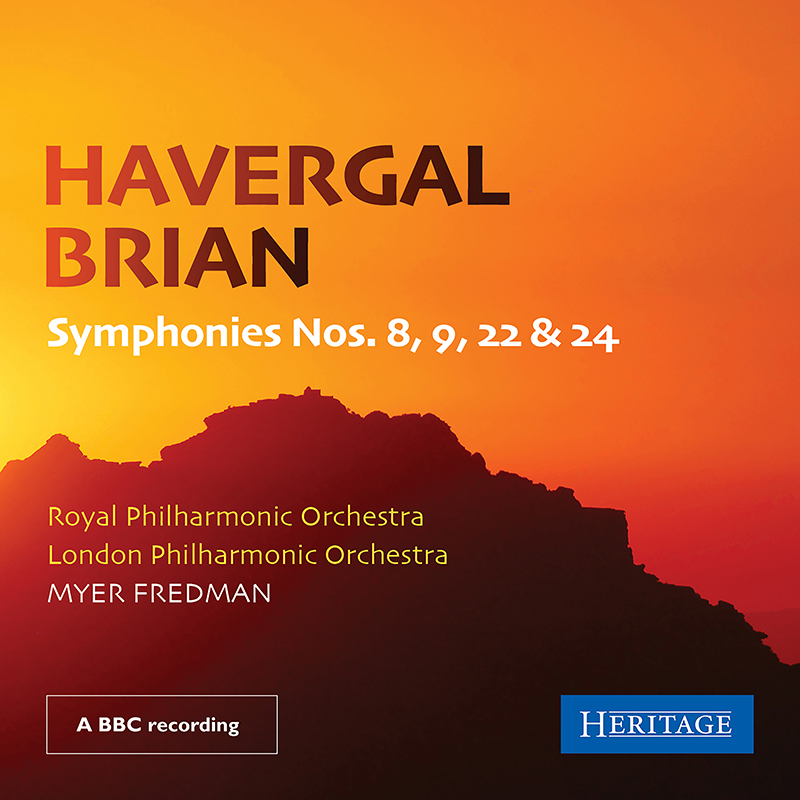
Brian Symphonies – no.8 in B flat minor (1949); no.9 in A minor (1951); no.22 in F minor, ‘Sinfonia Brevis’ (1964-5); no. 24 in D major (1965)
Royal Philharmonic Orchestra (nos.8,9 & 22), London Philharmonic Orchestra (no.24) / Myer Fredman
Heritage HTGCD146 [77’46’’]
Broadcast performances from St John’s, Smith Square, London on 28 March 1971 (nos. 9 & 22) Maida Vale Studios, London on 27 June 1971 (no.8) and 1 April 1973 (no.24)
Reviewed by Richard Whitehouse
What’s the story?
Heritage continues its releases of pioneering symphonic broadcasts by Havergal Brian with this issue of performances from the 1970s conducted by Myer Fredman, two of these being world premieres in what was a productive decade for furthering the music of this composer.
Born in Plymouth and later resident in Australia, Fredman (below) (1932-2014) set down Bax’s first two symphonies, together with Brian’s Sixth and Sixteenth Symphonies (Lyrita) that remain among the finest such recordings. He also made studio broadcasts of the present symphonies which, as John Pickard indicates in his detailed booklet notes, are among the most revealing of Brian performances from the period either side of the composer’s death – making them a natural inclusion for a series such as that now undertaken by the enterprising Heritage label.
What’s the music like?
This was the fourth hearing of the Eighth Symphony, coming after two live broadcasts with Adrian Boult in 1954 and one by Rudolf Schwarz in 1958. In many ways a template for what came after, its single span elides sonata-form and multi-movement design with a cohesion the greater for its overt unpredictability. The initial rhythmic figure (one of Brian’s most striking such openings) is not quite together, but thereafter Fredman exerts firm while never inflexible control over the interplay of martial dynamism and contemplative stasis, building its central climax superbly if losing momentum into the contrasted passacaglias – the second of which brings only a fugitive calm in its wake. Commercially recorded by Charles Groves in 1977 (EMI/Warner) and Alexander Walker (Naxos) in 2016, this work awaits public performance.
Preceded by live broadcasts with Norman del Mar in 1958 and ’59 (the latter now on Dutton), the Ninth Symphony features three continuous movements that outline a Classical framework. Fredman launches the initial Allegro with due impetus and charts a secure course through its quixotic changes of mood – the hushed transition into the reprise especially striking. He is no less focussed in a central Adagio whose musing reverie is constantly undercut by militaristic aggression, a reminder Vaughan Williams’s Sixth had appeared three years before, while the final Allegro tempers its festive cheer with a plaintive interlude which even the jubilant coda only just outfaces. Surprising that since Groves’ public performances in Liverpool and at the Proms in 1976, then his commercial recording a year later, this work has remained unheard.
The remaining performances are both world premieres of works which form outer parts of a symphonic triptych. Lastly barely 10 minutes, the Twenty-Second is (as its subtitle implies) the shortest of Brian’s cycle if hardly the least eventful. More impulsive than Lázsló Heltay with his 1974 recording (CBS/Heritage), let alone Groves in his spacious 1983 performance, Fredman teases out the eloquence of the initial Maestoso through to its fervent culmination, then brings a deft nonchalance to the ensuing Tempo di marcia such as makes contrast with its baleful climax the more telling. Brooding and fatalistic, the coda ranks among the finest passages in post-war symphonic literature and Fredman captures its essence. Walker comes close with his 2012 recording (Naxos), but this account effortlessly transcends its 52 years.
A pity Fredman never tackled No. 23, who three Illinois hearings by Bernard Goodman in October 1973 make it only the Brian symphony premiered outside the UK, but he did give the Twenty-Fourth. After its intense then impetuous predecessors, this one-movement piece feels more expansive for all its methodical ingenuity. The martial opening section is adroitly handled so its breezy extroversion reveals unexpected inwardness towards its centre then at its close; a whimsical and lightly scored interlude making way for the (relatively) extended adagio which, in its searching if often equivocal repose, brings both this work and those two before it to an affirmative end. Walker’s 2012 account (Naxos) enables all three symphonies to be heard in consecutive order, but the insights of this first performance remain undimmed.
Does it all work?
Almost always. Fredman has an audible grasp of Brian’s often elusive thinking, so that these performances unfold with a formal inevitability and expressive focus often lacking elsewhere. The Royal Philharmonic Orchestra betrays passing uncertainty with Brian’s more idiosyncratic touches, whereas the London Philharmonic Orchestra copes ably with what is among his most approachable later symphonies. Heritage has done its customary fine job opening out the sound, and anyone who knows these performances through the pirated Aries LPs will be delighted at the improvement.
Is it recommended?
Indeed. Those familiar with these symphonies from the studio recordings will find Fredman’s interpretations an essential supplement. Hopefully this series will continue apace, ideally with John Poole’s 1974 performance of the Fourth or Harry Newstone’s 1966 take on the Seventh.
For purchase information on this album, and to hear sound clips, visit the Heritage website. For more on the composer, visit the Havergal Brian Society – and for more on Myer Fredman, visit a dedicated page on the Naxos website
Arnold Commonwealth Christmas Overture Op.64 (1957) Clarinet Concerto no.1 Op.20 (1948) Divertimento no.2 Op.24 / Op.75 (1950) Larch Trees Op.3 (1943) Philharmonic Concerto Op.120 (1976) The Padstow Lifeboat Op.94a (arranged for orchestra by Philip Lane)
BBC Philharmonic Orchestra / Rumon Gamba
Chandos CHAN20152 [68’50″’] Producers Brian Pidgeon and Mike George Engineers Stephen Rinker, Richard Hannaford and John Cole Recorded 5 & 6 December 2019, 29 July at MediaCity UK, Salford
Reviewed by Ben Hogwood
What’s the story?
This collection of six pieces from Sir Malcolm Arnold’s composing career stretches from one of his first published pieces, Larch Trees, to one of his last, the Philharmonic Concerto. Both were written for the London Philharmonic Orchestra, for whom he played trumpet from 1941 until 1948, and with whom he maintained a close association as a composer.
In between these pieces Chandos have chosen a satisfying mix of styles to reveal Arnold as a multi-faceted composer, not just the humourous one of which we hear most. That side of his writing is happily celebrated through The Padstow Lifeboat and the Divertimento no.2 for orchestra reveals the happiness he found through writing for children and young people, being young at heart himself.
The Commonwealth Christmas Overture finds Arnold in commission mode, called upon to write the music for Royal Prologue: Crown and Commonwealth, a programme narrated by Sir Laurence Oliver to preface the 25th Christmas speech by a ruling monarch. Completing the collection is the first of many concertos from Arnold’s pen, and the first of two for clarinet.
What’s the music like?
Chandos have already presented us with a good deal of Sir Malcolm Arnold’s music, and this is further enhanced by a programme giving us first recordings and revealing each side of the composer’s personality.
The Commonwealth Christmas Overture gets proceedings off to a suitably ceremonial start, with plenty of bluster and high jinks, all buoyed by colourful percussion. The influence of William Walton is immediately evident, for the main theme has more than a little in common with his own ceremonial march Crown Imperial, but Arnold goes on to develop it in his own inimitable way.
The Clarinet Concerto is a compact piece, deft and slightly bluesy in the outer movements but pausing for meaningful reflection in the Andante, the emotional centre of the work.
The Second Divertimento, long thought lost, is a fun piece where a lot happens in nine minutes! Using a traditional-sounding structure, Arnold has a lot of fun with the bracing Fanfare, atmospheric Nocturne and grand Chaconne, harnessing the power of the large orchestra.
The two pieces for the London Philharmonic are next, and are vividly contrasting pieces of work. Larch Trees is an evocative musical sketch, reminiscent of Moeran in the way it pans out over the rugged terrain of northern England, while also confiding intimately in its listeners through the woodwind. The Philharmonic Concerto is more obviously noisy and confrontational, this late work utilising the dissonance which will be noted by those familiar with Arnold’s later symphonies. This is not comfortable music but it is brilliantly written, challenging the orchestra to throw off their shackles. The probing violin lines of the Aria offer a chance for deeper reflection.
Finally The Padstow Lifeboat, one of Arnold’s brass band treasures, with its persistent ‘wrong note’ which warns all shipping. It makes for the ideal sign-off.
Does it all work?
Yes, and wonderfully so. Rumon Gamba has enjoyed a long and fruitful association with Arnold’s music and comes up trumps here, leading the BBC Philharmonic Orchestra in some characterful and personal accounts. Arnold could hardly wish for better advocacy and understanding, the conductor charting his youthful prowess in Larch Trees, whose softer contours benefit from excellent recording by the Chandos engineers.
The Clarinet Concerto no.1 is brilliantly played by Michael Collins, negotiating the wide leaps of the solo part with aplomb, while responding with grace in the soulful slower sections. The strings of the BBC Philharmonic exploit the depths of the darker slow movement, its temperature appreciably colder by the end.
Is it recommended?
Enthusiastically. This is an anthology that will appeal to seasoned Arnold listeners, for its mix of the familiar and a curio or two, while it is also the ideal place for those new to the composer. If you are after some music to combat the onset of January, you have come to the right place!
Listen
Buy
For more information and purchasing options on this release, visit the Chandos website
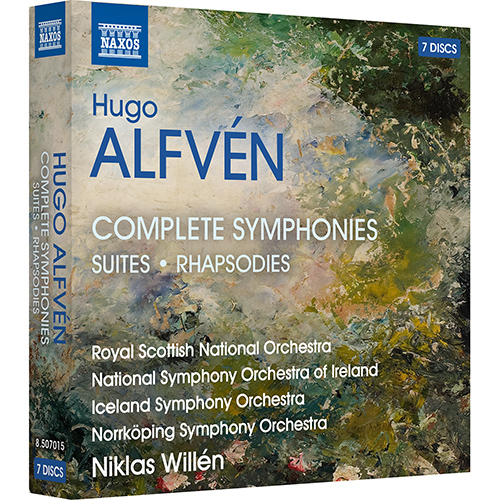
Royal Scottish National Orchestra, National Symphony Orchestra of Ireland, Iceland Symphony Orchestra, Norrköping Symphony Orchestra / Niklas Willén
Naxos 8.507015 [7 discs, including a bonus of Swedish Orchestral favourites]
Reviewed by Ben Hogwood
What’s the story?
Swedish composer Hugo Alfvén was born 150 years ago this year, and this attractive box set from Naxos celebrates the anniversary by bringing together the five symphonies recorded under the baton of fellow countryman Niklas Willén. They are presented alongside a number of Alfvén’s suites and orchestral works.
What’s the music like?
Attractive, airy and extremely enjoyable. Before Alfvén came along, Sweden had very few symphonic composers of note, Berwald excepted, and this cycle of substantial musical structures helped bring the symphony to a new audience.
Listening to each of the five works plots a course through Alfvén’s career, revealing him to be a gifted melodist and orchestrator. He writes with a clarity suggesting he studied the music of Mendelssohn and Schumann, but the orchestral works have an opulence closer to Richard Strauss and Wagner.
The Symphony no.1 in F minor Op.7 is laden with drama, if not yet fully confident in its structural steps. The Symphony no.2 in D major Op.11, which firmly established Alfvén as a composer, finds a glowing, lyrical approach. The Symphony no.3 in E major Op.23 is a joy, celebrating love and nature in the brightest E major, with richly tuneful episodes and rapturous outpourings from the strings. The Symphony no.4 in C minor Op.39, subtitled From The Outermost Skerries, has impressive depth, its four movements running continuously as they tell of the unique landscape of the Stockholm archipelago. Finally the Symphony no.5 in A minor Op.54 has a broader melodic platform, darker in some respects but loaded with extra resolve.
The accompanying suites show off Alfvén’s affinity with the stage and a natural aptitude for storytelling – The Prodigal Son, Synnöve Solbakken and A Country Tale all have good tunes and clear, bright orchestration. The shorter pieces included here should be better known, too – the Swedish Rhapsodies are winsome pieces, while the Festival Overture rises well above its functional role and the Elegy is equally meaningful.
Does it all work?
Yes, thanks to vibrant performances from each of the four orchestras used by Naxos in the gradual assembly of this cycle, all under the expert guidance of Niklas Willén. His choices of tempo are instinctively right, backed by an innate understanding for the flow of this music. An extra disc of Swedish orchestral favourites, featuring works from Alfvén, Larsson, Peterson-Berger, Söderman, Stenhammar and Wirén, is a considerable bonus.
Is it recommended?
Yes, with enthusiasm. While other composers may be ahead of him in the symphonic popularity contest, Alfvén’s music is highly attractive and full of good things for the casual or the attentive listener. Take this chance to explore further and you will not be disappointed!
Listen / Buy
You can find out more about this recording, and explore purchase options, on the Naxos website