It is a beautiful spring day outside Arcana’s ‘head office’ today…so to celebrate, one of Dvořák‘s sunniest symphonies is on the playlist. Here is a performance given by the Frankfurt Radio Symphony Orchestra and Manfred Honeck, in celebration of the green season:
Category Archives: Orchestral
The Bridge Festival – four days of live music for strings this week in Glasgow

We bring news of an exciting new festival coming to Glasgow this week. The Bridge Festival, originally scheduled for May 2020, is bringing some of Europe’s finest string-playing ensembles together for a four-day program of inspiring music.
Hosting the event are the Scottish Ensemble, who will be joined by the Trondheim Soloists, Ensemble Resonanz and the Estonian PLMF Music Trust, a talent development organisation offering opportunities for musicians without setting age limits.
The concerts are fascinating. Thursday 21 April will see a combined opening concert, all ensembles joining for a programme of Nachtmusik at the Barrowland Ballroom, with music from Hildegard von Bingen to Jonny Greenwood by way of two world premieres. These are commissions from Mica Levi (Flag) and Erkki-Sven Tüür (Deep Dark Shine), and the works are complemented by Penderecki’s Polymorphia – for 48 solo strings – and Greenwood’s 48 Responses to Polymorphia.
On Friday 22 April a lunchtime concert from the PLMF Music Trust showcases their home country. The trust, now nearly 20 years old, supports the development of talented professional musicians by organizing master classes, opportunities to perform and by introducing them internationally. Estonia! will include more Tüur (Symbiosis) and the Concerto for Chamber Orchestra from Jaan Rääts, while looking at the Estonian classical heritage through the eyes of Artur Lemba’s String Sextet and Heino Eller’s Five Pieces for Strings.
Later that day the Scottish Ensemble will perform Anna Meredith’s Anno at Tramway, with performances at 6pm and 8pm. Anno was written for the group, after an observation by the ensemble’s artistic director Jonathan Morton that Meredith’s style had similarities to Vivaldi. In response she wove an original work into Vivaldi’s Four Seasons, a clever interpolation that provides an invigorating live experience. The performances will be complemented by work from visual artist Eleanor Meredith, the composer’s sister.
Later still – at 9.30pm – there will be a chance to enjoy Ensemble Resonanz’s club night urban string, which will transform the Glad Café into a hotbed of minimalism. Music by Lou Reed, John Cage, Julia Wolfe and Glaswegian DJ Charlie Knox is promised.
Saturday 23 April offers what looks like a special concert of Nordic music old and new, given by the Trondheim Soloists. The ensemble will bring with them more traditional Nordic classical fayre – Grieg’s Two Nordic Melodies and Peer Gynt Suite, with the latter in a version featuring the sounds of the Norwegian national instrument, the Hardingfele. Sibelius’s Valse Triste will also appear, contrasted with Britta Byström’s A Walk To Gade.
Finally, on Sunday 24 April, comes a fascinating musical melting pot in Saint Lukes at 8pm. Ensemble Resonanz will be joined by guest performers including Hamburg-born bağlama player and vocalist Derya Yildirim and duduk player Deniz Mahir Katal. Twelve composers were asked to write a new work, with new compositions incorporating traditional Turkish, Anatolian, Kurdish and Greek songs, as well as new works for Derya’s voice, the bağlama (a Turkish stringed instrument, similar to the lute) and the string players of Ensemble Resonanz.
The result is a new, trans-cultural song cycle, combining old folk songs and new music, performed in modern cultural settings and creating a new experience of music from across Europe and across the centuries.
It should be a fascinating and inspiring four days of music – and for more information and tickets for each of The Bridge Festival concerts, you can head to the dedicated website
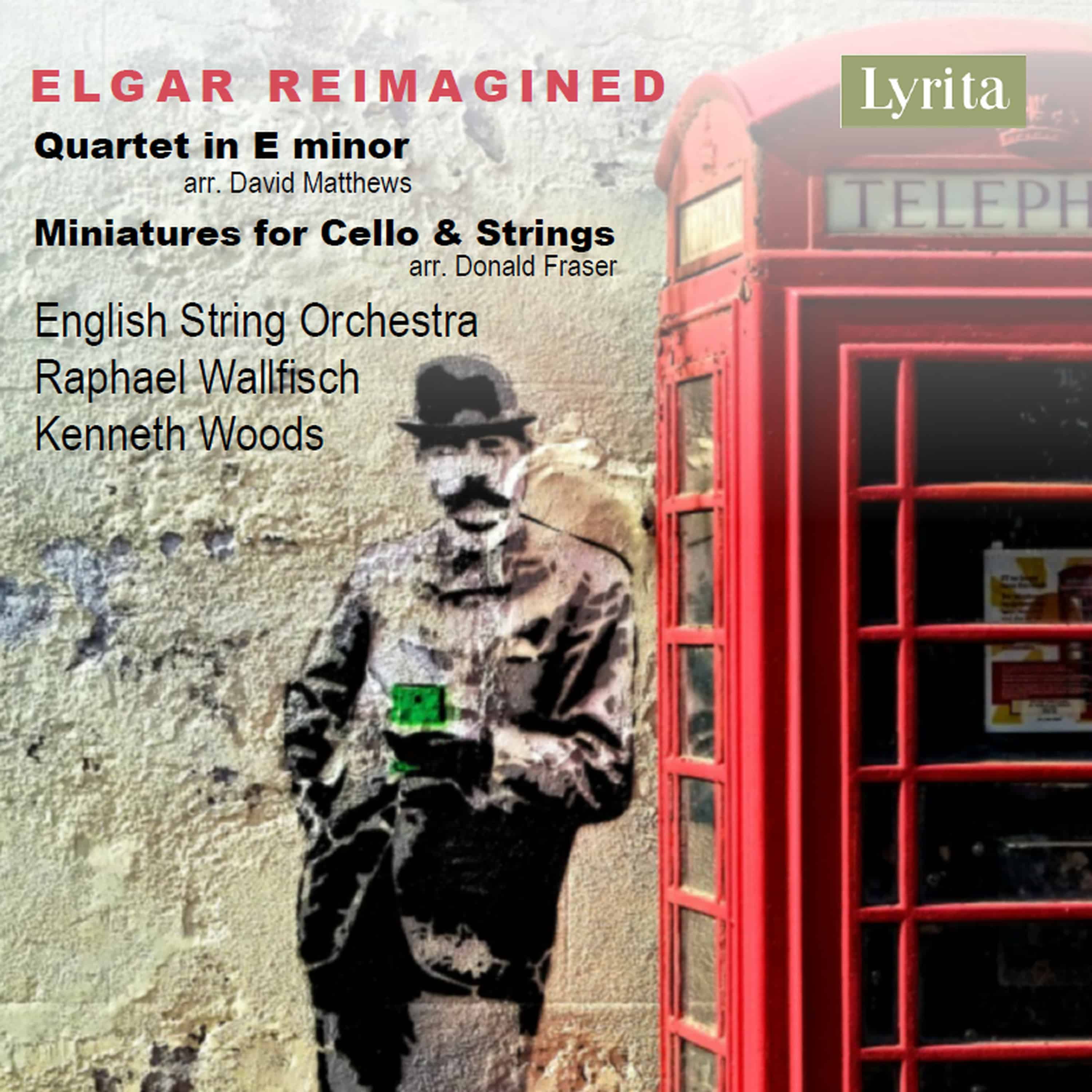
On record – Elgar Reimagined (Raphael Wallfisch, English String Orchestra / Kenneth Woods (Lyrita)

Elgar arr. Matthews String Quartet in E minor Op. 83 (1918)
Elgar arr. Fraser Miniatures for Cello and Strings: Chanson de Matin, Op.15 No. 2 (1899). Chanson de Nuit, Op.15 No. 1 (1899). The Wild Bears, Op. 1b No. 6 (1908). Nimrod, Op.36 No. 9 (1899). Romance in D minor, Op.62 (1910). Sospiri, Op.70 (1914). Mazurka, Op.10 No.1 (1899). Pleading, Op.48 (1908). In Moonlight (1904). Salut d’Amour, Op.12 (1888). Adieu (1933)
Raphael Wallfisch (cello), English Symphony Orchestra / Kenneth Woods
Producer Phil Rowlands Engineer Tim Burton
Lyrita SRCD 394 [69’27”]
Recorded 22 September and 9 October 2020 at Wyastone Concert Hall, Monmouth
Written by Richard Whitehouse
What’s the story?
This new release by the English String Orchestra focuses on Elgar, a composer championed by this ensemble throughout its 44 years of existence, whose music is given an appealing and (for the most part) instructive appraisal across the programme of arrangements featured here.
What’s the music like?
The principal work is the String Quartet in E minor, arranged by David Matthews. Second in a wartime triptych of chamber pieces, it is less introspective than the Violin Sonata preceding it but less emotionally charged than the Piano Quintet which came after, while arguably the most finely proportioned – not least in terms of the subtle transformation of thematic elements across and between its movements. In this guise, it follows on from the Serenade then Introduction and Allegro as the hitherto missing large-scale work for string orchestra of Elgar’s high maturity.
Matthews has been mindful to equate the soloistic with the ensemble potential of this music, so the result is neither straightforward transcription nor radical re-conception. The opening Allegro discreetly evokes an autumnal rumination as sets the tone for much of what follows; even finer is the central Piacevole, its main theme suffused with an intensity whose extent is only revealed at the close. If the emotional acuity of the final Allegro is marginally diffused, there is no absence of purposeful intent as the music proceeds to a coda of terse decisiveness.
The remainder of this programme comprises a sequence of Miniatures, arranged for cello and strings by Donald Fraser and played by Raphael Wallfisch. Ostensibly an 11-movement suite, its efficacy in terms of smaller groupings and even individual encores should be self-evident.
Chanson de Matin launches proceedings in mellifluous fashion, and if the cello’s assumption of the melodic line is slightly to the detriment of the original scoring, that could hardly be said of Chanson de Nuit whose sombre contours and inward character are unerringly realized. Nor does The Wild Bears lose out on vivacity, and if the arrangement conjures up Saint-Saëns, this only serves to underline the importance of ‘Second Empire’ French music on Elgar’s thinking. The cello’s dominance in Nimrod rather detracts from the subtlety of this Enigma Variation’s instrumentation – conversely, the Romance brings soloist and strings into even closer accord than the composer’s version with orchestra. The highlight here is Sospiri, which presents one of Elgar’s finest inspirations in a striking new light. Lighter fare comes in the robust tread of the Mazurka, followed by an eloquent take on the song Pleading. In Moonlight (adapted from In the South) responds well to such limpid treatment, as does Salut d’Amour in conveying its essence without cloying. A wistful take on the piano piece Adieu provides an affecting close.
Does it all work?
Very largely. The idiomatic nature of the String Quartet is enhanced by the ESO’s committed playing under Kenneth Woods, a follow-up to their recording of the Piano Quintet in Fraser’s orchestration (Avie), while Raphael Wallfisch’s conviction in the Miniatures is undoubted.
Is it recommended?
Indeed, not least as the quality of the playing is abetted by the naturalness of the sound and informativeness of annotations by Matthews and Woods. Heard together, these two parts of Elgar Reimagined make for desirable listening in this 165th year since the composer’s birth.
Listen
Buy
You can discover more about this release and make a purchase at the Lyrita website. For more information on the artists, click on the names for Raphael Wallfisch, Kenneth Woods and the English String Orchestra – and for the arrangers, David Matthews and Donald Fraser

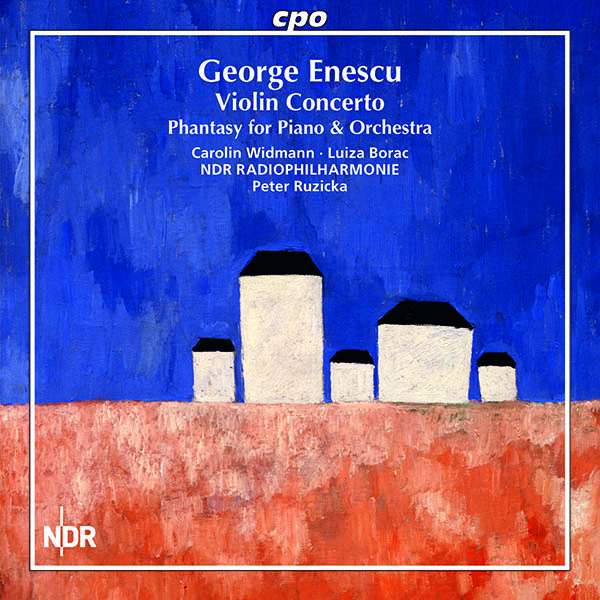
On record – Enescu: Violin Concerto & Phantasy (Carolin Widmann, Luiza Borac, NDR Radiophilharmonie / Peter Ruzicka) (CPO)

Enescu
Violin Concerto in A minor (1896)
Phantasy in D minor (1896/8)
Carolin Widmann (violin), Luiza Borac (piano), NDR Radiophilharmonie / Peter Ruzicka
Producer Elisabeth Kemper Engineer Daniel Kemper
CPO 555 487-2 [53’32”]
Recorded 25-28 May 2021 at Grosser Sendesaal, Landesfunkhaus, Hannover
Written by Richard Whitehouse
What’s the story?
CPO continues its coverage of little-known Enescu with this coupling of two pieces from the composer’s teenage years, persuasively rendered by leading performers and with a conductor second to none through his expanding the orchestral output of a still under-appreciated figure.
What’s the music like?
Although not his ‘breakthrough’ year, 1896 was a significant one for Enescu in terms of those compositions he at least attempted. He was not yet 15 when premiering the first movement of a Violin Concerto whose Andante was not played and its finale likely never written. Even so, the audience must have been surprised and even a little bemused at the audacity of a teenager who opened with an Allegro moderato rivalling those of the Brahms and Beethoven concertos in its scale and intent, and one whose technical display is secondary to its weight of argument.
Enescu having relocated to Paris after seven years in Vienna, evidence of competing aesthetic influences is not hard to discern – with Brahms the audible precursor of that Allegro, down to the climactic entry of the soloist after a lengthy opening tutti, then a (self-written) cadenza as serves a formal rather than virtuosic purpose. Despite being considerably longer than that of the Brahms, the Andante looks more to French antecedents – notably the Third Concerto of Saint-Saëns whose siciliano profile it utilizes, but not a tendency for pronounced expressive contrasts that is exemplified by the rhythmic impetus of its alternating episodes. Exactly why Enescu never completed this work is uncertain, yet if he felt its influences too obvious, such derivativeness need not be a barrier to appreciation or enjoyment of these movements today.
Enescu unlikely had any knowledge of the Violin Concerto that Busoni was writing at much this time, yet the former’s Phantasy has a tangible aura of the music his older contemporary was then writing. Witness the stealthy introduction as surges forth into the main movement, its alternation of genial assertiveness and ironic rumination itself a Busonian trait, as too the close-knit integration between soloist and orchestra or the subtle ambiguities of its harmonic writing. CPO’s booklet note gives 1898 as the date of composition which other sources give as two years earlier, but there is general agreement that its (only) performance took place at Bucharest in 1900. By then Enescu had written his first undoubted masterpieces, the Second Violin Sonata and Octet for strings, and no doubt felt the piece suffered through comparison.
Does it all work?
Yes, on its own terms. The rapidity with which Enescu evolved as a composer meant he soon left behind the influences as are audible here, which does not make either of these pieces any less worth hearing or merely for enthusiasts. Carolin Widmann is classy casting in the Violin Concerto, articulating its lengthy structures with no mean artistry, while the Enescu specialist Luiza Borac (most recently heard in in the torso of a Piano Concerto from the same period on Profil Hänssler) ensures a cohesion in the Phantasy without limiting its imaginative qualities.
Is it recommended?
Indeed, not least when the recording is unexceptionally fine and Volker Tarnow’s annotations are unfailingly informative. Hopefully CPO and Ruzicka will further their Enescu exploration with the Second and Third ‘School’ Symphonies or sundry orchestral pieces from this period.
Listen
Buy
You can discover more about this release and make a purchase at the Presto website. For more information on the artists, click on the names for Carolin Widmann, Luiza Borac, Peter Ruzicka and the NDR Radiophilharmonie