Talking Heads: Ryan Teague

Interviewed by Ben Hogwood

Asked to describe himself, Ryan Teague could easily offer the text of his website biography as a succinct summary. Here the multiple disciplines of composer, sound designer and multi-instrumentalist are listed, with the declaration that the Bristol-based artist ‘combines acoustic sources and arrangements with electronic synthesis and processing to create unique contemporary soundscapes’.

What we could add to that is that over nearly fifteen years of commercially released albums he has travelled through a number of very different styles, rarely visiting the same one twice. We have been able to marvel at his treatment of acoustic instruments in a style that allows the influences of minimalism and the gamelan to be heard. More recently, on the new album Recursive Iterations, he has started to look at algorithms and their use in electronic music.

It is a very distinctive style, as though Teague has joined up a series of different statements that travel round in circles, and each time they pass the listener something has changed. As we talk about his music, he agrees with this first point. “Yes, that’s pretty much it in a nutshell. The algorithm is exactly that, a 360 degree rotation, with every variation possible within the parameters. It’s not always obvious, and some come around more often than others.”

The press release is helpful here, describing how ‘the musical structure is derived from a custom–written algorithmic system that sequences harmonic and rhythmic events in ever-shifting patterns. Hyperreal electro-acoustic phrases and digitally synthesised fragments come and go in continual rotation, re-framed and re-contextualised by their proximity to other events in the sequence as the compositions evolve. The effect evokes a minimalist bricolage, hypnotic and kaleidoscopic in nature, and calls to mind artists such as Oneohtrix Point Never, The Haxan Cloak and Ital Tek‘.

In spite of this detail there is plenty of room for manoeuvre and expression. Some of Teague’s melodies and harmonies are playful, and some are left open-ended, as though he were facing outwards. “I think there’s a sense that it’s constantly leading you somewhere but never quite arriving,” he says. Picking the second iteration as an example, he cites the use of “sounds off an old radio from the 1950s, together with a Hawaiian guitar. They kind of fit together. Getting them to work coherently together is a challenge but one that I really enjoy.”

He has a wealth of experience of music in the longer form – substantial instrumentals on his albums prove that – but also in the shorter attention span world of advertising and TV. Has that helped him with what is a concentrated approach on Recursive Iterations? “It has a bit, but I think the relationship is more derived from exploring certain aspects rather than the film or advert work. It’s getting to the bottom of sound design and pushing sounds to their limits, so that you are finding the very bottom and the very top of each. I guess working in TV stuff you have to get proficient at very broad briefs and sonic requirements, but this was more of a personal point. It helped that I have been working with a really good Hi Fi system and seeing how far I could push it. I have an ARCAM amp and B&W speakers, and on those it has been a real revelation to hear things in such a different way so it informed my work in more recent times.” It also explains why the new album comes into its own on headphones, the full range of its frequencies revealed.

Contrary to expectations, Teague’s training has not been formal. “No, not strictly”, he says. “On my very first press release someone put that I’m classically trained. I’m not, but I went to art school and studied sound intensely. I find that I’m more interested in structures, and I play classical guitar, but I’m not formally trained. I would say I have a good understanding of harmony, and also that I was always ambitious with sound. As a kid I was really making dance music, and that’s what I always thought I would be doing for a while. I have ultimately found beats to be restrictive though. There was a linear path that I had to get off in my early 20s, and I wanted to find ways I could express myself.”

Teague approaches his structures “more through clarity of vision of ideas, and I literally see them visually. I know what I’m going to do before I start. For me the timbre is very visual, so that when I’m working on a metallic piece, I am focused on achieving a particular sonic effect. It’s architectural rather than sitting down at the piano. When you get to constructing harmonies, that’s where you have to sit down and work it out.”
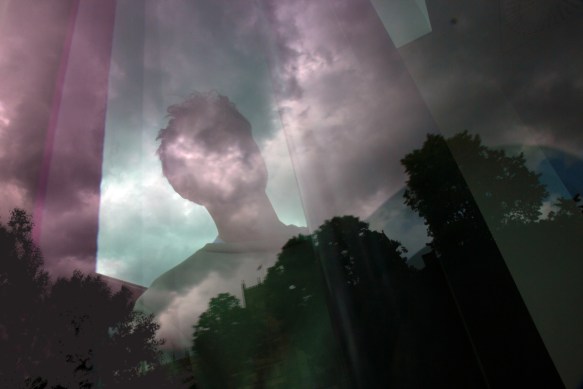
A common mistake from reviewers and interviewers – this one partially included! – is that Teague is influenced primarily by the music of Steve Reich. Yet while he fully respects the work of the master minimalist, Teague’s references spread further afield. “The Reich reference comes up a lot, probably in every review I’ve ever had, but if anything I was much more interested in the work of John Adams, and his sense of structure and development was much more in my early references. Colin McPhee was a big inspiration to me too, because I went on to study the gamelan myself. He achieved things more than 50 years before the likes of John Adams and Steve Reich came along, and is tragically not really credited for that.”

Post-tonal music also exerts a pull, though more in its instrumentation and concentration than its actual harmonies. “Webern is a very strong influence”, says Teague, “distilled down to his element. What he does in his music is not to be afraid of silence, and to use the space between notes to make the maximum impact. For me Webern is incredibly innovative, and massively overlooked. I would also check Morton Feldman, for his use of time, space and colour. A lot of electronic music too. I don’t tend to keep up with what’s going on at the moment, but I do have my comfort music.”

He thinks on, and another name comes to mind. “One reference especially relevant to Recursive Iterations would be Richard Skelton. He pretty much works solely with acoustic instruments, with beautiful strings, drones and treated piano. He sets up a few things that keep happening at various points, using beautiful, shimmering music without being too cheesy. That is a challenge that I set myself, asking how can I set things on their own cycles without getting in their way?”

As befits a composer of several disciplines, Teague is working on a number of different projects concurrently. “I have a TV thing and a film thing, but can’t say too much about either unfortunately. The album was only finished back in July so I’m formulating my next project, which will be very different. I am thinking perhaps of something in the live arena with a different energy. The studio can be a bit lacking on its own so I’m keen to open things up and take in a different energy. I have ideas forming in that area!”

He agrees that Recursive Iterations is very different to previous albums, “I’m never a good judge of that sort of thing, but that’s happened before. It is certainly very different to the kind of guitar-based stuff I did for Causeway or when I worked with the gamelan for Storm Or Tempest May Stop Play. That has been dance music with acoustic instruments.”

“I could almost have different audiences for different projects”, he considers, “because I go through different phases of different styles and I’m quite clear about the sonic worlds those things inhabit. Recursive Iterations sounds more electronic, and thinking back I guess Burial would be another key reference. Sometimes I think I’m not representing myself very well, with such different styles!”

At this point the music of a composer such as Beethoven comes to mind, the composer able to move between such contrasting forms as symphony, string quartet, piano sonata and song. “I think it changes as the scene evolves, thinking of the present day”, says Teague. “With the post-classical scene my involvement was back to 15 years ago, with the Six Preludes but more recently it’s gone nuts. I’m trying to do something else now. Maybe I could cash in and do loads of piano music now, so that we could play it to people in offices and pacify them! These things all get capitalised on and it becomes a business. So many labels are jumping on that and it’s a bit too late now. The album I’ve just finished was a bit of an antidote to that for me, with the idea to do something bolder sonically.”

Ryan Teague‘s new album Recursive Iterations is self-released on Friday October 25. It can be heard and purchased from his Bandcamp site below:

Stay tuned for a special playlist from Ryan, exclusive to Arcana, in the coming days!

In concert – Loscil & Marconi Union @ Rich Mix, London

Loscil & Marconi Union

Rich Mix, London, Monday 21 October 2019

Written by and images (c) Ben Hogwood

How do you define pure musical ambience? Is it music you can leave it on in the background and do all manner of tasks to, or is it the sort where you become so transfixed that everything else is blocked out?

Loscil’s music falls emphatically into the latter category. He may have been on the stage at Rich Mix for 45 minutes, but for that time the entire audience were gathered up and taken to the outer reaches of Vancouver, British Columbia. This is where Scott Morgan, the man behind the moniker, resides – and it is the wild, open panoramas of the region that his music so successfully evokes.

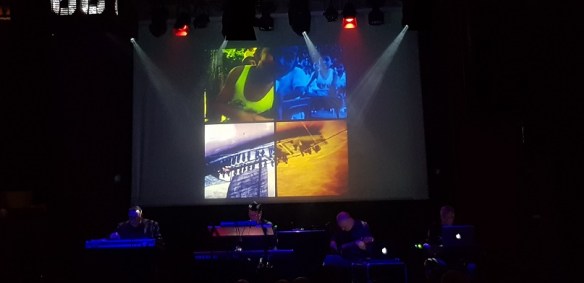
Equivalents, his most recent album, is a series of responses to black and white photographs of clouds by Alfred Stieglitz in the early 20th century, and the formations billowed on projections behind Morgan for much of his set. This aided the feeling of total immersion in the elements, meaning all we were lacking was the wind on our faces and the rain on our heads.

With little in the way of propulsive rhythm, Loscil’s music somehow captures the raw power and scale of the elements, the expanse of the Pacific coast stretching out as far as the eye can see. The mind’s eye is also drawn to natural phenomena closer at hand, with forests, lakes and birds all effortlessly alighting in the imagination.

We traversed five numbers from the Equivalents album in all, in a I – III – II – V – VII formation (with the image for the beautifully restful II shown above). The air was thick with big chords, Loscil’s keyboards and sequencing taking on quasi-orchestral designs. When silence arrived, in the middle of the set, nobody dared to move – and, after an intake of breath, on we went. It is a long time since I saw an audience so transfixed in a gig, and Loscil’s music took us somewhere truly special, way outside of a bar in Bethnal Green.

Supporting this transcendental experience was a more beat-driven variation on musical ambience from Marconi Union (above). The long-standing Manchester group make music that is more urban in origin, at one with the setting in which we found ourselves. Like Loscil they used projections, usually halved on the screen and complementing the more city-based and percussive approach perfectly.

Night time visions for tracks like Sleeper were transporting, as were the images of travel by car or train before them. Piano and guitar were key elements here, sensitively played as the quartet gelled effortlessly on stage.

The first part of Weightless was arguably the most effective, its subtly changing textures and evocations of twinkling lights most effective before an audience fully on board with this antidote to Monday night drudgery.

Both acts offered proof positive that ambience can be a transporting experience, and that the rich talent and intensity in this field remains undimmed. With well-chosen DJ sets from The Grid’s Richard Norris in and around the live acts, as part of his Group Mind initiative, this was a night to celebrate the surprising power of ambient music, whether foreground or background.

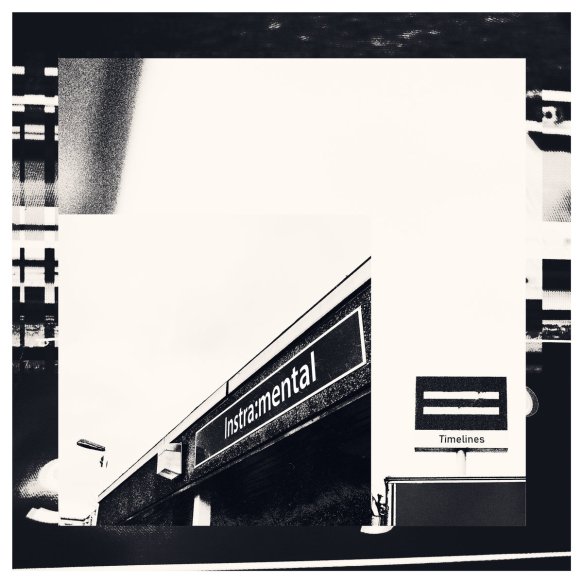
Switched On – Instra:mental: Timelines (Nonplus Records)

reviewed by Ben Hogwood

What’s the story?

When Instra:mental started the Autonomic podcast series with like-minded producer dBridge, their mantra was ‘music first, drum & bass second’. The duo – Alex Green (aka Boddika) and Damon Kirkham – qualified this by saying at the time that their aim was not necessarily to make a drum & bass track, but to make music that was ‘emotionally charged, personally edifying and organic’. They proved this in their excellent contribution to the Fabric compilation series.

Timelines revisits the Autonomic series from their perspective, bringing together five of vinyl-only contributions with six previously unavailable archive tracks. Marking the fiftieth release on the Nonplus label, it is in effect their second album, eight and a half years after the excellent Resolution 653 in 2011.

What’s the music like?

With little reason to change a successful formula, Instra:mental continue to switch between brooding panoramic instrumentals and close-up, stripped back pieces of sharper sound and raw rhythm. Sakura and Pacific Heights fall resolutely into the former category, beautifully structured and weighted, and keeping a serene beauty until bolstered by the substantial rhythm sections. Tracks like Encke Gap, with its more explicit techno references, fall into the latter description.

The music will appeal to drum & bass listeners but it is actually more versatile than that, flexible enough to bring in lovers of deep house or even slower jams. This is because a lot of Instra:Mental’s music can be appreciated at either a fast or slow tempo. As they say in their commentary to the album, a lot of their tracks operate at a nippy 170bpm – but have rhythms inbuilt to cater for those who might prefer half the speed. This brings a curious tension to their music as well, found in the likes of the slower Deep Night, a nocturnal scene with a slight edge, or Photograph, a subtly reflective beauty. End Credits is even more delicately shaded, but again the tension this creates is exquisite.

Watching You is a superb example of their craft, a nocturnal, urban portrait, while Elsewhere has a 1980’s soundtrack edge to its main riff, an intriguing clash of modern with recent past that pans out nicely to a wider perspective around halfway through. Final track More Than is perhaps the pick, another piece of reflection but a beautifully voiced one.

Does it all work?

Largely, yes. Heard in a single LP the duo’s approach can seem a little singular at times, but if you’re listening on good headphones you will be able to fully appreciate the nuances of their rhythms and the ‘less is more’ approach that makes their music more pictorial. Better still, hear it on a dancefloor somewhere!

Is it recommended?

Yes – fans will not need any convincing and will certainly be pleased with the results of Timelines. It will be interesting to see where the duo go from here.

Stream

Buy

Switched On – Back To Mine: Jungle (DMC)

reviewed by Ben Hogwood

What’s the story?

The rejuvenated Back To Mine series – now into its third decade – moves on to Jungle. Two albums down, the figureheads of the seven-strong group, Josh Lloyd-Watson and Tom McFarland, have put together a collection of the music making them tick behind the scenes. As with a good number in the series so far, that means selections from the tour bus, the after party and almost certainly the morning after. It provides an insight to fans from behind the scenes on what makes them tick, and illustrates their policy of going for music they like, whatever the genre.

What’s the music like?

Predictably varied. After a nice bit of hot weather soul from Barbara Moore, it’s not long before the temp rises with No Fear, a lovely bit of affirmative Afro-funk from Jungle’s own producer Inflo, and the funk-fuelled disco house of Merle’s Fannie Likes 2 Dance. Having switched tack with four to the floor we go deeper with newer house from Manuel Darquart’s Birds Of Paradise and the lush heat soaked Red Haze from DrumTalk.

Gradually the tempo slows with the bumpy Space Cadet from Admin, a lovely deep bit of funk, and the even more lush sounds of The MariasCariño. All the while we are heading for Sly5thAve and a superb cover of Frank Ocean’s Super Rich Kids, a typical example of Jungle’s light hearted and party fuelled approach.

The small hours having arrived, it’s an ideal opportunity for Kamaal Williams’ woozy High Roller, Sam Evian’s soft hearted Next To You and an off kilter Lavender from BADBADNOTGOOD and KAYTRANADA. As is traditional the host should add a track of their own, and Jungle’s is a typically heady Come Back A Different Day, over a stumbling rhythm, which pans out even further to Mansur Brown’s Shiroi.

For the home straight it’s slower and sultry funk from The Flying Stars Of Brooklyn NY’s Live On, then SAULT’s catchy torch song Masterpiece. Paul Cherry’s Like Yesterday is a rueful song of modern relationship ills, before the sleepy cinematic closer, HNNY’s Sunday. The house lights go up soon after!

Does it all work?

Pretty much all. Jungle have nailed the brief of the Back To Mine series, which ideally keeps the listener entertained and guessing, while educating them on some new sounds and bringing a bit more perspective to the music the hosts make. Jungle tick all those boxes and add some humour, sauce and funk.

Is it recommended?

Yes – an easy recommendation for a really enjoyable set of tunes. A bit smoky, certainly a bit rhythmic, and uplifting too. What’s not to like?

Stream

Buy

Switched On – Special Request: Offworld (Houndstooth)

reviewed by Ben Hogwood

What’s the story?

Paul Woolford’s third album of the year under the Special Request moniker attempts to answer a question. What if Jam & Lewis signed to Metropolis?

The thought of one of soul music’s finest production duo hanging out with Juan Atkins at the beginning of another era in Detroit musical history in the mid-1980s is an irresistible one, and Woolford’s ambitious attempt to bring the combination to life is what powers Offworld.

What’s the music like?

There are seven expansive tracks, mostly instrumental and rich in analogue colour, put together with Woolford’s trademark instinctive approach.

Immediately it finds the sweet spot with the booming bass, analogue highs and strong vocal of 237,000 miles. More typical of the album are the vast spaces evoked by Offworld Memory 3. Front Screen Projection looks back to Jean Michel Jarre with its synth sound and riff, but forward with its no-nonsense breakbeat, while Arse End Of The Moon, a classic Woolford title, has sharper sounds and clattering, big beat percussion. Morning Ritual is also a lovely track, a brooding instrumental, before a rather fine remix of The Grid’s Floatation, signing off with an affectionate quarter-hour of expansive ambience and a nicely done retro beat.

Does it all work?

Once again – yes. Woolford never pads his albums out too much, either in texture or duration, so while Offworld is not much longer than an extended EP without the Grid remix, it works brilliantly well.

Is it recommended?

Yes indeed – as much as the first two albums of this year’s crop did. Paul Woolford is on a roll right now and it’s up to us to keep up!

Stream

Buy