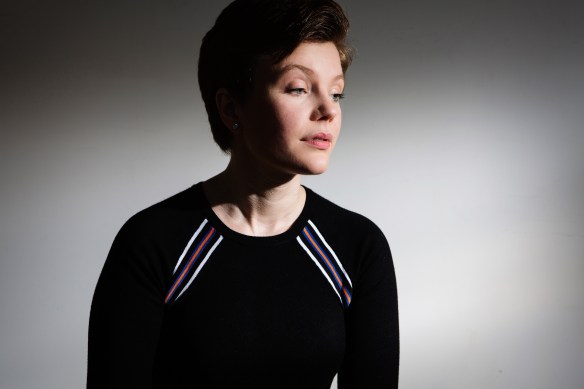
Clare Hammond talks to Arcana about her upcoming world premiere performance in Cardiff’s Hoddinott Hall of Kenneth Hesketh’s new Piano Concerto, and new disc of music by Mysliveček.
Interviewed by Ben Hogwood
The premiere of a piano concerto remains a special event, even in a form that has been in existence for at least three hundred years. Pianist Clare Hammond currently has interest in both ends of that evolutionary spectrum, for in the first quarter of 2019 she gives the premiere of a brand new Piano Concerto, by Kenneth Hesketh – but also releases a new disc of little-known works for keyboard by 18th century Czech composer Josef Myslivecek, including two piano concertos.
Arcana took the opportunity to talk with Clare about these exciting developments, beginning with Kenneth Hesketh’s new work, due to premiere this Friday! His concerto has the intriguing title Uncoiling The River, which perhaps unwittingly is depicted in visual form by the river of paper required for the piece and posted on Twitter by Hammond recently:
Clare has no doubt on which way her latest encounter with Hesketh’s music is likely to head. “It’s going to be absolutely brilliant”, she enthuses. “It’s a mammoth piece from list of… Lots more to do than just play the notes on the piano. New influences, incredibly complex. Rich work on all fronts.” It is the latest in an extremely productive meeting of creative minds. “We met in 2010, and since then we have worked together a lot,” she explains. “Ken has talked about writing a concerto for some time, and pitched it to the BBC and the Royal Liverpool Philharmonic Orchestra. We managed to get things together, and he wrote it once we had the commission.”
It was not the first time Hesketh has written for Hammond, with a complete solo piano disc entitled horae (pro Clara) released on BIS last year. “The horae is a 40-minute solo piece written for me, and it uses extended techniques,” she explains. “Ken’s style of writing is often very complex and dense, and it has a lot of mechanical energy. I feel quite natural with it although it takes ages to learn the notes.”
How long did it take to learn the concerto? “To get up to speed, to the state of working with an orchestra, takes about three weeks”, she says. “I like to blitz things! I’m much quicker than I used to be, and I have methods. I have new ways of marking up scores, in my own different colours, I found it really helps and I have funny ways of managing music, with the page turning especially.”
Uncoiling The River, while dedicated to Clare, has a meaningful dedication to her second daughter, one-year old Emme. “It’s particularly personal as we’ve developed a close collaborative relationship. In the Piano Concerto we use a Kolam for Emme, which is a Hindu tradition passed on from mother to daughter. It is a geometric pattern made with coloured rice, and that is the point in the concerto where I use the bells – I have ten of them on a table next to me, and the Kolam dictates the way they are laid out. It’s a nice thing for Emme, and Ken’s also drawn a picture for her that she has in her room.”
Understandably Emme will not be at the premiere, which will take place in the BBC’s Hoddinott Hall at the Millennium Centre in Cardiff. It will form the centrepiece of a concert marking the hall’s tenth anniversary, and judging from the opening page will feature a sizeable orchestra. “They are quite large forces,” confirms Hammond, “but Ken uses every element in a very imaginative way. It’s a completely unified piece of writing. We don’t rehearse with the orchestra until two days before the concert, but I’ve heard a MIDI version in Sibelius that replicates the sonorities, which is really helpful.”
I ask Clare about the stylistic innovations she mentions in the piece. “It is a very tense and complex piece. I’m assured the orchestral parts aren’t too complicated but sometimes he has a very different sonority in mind. One of the main influences on his sound was the time he spent as a choirboy in Liverpool Cathedral, and how he heard the music from where he was singing. The sonorities he heard in the cathedral mean it wouldn’t necessarily be crystal clear, but he uses that to the advantage of the overall sound and it’s in force here. It has informed a lot of his work over the years, too, to play with the sound in an architectural sense.”
Hesketh is not the only composer with whom Hammond enjoys a strong creative bond. Her recent disc of piano works by Robert Saxton garnered critical acclaim (not least on Arcana). “That was a lovely disc to make, because he is another composer with whom I have a good relationship over a long period of time. Over half the disc is music written for me so it is a really personal piece of work. It finishes with a lullaby for Rose my older daughter. He ‘met’ her when she was 2 months old, and since it was released it’s got an enormous number of hits on Spotify thanks to being included in a number of playlists.”
She is keenly aware of the importance to combine working with living composers and playing much ‘older’ music, and highlights the mutual benefit of working this way. “For me it’s a really fulfilling way of doing things and exploring the repertoire. You’re continually pushing boundaries, both stylistically and personally. I think getting the composer’s feedback in real life is great too. Sometimes we deify the music that has lasted all this time from Mozart and Beethoven, say, and you have to touch it with kid gloves. The composers I’ve worked with are practical and pragmatic and know how to create the sounds that they want, and there’s not that stultifying approach at all.”
From Mozart’s time rather than Beethoven’s, Josef Mysliveček is a very intriguing figure to say the least. “He was friends with Mozart, and was the only composer that Mozart really respected”, says Hammond, “though sadly they became estranged because of his business with Mozart’s father Leopold”. It is tempting to thing Mysliveček would be considered for reappraisal because of his colourful past (he was known as Il Boemo (The Bohemian) but as Hammond explains it is his music that does the talking.
“Mysliveček’s music has a certain freshness and a vitality to it, and although now we are used to complex textures and outlandish harmonies, this was all very exciting in his time. It’s a new thing for me – and if he is completely new to you as a composer I would recommend you start off with his Wind Octets:”
For her new disc of Mysliveček Keyboard Concertos and solo works, due for release on BIS Records in March, Hammond worked with the Swedish Chamber Orchestra. It is another example of a rich and varied career of collaborations, typified by a recent audiovisual project Ghosts And Whispers. It is described on her website as ‘an unbroken sequence of fragments, last thoughts, elegies and absences by Schubert, Mozart, Wagner, Janáček, Stravinsky, Jacquet de la Guerre and Schumann, inter-leaved with movements from John Woolrich’s Pianobook.’
Her enthusiasm for the project matches that for her work Hesketh and Mysliveček. “I want to continue with it, as it’s been really interesting. Initially John Woolrich got in touch with the Quay Brothers, who are stop-motion animators, and had the idea for this project. I don’t have much experience in this area, and working with living artists is really interesting. I only actually saw myself in it recently, and it was the first time I’ve heard it and seen it for the first time. The synchronisation informs the narrative of the film and that’s really exciting.”
This is not the only time Hammond has appeared on film, for she has a piano-playing role as a younger Miss Shepherd in the big screen adaptation of Alan Bennett’s play The Lady in the Van. “If the opportunity comes up again I would do it for sure,” she says. “That film was particularly lovely, and not just because I was working with people who are brilliant at their job but because they are really nice people. It came out the blue, from a friend of the composer assisting George Fenton, who wrote the soundtrack. They needed a young pianist with blue eyes, and they thought of me!”
Clare Hammond and the BBC National Orchestra of Wales, conducted by Martyn Brabbins, will give the world premiere of Kenneth Hesketh’s Piano Concerto, Uncoiling the River, as part of a concert celebrating the 10th birthday of the Hoddinott Hall in Cardiff on Friday 25 January. The concert will be subsequently broadcast on BBC Radio 3.
Details of her new, forthcoming disc of Mysliveček – due for release on BIS in March – can be found on Hammond’s website.
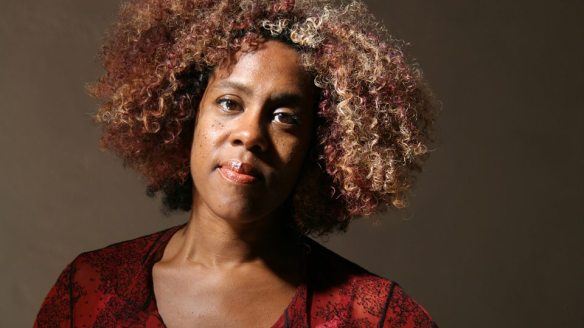
Errollyn Wallen is a positive force to be reckoned with in music. One of the primary reasons for this is her refusal to be restricted or compromised on a number of fronts, chief among them musical style and diversity. Both have presented lasting historical problems within classical music, but a chat with Errollyn makes anything seem possible through collaboration, flexibility and inclusivity. All these qualities and more have led to an MBE, awarded in June 2007 for services to music.
One of her passions and major achievements – as well getting her music played in space (of which more later!) is her involvement with Snape Maltings’ Friday Afternoons project, inspired by Benjamin Britten but taking on a new lease of life since the composer’s centenary year in 2013. Wallen is the composer of a dozen new songs for this year’s project, which she has entitled MAP: Songs For Children Everywhere. The collection is inspired by her travels around the world, from her native Belize to Suffolk and from Palestine to Scotland, and received its premiere in May at Hull’s Albermarle Centre. For performances as part of Friday Afternoons, which takes place on Friday 16 November, choirs can download the music directly from the website, where there are guides to difficulty, duration and availability.
When Arcana calls to discuss the new cycle Wallen is jetlagged after a trip to Nebraska, but she proves an engaging and passionate interviewee. She talks enthusiastically about her early meetings with the team performing MAP. “It was really inspiring with the school children, and part of the joy of the experience has been accompanying them myself. I was up there as far back as February, and I also tried some songs with local children in Suffolk which went well. It’s been so inspiring, we enjoyed hearing their response and they enjoyed it early on in the process.”
Her approach was one of freedom. “I tried not to write too much down, and I tried to put myself into my child’s self, which is why I included the song It’s Quarter To Nine:
Children find everything interesting. For instance Lonely Dog was about how there was a dog just mooching around at a bus stop:
… while A Sweet Shop in Jenin was about a shop full of amazing sweets in Palestine:
The Baby came about through working with Mahogany Opera, asked a boy if there’s a baby in the house. In some ways I knew children would get the idea and feel of the songs and use them to make vivid pictures, and that they would love the sound of words. All the texts are my own except for this one, it was a lovely, bouncy rhythm:
She considers the musical advantages of working with children. “They don’t have the barriers that adults might do, and also the voices I was writing for were untamed so I had to think about that too. I don’t go too much below middle ‘C’ in the songs, but I was still trying out the ranges of things. Some would be stretching difficulty but I also included an unaccompanied song, so that it gets across the freshness of children’s voices. In Rice and Beans – and Plantain too! I was using a song I admire called Old Abraham Brown. The song was modelled on it, using the words “I like rice and beans”, and using canons to create counterpoints. He’s a person that’s always been on my mind, and it was thinking back to the singing we did at school.”
Wallen is a passionate advocate of choirs in schools. “It’s a way in for children. You’ve got the words, stories and atmospheres, and you have security of singing in a larger group. A good example is that at one of the schools we went to there was a girl who couldn’t sit still, but by the end the kids were focussed on learning and she joined in with all the singing.”
It was important to her that Hull, last year’s City of Culture, should be part of the project. “I particularly asked to go back”, she says. “I was involved in the PRS Foundation biennial, and I also worked with a residency with refugees and primary school children. I was made aware of just how much singing they didn’t do. Together we made a piece about water and Hull, a companion piece to The Mighty River. I said let’s go back to Hull to continue that legacy. There will be lots of schools performing at the Albemarle Centre, we had a workshop with works for solo cello. The youngest was three and the eldest was 70.”
The composer continues to be a frequent traveller. “You store up impressions,” she says. For MAP I thought I’ve been to so many different places that I wanted to share some of those moments. One of the songs, Star, came from a memorable drive in the highlands of Scotland where I saw nobody for a long time but then came across a group of 20 or so deer. I was thinking about how would I remember the moment, and I can’t tell you how much I enjoyed composing it and am so pleased to have written it!”
While her travelling has so far remained Earth-bound, Wallen’s music has gone ahead of her into space – including her self-titled solo album ERROLLYN. “This happened because I met an astronaut in Houston called Steve MacLean”, she recalls. “He gave a talk to two of us which was great fun. He said he had always wanted to learn piano, but his children laughed at him. I taught him the bass line of my song Guru, so that he could improvise over it. He was about to go on to the Space Shuttle STS-115. We became very good friends, and later I made a short film with him called Falling. He took all three of my CDs to space with him, and NASA framed one of them for me. It was wonderful hearing his stories.”
Errollyn’s Ensemble X has a stirring motto: ‘We don’t break down barriers in music… we don’t see any’. Does she feel we are starting to get there in music across the board, or is there still much work to be done? “I think we’ve still got a long way to go”, she says with a hint of weariness, “but it can only be economics. It doesn’t make sense because I’ll go somewhere like Venezuela that has so much poverty and rich diversity in its music. We’ve got a perception problem with the wider public. The musicians know that’s not true. The funding cuts in schools do not help. We need to avoid losing generations of children who are talented and missing out. I do worry a lot, but when I see what Chineke! are doing the response is fabulous. Yet some people have been uncomfortable with them and that’s not the way to do it.
The positives are very clear, however. “It’s a joyfulness too”, she says. “I love playing with Chineke!, and Chi-chi Nwanoku, their founder, creates an atmosphere of true collaboration. It hasn’t been that easy with a lot of people, because when I started I was told what not to do. Everybody’s got to do what they want to do, and it’s wrong to hold them back.”
Chineke! and the emerging cellist Sheku Kanneh-Mason are of course closely linked, and while Wallen welcomes his prominence there is a guarded warning too. “The world is ready for Sheku and it’s brilliant that he is there, but there have been Shekus before him. I think it’s a good time that people are waking up to the importance of diversity. What I have learned is that you cannot expect things to change unless you are taking part in them yourself. If you have grown up without seeing a person of colour you might have prejudices that are wrong. It’s not your fault but it’s important to recognise it.”
As regards writing for those of a much younger age, the importance of this task is not lost on her. “I still think composers and institutions think writing for children isn’t important, but it’s the future and sets what they remember. I wanted to be close to the action and see if I’d judged this right.”
For more information on Errollyn Wallen, you can visit her website
With the divisiveness surrounding these shores on account of Brexit, here is a tale of cross-European collaboration and unity. London-born and Italian based, conductor Damian Iorio has close links with Russia, France – and Milton Keynes. Arcana hooked up with him for a chat about conducting Russia’s flagship opera, bringing classical music to the UK commuter belt and promoting ‘home’ composers via the Naxos label.
We begin by talking about the flagship opera – Musorgsky’s epic, Boris Godunov, which Iorio has conducted at the Opéra Bastille in Paris this summer. He is wholly enthusiastic about the experience. “It has been very good, and what helps is that the production itself was great, and of course the music is marvellous. The cast have been phenomenal too. This is the first time I’ve conducted Boris, and we have done the first version – which isn’t done very often. It is not so well known, and there has been a lot of hard work to get it free and put it on.”
The opera had a complicated genesis, which he takes up. “The potted history is that the first version wasn’t passed by the imperial theatre committee, because they wanted more female roles. There were large-scale scenes, and it was never staged. Then for the second version he added the last act, and it was staged but not ultimately very much. Musorgsky was not a professional composer and his technical abilities were not so great, so Rimsky-Korsakov completed an orchestration, and this was taken as a new edition. We had to tweak it a bit, restoring some of the chamber-like qualities of the first version, especially because in Bastille we had a 15-year-old singing the address, so we had to be very careful balancing that out.”
Iorio has conducted opera in Paris before. “Ten years ago I was there to conduct Smetana’s The Bartered Bride”, he recalls. “From that I learned they have their own characteristics, and I remember the entrance to the pit and feeling the history behind me. There’s a little door near the pit that goes to a lake, a man-made reservoir. I thought I could disappear forever with all the ghosts of the past! It is a very large pit, and when I conduct there I feel a great sense of occasion. It is a real honour and privilege to have been there.”
Boris has more Parisian connections – and has also reaffirmed Iorio’s love for Russia. “It is a very important musical statement that has influenced both Debussy and Ravel”, he asserts. “The Pushkin libretto is based on fact, and so it is a very important historical statement. We worked with some great Russian singers for this production, and they treated me as Russian. I love the country deeply – my wife is Russian, I speak Russian, and it is an honour to be respected like that. I learnt from them of course, not least because the librettos were incredibly complicated. My wife and I translated it word by word to get behind the double meetings. The published version is complicated, and we had to get behind the text to understand the history of certain phrases and sayings.”
First impressions might imply opera in Paris and concerts in Milton Keynes inhabit very different worlds, but Iorio enjoys the contrast between the two. He has been Music Director of the Milton Keynes City Orchestra since 2014, and enjoys it greatly – with music the common ground linking this to his work in Paris. “Milton Keynes is a very different animal but we have had Russian music there too in our recent season, through a programme of operatic music. We have done Mozart and Haydn too, and we have hooked up with some fantastic musicians, including Stephen Hough and Chloe Hanslip.”
He thrives on his dual nationality, as well as a multicultural thread that runs through his family. “I am half English and half Italian, and all my family are musicians. I was born and brought up in the London musical life, but I’ve worked for periods in Italy and lived and studied in Russia. I have a great affinity with Russia and actually feel quite Russian. To add to that I played in a Danish orchestra for six years, and still speak Danish now. It’s very important to know languages I think, to relate to the people you work with and the environment you’re in.”
The conductor is keen to further the cause of a number of Italian composers from the turn of the century, in the process of being rescued from comparative obscurity. Respighi is already relatively well-known, and Iorio has explored the trilogy of Roman symphonic poems with several orchestras, most recently the Kyoto Symphony Orchestra in April. The cause of Pizzetti and his contemporaries, however, is lesser known – and Iorio has recorded a disc for Naxos of the composer’s Symphony in A major and Harp Concerto.
“There are a lot of Italian composers who are not so well known,” he explains. “The list includes Malipiero and Casella as well as Pizzetti. These were all important figures at the time, but they had a rather different relationship with Fascism, and relating with the opera became more important in Italy. What I have been trying to do recently is to discover and record the repertoire of these composers. When my father was growing up, Italy was a great place for the Avant-garde. Last for a few decades but very interesting looking back. The Pizzetti symphony was written for the 2600th anniversary of the accession of the first Emperor of Japan. Britten wrote the Sinfonia Da Requiem for the same festival but it was turned down – and yet he had written this incredible piece. Pizzetti was considered on the same level as Britten and the Soprano and Harp Concerto are beautiful pieces.
Iorio speaks passionately about his work in this area. “It is important that people have access to this music, because in the past it has been recorded either badly or not at all. There is a whole world to be discovered, and I believe it’s the right time to program it again. I have a family link, as my grandfather’s wife was principal at the conservatoire in Naples and Rome. She had links to all these composers, and that gives the recording a personal edge for me.
It is of course pleasing to Arcana’s ears to learn that Iorio does not restrict himself to classical music – and does in fact have a deep love of progressive rock. Flitting between the styles comes naturally. “I’m trying to educate my kids properly, and that includes listening to Planet Rock. When I was 13-14 and living in London, there was a guy called Tony that I got to know. I had a cheap guitar so we did twelve-bar blues in the play centre, and he would let me play along. I used to play along to the music of Queen and Metallica – amongst many others! – and I used to go to Hammersmith Odeon and see concerts.”
Iorio highlights the pianist Gabriele Baldocci, with whom he performed Chopin’s Piano Concerto no.2 with the Milton Keynes City Orchestra – as a classical artist who also loves rock music, and has written his own Queen tribute.
“It is not a coincidence that in a lot of classical musicians listen to rock”, he affirms. “They work hard, they’ve got technique and a lot of musicians can relate to that. A lot of pigeon holing goes on in music and it would be nice to move between these areas more freely.”
He has a lot to look forward to in the coming months of 2018. “We have a new season at Milton Keynes, where we will have some very good soloists, and I will be going back to orchestras in Holland and Spain. I have my National Youth String Orchestra here in London, and they will be playing at Kings Place on 12 August. We have some amazingly talented kids in Britain, and some choose to come to us instead of the National Youth Orchestra. Then from February onwards I will be with the Welsh National Opera and we will be doing Mozart‘s The Magic Flute. I also have Holst‘s The Planets with the Royal Philharmonic Orchestra at the Albert Hall. There is plenty to look forward to!”
Damian Iorio conducts the National Youth String Orchestra in a program of Mendelssohn, Strauss, Britten and Tchaikovsky over three dates in York, Ambleside and London – appearing at Kings Place on 12 August. For ticket information click here. For more information on Iorio’s forthcoming dates, you can visit his website
Meet Emily Howard, the featured composer at this year’s Aldeburgh Festival. We will hear four works from her impressive canon – a new orchestral piece, sphere, receiving its UK premiere together with Magnetite in a program from the BBC National Orchestra of Wales and Mark Wigglesworth. This concert comes a day after Afference, her string quartet, which will be played by the Piatti Quartet.
Her biggest work to date, however, is a new opera, To See The Invisible. Developed with writer Selma Dimitrijevic and director Dan Ayling, it will receive three performances at the head of the festival. Arcana was able to chat with Emily to get her thoughts on the new pieces. As is traditional, however, I began by asking for her earliest recollections of classical music.
“I was lucky that it was always around me since I was young,” she recalls. “My dad, a medic, also played the cello. I was brought up in the Wirral, near Liverpool, and I remember going to see the Liverpool Mozart Orchestra, and really loving it. I was taken to operas as well, and because my mum is a pianist too, I was around music all the time.”
Howard began learning her music in a traditional route, but soon realised composition was the discipline for her. “When I was really young I started learning the cello. I was never so good at very regular and disciplined practice – even then I was always more interested in exploring new sounds and tones. Composing came naturally in that way, at the age of eight or nine years old, and what I really wanted to do was write a piece for orchestra. I made a piece for the cello, and transcribed for orchestra. I wrote it all out and the composer/conductor Guy Woolfenden, who was a great influence, was really kind and got the orchestra to play it through!
Fast forward to 2016, when Emily’s Torus (Concerto for Orchestra) enjoyed its world premiere at the BBC Proms in 2016, her ‘home’ orchestra conducted by Vasily Petrenko. It made a strong impression on those present (including yours truly). She declares herself “really pleased, overwhelmed” with the reaction. “The piece has won a British Composer Award since then, too. You can’t tell necessarily how these things are going to go but I was absolutely delighted!”
To See The Invisible is her biggest work to date, and she considers the challenges in writing such a substantial piece for the stage. “It lasts about eighty minutes in total. To be honest I have no idea how I managed to write something that long, but I suppose you’ve got the narrative and texts, which have helped to extend it to a length similar to that of Mahler’s Third Symphony. I had worked with Selma before on Zátopek!, a mini-opera I completed several years ago. We have been talking ever since, and with our director Dan Ayling, the approach has been truly collaborative, making it a very exciting and enjoyable experience. Composing abstract music is not a sociable activity necessarily, and I have found that throughout the opera process, it really helps when you share ideas with your creative partners, and take on board their viewpoints, often very different. Collaboration is a wonderful thing, and it does change you.”
The opera takes its inspiration from a short science fiction story by Robert Silverberg. “For ages Selma and I had been talking about writing an opera based on the experience of a person who is shunned by a society. The central character would be ignored, rather like being sent to Coventry. While Selma was writing the libretto, her brother said about the Silverberg story in which a character is sentenced to a ‘Year of Invisibility’ for ‘a crime of coldness’. It turned out that Selma had been partially remembering the story and we read it and the opera became an adaption. We were really knocked out by the Silverberg.”
She describes the setting in more detail. “It is a sort of musical deuce, where this person is somehow different, and the story plays on the isolation of people who do not fit the system and are excluded from society. Therefore I wanted The Invisible, the opera’s protagonist, to be vocally distinct from the other characters and I chose for them to be represented by baritone and soprano voice simultaneously, particularly in the character’s private moments.” The singers are required to have great flexibility and dexterity here. “The soprano and baritone have really wide ranges, together they are a meta-voice portraying an emotional journey, with the baritone often a lot higher than the soprano.”
Musically, the opera is about collisions between The Invisible’s world and the World of Warmth. “I have intentionally set up contrasting sound worlds with The Invisible’s language consisting of musical extremes, ranging from ethereal to anguished. The World of Warmth is much more traditional and tempered in feel.” The opera looks beneath the surface of these different worlds. “With the World of Warmth, we are all asking is this really the world of warmth?”
One of the many intriguing elements of Howard’s work is its fascination with the relationship between music and mathematics. This is perhaps best captured in a recent work, The Music of Proof.
A collaboration with mathematician Marcus du Sautoy, it began while Howard was writing another – Torus (Concerto for Orchestra) – itself a musical work influenced by mathematics. “I met Marcus through a friend when I was writing Torus, and we had a coffee at the Royal Albert Hall. We really connected about the piece, and about the doughnut shape of the hall’s construction. He immediately said the Royal Albert Hall is torus-shaped (shaped like a doughnut), and since then we have been meeting and working together on various projects.”
“We presented The Music of Proof at New Scientist Live in 2017, featuring a newly composed work entitled Four Musical Proofs and a Conjecture premiered by the Piatti Quartet, five miniatures for string quartet. Each miniature is related to a different style of mathematical proof and in order to compose them, I had asked myself the question “What if I approach writing music as though I am proceeding with the construction of a mathematical proof?” This was a completely different way of working for me and certainly helped me to brush up on some mathematical proofs I had all but forgotten! In the show, Marcus explains the proof, and I explain what I did in response – I have found very different ways to translate aspects of these proofs into music, and then you get to hear the music. We’ve recently repeated the show in Sheffield at Music in the Round.”
The success of the collaboration has filtered through to Howard’s tuition work at the Royal Northern College of Music. “At the RNCM, we have started PRiSM (which stands for Centre for Practice & Research in Science & Music), and we are encouraging collaborations between music students, scientists and mathematicians. I feel that there are real links to be explored: for me both music and maths are about pattern-making.”
“As a composition student, I had wanted to take ideas from mathematics and science and create musical shapes with them, and to begin with I found this difficult. As my musical craft has grown, I feel as though I’ve become more successful at translating ideas from mathematics into musical ideas on which to base my work. For instance, when I created Torus, I imagined I was on the surface of the shape, travelling around and around in one direction, and encountering different landscapes as I went. Around 14 minutes into the work, there is a significant shift and a complete change of musical soundworld, and this is where I had instead imagined a rotation in the other direction. So considering mathematical shapes in this way does help me to define musical shapes and structure in my compositions.”
Returning to the Aldeburgh Festival, Afference – completed in 2014 – represents a significant foray into chamber music. “That was a very difficult piece to write”, she admits. “I had written several orchestral pieces and I really wanted to write some chamber music. I spent ages on it and it’s helped me a lot to write that piece. Perhaps with chamber music in general and certainly with this work, everything feels much sparser and I find that every note, every gesture has a poignant significance. The Piatti Quartet are playing it at the festival, and it will be very interesting to hear them perform another of my works – they’re such fantastic players. They’ve put in an incredible amount of work on the piece.”
Howard is naturally delighted to be given such a prominent role in this year’s festival. “It’s an honour, I’m really proud of being Composer In Residence, alongside esteemed colleagues such as Sir Harrison Birtwistle, Simon Holt, and of course it’s Benjamin Britten’s festival. It’s a wonderful festival and a magical place – especially for opera. In fact we developed To See The Invisible in Aldeburgh, so the piece has grown up there!”
For more information on Emily Howard, visit the composer’s website
When it comes to British music, Martyn Brabbins is your man.
His current set of projects are particularly invigorating. A cycle of Vaughan Williams symphonies with the BBC Symphony Orchestra is off to a flying start, with a recording of A London Symphony on Hyperion. A cycle of the symphonies of Sir Michael Tippett with the BBC Scottish Symphony Orchestra is also underway for the same company, and will include the world premiere of the composer’s early Symphony in B flat. Then there is the small matter of English National Opera, where Brabbins is Music Director – and it’s after a stint of rehearsals and creative advice there that Arcana takes him to the pub for a well-earned drink. As you might hope for one deeply involved in English symphonies, he chooses a pale ale.
“We’ve just done the Sea Symphony!” he proclaims when the small matter of the Vaughan Williams cycle is raised. Does that mean with the first two works covered, that the nine symphonies will proceed in chronological order? “They will now,” he confirms, “we’re doing the Third (the Pastoral) and the Fourth next year. One at a time! I supposed we didn’t do the Sea Symphony first because of the chorus availability, but it doesn’t matter.”
A London Symphony (no.2) is now out on Hyperion, and has been extremely well received, not least for the extended edition used. “What I really like about it was the version we did. A real Vaughan Williams buff said to me that we should do this version. It has been recorded before, but he thought – and I agree with him now – that some of the music that Vaughan Williams put back in is absolutely fantastic.
I know the original, and even some of the music that we’ve cut out of the version we’ve done is amazing – but as a one-off performance piece that original version is a bit too long. This one is only five more minutes, but you get such pay-offs in the new music, especially at the very end of the piece and in the slow movement. The slow movement coda is absolutely ravishing. When we recorded it with the BBC Symphony Orchestra they realised it was different and they were completely convinced. I don’t remember anybody saying they preferred the original, and at the time, when we were recording in Henry Wood Hall, it felt so right because this is the orchestra for whom it was written. It is in their blood and in their spirit, possibly more than any other British orchestra.”
The orchestra has a rich recent history with VW, due to their conductor laureate Sir Andrew Davis. “He did a cycle with them,” says Brabbins, “and somehow it felt like they knew how it should go, and on a technical level they can do everything anyway. You just press the right buttons and they are so incredibly responsive, and so willing to go where you want them to go.”
Did he take their performing history into account when preparing the recording? “No, not at all. I just feel the fact they have that history means they don’t just do it how they’ve done it –they have the DNA of the music. It was like that in the BirtwistleEarth Dances, which we performed alongside the Sea Symphony at the Barbican in November. They are the only orchestra in the world that has got it in their blood. With that piece particularly it’s incredibly difficult and they have to work really hard, but in that performance it felt like they were meeting a familiar friend.”
I confess to Brabbins that I have struggled with Birtwistle at times – the Earth Dances included – due more to my own response to the music than anything else. It is however telling to witness the effect his music has on devotees such as its conductor. “It was a shattering performance, and I think anyone who was there was very positive about it”, he says. “Again the orchestra wondered why we weren’t recording it! Some of them might not like it but they take enormous pride in doing it. It’s like taking a really high, haute cuisine recipe and doing something out of the ordinary with it. It’s in every musician’s grasp but you have to grasp it. We all have those challenges in our lives I imagine, but when you’ve achieved it the rewards are so great. I think for your case it’s just repetition, listening to it more. I’ve always listened to a lot of contemporary music, and I trained as a composer, so I’ve always been interested, not in an anoraky kind of way but I’ve always found it hugely rewarding to explore music. As a professional I always want to do the best for my colleague composers. It gives me a huge sympathy for them!”
He elaborates. “When I think a composer has done their utmost to make a piece work, and they’re being practical, professional and interacting well with the musicians, when you get everything going well – like the opera I’ve been doing with Nico Muhly, Marnie – then it’s great. They’re not all like that, but I do try to pride myself on being a good intermediary between composer and orchestra. That can be very fraught, because if a composer doesn’t handle them right, you’re in deep water.”
A form of negotiation, essentially? “You have to be diplomatic but you have to be that all the time as a conductor. When there is a composer in the room there is a chance of a catastrophic outburst. I’ve witnessed players really lose their temper, and witnessed composers behave awfully – and once that happens, nobody is a winner! So I try all I can to avoid that.”
As is customary, at some point in an Arcana interview we ask our subjects to cast their mind back to their first encounters with classical music. Martyn thinks hard before taking up the story. “I remember music moving me as a child, especially when I sang it. I used to make myself feel sad singing Edelweiss from The Sound of Music. I grew up in a non-musical household, but joined a brass band at the age of eight or nine. Through that I would have got to know arrangements of classical music.”
He gives more detail on his family history. “When I think that I had a working class background, and am one of five kids, it’s pure fluke that I’m here. I’m quite proud of that, because I left school at 14. My dad and mum worked in a shop, dad became a travelling salesman, and there was no education to speak of.
My dad was a paratrooper in the Second World War, and was a prisoner of war. Looking back, he is a hero for me. He then had a tragic car crash when I was at the age of seven. I had a younger brother, an elder brother and two elder sisters, and he was in his late 40s. He never really got himself back. His kidneys failed, and he had renal dialysis for 15 years at home. Both of my parents died before I went to study conducting, in the same year. They were hugely wonderful to me, and in no way did they discourage music. Dad had a good singing voice, and I remember he had about four classical records. I used to nick them and play them very loudly in my bedroom if I could – the KarajanVerdiRequiem, Schubert’s Unfinished Symphony with Karl Böhm and Sibelius’ Symphony no.5 conducted by Anthony Collins. They are the records I remember at home in my teens.
I was born in Leicester, and dad heard Gigli and Caruso there. There was never any serious idea that I would become a musician though. One of my oldest sisters went to university, and I did in the end, but my other siblings are an electrician, a chef and a secretary who went to run a company. When you talk to other conductors there is probably a private education somewhere along the way, from Cambridge or Oxford. Don’t get me wrong, I’m not saying any of that is a bad thing – it’s wonderful! – but I never saw myself in that league. It took me a while to even think I could be a conductor because of my background, my lack of keyboard skills – and I wasn’t a chorister either. There were so many things against it but in my early 20s after graduating people said why don’t you take it seriously? That’s how it started, with a few brass bands. I played in a band but then conducted the one I had grown up in as a member. It was too far to travel to Northamptonshire and so I got a band in London, then conducted amateur choirs and orchestras. Then I went off to Russia and it all happened after that, so it was a very unorthodox route!”
Now for Brabbins it is all about giving something back, and he is equally keen to talk about this as he is his own new recordings. “I’ve just established a youth company at the ENO, the Harewood Artists Programme, and some of the youngsters are clearly from disadvantaged circumstances, but when you hear them making music and drama together I realise just how lucky I am to be here. I’m a donor to the Baylis programme here at ENO, simply because I realise that so many kids with talent are never given the chance. This has got nothing to do with CDs though! I’m president of the Salomon Orchestra, who are amateurs, and Music Director of the Huddersfield Choral Society. I’m president of the Royal Choral Union in Edinburgh, and the Towcester Choral Society where I grew up. I really care about music making for all people.”
I remark how this dedication to the community recalls tales of Vaughan Williams, and he nods vigorously. “Of course! He did amazing things, and he wrote music to speak to everyone. The Hymn Tunes on the new disc are a great example of that.”
Does he think that London now is so different from Vaughan Williams’ capital city that A London Symphony is less meaningful? “I realised this morning that I haven’t read Tono-Bungay, the H G Wells book that the piece is inspired by, so I’m going to put that right as soon as I can. I think there is still enough of a connection with the spirit of London from that period somehow. It’s a completely different city in all manner of ways, but still there is a kind of special flavour about London. You can talk to a cabbie or walk down some of the back streets, or go to some East End or South London locations, and there are certain connections. It seems to me that Londoners still have that pride in their history, so although it has changed you can still smell the same London that Vaughan Williams did – maybe not quite as smoggy! I think that is where the cover of that disc is fantastic, Simon Perry and those guys find such fantastic artwork for their discs at Hyperion.”
As the symphony cycle progresses Brabbins will inevitably arrive at the angrier wartime symphonies, the Fourth and Sixth in particular. Will he then be more mindful of his father’s role in the war? “Well Vaughan Williams was of course a driver in the First World War”, he notes, “and he went off to France. The Pastoral is influenced by his experiences in France. As for my connection, I was born in 1959, so if you think back from here that’s only 15 years after the war ended, which is incredible. You don’t think of things like that until you’re much older, but realising how close it all was is amazing. My dad was a prisoner of war, and we’ve got the telegrams from the war office saying ‘Missing In Action’. It’s incredibly touching and moving.”
“Having that family connection and experience…everything infuses how you perform, how you look at stuff. I went to Auschwitz for the first time recently, and that leaves an indelible mark on how you view things. The whole thing is so profoundly inhuman and unrepeatable, but sadly the same tragic stuff is still going on. Life is full of horrible things, and as I get older I realise my emotions in performance are much more free, and bubble over sometimes. The whole thing gets to me! I think that’s all to do with the things one goes through, your history and pre-history, and stuff that happened to you or your family. I’ve got three children and one of them has had health problems, my wife has had brain surgery previously, I lost my parents in my 20s – all those things give you a grounding in emotion somewhere, and it comes out.”
The music of Vaughan Williams will be forever close, it would seem. “I remember I was doing the Fifth Symphony on tour in China. I had to go there about 3-4 days after my father in law died, and I had to get back to see him. Because I lost my parents early he was like a father to me. We were doing Vaughan Williams’ Fifth in Beijing, and in the slow movement I just collapsed. I carried on but music has that way of speaking in a way that is unexpected, perhaps. The Fourth and Sixth as you say, there is a palpable anger there. He wouldn’t have it said that the Sixth is about the Second World War but…”
What about the striking discord in the epilogue of the London Symphony, does that have a similar quality? “Harmonically I find the whole piece very subtle, and everywhere there are places that become dissonant and then come back, bass lines that are sustained, and dissonances that come against it. I think it’s incredible music. The way he evokes place, somehow, and weather – you can almost feel the mist. The Scherzo is fantastic in this way, the Nocturne too.”
He also notes the French influence. “I think that time with Ravel was very important, and that Vaughan Williams did the right thing going to him. The orchestration, the colours and the way he subdivides the string sections – it’s amazing stuff and I’m sure that is the French influence.”
As a coupling to the London Symphony Brabbins chooses two vocal pieces, Elizabeth Watts singing Sound Sleep and Orpheus With His Lute, and then conducts the Royal College of Music Brass Band in the Variations. “The songs are very lovely, they’ve never been recorded – and there is something similar to go on the Sea Symphony disc. I have to say that for me the real thrill was doing the brass band variations, and of course now you know my background you can see that.”
“It just occurred to me that I played that piece as a boy and had never conducted it. I said to Simon Perry, how about it, and he said yes, if that’s what you want to do! I had just got this position at the Royal Northern College, and for them it’s quite a treat, for the students to prepare and record something under the conditions we did was wonderful. It’s top quality stuff, the producer Andrew Keener is a genius to work with, so educationally it was brilliant, and they get on to a successful disc, so it’s a win-win situation! For me getting that on there was great, because it takes me back to my roots.”
His own compositions have come to light at a similar time. “As an aside, James MacMillan has got a festival up in Ayrshire, and he asked me if I would conduct a brass band in the festival that’s just gone. I thought it over, and by the third beer I said yes! I hadn’t conducted a brass band for 30 years, and it was like going home. It was the Dalmellington Band, one of the top bands in Scotland, and it was so thrilling to go back and hear that sound, to feel the enthusiasm, the joy they get. It’s nice to go back to your roots.
When James asked me we came up with a few pieces – Eric Ball’s Resurgam, Herbert Howells’ Suite from Pageantry, and a world premiere from Jay Capperauld and the MendelssohnHebrides Overture. It was alright, once I got them not to play too loudly! I also mentioned to James that in 1980-81 I wrote two very short pieces for brass band that have never been played. I ran through one and the band couldn’t play it at the time. They’ve been in my attic for 30 years, and I sent it to James and he said we’d do them! So there were two Brabbins premieres…and someone was there and they want to publish them, which is great! It was a terrific experience all round.”
Recently Brabbins has brought the music of Sir Michael Tippett back into the spotlight, and he reflects briefly on the composer. “I knew him a little, I did a few projects with him in the latter years of his life. I knew his music, and I met him quite a few times and Meirion Bowen, his partner, who was a Guardian critic – I knew him quite well. Poor Tippett disappeared once he died, apart from the obvious pieces. So a few years ago with Steven Osborne we did the Piano Concerto, and I’ve done A Child Of Our Time – we staged it with ENO and I’ve done it in concert. I’ve not done any major repertoire apart from this, so I suggested we do a Tippett Symphony cycle. The BBC Scottish Symphony Orchestra were willing to program them, two last season and two this, and I can tell you it’s going to be good. I’ve got a copy of the first disc, and I think it’s as good as any of the other recordings. I think it will be very well received. That music is very difficult, and it needs a bit of time to get to know. The orchestra really took it to heart. We have just done the Third in concert and they really loved it. That’s quite a feat.”
“The most exciting part of the project is the ‘rediscovery’, the Symphony in B flat, which is a new discovery for me too. An academic friend alerted me to it, and we looked – and I thought we should do it! However there was a clause in his will that we had to overcome, so I asked the trustees and the Tippett Foundation, and in the end they decided on balance that it would be better for that piece to be heard, especially by people who knew Tippett. The thought being to get it out while his friends are still around! It’s a significant piece, around half an hour, and if I understand correctly it had a lot of performances, more than a handful at least. When Schott’s the publishers took him on, I think it was in the 1950s, and he decided to withdraw it. I can see what he means, but historically it is an interesting thing.”
You can hear the Symphony in B flat on the BBC iPlayer here
British music is a huge part of Brabbins’ life, and he is combining it with his work for English National Opera. “Yes, and with repertoire that has been neglected for a little too long. We’re talking about bringing back some British pieces which haven’t been done for a while. It’s a great company with an amazing history, and a wonderful orchestra and chorus. Sadly it’s had trials and tribulations in other areas, so I’m hoping we can have a period of some stability and re-establish what the company is really about, which is making great music and getting the dramas on stage, which we do well! The Barber of Seville, Aida, Rodelinda – they have had fantastic quality of voices, all of them. Marnie is really good too.”
Is there any more British orchestral music he is keen to do? “There are people around I would like to have a look at”, he says, “and not necessarily British! I’ve got scores at home of the symphonies of Gavril Popov, they’re just enormous, and there are interesting people out there. Myaskovsky I would like to do. I’ve done all the Bruch violin music, and I’d like to record the symphonies.
Over the years, for many years, I recorded what I was asked to record. Now I can say I’d like to record this, what do you think? They’re not going to say yes to a Beethoven cycle, I’d do those in concert. I should be doing stuff that other people aren’t doing and that I can do as well as anybody. I would love to do the Elgar Symphonies, all three of them, at some point. I did the First, 15 years ago, and it was a mistake. We didn’t have time, the orchestra didn’t know it and it wasn’t ideal. I’d love to do it again. It was with the Brussels Philharmonic Orchestra. They’re a fine orchestra but Elgar needs to be in your blood before you record it.”
Elgar has an increased international appeal now – but he is not the only British composer to enjoy elevated status. “I tell you where they love Vaughan Williams is Japan”, says Brabbins. “I’ve done the Antarctica and the London Symphonies, and they love it. It’s the pentatonic quality!”
Finally, what is his relationship with London in comparison to Vaughan Williams’ own? “The first time I came to London was to see Tutankhamun at the British Museum,” he recalls, “and I remember seeing someone like Houdini near the Tower of London, completely chained up. I must have been a little boy…but then I came to London to live in 1977, to go to Goldsmiths, and I lived here until 1989. I met my wife in 1977. I did 2 years as a postgraduate, she did a year, she went off to Germany to work (she’s a violinist) and she came back. We got a flat in London, in Wimbledon, in 1984, and lived there – although in 1986 I went off to Russia for two years. We decided to move out just before our first child was born. I live very near to Down Ampney, fifteen miles away in Gloucestershire. It’s a very musical county – we’ve had Howells and Holst, Elgar’s up the road, Finzi lived in Painswick, there is Vaughan Williams of course – it’s everywhere!”
You can read more about Martyn Brabbins at his website. The recordings of Vaughan Williams’ A London Symphony and Tippett’s Symphonies nos. 1 & 2 are both available now from Hyperion.