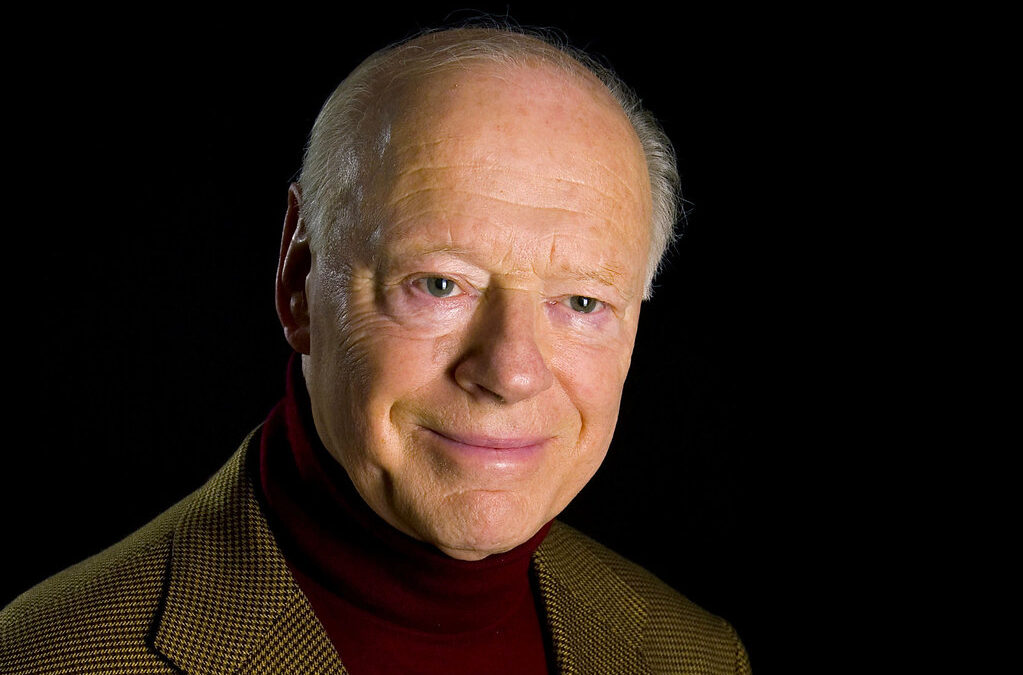
Last week we heard the sad news of the death of Dutch conductor Bernard Haitink at the ripe old age of 92.
Haitink was a special man indeed, seen by many as the last in a long line of ‘old school’ conductors. He was an artist of great craftsmanship and elegance, who earned the respect of his peers through an incredibly long career that only ended in 2019.
The tributes flooding in from ensembles the conductor worked with say everything about Haitink as a man. The Salzburg Festival declared, “The music world has lost one of its very greatest. His aim was never to triumph; probably that is why his interpretations became such triumphs.” The Berliner Philharmoniker praised how “He always impressed and inspired us with his qualities – his great craftsmanship, his perfect knowledge of the score, his warm, noble bearing.” From Sir Simon Rattle, an insight borne of personal experience: “He was one of the rare giants of our time, and even rarer and more precious, a giant full of humility. My dear Bernard, we keep you deep in our hearts.”
Like many people I have had the pleasure of listening to Haitink’s recordings for many years, but my first live memories go back to the first ever BBC Proms concert I attended in September 1997. There he conducted the European Union Youth Orchestra in Bruckner’s Symphony no.7, following a sensitive account of Beethoven’s Piano Concerto no.4 where the soloist was Emanuel Ax. By coincidence the same works and soloist featured at Haitink’s last Prom in 2019, this time with the Vienna Philharmonic.
I also saw Haitink at the Proms in 2005, conducting the London Symphony Orchestra as soloist Hélène Grimaud performed the Ravel Piano Concerto. After the interval, Haitink gave a characteristically poised account of Shostakovich’s Eighth Symphony, which left its mark on this particular listener for days:
I remember too a very special pair of Proms in 2011, Haitink and Ax united once again for Brahms with the Chamber Orchestra of Europe, one of several ensembles with which the conductor forged a special relationship.
As a recording artist, Haitink gave us a vast array of special symphony, concerto and opera recordings. He recorded multiple symphony cycles of Mahler, Bruckner, Beethoven, Brahms and Schumann, not to mention landmark collections of Shostakovich and Vaughan Williams symphonies with the Concertgebouw and London Philharmonic Orchestras, and fine cycles of Rachmaninov and Beethoven piano concertos with Vladimir Ashkenazy and Alfred Brendel respectively. That’s before we even get to opera! There he delivered much-loved recordings of Mozart, Wagner, Richard Strauss and Britten to highlight just a few.
I have delved into the discography for a set of recordings with personal significance – which can be accessed on the Spotify playlist below. They include Mahler, Bruckner, Shostakovich and begin with Vaughan Williams’ Symphony no.5, with the London Philharmonic Orchestra.
It is safe to say that Bernard Haitink will occupy a special place in the heart of many a musician and listener, and this gives just a small number of reasons why:
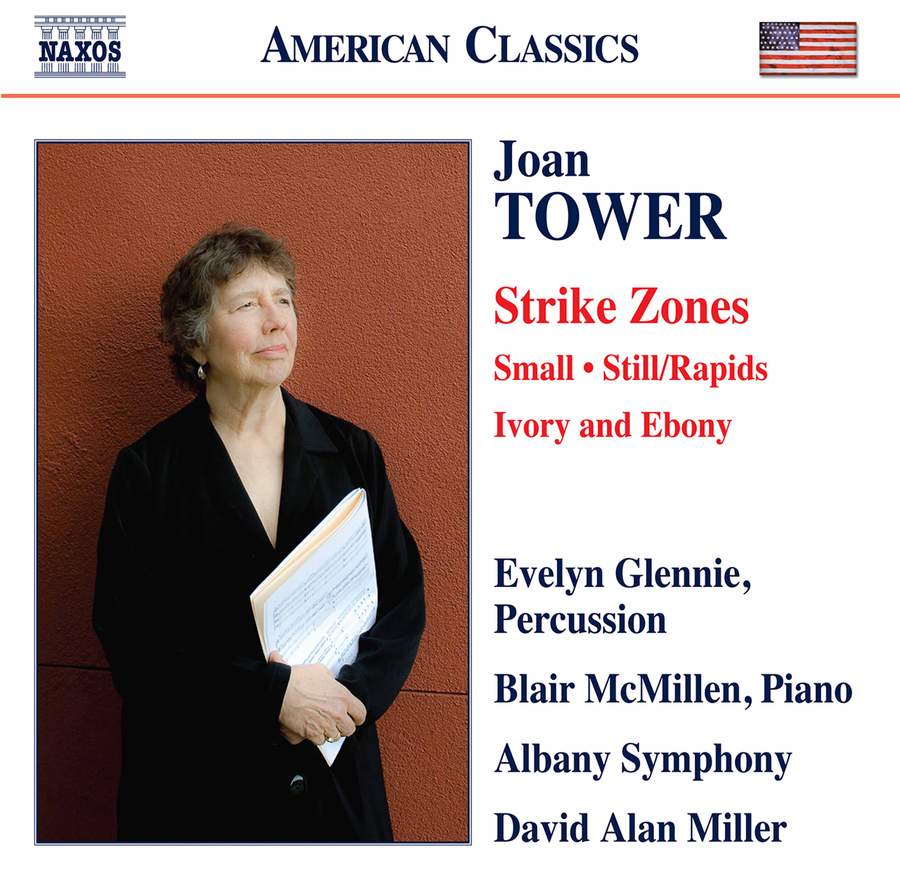
This year’s incarnation is ‘Celebrating Women In Music’, and there are two I would like to celebrate on this particular album, released by Naxos earlier this year. Percussionist Dame Evelyn Glennie will not need much introduction, for she is probably a familiar figure to you – but I would like to add to that the name of American composer Joan Tower.
Born in 1938, Tower has recently come to greater prominence thanks to the release of some excellent new recordings on the Naxos label. The latest is headed by Strike Zones, a concerto written for Glennie.
To quote from Tower’s program note: “Most percussion instruments are struck (hence the word ‘strike’ in the title) and I decided to have the percussion placed across the front of the stage with the soloist moving from one ‘zone’ to another – starting with the more fragile vibraphone and ending with a tour de force of drums. The other ‘zones’ include a marimba solo, a cymbal/hi-hat group, an ensemble of smaller/softer instruments (like the maraca, piccolo woodblock, castanet), a xylophone solo, and a trio with two other players placed in the hall echoing/‘reverberating’ the glockenspiel (with crotales) and the castanets (with more castanets)”
It is a piece of high drama, a composition with some compelling arguments and fascinating textures, best experienced on a big audio system or headphones.
Strike Zones is complemented by Still/Rapids, another substantial work for piano and orchestra. Rapids was a repeat commission from pianist Ursula Oppens, and is a fast-paced work – to which Tower has added the slow introduction Still. The two sections make a piece that proves every bit as dramatic as Strike Zones, with the unmistakable feeling of the American outdoors.
Meanwhile Small, also written for Dame Evelyn Glennie, is written for tiny percussion instruments – a rather lovely contrast to Strike Zones. Completing the album is Ivory and Ebony, which, as you might have guessed, is a piece for piano, commissioned by the San Antonio International Piano Competition.
I would urge you to have a listen, as Joan Tower’s music is both approachable and powerful. Hers is a distinctive musical voice well worth getting to know.
Kick It: A Social History of the Drum Kit
by Matt Brennan
Oxford University Press 2020 (371 Pages, ISBN: #978-0-19-068387-0)
Reviewed by John Earls
Matt Brennan starts his magnificent social history of the drum kit by citing one of the many frequently made ‘jokes’ about drummers based on the stereotype of them being unintelligent (in fact all chapters start with ‘jokes’ concerning drummer stereotypes). He then demonstrates how the supposed stupidity of drummers is rooted in the history of racial stereotypes (primitive-savage drummer) and goes on to explain how the drum kit is “not only a product of musical ingenuity at the turn of the [twentieth] century, but also an outcome of massive historical changes in human migration, trade and engineering, beginning with the forced migration of the transatlantic slave trade”.
This is an ‘academic’ book (Brennan is Reader in Popular Music at the University of Glasgow) and the book is rigorous and detailed in its research and analysis. But it’s an incredibly rich story that Brennan makes sure never gets dry in the telling. It’s a riveting account of the importance of drums and drummers in music’s history (and future), deftly done through a largely chronological narrative cleverly structured in chapters focused on six ‘drummer’ themes: clever, noisy, studious, creative, working and indispensable.
We see the development of so-called ‘highbrow’ and ‘lowbrow’ music with drums and drummers confined to an inferior status both between and within musical genres, and are then taken on a journey through the development of jazz, rock, and hip hop that challenges and upends many perceptions and myths.
The book also covers the role of drums and percussion in classical music which has its own ‘highbrow’ and ‘lowbrow’ story. The French composer Hector Berlioz, for example, published a guide for composers that divided percussion into two categories: a first order of instruments with recognisable pitch (e.g. timpani, bells, glockenspiel) and a lower order of “noises designed for special effect” (e.g. bass drum, snare drum, cymbals) which, as Brennan points out, would form the core components of the drum kit.
Of course, composers would later write works for dedicated percussion ensembles including Edgard Varèse’s Ionisation, John Cage’s Quartet for Percussion, and Steve Reich’s milestone piece Drumming.
The role of jazz is central to this story, including the evolution of styles, development of equipment, and status of drummers. Gene Krupa, the ‘King of Swing’ and ‘World’s Highest Paid Drummer’ as a 1939 Slingerland catalogue has it, is identified as playing a key role in all these aspects.
Many jazz greats are also woven into the narrative, with Max Roach and Kenny Clarke rightfully explored.
The chapter on ‘Working Drummers’ is particularly good, capturing drumming as a “distinct form of musical labour” and showing not only how the economic and cultural value assigned to a drummer’s work has changed over time, but “how the seat behind the drum kit became a gendered workplace”. Brennan examines the tragic story of Karen Carpenter and suggests that it can be used as a kind of parable to illuminate a bigger picture of the sexist social conditions faced by women drummers. The same ‘social history’ approach helps explain why nineteenth-century American drum manufacturers tended to be overwhelmingly white.
The book is also good on the raw deal that drummers often get in respect of musical authorship using Clyde Stubblefield, who played in James Brown’s band, and his role in Funky Drummer as a case study.
Two ‘star’ drummers often perceived in the ‘wild animals of rock’ mythology are John Bonham (Led Zeppelin) and Keith Moon (The Who) and Brennan writes brilliantly about their styles and roles in their respective bands, but also movingly about issues concerning lack of self-esteem.
By contrast, the role of modest rock drummer is exemplified by Charlie Watts (The Rolling Stones) who whilst undoubtedly extremely knowledgeable and skilful at his craft is more interested in praising the artistry of others – “there are a million kids who can play like me”.
Brennan neatly challenges this in a nice piece about the Stones Sympathy for the Devil and its opening groove and shows how comments by Stones’ frontman Mick Jagger reveal how “Jagger’s ignorance comes across on several levels”. (By the way, Mike Edison’s Sympathy for the Drummer – Why Charlie Watts Matters is another excellent book, but it’s a rollicking read of a very different type).
The final chapter explores the relationship between drums, drummers, technology and the rise of the machines. It’s a fascinating take on the “back and forth influence between acoustic kit drummers and beatmakers” such as J Dilla. Incidentally, the relationship between drummers and technology is not just about electronic devices. One of the best examples explored earlier in the book is the ingenuity of drummers and equipment manufacturers in respect of the bass drum pedal.
This is a wonderful book and Brennan has done a great service to drummers and all lovers of music. As he says himself “we are all drummers now.”
John Earls is Director of Research at Unite the Union (and a former drummer). He tweets at @john_earls
Today marks the 50th anniversary of the death of Russian composer Igor Stravinsky.
Stravinsky was a true revolutionary, and at Arcana we are looking forward to exploring the music behind that revolutionary voice later on in his anniversary year.
For now, here are three personal favourites of mine. The first is the ballet Petrushka, written in 1911 when Stravinsky was emerging from the influence of his teacher, Rimsky-Korsakov. This was the piece that switched me on to the composer’s colourful and descriptive sound world, highlighting his thoroughly original harmonic thinking:
The second is a much later ballet, Agon, written in America in 1957. By this time Stravinsky had explored a number of different styles, and was beginning to push the boundaries of tonality along with a new, more austere form of orchestration. In spite of that, there is an appealing warmth to the sparse textures of this, his final ballet:
Finally, a true favourite – the Symphony of Psalms. I was fortunate enough to play the cello in a performance of this and I can honestly say it was one of the most enjoyable 25 minutes of my musical life. The first chord is quite unlike anything I had heard before, but as the piece progresses Stravinsky’s use of the choir and orchestra is highly unusual for anything written in 1930, culminating in a wonderful, meditative Laudate Dominum that could easily go on for eternity. This performance conducted by Pierre Boulez is one of the best:
Stay with Arcana for some exciting explorations of Stravinsky later in 2021, but for now raise a toast to a wholly original voice.
With an almost complete absence of live music in Europe currently, online concerts are a relative godsend – provided you are willing to stare at the same screen you might have used for work earlier in the day. With this in mind, Arcana took the opportunity to visit the Berliner Philharmoniker’s Digital Concert Hall, with the purpose of watching the orchestra’s Golden Twenties festival.
This celebration of one of the most vibrant artistic periods in Berlin’s history centred on the instrumental music of Kurt Weill (above), with imaginative repertoire choices putting his music into a helpful and contrasting context. His teacher Busoni featured briefly, along with Hindemith, Eisler and Richard Strauss.
More of Strauss later, but having reviewed the first concert – with a fine Berlin premiere performance of Weill’s First Symphony – Arcana watched the symphonic sequel with the Karajan Academy of the Berliner Philharmoniker, energetically directed by Marie Jacquot (below).
Their programme included two fine Weill pieces but began with the Suite no.3 for orchestra by Hanns Eisler. For a composer whose songs feature relatively often in recital, Eisler’s orchestral music is scarcely heard. This is a shame because it is packed with good tunes and more than a dash of humour – which Suite no.3 enjoyed. This brisk, and in some cases brusque piece, had an appealing and gritty determination, with elements of the baroque toccata in its forward momentum. The instrumentation is that of a band rather than an orchestra, with guitar and snare drums taking prominent roles, which also appeals – and the playful rondo worked well, even though it could have had more of a smile on its face. There was excellent musicianship in this bittersweet account, topped by the muted trumpet of a soft-hearted intermezzo.
Weill’s Violin Concerto was next, a substantial work written for soloist and wind orchestra – but with no strings, an innovative set-up predating Stravinsky’s own work for piano and winds. The baleful clarinets in the opening statement reflected the composer’s feelings on the passing of his teacher, Feruccio Busoni. As the movement got into gear the movement was more mechanical, driven on by soloist Kolja Blacher (above), with considerable tension at the end of the first movement. A more playful second movement nocturne ensued, with pinpoint xylophone contributions, before an authoritative cadenza and an affecting Serenata with a high line. Blacher was particularly impressive here, technically secure throughout and broadly expressive. The finale had a strong sense of purpose, again superbly marshalled by Jacquot. A poignant pause ensued but was followed by a headlong rush into the closing pages, the soloist at the wheel, and the orchestra superb in their pithy contributions.
Weill’s Second Symphony followed the interval, a substantial piece which actually received its premiere in Amsterdam in 1934. With a tighter grip on the musical material than the first, it features an economical use of the orchestra. Here there were lovely solos from the woodwind but with a good deal of forward momentum and bite to the strings. Ensemble was tautly defined throughout, and there was a nice element of humour in the unexpectedly jaunty theme for the Largo second movement. Impassioned cello and flute solos led to an intense apex of feeling in the middle. Jacquot, whose conducting was clear and sprightly throughout, urged the players on in a tightly controlled third movement, with bustling rhythms and a longer, meaningful trumpet solo before a quick rush to finish a really excellent concert.
Due to Coronavirus a few adjustments had to be made to the third concert. Replacing Sir Donald Runnicles as the conductor was Thomas Søndergård (above), making his Berliner Philharmoniker debut – which as a result meant the substitution of works from Schreker, Berg and d’Albert with works by Sibelius and Prokofiev.
The scheduled Kurt Weill performance, the suite arranged by Wilhelm Brückner-Rüggeberg from The Rise and Fall Of The City Of Mahagonny, just about kept us in 1920s Berlin. Prior to that we heard the suite from Prokofiev’s opera The Love For Three Oranges, completed in 1919. Prokofiev’s music of this period is all about energy, dissonance and wit, and Søndergård was great to watch as he brought these qualities to the fore in music we seldom hear live nowadays. There was a satisfying heft to the orchestral sound, and while the performance could have gone even further with its sardonic wit, the turbulent finale was very well done, as was a keenly felt slow movement with richly textured strings.
Søndergård specialises in the music of Sibelius, and the Sixth Symphony is one of the Berliners’ most-performed symphonies from his output. This account had sumptuous sound and control as its principal merits, a compelling beginning cutting to an exceptionally fluid faster movement. Similarly the second movement, with a wavelike profile, had wonderful sound, while the scherzo was notable for its clear as spring textures. In the finale the conductor’s use of silence proved key, as did Sibelius’ notes themselves of course. Conducted with passion, this was a satisfying account with a reverent ending.
By this time the ear was yearning for the festival’s main character, Kurt Weill – and the smaller band used for The Rise and Fall of the City of Mahagonny gave us the highlights of the concert. Weill does not tend to feature in Søndergård’s repertoire, so one wonders how long he had to learn it – but he was inside the score with obvious enjoyment, allowing the players to express themselves and encouraging them to play with the tempo stylishly. Trombone and alto sax were excellent in the Moderato assai section, while the interlocking brass in the Molto vivace made a beautiful sound. The final Largo held most of the emotional cards, however, with a driven march bringing us home convincingly.
Christian Thielemann took charge of the fourth concert, a nicely weighted combination of the familiar and the unlikely. Thielemann does much for the Hindemith cause, and the composer’s Neues vom Tage overture was a bracing opener in concert form, laced with humour and packed with melodic interest.
Busoni was an inspired choice, a composer who remains difficult to pin down and who still sounds on the edge of modernity. His Tanzwalz, a colourful tribute to Johann Strauss II, has persuasive rhythms, spicy added notes and rich orchestral textures, which the orchestra thoroughly enjoyed. Thielemann’s conducting enhanced the rhythmic profile and the dance elements of the piece – as it did in the complementary Künstlerleben that followed. The violins really sang in the Busoni, as did the cellos towards the start of the Johann Strauss.
Richard Strauss followed, Camilla Nylund replacing Diana Damrau for a set of typically songs. These were well chosen, ranging from the fervent singing of Ständchen to the walking pace of the serene Wiegenlied, where the orchestra added nicely pointed counterpoint to Nylund’s expressive vibrato. Allerseelen was passionately sung, as was Morgen, with the necessary restraint and a beautiful duet between singer and solo violinist, unfortunately not credited.
We had a choral curiosity from Strauss to finish, the Berliner Philharmoniker’s second ever performance of Die Tageszeiten, published as the composer’s Op.76 in 1928. Written for male chorus and orchestra, this comparatively late work sets four sections of the day, as described by poet and regular Strauss collaborator Joseph Eichendorff in his Wanderlieder.
The men of the Rundfunkchor Berlin used the Philharmonie imaginatively, distanced across the stalls above the orchestra, who sat at much closer proximity thanks to their regular testing regime. The piece began with a call to arms, full of spring vigour, before the warm sunbeams breathed calm on the slower Afternoon Rest, which became increasingly chromatic. The wind was a more obvious presence in Evening, depicted by rollng timpani and restless orchestral figures, while Night made a beatific start, with some lovely singing from the men. The density increased but was tapered by a rather lovely unaccompanied chorale near the end, subsiding to a serene finish which was conducted with affection and satisfaction by Thielemann
While Coronavirus inevitably affected the content and artistic direction of The Golden Twenties, it still proved an interesting and stimulating festival, and it was especially satisfying to to see Kurt Weill’s instrumental music getting more of the recognition it surely deserves.
Concert 2
Eisler Suite for Orchestra no.3 Op.26 ‘Kuhle Wampe’ Weill Violin Concerto Op.12 Weill Symphony no.2
Konja Blacher (violin), Scholars of the Karajan Academy / Marie Jacquot
Concert 3
Prokofiev The Love for Three Oranges Suite Op.33bis Sibelius Symphony no.6 in D minor Op.104 Weill The Rise and Fall of the City of Mahagonny: Suite (arr. Wilhelm Brückner-Rüggeberg)
Berliner Philharmoniker / Thomas Søndergård
Concert 4
Hindemith Neues vom Tage (News of the Day), Overture from the Opera with Concert Ending Busoni Tanz-Walzer Op.53 Johann Strauss II Künstlerleben Op.316 Richard Strauss Ständchen Op.17/2; Freundliche Vision Op.48/1, Wiegenlied Op.41/1, Allerseelen Op.10/8, Zueignung Op.10/1, Morgen Op.27/4 Richard Strauss Die Tageszeiten Op.76
Camilla Nylund (soprano), Rundfunkchor Berlin, Berliner Philharmoniker / Thomas Søndergård