It is a beautiful spring day outside Arcana’s ‘head office’ today…so to celebrate, one of Dvořák‘s sunniest symphonies is on the playlist. Here is a performance given by the Frankfurt Radio Symphony Orchestra and Manfred Honeck, in celebration of the green season:
Debussy arr. Büsser Petite Suite; Debussy arr. Caplet La boîte à joujoux (1919), Children’s Corner (1911)
What’sthestory?
This beautifully packaged collection from BIS brings together a trio of Debussy pieces arranged for orchestra. There are two characterful suites whose cleaner lines look back to classical and baroque forms, beginning with the four-movement PetiteSuite, originally for two pianos and arranged for orchestra by Henri Büsser.
The central work of the three is La boîte à joujoux (Thetoybox). This surprisingly substantial piece was written by Debussy in 1913 as a piano score, but due to the first World War was not performed until 1919, after the composer’s death, by which time it had been orchestrated by André Caplet. The ballet tells in miniature detail of a toy soldier falling in love with a doll protected by a polichinelle, who will not give her up. The two fight and the soldier is wounded, but is nursed back to health by the doll, and they fall in love.
Caplet was a trusted collaborator, having already arranged Debussy’s Children’sCorner suite for orchestra in 1911. The composer wrote the piano version for his daughter Claude-Emma, nicknamed ‘Chou-Chou’, in 1908.
What’sthemusiclike?
As attractive as the cover! What is abundantly clear from each of the three scores is that even in his keyboard music Debussy had orchestral designs – which Caplet and Büsser bring to fruition.
The PetiteSuite is a charmer in this performance, from the languid Enbateau to the brisk, bracing Ballet. The phrasing is especially beautiful in the winds towards the end of the former, while there is an attractive lilt to the Cortège and a light bounce to the rhythms of the Menuet.
La boîte à joujoux features some exquisite storytelling and wind playing. There is a beautiful oboe solo as the scene isset in the toy shop, the music hanging mysteriously. The lovely clarinet in The doll’s waltz is complemented by detailed shading in the strings. There are stylish contributions from the orchestral pianist too, especially at the very end where the orchestra hang on every note. The bluster of battle and The sheepfold for sale leads to a translucent coda. Here a tender, slightly mournful finish from piano is trumped by an emphatic sign off from the orchestra
Children’sCorner is similarly colourful. The Berceuse has long shadows enhanced by the bass strings, but the SerenadefortheDoll is delightful. TheSnowIsDancing is appropriately mysterious, and there is a poignant oboe solo for The Little Shepherd. Finally the Golliwogg’s Cake Walk is a brilliant study of light and shade, with the ebullient theme a treat.
Doesitall work?
It does. Pascal Rophé brings great detail to Debussy’s storytelling, and while the orchestral playing is of an extremely high standard the wind section deserve special mention for the way in which they inhabit the characters of each tale. The BIS recording captures every detail. There are also reminders that in spite of these colourful stories the spectre of World War One lies in the shadows.
Isitrecommended?
Heartily. This is a colourful and thoroughly enjoyable album, lovingly realised and beautifully played. An essential addition to any Debussy collection.
I wanted to place on record my appreciation for three very different but fiercely passionate musical contacts we have very sadly lost in recent weeks.
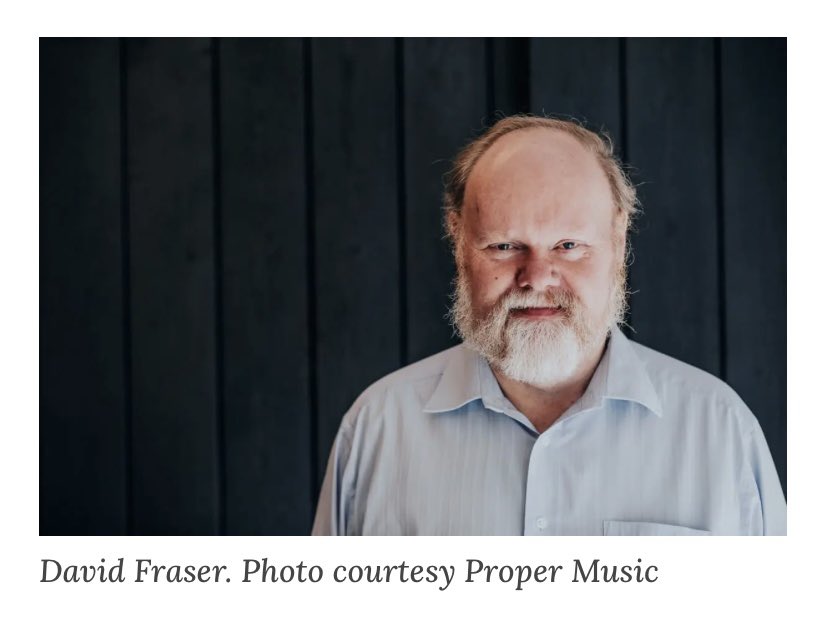
My heartfelt condolences go to the family and friends of David Fraser, who until recently worked for the excellent distributor Proper Music. David headed the press and marketing facility in the UK for the prestigious ECM label, a position from which he was able to make many enlightening musical recommendations. I remember him as a generous, kind-hearted contact who was always pleased to talk and continually modest about his vast musical knowledge. Thank you, David – I shall miss our chats, and include one of our mutual loves, the music of György Kurtág – one of his Bach arrangements – below:
The world of classical music has also been paying tribute to Stewart Brown, who died earlier this month at the age of 69. Stewart founded and ran the Testament label from 1990 onwards, creating an important resource of historical recordings that were largely remastered on his watch. Many an EMI recording was enhanced at Stewart’s hand, and we will greatly miss the excellence of the projects he oversaw.
I only know a fringe of the Testament catalogue well, but the recordings I have reviewed and enjoyed include Erich Leinsdorf conducting Prokofiev, Carlo Maria Giulini’s Bruckner, Sir John Barbirolli’s Mahler, a chamber recital from David Oistrakh, Mstislav Rostropovich and Benjamin Britten in recital at the Aldeburgh Festival, one of the label’s most recent releases, and a wonderful series of Clemens Krauss conducting Richard Strauss. All those recordings are testament (pun intended) to Stewart’s eye for a valuable recording, and us record collectors owe him heartfelt thanks for his achievements. Most importantly – as his close friends have confirmed – he was a lovely man.
The third of my musical musketeers is John Bourke. I never met John, but while he was running his own music PR enterprise we built up that most modern of musical friendships, a regular e-mail and social media correspondence. Whenever he had something he genuinely thought I would enjoy, John would be on the virtual blower.
That is the key element – John was never too pushy with the music he was promoting, unless he felt the listener / reviewer would appreciate it, and our friendship grew on that assumption. Several of Arcana’s interviews and playlist features are the result of John’s thoughtful prompting, while a great many more of my musical discoveries, especially the Glacial Movements label – were made possible through John’s correspondence. Thank you John – and I hope that wherever you are resting now that you have the most ambient of electronic music to keep you company.
Take some time out this weekend – three minutes and forty-one seconds to be precise – and enjoy this video, a taster of pianist Vanessa Wagner‘s new album Study of the Invisible.
Released today on InFiné Music, the album is a carefully constructed suite of modern piano music, taking in minimal approaches but casting its net wider to hear from composers such as Caroline Shaw, Julia Wolfe and Harold Budd.
Arcana will carry a full review of the album, and an interview with Vanessa where we discuss the recording of the album and her approach to the piano. For now, though, enjoy the peace and stillness of this video!
You can read more about Vanessa Wagner at her website – and to hear more from the album, listen on by using the Bandcamp link below:
Composer Charlotte Harding returns with the intriguing track III, marking her debut as a solo artist.
Her new track, shown here in TRI Remix form, uses a string quintet and plays around with their sounds to make a musical language Harding calls ‘clectro’. Put simply, clectro = classical + electronic!
If you watch the video, directed by John Minton with artwork from Keaton Henson, you will see how the description is rather apt – and also get an idea for Harding’s powers of invention. She looks set to bring a fresh approach to the meeting point of the two styles – we will certainly keep our ears peeled for more!
You can read more about Charlotte Harding’s work at the Faber Alt. website, and also her own website here




 Arcana.fm